
For the classical economists, the quantity theory of money provided an explanation of
movements in the price level. Changes in the price level result
A. from proportional changes in the quantity of money.
B. primarily from changes in the quantity of money.
C. only partially from changes in the quantity of money.
D. from changes in factors other than the quantity of money.
Answer:
If expectations are formed rationally, then individuals
A. will have a forecast that is 100% accurate all of the time.
B. change their forecast when faced with new information.
C. use only the information from past data on a single variable to form their forecast.
D. have forecast errors that are persistently low.
Answer:
The modern commercial banking system began in America when the
A) Bank of United States was chartered in New York in 1801.

B) Bank of North America was chartered in Philadelphia in 1782.
C) Bank of United States was chartered in Philadelphia in 1801.
D) Bank of North America was chartered in New York in 1782.
Answer:
An increase in stock prices ________ the size of people’s wealth and may ________
their willingness to spend, everything else held constant.
A. increases; increase
B. increases; decrease
C. decreases; increase
D. decreases; decrease
Answer:
A fully amortized loan is another name for
A. a simple loan.
B. a fixed-payment loan.

C. a commercial loan.
D. an unsecured loan.
Answer:
Of the following, which would be the last choice for a bank facing a reserve deficiency?
A. Call in loans.
B. Borrow from the Fed.
C. Sell securities.
D. Borrow from other banks.
Answer:
If the economy is characterized by a certain and stable LM curve, then ________ target
produces ________ fluctuations in aggregate output.
A. an interest rate; smaller
B. a money supply; smaller
C. a money supply; larger
D. an exchange rate; larger

Answer:
Under the Gramm-Leach-Bliley Act the oversight of the securities activities of bank
holding companies belongs to
A) the SEC.
B) the Comptroller of the Currency.
C) the U.S. Treasury.
D) the Federal Reserve.
Answer:
Under the Exchange Rate Mechanism of the European Monetary System, when the
German mark depreciated below its lower limit against the British pound, the Bank of
England was required to buy ________ and sell ________, thereby ________
international reserves.
A) pounds; marks; losing
B) pounds; marks; gaining
C) marks; pounds; gaining
D) marks; pounds; losing

Answer:
Studies of mutual fund performance indicate that mutual funds that outperformed the
market in one time period usually
A. beat the market in the next time period.
B. beat the market in the next two subsequent time periods.
C. beat the market in the next three subsequent time periods.
D. do not beat the market in the next time period.
Answer:
The time and money spent in carrying out financial transactions are called
A. economies of scale.
B. financial intermediation.
C. liquidity services.
D. transaction costs.
Answer:

An example of permanent insurance is ________ insurance, and an example of
temporary insurance is ________ insurance.
A. term; variable life
B. whole life; variable life
C. whole life; term
D. term; whole life
Answer:
From before the financial crisis began in September of 2007 to when the crisis was over
at the end of 2009, the huge expansion in the Fed’s balance sheet and the monetary base
did not result in a large increase in monetary supply because
A. most of it just flowed into holdings of excess reserve.
B. the Fed also increased the required reserve ratio.
C. the Fed also conducted open market sales.
D. the discount loan decreased.
Answer:

Either a dual or hierarchial mandate is acceptable as long as ________ is the primary
goal in the ________.
A. price stability; short run
B. price stability; long run
C. reducing business-cycle fluctuations; short run
D. reducing business-cycle fluctuations; long run
Answer:
________ flexible wages and prices imply that the short-run aggregate supply curve is
________.
A. More; flatter
B. Less; steeper
C. less; vertical
D. More; steeper
Answer:

Using the information in situation 20-2, if government spending increases by $100, then
the equilibrium aggregate output will change by
A. -$1,000.
B. -$100.
C. $100.
D. $1,000.
Answer:
Which of the following statements uses the economists’ definition of money?
A. I plan to earn a lot of money over the summer.
B. Betsy is richshe has a lot of money.
C. I hope that I have enough money to buy my lunch today.
D. The job with New Company gave me the opportunity to earn more money.
Answer:
With the creation of the Federal Deposit Insurance Corporation
A. member banks of the Federal Reserve System were given the option to purchase

FDIC insurance for their depositors, while non-member commercial banks were
required to buy deposit insurance.
B. member banks of the Federal Reserve System were required to purchase FDIC
insurance for their depositors, while non-member commercial banks could choose to
buy deposit insurance.
C. both member and non-member banks of the Federal Reserve System were required
to purchase FDIC insurance for their depositors.
D. both member and non-member banks of the Federal Reserve System could choose,
but were not required, to purchase FDIC insurance for their depositors.
Answer:
An increase in the money ________ shifts the LM curve to the ________, causing the
interest rate to fall and output to rise, everything else held constant.
A. demand; right
B. demand; left
C. supply; right
D. supply; left
Answer:

________ are the only depository institutions that are tax-exempt.
A) Commercial banks
B) Savings and loans
C) Mutual savings banks
D) Credit unions
Answer:
If mortgage brokers do not make a strong effort to evaluate whether the borrower can
pay off a loan, this creates a
A. severe adverse selection problem.
B. decline in mortgage applications.
C. call to deregulate the industry.
D. decrease in the demand for houses.
Answer:
If the Fed pursues a strategy of targeting an interest rate when fluctuations in money
demand are prevalent
A. fluctuations of nonborrowed reserves will be small.
B. fluctuations of nonborrowed reserves will be large.
C. the Fed will probably quickly abandon this policy, as it did in the 1960s.
D. the Fed will probably quickly abandon this policy, as it did in the 1950s.
Answer:
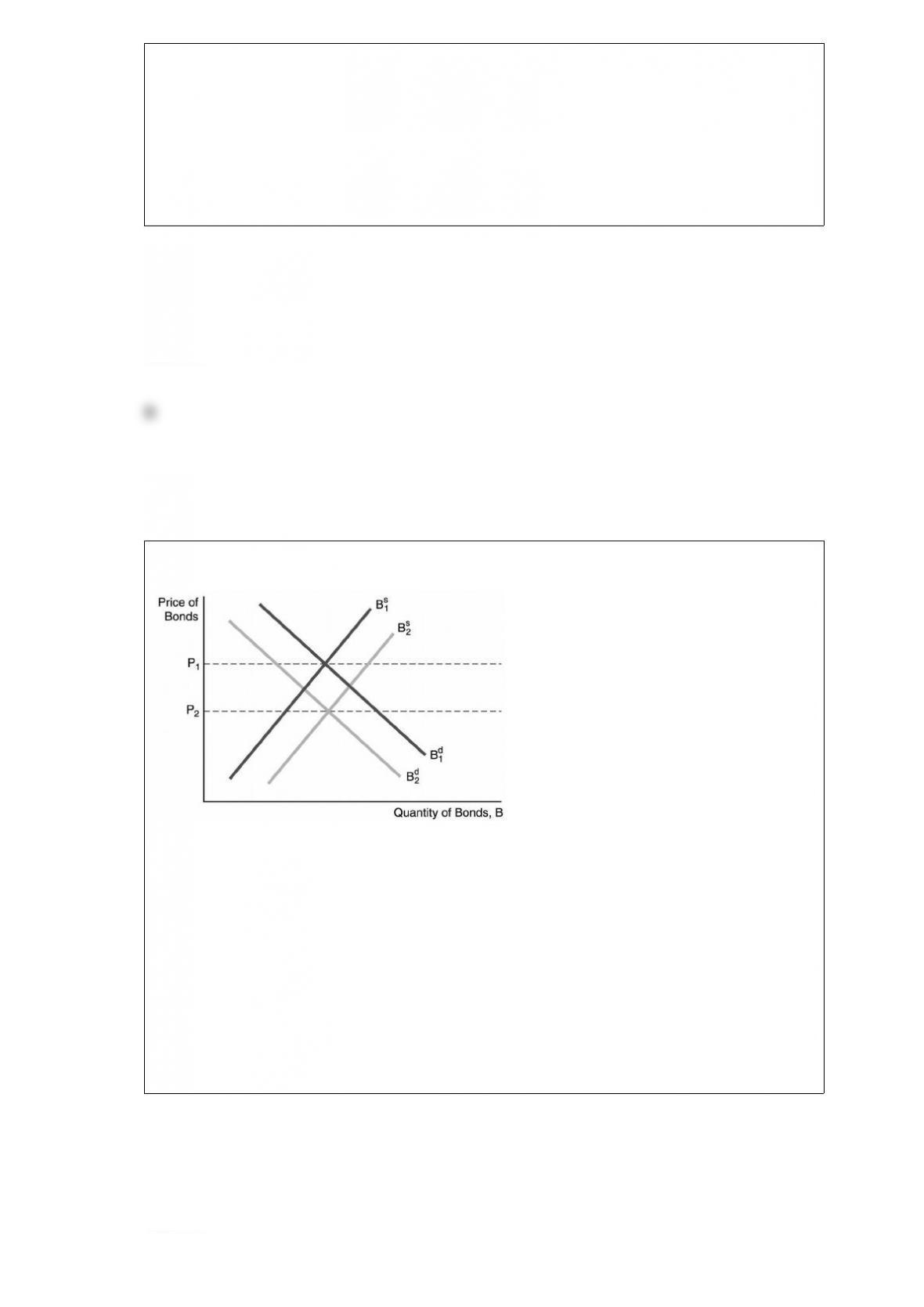
In the figure above, the price of bonds would fall from P1 to P2 when
A. inflation is expected to increase in the future.
B. interest rates are expected to fall in the future.
C. the expected return on bonds relative to other assets is expected to increase in the
future.
D. the riskiness of bonds falls relative to other assets.
Answer:

Credit card debt is
A. secured debt.
B. unsecured debt.
C. restricted debt.
D. unrestricted debt.
Answer:
Everything else held constant, if the tax-exempt status of municipal bonds were
eliminated, then
A. the interest rates on municipal bonds would still be less than the interest rate on
Treasury bonds.
B. the interest rate on municipal bonds would equal the rate on Treasury bonds.
C. the interest rate on municipal bonds would exceed the rate on Treasury bonds.
D. the interest rates on municipal, Treasury, and corporate bonds would all increase.
Answer:

In this type of arrangement, any balances above a certain amount in a corporation’s
checking account at the end of the business day are “removed” and invested in
overnight securities that pay the corporation interest. This innovation is referred to as a
A. sweep account.
B. share draft account.
C. removed-repo account.
D. stockman account.
Answer:
A fall in inventories is synonymous with ________ investment.
A. negative fixed
B. positive fixed
C. positive inventory
D. negative inventory
Answer:

Keynes’s theory of the demand for money is consistent with
A. countercyclical movements in velocity.
B. a constant velocity.
C. procyclical movements in velocity.
D. a relatively stable velocity.
Answer:
The risk premium on corporate bonds reflects the fact that corporate bonds have a
higher default risk and are ________ U.S. Treasury bonds.
A. less liquid than
B. less speculative than
C. tax-exempt unlike
D. lower-yielding than
Answer:
When compared to exchange systems that rely on money, disadvantages of the barter
system include

A. the requirement of a double coincidence of wants.
B. lowering the cost of exchanging goods over time.
C. lowering the cost of exchange to those who would specialize.
D. encouraging specialization and the division of labor.
Answer:
One reason financial systems in developing and transition countries are underdeveloped
is
A) they have weak links to their governments.
B) they make loans only to nonprofit entities.
C) the legal system may be poor making it difficult to enforce restrictive covenants.
D) the accounting standards are too stringent for the banks to meet.
Answer: