
If interest rates increase from 9 percent to 10 percent, a bank with a duration gap of 2
years would experience a decrease in its net worth of
A. 0.9 percent of its assets.
B. 0.9 percent of its liabilities.
C. 1.8 percent of its liabilities.
D. 1.8 percent of its assets.
Answer:
The goal for high employment should be a level of unemployment at which the demand
for labor equals the supply of labor. Economists call this level of unemployment the
A. frictional level of unemployment.
B. structural level of unemployment.
C. natural rate level of unemployment.
D. Keynesian rate level of unemployment.
Answer:
Real business cycle theory states that the most important cause of business cycles is
A. shocks to the money supply.
B. interest rate shocks.
C. Federal Reserve policy decisions.
D. shocks to tastes and technology.
Answer:
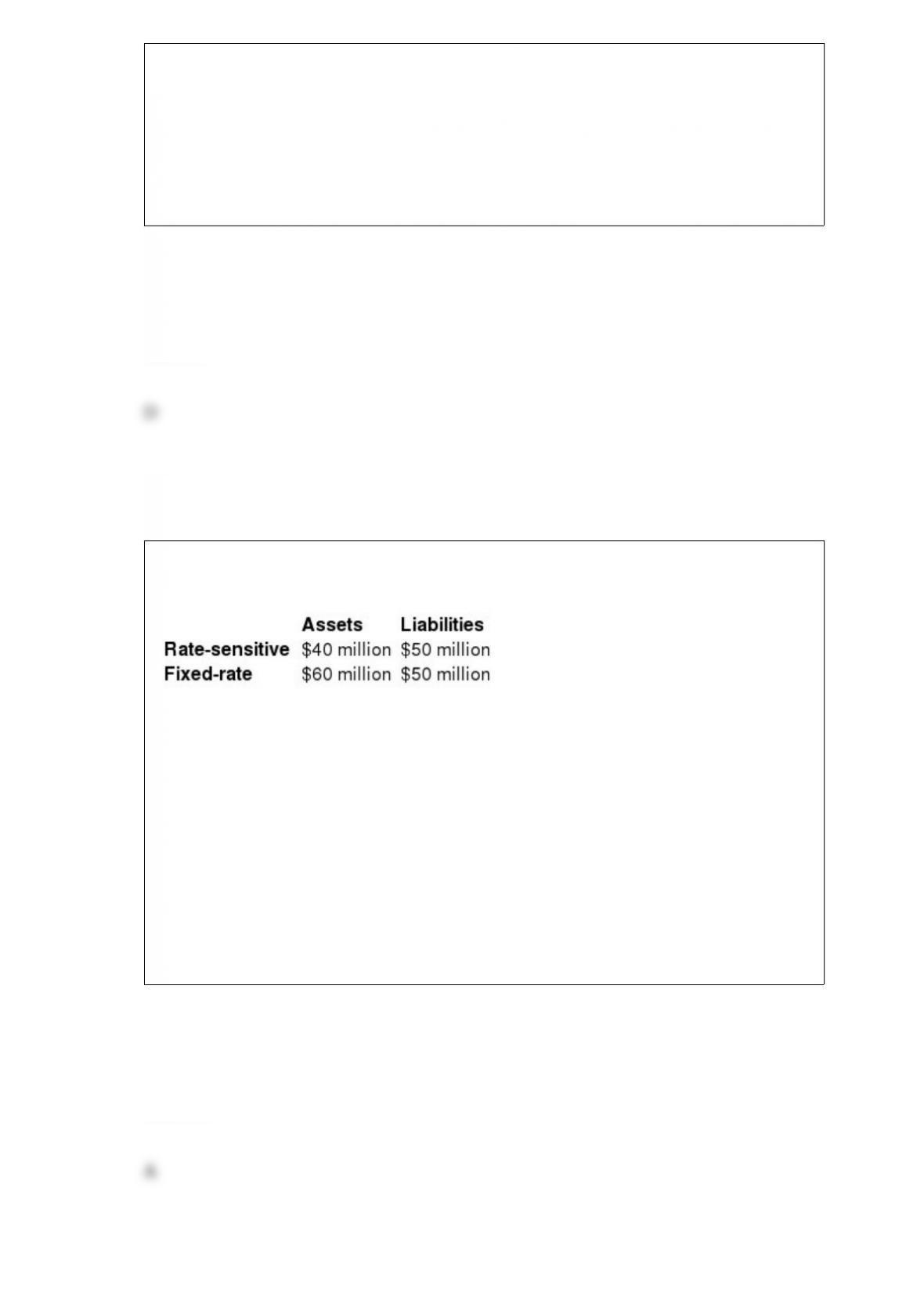
First National Bank
Assuming that the average duration of its assets is four years, while the average
duration of its liabilities is three years, then a 5 percentage point increase in interest
rates will cause the net worth of First National to ________ by ________ of the total
original asset value.
A. decline; 5 percent
B. decline; 10 percent
C. decline; 15 percent
D. increase; 20 percent
Answer:

The belief that bank failures were regularly caused by fraud or the lack of sufficient
bank capital explains, in part, the passage of
A. the National Bank Charter Amendments of 1918.
B. the Garn-St. Germain Act of 1982.
C. the National Bank Act of 1863.
D. Federal Reserve Act of 1913.
Answer:
An increase in the foreign interest rate causes the demand for domestic assets to
________ and the domestic currency to ________, everything else held constant.
A. increase; appreciate
B. increase; depreciate
C. decrease; appreciate
D. decrease; depreciate
Answer:

If you expect the inflation rate to be 12 percent next year and a one-year bond has a
yield to maturity of 7 percent, then the real interest rate on this bond is
A. -5 percent.
B. -2 percent.
C. 2 percent.
D. 12 percent.
Answer:
Bank customers perceive Internet-only banks as being
A. more secure than physical bank branches.
B. a better method for the purchase of long-term savings products.
C. better at keeping customer information private.
D. prone to many more technical problems.
Answer:
Which of the following are reported as assets on a bank’s balance sheet?
A. borrowings

B. reserves
C. savings deposits
D. bank capital
Answer:
One suggested method of reducing excessive risk-taking by SIFIs is to require them to
hold ________ capital when credit is expanding rapidly and ________ capital when
credit is contracting.
A. less; more
B. more; no
C. more; less
D. less; no
Answer:
The return on a 5 percent coupon bond that initially sells for $1,000 and sells for $950
next year is
A. -10 percent.

B. -5 percent.
C. 0 percent.
D. 5 percent.
Answer:
An equal decrease in all bond interest rates
A. increases the price of a five-year bond more than the price of a ten-year bond.
B. increases the price of a ten-year bond more than the price of a five-year bond.
C. decreases the price of a five-year bond more than the price of a ten-year bond.
D. decreases the price of a ten-year bond more than the price of a five-year bond.
Answer:
Liquidity provision and asset purchase may not be enough to stimulate the economy
unless the these policy actions are able to
A. lower the real interest rate for investments.
B. lower the short-term real interest rate.
C. raise the policy rate above zero.

D. lower the policy rate.
Answer:
Hedge funds require large minimum investments ranging from ________ to ________
or more.
A. $100,000; $1 million
B. $1000; $10,000
C. $100; $1000
D. $$10,000; $25,000
Answer:
Member commercial banks have purchased stock in their district Fed banks; the
dividend paid by that stock is limited by law to ________ percent annually.
A. four
B. five
C. six
D. eight

Answer:
Potential weaknesses of nominal GDP targeting include
A. it is more complicated to explain to the public than inflation targeting and thus the
public might be confused about the objectives of the central bank.
B. it implies that the central bank will respond to slowdowns in the real economy even
if inflation is not falling.
C. real GDP growth that is below potential or inflation that is below the inflation
objective will encourage more expansionary monetary policy.
D. it focuses not only on controlling inflation but also explicitly on stabilizing real
GDP.
Answer:
When bad storms slow the check-clearing process, float tends to ________ causing the
Fed to initiate defensive open market ________.
A. decrease; sales
B. decrease; purchases
C. increase; sales
D. increase; purchases

Answer:
Everything else held constant, when prices in the art market become more uncertain
A. the demand curve for bonds shifts to the left and the interest rate rises.
B. the demand curve for bonds shifts to the left and the interest rate falls.
C. the demand curve for bonds shifts to the right and the interest rate falls.
D. the supply curve for bonds shifts to the right and the interest rate falls.
Answer:
A central bank has ________ chance to identify a credit-driven bubble compared to an
irrational exuberance bubble.
A. a greater
B. less of a
C. about the same level of a
D. a greater, less or about the same level of a
Answer:

One factor contributing to the decline in cost advantages that banks once had is the
A) decline in the importance of checkable deposits from over 60 percent of banks’
liabilities to 2 percent today.
B) decline in the importance of savings deposits from over 60 percent of banks’
liabilities to under 15 percent today.
C) decline in the importance of checkable deposits from over 40 percent of banks’
liabilities to 15 percent today.
D) decline in the importance of savings deposits from over 40 percent of banks’
liabilities to under 20 percent today.
Answer:
In the market for reserves, if the federal funds rate is between the discount rate and the
interest rate paid on excess reserves, a decline in the reserve requirement ________ the
demand of reserves, ________ the federal funds rate, everything else held constant.
A. decreases; lowering
B. increases; lowering
C. increases; raising
D. decreases; raising
Answer:
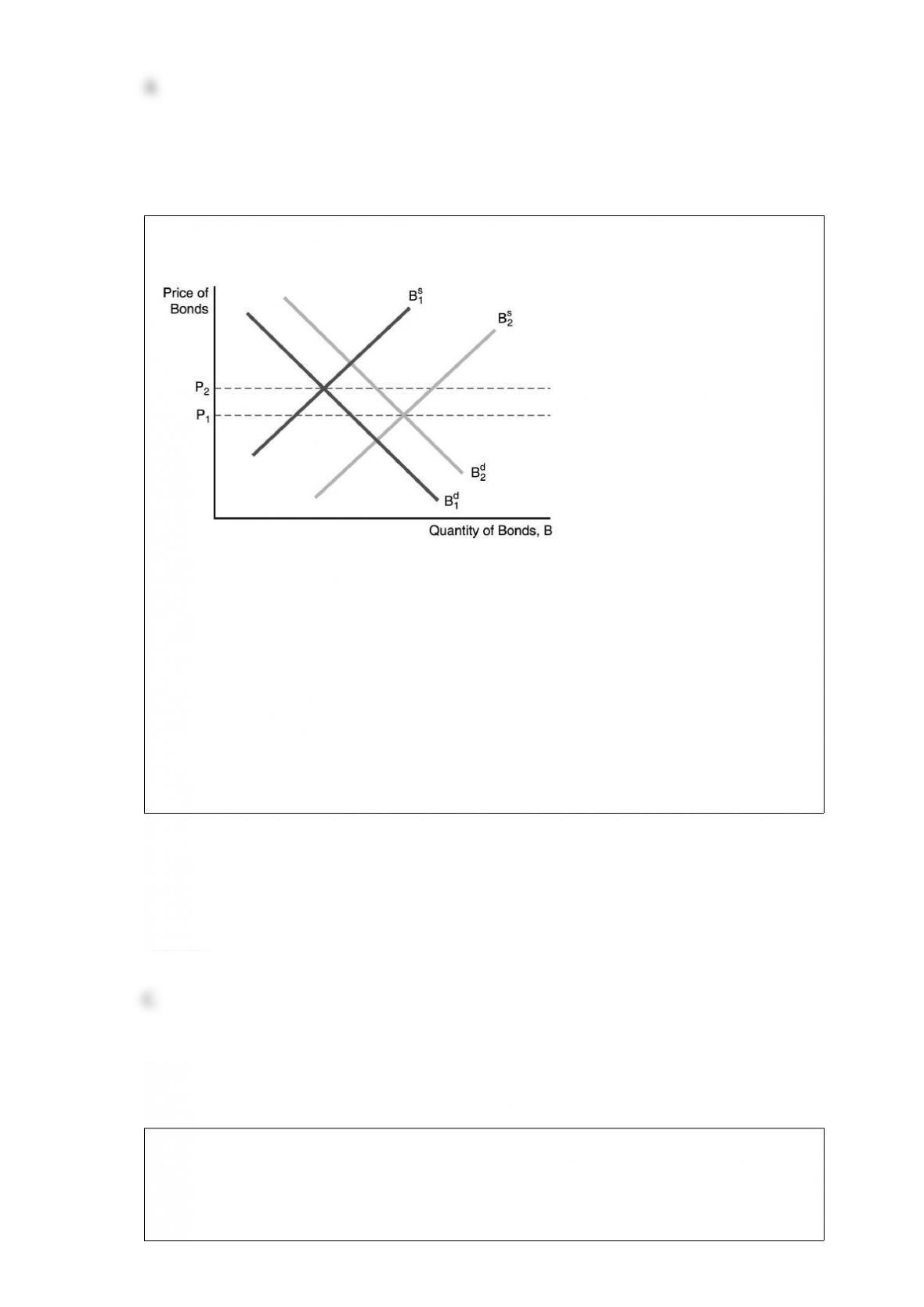
In the figure above, a factor that could cause the demand for bonds to shift to the right
is
A. an increase in the riskiness of bonds relative to other assets.
B. an increase in the expected rate of inflation.
C. expectations of lower interest rates in the future.
D. a decrease in wealth.
Answer:
The view that expectations change relatively slowly over time in response to new
information is known in economics as
A. rational expectations.

B. irrational expectations.
C. slow-response expectations.
D. adaptive expectations.
Answer:
The demand for Picasso paintings rises (holding everything else equal) when
A. stocks become easier to sell.
B. people expect a boom in real estate prices.
C. Treasury securities become riskier.
D. people expect gold prices to rise.
Answer:
Evidence from the United States and other foreign countries indicates that
A. there is a strong positive association between inflation and growth rate of money
over long periods of time.
B. there is little support for the assertion that “inflation is always and everywhere a
monetary phenomenon.”

C. countries with low monetary growth rates tend to experience higher rates of
inflation, all else being constant.
D. money growth is clearly unrelated to inflation.
Answer:
Because of the abuses by state banks and the clear need for a central bank to help the
federal government raise funds during the War of 1812, Congress created the
A. Bank of United States in 1812.
B. Bank of North America in 1814.
C. Second Bank of the United States in 1816.
D. Second Bank of North America in 1815.
Answer:
The total quantity of an economy’s final goods and services demanded at different
inflation rates is
A. the aggregate supply curve.
B. the aggregate demand curve.

C. the Phillips curve.
D. the aggregate expenditure function.
Answer:
Regular bank examinations and restrictions on asset holdings help to indirectly reduce
the ________ problem because, given fewer opportunities to take on risk, risk-prone
entrepreneurs will be discouraged from entering the banking industry.
A. moral hazard
B. adverse selection
C. ex post shirking
D. post-contractual opportunism
Answer:
In the Keynesian cross diagram, a decline in autonomous consumer expenditure causes
the aggregate demand function to shift ________ and the equilibrium level of aggregate
output to ________, everything else held constant.
A. up; rise
B. up; fall

C. down; rise
D. down; fall
Answer:
A central feature of monetary policy strategies in all countries is the use of a nominal
variable that monetary policymakers use as an intermediate target to achieve an ultimate
goal such as price stability. Such a variable is called a nominal
A. anchor.
B. benchmark.
C. tether.
D. guideline.
Answer:
While legislation enacted in 1998 granted the Bank of Japan new powers and greater
autonomy, its critics contend that its independence is
A. limited by the Ministry of Finance’s veto power over a portion of its budget.
B. too great because it need not pursue a policy of price stability even if that is the
popular will of the people.

C. too great since the Ministry of Finance no longer has veto power over the bank’s
budget.
D. limited since the Ministry of Finance can dismiss senior bank officials.
Answer:
The global financial crisis of 2007-2009 not only led to a worldwide recession, but also
a ________ in the European nations that use the euro currency.
A. currency devaluation
B. budget surplus
C. sovereign debt crisis
D. tax cut
Answer:
If the nominal rate of interest is 2 percent, and the expected inflation rate is -10 percent,
the real rate of interest is
A. 2 percent.
B. 8 percent.
C. 10 percent.

D. 12 percent.
Answer:
The preferred habitat theory of the term structure is closely related to the
A. expectations theory of the term structure.
B. segmented markets theory of the term structure.
C. liquidity premium theory of the term structure.
D. the inverted yield curve theory of the term structure.
Answer: