
Mutual funds in which a fixed number of nonredeemable shares are sold at an initial
offering and are then traded in the over-the-counter market, like shares of common
stock, are called
A. open-end funds.
B. close-end funds.
C. OTC funds.
D. primary-issue funds.
Answer:
Economists define investment as the purchase of
A. a new physical asset such as a new machine or a new house.
B. any physical asset, whether new or not, used by business to increase production.
C. any physical asset used by business to increase production and the repurchase of
common stock.
D. business spending on capital and household spending on durable goods.
Answer:
Which of the following policy measures created an Office of Credit Ratings at the SEC

with its own staff and the authority to fine credit-rating agencies and to deregister an
agency if it produces bad ratings?
A. the Dodd-Frank Wall Street Reform and Consumer Protection Act of 2010
B. Sarbanes-Oxley Act of 2002
C. Global Legal Settlement of 2002
D. Gramm-Leach-Bliley Act of 1999
E. Riegle-Neal Act of 1994
Answer:
The absence of money illusion means that
A. as real income doubles, the demand for money doubles.
B. as interest rates double, the demand for money doubles.
C. as the money supply doubles, the demand for money doubles.
D. as the price level doubles, the demand for money doubles.
Answer:
Equity contracts

A) are claims to a share in the profits and assets of a business.
B) have the advantage over debt contracts of a lower costly state verification.
C) are used much more frequently to raise capital than are debt contracts.
D) are not subject to the moral hazard problem.
Answer:
A discount bond is also called a ________ because the owner does not receive periodic
payments.
A. zero-coupon bond
B. municipal bond
C. corporate bond
D. consol
Answer:
In the United States during the late 1970s, the nominal interest rates were quite high,
but the real interest rates were negative. From the Fisher equation, we can conclude that
expected inflation in the United States during this period was

A. irrelevant.
B. low.
C. negative.
D. high.
Answer:
When the European System of Central Banks uses main refinancing operations, it is
similar to the Federal Reserve using
A. dynamic open market operations.
B. defensive open market operations.
C. discount policy.
D. reserve requirements.
Answer:
If expectations of the future inflation rate are formed solely on the basis of a weighted
average of past inflation rates, then economists would say that expectation formation is
A. irrational.

B. rational.
C. adaptive.
D. reasonable.
Answer:
Everything else held constant, an increase in the required reserve ratio on checkable
deposits will cause
a. the money supply to rise.
b. the money supply to remain constant.
c. the money supply to fall.
d. checkable deposits to rise.
Answer:
Although foreign exchange market trades are said to involve the buying and selling of
currencies, most trades involve the buying and selling of
A. bank deposits denominated in different currencies.
B. SDRs.

C. gold.
D. ECUs.
Answer:
If the Fed wants to temporarily inject reserves into the banking system, it will engage in
A. a repurchase agreement.
B. a matched sale-purchase transaction.
C. a reverse repurchase agreement.
D. an open market sale.
Answer:
The agency that restricts insider trading is the
A. Federal Reserve System.
B. Securities and Exchange Commission.
C. Office of the Comptroller of the Currency.
D. Federal Deposit Insurance Corporation.

Answer:
In the market for reserves, if the federal funds rate is above the interest rate paid on
excess reserves, an open market sale ________ the supply of reserves causing the
federal funds rate to ________, everything else held constant.
A. decreases; decrease
B. increases; decrease
C. increases; increase
D. decreases; increase
Answer:
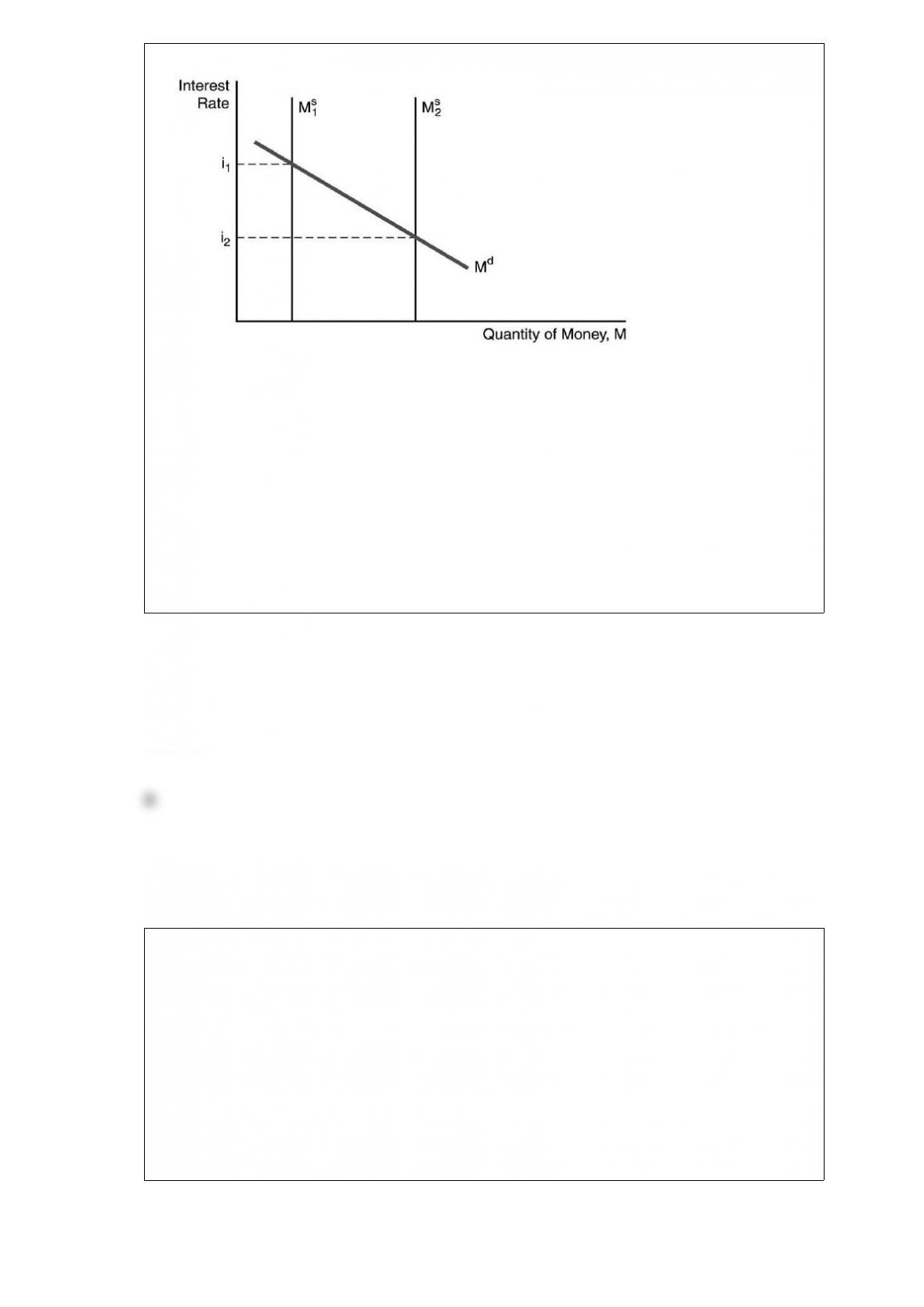
In the figure above, the decrease in the interest rate from i1 to i2 can be explained by
A. a decrease in money growth.
B. an increase in money growth.
C. a decline in the expected price level.
D. an increase in income.
Answer:
The purpose of the disclosure requirements of the Securities and Exchange Commission
is to
A. increase the information available to investors.
B. prevent bank panics.
C. improve monetary control.
D. protect investors against financial losses.

Answer:
Everything else held constant, an increase in autonomous planned investment spending
will cause the IS curve to shift to the ________ and aggregate demand will ________.
A. right; increase
B. right; decrease
C. left; increase
D. left; decrease
Answer:
Everything else held constant, an increase in net taxes will cause the IS curve to shift to
the ________ and aggregate demand will ________.
A. right; increase
B. right; decrease
C. left; increase
D. left; decrease
Answer:

The ability to use the too-big-to-fail policy was curtailed by the passage of the FDICIA.
To use this action today, the FDIC must get approval of a two-thirds majority of both
the Board of Governors of the Federal Reserve and the directors of the FDIC and also
the approval of the
A. Secretary of the Treasury.
B. Senate Finance Committee Chairperson.
C. President of the United States.
D. governor of the state in which the failed bank is located.
Answer:
In order to reduce risk and increase the safety of financial institutions, commercial
banks and other depository institutions are prohibited from
A. owning municipal bonds.
B. making real estate loans.
C. making personal loans.
D. owning common stock.
Answer:

Which of the following statements comparing the European System of Central Banks
and the Federal Reserve System is TRUE?
A. The budgets of the Federal Reserve Banks are controlled by the Board of Governors,
while the National Central Banks control their own budgets and the budget of the
European Central Bank.
B. The European Central Bank has similar power over the National Central Banks when
compared to the level of power the Board of Governors has over the Federal Reserve
Banks.
C. Just like the Federal Reserve System, monetary operations are centralized in the
European System of Central Banks with the European Central Bank.
D. The European Central Bank’s involvement in supervision and regulation of financial
institutions is comparable to the Board of Governors’ involvement.
Answer:
The ________, the difference between the interest rate on Baa corporate bonds and U.S.
Treasury bonds. rose sharply during the Great Depression.
A. credit boom
B. credit spread
C. adjustable-rate
D. default swap

Answer:
Conflicts of interest arising from management advisory services brought down
________ in 2002.
A. Enron
B. WorldComm
C. Arthur Andersen
D. Global Crossing
Answer:
The Federal Open Market Committee’s “balance of risks” is an assessment of whether,
in the future, its primary concern will be
A. higher exchange rates or higher unemployment.
B. higher inflation or a stronger economy.
C. higher inflation or a weaker economy.
D. lower inflation or a stronger economy.
Answer:

Factors that can cause the supply curve for bonds to shift to the right include
A. an expansion in overall economic activity.
B. a decrease in expected inflation.
C. a decrease in government deficits.
D. a business cycle recession.
Answer:
The Volcker Rule addresses the off-balance-sheet problem involving
A. trading risks.
B. selling loans.
C. loan guarantees.
D. interest rate risks.
Answer:
In the market for reserves, if the federal funds rate is above the interest rate paid on
excess reserves, an open market purchase ________ the supply of reserves and causes
the federal funds interest rate to ________, everything else held constant.
A. decreases; fall
B. increases; fall
C. increases; rise
D. decreases; rise
Answer:
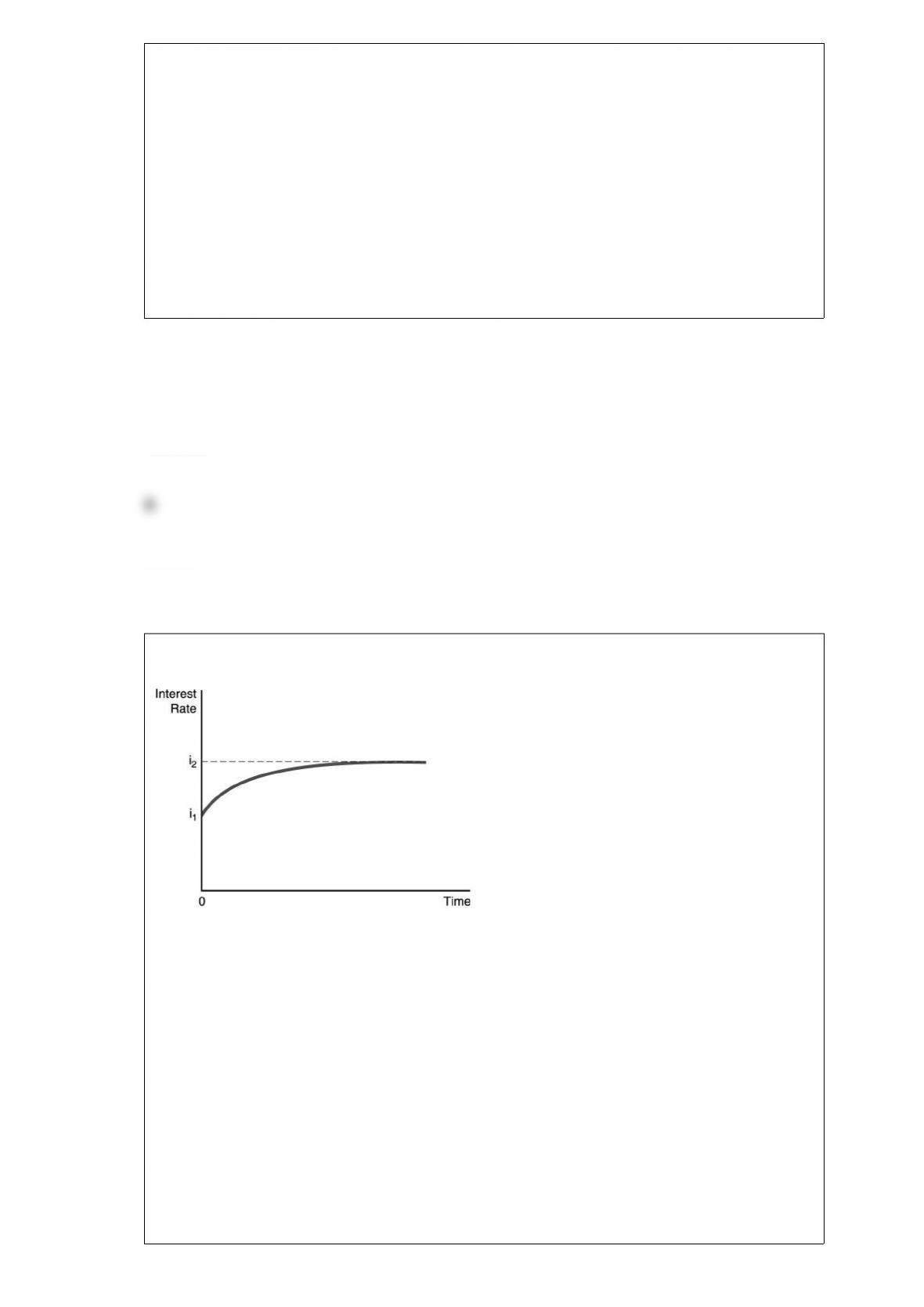
In the figure above, illustrates the effect of an increased rate of money supply growth at
time period 0. From the figure, one can conclude that the
A. liquidity effect is smaller than the expected inflation effect and interest rates adjust
quickly to changes in expected inflation.
B. liquidity effect is larger than the expected inflation effect and interest rates adjust
quickly to changes in expected inflation.
C. liquidity effect is larger than the expected inflation effect and interest rates adjust
slowly to changes in expected inflation.
D. liquidity effect is smaller than the expected inflation effect and interest rates adjust

slowly to changes in expected inflation.
Answer:
In the Keynesian framework, as long as output is ________ the equilibrium level,
unplanned inventory investment will remain ________, firms will continue to lower
production, and output will continue to fall.
A. below; negative
B. above; negative
C. below; positive
D. above; positive
Answer:
According to Edward Kane, because the banking industry is one of the most ________
industries in America, it is an industry in which ________ is especially likely to occur.
A. competitive; loophole mining
B. competitive; innovation
C. regulated; loophole mining
D. regulated; innovation

Answer:
The experience of disintermediation in the banking industry illustrates that
A. more regulation of financial markets may avoid such problems in the future.
B. banks are unable to remain competitive with other financial intermediaries.
C. consumers no longer desire the services that banks provide.
D. markets invent alternatives to costly regulations.
Answer:
In a one-period valuation model, a decrease in the required return on investments in
equity causes a(n) ________ in the ________ price of a stock.
A. increase; current
B. increase; expected sales
C. decrease; current
D. decrease; expected sales
Answer:

Which of the following policy measures prohibited compliance officers from being
involved in producing or selling credit ratings?
A. the Dodd-Frank Wall Street Reform and Consumer Protection Act of 2010
B. Sarbanes-Oxley Act of 2002
C. Global Legal Settlement of 2002
D. Gramm-Leach-Bliley Act of 1999
E. Riegle-Neal Act of 1994
Answer: