Archives
978-1457663536 Chapter 1 Part 1
1 Becoming a Public Speaker <A> OBJECTIVES To recognize the many benefits of public speaking. To enhance your career as a student. To find new opportunities for civic engagement. To recognize the classical roots of public […]
978-1457663536 Chapter 1 Part 2
What are the benefits of public speaking both personally and professionally? Based on the benefits of public speaking: What skills do you hope to gain from this class? Are there other classes and out-of-school opportunities where you can […]
978-1457663536 Chapter 10
10 Citing Sources in Your Speech <A> OBJECTIVES To cite your sources to enhance your own authority and demonstrate solid support for your reasoning. To offer key source information. To demonstrate the source’s trustworthiness. To avoid […]
978-1457663536 Chapter 11
11 Organizing the Body of the Speech <A> OBJECTIVES To understand the value of organization in a speech. To recognize the parts of a speech. To create main points that express your major claims. To use […]
978-1457663536 Chapter 12
12 Types of Organizational Arrangements <A> OBJECTIVES To use a pattern to help listeners process and retain information. To choose from a variety of organizational patterns. To be aware that subpoints need not follow the pattern selected for […]
978-1457663536 Chapter 13
13 Outlining the Speech <A> OBJECTIVES To plan on developing two outlines before delivering your speech. To become familiar with sentence, phrase, and key-word outlines. To know the benefits and drawbacks of the three outline formats. […]
978-1457663536 Chapter 14
14 Developing the Introduction <A> OBJECTIVES To prepare the introduction. To use the introduction to gain audience attention. To preview the topic and purpose. To establish your credibility. To preview the main points. To […]
978-1457663536 Chapter 15
15 Developing the Conclusion <A> OBJECTIVES To use the conclusion to serve several functions. To make the conclusion meaningful and memorable. <A> CHAPTER CONTENT OUTLINE I. Functions of conclusions A. The first function of the conclusion is to […]
978-1457663536 Chapter 16 Part 1
16 Using Language to Style the Speech <A> OBJECTIVES To prepare your speeches using an oral style. To strive for simplicity. To aim for conciseness. To use repetition frequently. To use personal pronouns. To […]
978-1457663536 Chapter 16 Part 2
Abstract Less Abstract Concrete summer hot weather sweltering heat congestion traffic jam gridlock Abstract language refers to words that are general and nonspecific, leaving meaning open to interpretation. Define figure of speech. Define three types of figures of speech, and […]
978-1457663536 Chapter 17
17 Methods of Delivery <A> OBJECTIVES To strive for naturalness in your delivery. To show enthusiasm. To project a sense of confidence and composure. To engage your audience by being direct. If you must read […]
978-1457663536 Chapter 18
18 The Voice in Delivery <A> OBJECTIVES To adjust your speaking volume. To beware of speaking in a monotone. To adjust your speaking rate for comprehension and expressiveness. To use strategic pauses and avoid meaningless vocal […]
978-1457663536 Chapter 19
19 The Body in Delivery <A> OBJECTIVES To remember the importance of your nonverbal behavior. To use nonverbal cues to enhance your credibility. To animate your facial expressions in appropriate ways. To maintain eye contact with […]
978-1457663536 Chapter 2 Part 1
2 Giving It a Try: Preparing Your First Speech <A> OBJECTIVES To construct and deliver your first speech using an overview. <A> CHAPTER CONTENT OUTLINE I. A brief overview of the speechmaking process A. The speaker should begin by analyzing […]
978-1457663536 Chapter 2 Part 2
about what to do and not do in front of an audience based on their experience. Many, if not all students have experience observing public speaking, be it listening to teachers, politicians, or clergy. They likely know what appeals to […]
978-1457663536 Chapter 20
20 Speaking with Presentation Aids <A> OBJECTIVES To use presentation aids to increase understanding and retention. To consider using props and models. To consider illustrating key points with pictures. To use graphs and charts to show […]
978-1457663536 Chapter 21
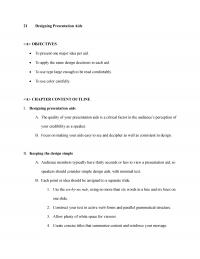
The quality of your presentation aids is a critical factor in the audience’s perception of your credibility as a speaker. Audience members typically have thirty seconds or less to view a presentation aid, so speakers should consider simple design aids, […]
978-1457663536 Chapter 22
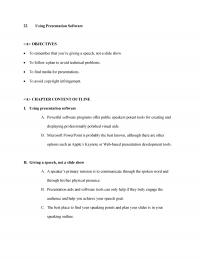
22 Using Presentation Software <A> OBJECTIVES To remember that you’re giving a speech, not a slide show. To follow a plan to avoid technical problems. To find media for presentations. To avoid copyright infringement. <A> CHAPTER […]
978-1457663536 Chapter 23 Part 1
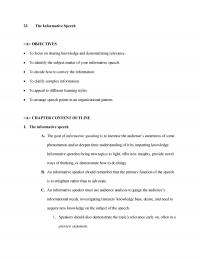
23 The Informative Speech <A> OBJECTIVES To focus on sharing knowledge and demonstrating relevance. To identify the subject matter of your informative speech. To decide how to convey the information. To clarify complex information. To […]
978-1457663536 Chapter 23 Part 2
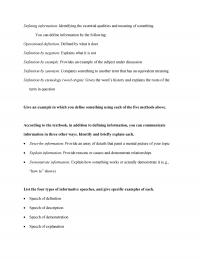
Defining information: Identifying the essential qualities and meaning of something You can define information by the following: Give an example in which you define something using each of the five methods above. According to the textbook, in addition to defining […]
978-1457663536 Chapter 24 Part 1
24 The Persuasive Speech <A> OBJECTIVES To select a persuasive purpose for your speech based on your specific goal(s). To increase the odds of achieving your persuasive speech goal. To recognize classical persuasive appeals using logos, pathos, […]
978-1457663536 Chapter 24 Part 2
Which do you think is most important to achieving persuasive outcomes in a speech: logos, pathos, or ethos? Why? This question itself requires students to be persuasive, in that they must argue convincingly for the superiority of one of the […]
978-1457663536 Chapter 25 Part 1
25 Developing Arguments for the Persuasive Speech <A> OBJECTIVES To understand the features of an argument. To select among three types of claims made in arguments. To choose the types of evidence that best support your claim. […]
978-1457663536 Chapter 25 Part 2
If evidence supports a claim, why do we need warrants? Warrants are what connect the claim with the evidence (or data in some cases). Warrants allow the audience to see how the evidence is used to support the claim, or […]
978-1457663536 Chapter 26
Claims of policy are often organized with the problem-solution pattern or the comparative-advantage pattern of arrangement. 26 Organizing the Persuasive Speech <A> OBJECTIVES To select an organizational pattern based on your claims, audience attitudes, and desired response. To use the […]
978-1457663536 Chapter 27
27 Special Occasion Speeches <A> OBJECTIVES To identify the primary function of your special occasion speech. To recognize the different types of special occasion speeches. To focus your speech of introduction on motivating the audience to listen […]
978-1457663536 Chapter 28
28 Preparing Online Presentations <A> OBJECTIVES To apply your knowledge of face-to-face speaking. To understand the unique demands of online delivery. To plan for the delivery mode. To select the appropriate online presentation format. <A> CHAPTER […]
978-1457663536 Chapter 29
29 Collaborating and Presenting in Groups <A> OBJECTIVES To focus on the goals of the group. To plan on assuming dual roles. To center disagreements on issues rather than personalities. To not accept ideas uncritically merely […]
978-1457663536 Chapter 30
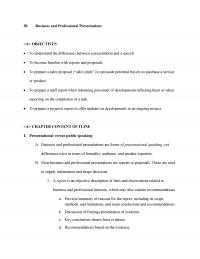
30 Business and Professional Presentations <A> OBJECTIVES To understand the differences between a presentation and a speech. To become familiar with reports and proposals. To prepare a sales proposal (“sales pitch”) to persuade potential buyers to purchase […]
978-1457663536 Chapter 31 Part 1
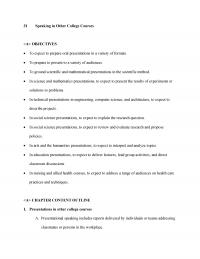
31 Speaking in Other College Courses <A> OBJECTIVES To expect to prepare oral presentations in a variety of formats. To prepare to present to a variety of audiences. To ground scientific and mathematical presentations in the scientific […]
978-1457663536 Test Bank Chapter 24 Principles of Persuasive Speaking_FIB
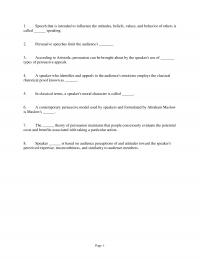
Page 1 1. Speech that is intended to influence the attitudes, beliefs, values, and behavior of others is called ______ speaking. 2. Persuasive speeches limit the audience’s _______. 3. According to Aristotle, persuasion can be brought about by the speaker’s […]
978-1457663536 Test Bank Chapter 24 Principles of Persuasive Speaking_MC
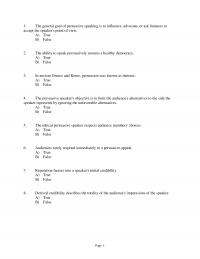
Page 1 1. The general goal of persuasive speaking is to influence, advocate, or ask listeners to accept the speaker’s point of view. A) True B) False 2. The ability to speak persuasively ensures a healthy democracy. A) True B) […]
978-1457663536 Test Bank Chapter 25
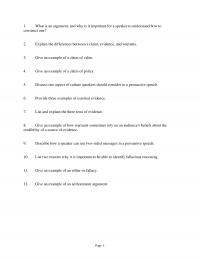
Page 1 1. What is an argument, and why is it important for a speaker to understand how to construct one? 2. Explain the differences between a claim, evidence, and warrants. 3. Give an example of a claim of value. […]
978-1457663536 Test Bank Chapter 25 Developing Arguments for the Persuasive Speech_FIB
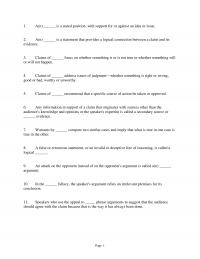
Page 1 1. A(n) ______ is a stated position, with support for or against an idea or issue. 2. A(n) ______ is a statement that provides a logical connection between a claim and its evidence. 3. Claims of ______ focus […]
978-1457663536 Test Bank Chapter 25 Developing Arguments for the Persuasive Speech_MC
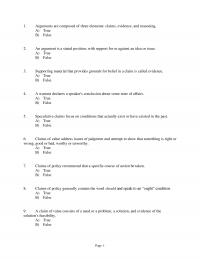
Page 1 1. Arguments are composed of three elements: claims, evidence, and reasoning. A) True B) False 2. An argument is a stated position, with support for or against an idea or issue. A) True B) False 3. Supporting material […]
978-1457663536 Test Bank Chapter 26
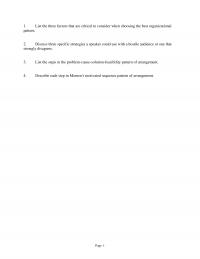
Page 1 1. List the three factors that are critical to consider when choosing the best organizational pattern. 2. Discuss three specific strategies a speaker could use with a hostile audience or one that strongly disagrees. 3. List the steps […]
978-1457663536 Test Bank Chapter 26 Organizing the Persuasive Speech_FIB
Page 1 1. When selecting a(n) _______, a speaker should consider the nature of his or her arguments and evidence, the audience’s attitudes toward the topic, and the response he or she wants to elicit. 2. ________ is a five-step […]
978-1457663536 Test Bank Chapter 26 Organizing the Persuasive Speech_MC
Page 1 1. Speakers should develop their arguments before deciding which organizational pattern to use. A) True B) False 2. Any of the persuasive organizational patterns will work for any persuasive topic. A) True B) False 3. The topical (categorical) […]
978-1457663536 Test Bank Chapter 27
Page 1 1. What are the functions of a special occasion speech? 2. Name the two goals of a speech of introduction. 3. Why is it important for a speech of introduction to be brief? 4. Provide two tips for […]
978-1457663536 Test Bank Chapter 27 Special Occasion Speeches_FIB
Page 1 1. The function of a(n) ______ speech is to entertain, celebrate, commemorate, inspire, or set a social agenda. 2. A speech of ______ is a short speech that prepares or “warms up” the audience for another speaker and […]
978-1457663536 Test Bank Chapter 27 Special Occasion Speeches_MC
Page 1 1. Special occasion speeches can be informative, persuasive, or a mix of both. A) True B) False 2. Special occasion speseches are prepared for a purpose dictated by the audience. A) True B) False 3. Some special occasion […]
978-1457663536 Test Bank Chapter 28
Page 1 1. What are the advantages and limitations of a real-time presentation? 2. What are the advantages and limitations of a recorded presentation? 3. Why is vocal variety so important for an online speaker/presenter? 4. List two platforms that […]
978-1457663536 Test Bank Chapter 28 Preparing Online Presentations_FIB
Page 1 1. ______ presentations connect the presenter and the audience live and at the same time. 2. In ________ presentations, speaker and audience are separated by space and time, in asynchronous communication. 3. __________, such as Camtasia or Adobe […]
978-1457663536 Test Bank Chapter 28 Preparing Online Presentations_MC
Page 1 1. Skill connecting with people in mediated environments primarily benefits people for their personal projects and needs. A) True B) False 2. Online speeches can be streamed live in real time or recorded for later distribution. A) True […]
978-1457663536 Test Bank Chapter 29
Page 1 1. Why are both social roles and task roles important to effective group decision making? 2. List and describe two antigroup roles. 3. Explain the difference between personal-based conflict and issues-based conflict. 4. Describe the two methods a […]
978-1457663536 Test Bank Chapter 29 Communicating in Groups_FIB
Page 1 1. Group member roles that directly relate to the accomplishment of the group’s objectives are called ______ roles. 2. Roles that facilitate group interaction are called ______ roles. 3. ______ roles, including “blocker” and “recognition seeker,” are not […]
978-1457663536 Test Bank Chapter 29 Communicating in Groups_MC
Page 1 1. A small group usually consists of between three and twenty people. A) True B) False 2. Agendas identify what will be accomplished during a meeting, not time limits for discussion. A) True B) False 3. Group-member roles […]

978-1457663536 Test Bank Chapter 30
Page 1 1. List the three common types of reports and proposals. 2. Why is the motivated sequence effective for organizing sales proposals? 3. Describe the difference between a proposal and a report. Page 2 Answer Key 1. 2. 3.
978-1457663536 Test Bank Chapter 30 Business and Professional Presentations_FIB
Page 1 1. Reports delivered by individuals or teams within the business or professional environment take the form of ______ speaking. 2. A(n) ______ proposal attempts to lead a potential buyer to purchase a service or product. 3. The motivated […]
978-1457663536 Test Bank Chapter 30 Business and Professional Presentations_MC
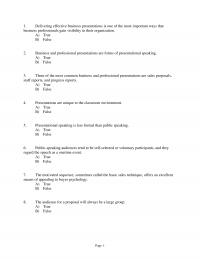
Page 1 1. Delivering effective business presentations is one of the most important ways that business professionals gain visibility in their organization. A) True B) False 2. Business and professional presentations are forms of presentational speaking. A) True B) False […]
978-1457663536 Test Bank Chapter 31
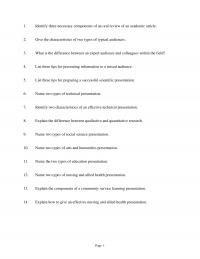
Page 1 1. Identify three necessary components of an oral review of an academic article. 2. Give the characteristics of two types of typical audiences. 3. What is the difference between an expert audience and colleagues within the field? 4. […]
978-1457663536 Test Bank Chapter 31 Presentations in Other College Courses_FIB
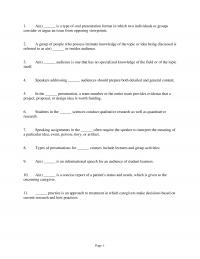
Page 1 1. A(n) ______ is a type of oral presentation format in which two individuals or groups consider or argue an issue from opposing viewpoints. 2. A group of people who possess intimate knowledge of the topic or idea […]
978-1457663536 Test Bank Chapter 31 Presentations in Other College Courses_MC
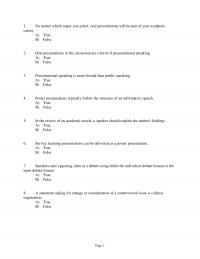
Page 1 1. No matter which major you select, oral presentations will be part of your academic career. A) True B) False 2. Oral presentations in the classroom are a form of presentational speaking. A) True B) False 3. Presentational […]