Archives
978-1452217819 Chapter 1 Lecture Note
Communication: A Critical/Cultural Introduction, 2e Warren & Fassett Chapter 1: Thinking Critically About Communication in Culture Lecture Outline Overview: This introduction to communication studies is the perspective of the authors. This is an important point to understand because the authors […]
978-1452217819 Chapter 1 Solution Manual
Communication: A Critical/Cultural Introduction, 2e Warren & Fassett Chapter 1: Communication: A Cultural Introduction Discussion Questions 1. How does your attitude toward a book or its content influence what it teaches you? 2. What are your predispositions toward this class? […]
978-1452217819 Chapter 10 Lecture Note
Communication: A Critical/Cultural Introduction, 2e Warren & Fassett Chapter 10: Interpersonal Relationships in Culture Lecture Outline Chapter Summary: In this chapter we are introduced to interpersonal communication and it’s connection of culture. Students will learn about the contexts in which […]
978-1452217819 Chapter 10 Solution Manual
Communication: A Critical/Cultural Introduction, 2e Warren & Fassett Chapter 10: Interpersonal Relationships in Culture Discussion Questions 1. What negative effects could occur if we do not practice compassionate or critical listening in our interpersonal relationships?
978-1452217819 Chapter 11 Lecture Note
Communication: A Critical/Cultural Introduction, 2e Warren & Fassett Chapter 11: Mediated Culture(s) Lecture Outline Chapter Overview: This chapter explores the ways in which mediated message impact our lives from the Internet to PowerPoint. In doing so, Warren and Fassett examine […]
978-1452217819 Chapter 11 Solution Manual
Communication: A Critical/Cultural Introduction, 2e Warren & Fassett Chapter 11: Mediated Culture(s) Discussion Questions 1. Discuss what the government can do, if anything to protect young people from pornographic material on the World Wide Web. 2. Do you envision books […]
978-1452217819 Chapter 12 Lecture Note
Communication: A Critical/Cultural Introduction, 2e Warren & Fassett Chapter 12: Communication as a Means of Social Action Lecture Outline Chapter Overview: In this chapter, Fassett and Warren explore how we can use our communication as a means of social action. […]
978-1452217819 Chapter 12 Solution Manual
Communication: A Critical/Cultural Introduction, 2e Warren & Fassett Chapter 12: Communication as a Means of Social Action Discussion Questions 1. What are some of the ways you feel western culture disciplines you to behave a certain way? In what ways […]
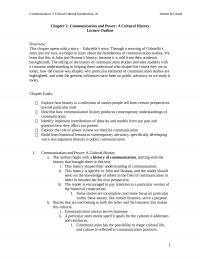
978-1452217819 Chapter 2 Lecture Note
Communication: A Critical/Cultural Introduction, 2e Warren & Fassett Chapter 2: Communication and Power: A Cultural History Lecture Outline Overview: This chapter opens with a story – Gabriella’s story. Through a weaving of Gabriella’s story into the text, we begin to […]
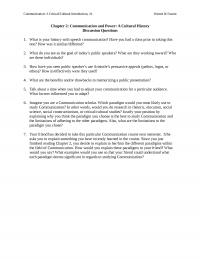
978-1452217819 Chapter 2 Solution Manual
Communication: A Critical/Cultural Introduction, 2e Warren & Fassett Chapter 2: Communication and Power: A Cultural History Discussion Questions 1. What is your history with speech communication? Have you had a class prior to taking this one? How was it similar/different? […]
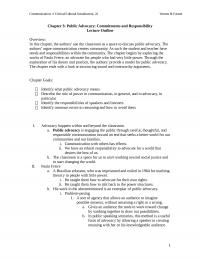
978-1452217819 Chapter 3 Lecture Note
Communication: A Critical/Cultural Introduction, 2e Warren & Fassett Chapter 3: Public Advocacy: Commitments and Responsibility Lecture Outline Overview: In this chapter, the authors’ use the classroom as a space to discuss public advocacy. The authors’ argue communication creates community. As […]
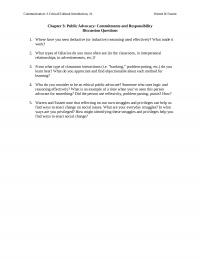
978-1452217819 Chapter 3 Solution Manual
Communication: A Critical/Cultural Introduction, 2e Warren & Fassett Chapter 3: Public Advocacy: Commitments and Responsibility Discussion Questions 1. Where have you seen deductive (or inductive) reasoning used effectively? What made it work? 2. What types of fallacies do you most […]
978-1452217819 Chapter 4 Lecture Note
Communication: A Critical/Cultural Introduction, 2e Warren & Fassett Chapter 4: Compassionate Critical Listening Lecture Outline Chapter Summary The authors work to distinguish the differences between listening and hearing. While doing so, the authors also push the notions of listening through […]
978-1452217819 Chapter 4 Solution Manual
Communication: A Critical/Cultural Introduction, 2e Warren & Fassett Chapter 4: Compassionate Critical Listening Discussion Questions 1. Instructors often encourage their students to engage in classroom activities and discussions. Sometimes an instructor’s syllabus will outline what is or is not considered […]
978-1452217819 Chapter 5 Lecture Note
Communication: A Critical/Cultural Introduction, 2e Warren & Fassett Chapter 5: Groups and Alliances in Culture Lecture Outline Chapter Overview: In this chapter, the authors approach groups in a unique way – by extending the conversation to the ways in which […]
978-1452217819 Chapter 5 Solution Manual
Communication: A Critical/Cultural Introduction, 2e Warren & Fassett Chapter 5: Groups and Alliances in Culture Discussion Questions 1. Have you ever been involved with a group that was facing a conflict? What do you believe were the major contributors to […]
978-1452217819 Chapter 6 Lecture Note
Communication: A Critical/Cultural Introduction, 2e Warren & Fassett Chapter 6: Identity and Perception Chapter Overview: In this chapter, the authors discuss the role of identity and perception in interpersonal relationships as well as in public advocacy and speech building. The […]
978-1452217819 Chapter 6 Solution Manual
Communication: A Critical/Cultural Introduction, 2e Warren & Fassett Chapter 6: Identity and Perception Discussion Questions 1. Because we’re not always aware of the ways in which our experiences influence our perceptions, what are some ways we might create a sense […]
978-1452217819 Chapter 7 Lecture Note
Communication: A Critical/Cultural Introduction, 2e Warren & Fassett Chapter 7: Language and Culture Lecture Outline Chapter Overview This chapter is an exploration in the power behind words. Throughout this chapter is the story of Joel and Denny and there struggle […]
978-1452217819 Chapter 7 Solution Manual
Communication: A Critical/Cultural Introduction, 2e Warren & Fassett Chapter 7: Language and Culture Discussion Questions 1. A variety of topics are able to incite excitement in communication. Together with the class, brainstorm some of those topics and the language used […]
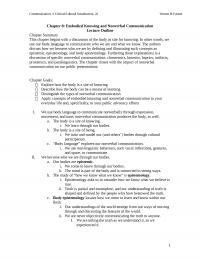
978-1452217819 Chapter 8 Lecture Note
Communication: A Critical/Cultural Introduction, 2e Warren & Fassett Chapter 8: Embodied Knowing and Nonverbal Communication Lecture Outline Chapter Summary This chapter begins with a discussion of the body as site for knowing. In other words, we use our body language […]
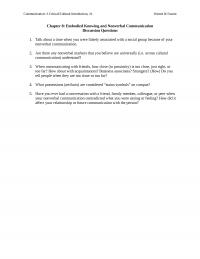
978-1452217819 Chapter 8 Soluton Manual
Communication: A Critical/Cultural Introduction, 2e Warren & Fassett Chapter 8: Embodied Knowing and Nonverbal Communication Discussion Questions 1. Talk about a time when you were falsely associated with a social group because of your nonverbal communication. 2. Are there any […]
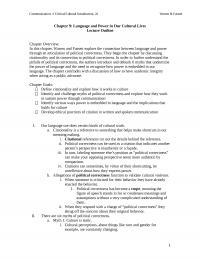
978-1452217819 Chapter 9 Lecture Note
Communication: A Critical/Cultural Introduction, 2e Warren & Fassett Chapter 9: Language and Power in Our Cultural Lives Lecture Outline Chapter Overview: In this chapter, Warren and Fassett explore the connection between language and power through an articulation of political correctness. […]
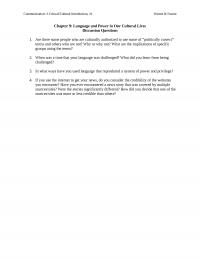
978-1452217819 Chapter 9 Solution Manual
Communication: A Critical/Cultural Introduction, 2e Warren & Fassett Chapter 9: Language and Power in Our Cultural Lives Discussion Questions 1. Are there some people who are culturally authorized to use some of “politically correct” terms and others who are not? […]
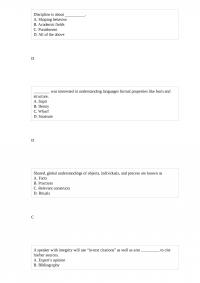
CAS 78688
Discipline is about __________. A. Shaping behavior B. Academic fields C. Punishment D. All of the above ________ was interested in understanding languages formal properties like form and structure. A. Sapir B. Denny C. Whorf D. Saussure D Shared, global […]
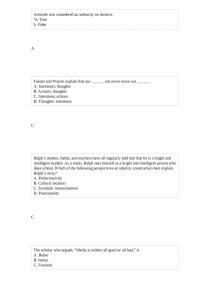
COM CM 68018
Aristotle was considered an authority on rhetoric. *a. True b. False Fassett and Warren explain that our ______ can never erase our ______. A. Intentions; thoughts B. Actions; thoughts C. Intentions; actions D. Thoughts: intentions C Ralph’s mother, father, and […]
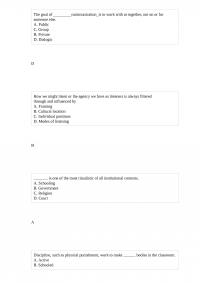
COMM 79647
The goal of _________communication_is to work with or together, not on or for someone else. A. Public C. Group B. Private D. Dialogic How we might listen or the agency we have as listeners is always filtered through and influenced […]
Communications Chapter 1 The Transmission Model Communication Explains Communication Circular
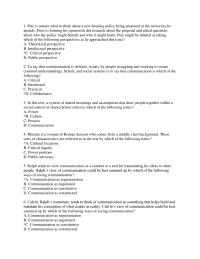
1. Pete is unsure what to think about a new housing policy being proposed at the university he attends. Prior to forming his opinion he did research about the proposal and asked questions about who the policy might benefit and […]
Communications Chapter 10 Rational Individual Emotional D Relational 15 All
1. Ritualistic behaviors can be found in which of the following? A. Education B. Romantic relationships 2. Interpersonal communication describes the exchange or interaction that occurs between people who are in a/an __________ relationship. *A. Interdependent B. Contextual C. Framed […]
Communications Chapter 11 Mediated Messages Tropes Movies 16 Being
1. Which of the following is an example of a mediated text? A. Television news 2. A __________ is something people already in power use to maintain their power. *A. Strategy B. Tactic C. Resistance D. All of the above […]
Communications Chapter 12 Advocacy Through Dialogue Advocacy Through Listening Advocacy
1. We learn to discipline __________. A. Ourselves 2. __________ is produced through communication. A. Discipline B. Identity *C. Both A & B D. Neither A nor B 3. Discipline is about __________. A. Shaping behavior B. Academic fields C. […]
Communications Chapter 2 Critical cultural Turn Social Constructionism Elocution Science 18
1. The Ancient Greeks taught and learned through speaking. Which of the following phrases best characterizes this feature of Ancient Greek life? A. Audible culture 2. The belief that nothing exists outside the human senses and those senses are always […]
Communications Chapter 3 Pay Attention Detail And Assess Disapprove Something
1. “Stealing is immoral. Plagiarism is stealing. Therefore, plagiarism is immoral.” This an 2. The __________ fallacy asserts that a particular action will set forth a chain of reactions that will inevitably lead to a certain result. A. Straw man […]
Communications Chapter 4 This Example Proactive Participants Inactive Participants C
1. ________________ is a passive act in which sounds vibrate off our eardrums. A. Listening 2. _______________ is an active process that requires our active attention and focus. *A. Listening B. Speaking C. Hearing D. Engaging 3. To develop a […]
Communications Chapter 5 Group Classroom Collaboration D Alliance 20 According
1. _______________ allows students to learn in a community of peers rather than hierarchically from the teacher alone. 2. Collaborative learning demonstrates on a smaller scale how knowledge is A. Created B. Improved C. Changed D. A & C E. […]
Communications Chapter 6 Hegemonic Group B Mythical Norm Symbolic Center
1. A compilation of your experiences as influenced by the social, political, and cultural factors that frame and mark those experiences describes which of the following terms? A. Reasonableness 2. The idea that our social reality emerges through our actions […]
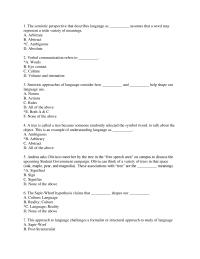
Communications Chapter 7 Sapir Denny Whorf D Saussure 17 The
1. The semiotic perspective that describes language as __________ assumes that a word may represent a wide variety of meanings. A. Arbitrary 2. Verbal communication refers to __________. *A. Words B. Eye contact C. Culture D. Volume and intonation 3. […]
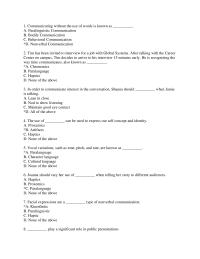
Communications Chapter 8 Body identity Connection Embodied Learning 16 Studes Have
1. Communicating without the use of words is known as __________. A. Paralinguistic Communication 2. Tim has been invited to interview for a job with Global Systems. After talking with the Career Center on campus, Tim decides to arrive to […]
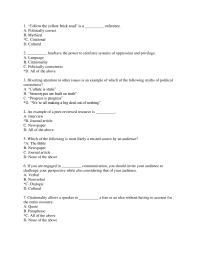
Communications Chapter 9 Progress Progress Culture Static 19 Sarah Explained
1. “Follow the yellow brick road” is a __________ reference. A. Politically correct 2. __________ has/have the power to reinforce systems of oppression and privilege. A. Language B. Citationality C. Politically correctness *D. All of the above 3. Diverting attention […]
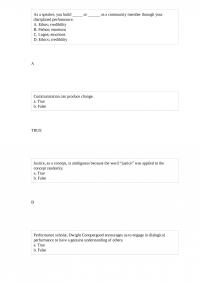
COMU 53617
As a speaker, you build _____ or ______ as a community member through your disciplined performance. A. Ethos; credibility B. Pathos; emotions C. Logos; emotions D. Ethics; credibility Communication can produce change. a. True b. False TRUE Justice, as a […]
COMU 55699
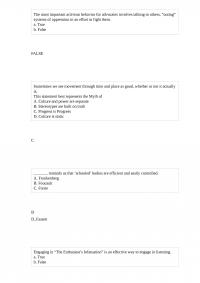
The most important activism behavior for advocates involves talking to others, “outing” systems of oppression in an effort to fight them. a. True b. False Sometimes we see movement through time and place as good, whether or not it actually […]
COMU 71100
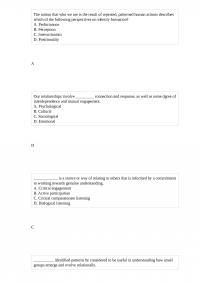
The notion that who we are is the result of repeated, patterned human actions describes which of the following perspectives on identity formation? A. Performance B. Perception C. Interactionism D. Positionality Our relationships involve _________ connection and response, as well […]
COMU 84303
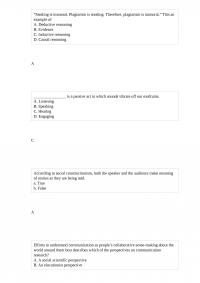
“Stealing is immoral. Plagiarism is stealing. Therefore, plagiarism is immoral.” This an example of A. Deductive reasoning B. Evidence C. Inductive reasoning D. Causal reasoning ________________ is a passive act in which sounds vibrate off our eardrums. A. Listening B. […]
STM 31478
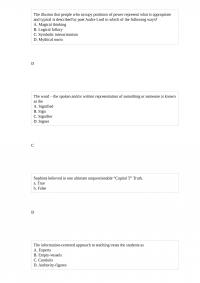
The illusion that people who occupy positions of power represent what is appropriate and typical is described by poet Audre Lord in which of the following ways? A. Magical thinking B. Logical fallacy C. Symbolic interactionism D. Mythical norm The […]
STM 39014
If a group is able to work through conflict toward cohesion, the members will move to the next step in small group evolution called A. Adjourning B. Forming C. Norming D. Storming An I-Thou relational type characterizes the relationship between […]
STM 52739
Interpersonal communication describes the exchange or interaction that occurs between people who are in a/an __________ relationship. A. Interdependent B. Contextual C. Framed D. None of the above It is typically a good idea to read from PowerPoint slides when […]
STM 57697
Ralph tends to view communication as a conduit or a tool for transmitting his ideas to other people. Ralph’s view of communication could be best summed up by which of the following ways of seeing communication? A. Communication as representation […]
STM 98489
Kate tells her friend Meagan that she likes cats. Her use of the word “cats” is an example of a signifier. a. True b. False According to the authors, finding out more about the author of the information you want […]