Archives
978-0133914689 Chapter 1 Part 1
1 Constitutional Democracy Multiple–Choice Questions 1. __________ was the primary author of the Declaration of Independence and a champion of constitutional democracy. a. Thomas Jeferson b. George Washington c. John Adams d. John Locke Topic: U.S. Government and Politicians […]
978-0133914689 Chapter 1 Part 2
c. Trying to come to an agreement on what rights to include would tear the new country apart. d. All states currently had their own bills of rights. Answer: a Test Bank Item Title: TB_Q1.5.25 Topic: To Adopt or Not […]
978-0133914689 Chapter 1 Part 3
46. Explain what is meant by representative democracy. 1. Deine a representative democracy as referring to a system of government in which the people elect leaders who govern and make laws. This is also known as a republic. 2. Indicate […]
978-0133914689 Chapter 10 Part 1
10 Congress Multiple–Choice Questions 1. The Constitution gives __________ the power to draw House district lines. a. the Senate b. the House c. the Supreme Court d. the states Topic: Congressional Elections Learning Objective: LO 10.1: Describe the congressional […]
978-0133914689 Chapter 10 Part 2
27. Which of the following is an enumerated power of Congress? a. the power to lay and collect taxes b. the power to make treaties c. the power to appoint federal judges d. the power to issue executive orders Topic: […]
978-0133914689 Chapter 10 Part 3
Skill Level: Apply What You Know Difficulty Level: Moderate 54. Which example best demonstrates a legislator acting as a trustee of his or her constituency? a. A legislator considers public opinion, refining it with information and careful thought. b. A […]
978-0133914689 Chapter 10 Part 4
Difficulty Level: Easy 88. __________ powers are the powers explicitly given to Congress in the Constitution. Topic: The Structure and Powers of Congress Learning Objective: LO 10.2: Differentiate the powers of Congress, and compare and contrast the structure and powers […]
978-0133914689 Chapter 10 Part 5
4. Despite Americans’ frustration with Congress, however, it is likely that America, which has its roots in Western European philosophy and culture, would poll in the same range as Western Europeans in their preference for legislative rule over a stronger, […]
978-0133914689 Chapter 11 Part 1
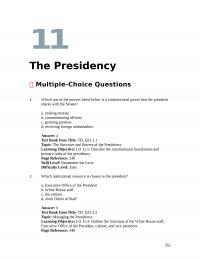
11 The Presidency Multiple–Choice Questions 1. Which one of the powers listed below is a constitutional power that the president shares with the Senate? a. making treaties b. commissioning officers c. granting pardons d. receiving foreign ambassadors Topic: The […]
978-0133914689 Chapter 11 Part 2
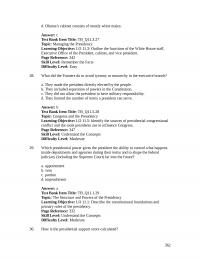
d. Obama’s cabinet consists of mostly white males. Answer: c Test Bank Item Title: TB_Q11.3.27 Topic: Managing the Presidency Learning Objective: LO 11.3: Outline the functions of the White House staff, Executive Office of the President, cabinet, and vice president. […]
978-0133914689 Chapter 11 Part 3
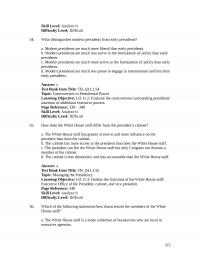
Skill Level: Analyze It Difficulty Level: Difficult 54. What distinguishes modern presidents from early presidents? a. Modern presidents are much more liberal than early presidents. b. Modern presidents are much less active in the formulation of policy than early presidents. […]
978-0133914689 Chapter 11 Part 4
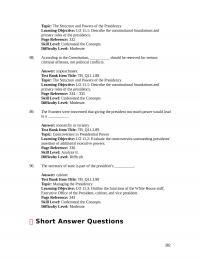
Topic: The Structure and Powers of the Presidency Learning Objective: LO 11.1: Describe the constitutional foundations and primary roles of the presidency. Page Reference: 332 Skill Level: Understand the Concepts Difficulty Level: Moderate 88. According to the Constitution, __________ should […]
978-0133914689 Chapter 12 Part 1
12 The Federal Bureaucracy and the Public Policy Process Multiple–Choice Questions 1. The __________ is a form of organization that delivers goods and services at the lowest cost through specialization of jobs, close supervision of employees, and uniform regulations […]
978-0133914689 Chapter 12 Part 2
26. A woman is most likely to be employed in which of the following departments? a. the Department of Housing and Urban Development b. the Department of Defense c. the Department of Energy d. the Department of Transportation Topic: Understanding […]
978-0133914689 Chapter 12 Part 3
a. The agency in charge of setting safety standards for oil and gas drilling also issued permits to the oil industry, which created a conflict of interest. b. British Petroleum was contributing large amounts of money to the campaign of […]
978-0133914689 Chapter 12 Part 4
Learning Objective: LO 12.2: Analyze the bureaucracy’s implementation options and its effectiveness. Page Reference: 366 Skill Level: Understand the Concepts Difficulty Level: Moderate 84. Subsidized housing for lower-income citizens is an example of __________ policy. Topic: Defining Public Policy Learning […]
978-0133914689 Chapter 12 Part 5
Topic: The Job of the Federal Bureaucracy Learning Objective: LO 12.2: Analyze the bureaucracy’s implementation options and its effectiveness. Skill Level: Analyze It Difficulty Level: Difficult 101. What are the benefits and drawbacks of providing citizens with enormous amounts of […]
978-0133914689 Chapter 13 Part 1
13 The Judiciary: The Balancing Branch Multiple–Choice Questions 1. Which article of the Constitution created the federal judiciary? a. Article III b. Article II c. Article VI d. Article I Topic: The Three Types of Federal Courts Learning Objective: […]
978-0133914689 Chapter 13 Part 2
c. Chief Justice Marshall d. President Roosevelt Answer: d Test Bank Item Title: TB_Q13.5.28 Topic: Judicial Power and Its Limits Learning Objective: LO 13.5: Assess the limits on judicial action and the role of the judiciary in a constitutional democracy. […]
978-0133914689 Chapter 13 Part 3
Learning Objective: LO 13.4: Trace the process by which Supreme Court decisions are reached, and assess influences on this process. Page Reference: 403 Skill Level: Understand the Concepts Difficulty Level: Moderate 56. Who represents the federal government in lower federal […]
978-0133914689 Chapter 13 Part 4
Answer: Supreme Court Test Bank Item Title: TB_Q13.2.89 Topic: The Three Types of Federal Courts Learning Objective: LO 13.2: Outline the structure of the federal court system. Page Reference: 391 Skill Level: Apply What You Know Difficulty Level: Difficult 90. […]
978-0133914689 Chapter 14 Part 1
14 Civil Liberties Multiple–Choice Questions 1. Which constitutional provisions ensure the protection of civil liberties? a. Article I and the Fourteenth Amendment b. the Bill of Rights and the Fourteenth Amendment c. Article II and the Bill of Rights […]
978-0133914689 Chapter 14 Part 2
Answer: b Test Bank Item Title: TB_Q14.6.27 Topic: Rights of Criminal Suspects Learning Objective: LO 14.6: Analyze the constitutional rights of criminal suspects. Page Reference: 433 Skill Level: Understand the Concepts Difficulty Level: Moderate 28. The Supreme Court has ruled […]
978-0133914689 Chapter 14 Part 3
Difficulty Level: Difficult 55. What was the significance of the Supreme Court’s decision in Miller v. California? a. The Court developed the exclusionary rule. b. The Court resolved debate over interpretation of the establishment clause. c. The Court broadened the […]
978-0133914689 Chapter 14 Part 4
Page Reference: 418 – 419 Skill Level: Remember the Facts Difficulty Level: Easy 87. Passed in 2001, the __________ expanded the size of the Foreign Intelligence Surveillance Court and lowered requirements to approve search warrants in cases involving terrorism. Topic: […]
978-0133914689 Chapter 15 Part 1
15 Civil Rights Multiple–Choice Questions 1. The first federal civil rights law enacted since Reconstruction was the Civil Rights Act of 1957. This law makes it a crime to __________. a. discriminate in public accommodations on the basis of […]
978-0133914689 Chapter 15 Part 2
d. disabled Americans Answer: c Test Bank Item Title: TB_Q15.3.26 Topic: Equal Protection of the Laws: What Does It Mean? Learning Objective: LO 15.3: Analyze the Supreme Court’s three-tiered approach used to evaluate discriminatory laws. Page Reference: 459 Skill Level: […]
978-0133914689 Chapter 15 Part 3
Answer: a Test Bank Item Title: TB_Q15.6.51 Topic: Education Rights Learning Objective: LO 15.6: Evaluate the historical process of school integration and the current state of affirmative action. Page Reference: 468 – 469 Skill Level: Analyze It Difficulty Level: Difficult […]
978-0133914689 Chapter 15 Part 4
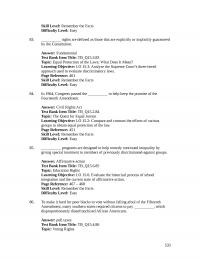
Skill Level: Remember the Facts Difficulty Level: Easy 83. __________ rights are defined as those that are explicitly or implicitly guaranteed by the Constitution. Topic: Equal Protection of the Laws: What Does It Mean? Learning Objective: LO 15.3: Analyze the […]
978-0133914689 Chapter 15 Part 5
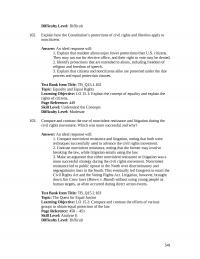
Difficulty Level: Difficult 102. Explain how the Constitution’s protections of civil rights and liberties apply to noncitizens. 1. Explain that resident aliens enjoy fewer protections than U.S. citizens. They may not run for elective office, and their right to vote […]
978-0133914689 Chapter 16 Part 1
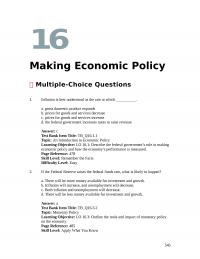
16 Making Economic Policy Multiple–Choice Questions 1. Inflation is best understood as the rate at which __________. a. gross domestic product expands b. prices for goods and services decrease c. prices for goods and services increase d. the federal […]
978-0133914689 Chapter 16 Part 2
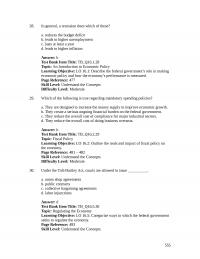
28. In general, a recession does which of these? a. reduces the budget deficit b. leads to higher unemployment c. lasts at least a year d. leads to higher inflation Topic: An Introduction to Economic Policy Learning Objective: LO 16.1: […]
978-0133914689 Chapter 16 Part 3
Topic: Monetary Policy Learning Objective: LO 16.3: Outline the tools and impact of monetary policy on the economy. Page Reference: 485 Skill Level: Apply What You Know Difficulty Level: Difficult 56. What has been the result of regulatory policies designed […]
978-0133914689 Chapter 16 Part 4
Answer: An ideal response will: 1. Define fiscal policy, which is the government’s use of taxation and spending policy to affect economic growth in the United States. 2. Explain how increasing or decreasing taxes speeds or slows economic growth. 3. […]
978-0133914689 Chapter 17 Part 1
17 Making Social Policy Multiple–Choice Questions 1. The Affordable Care Act, colloquially known as Obamacare, deals primarily with what policy area? a. education b. health care c. welfare d. economics Topic: Social Policy Challenges for the Future: Health, Education, […]
978-0133914689 Chapter 17 Part 2
Answer: d Test Bank Item Title: TB_Q17.3.26 Topic: Social Policy Challenges for the Future: Health, Education, and Crime Learning Objective: LO 17.3: Evaluate the current status of and challenges for federal government policy in the areas of health care, education, […]
978-0133914689 Chapter 17 Part 3
53. Which of the following is necessary information to determine eligibility for a means-tested program? a. the number of years a person has worked before retirement b. the number of years a person has been on Social Security c. the […]
978-0133914689 Chapter 17 Part 4
88. Social Security was designed to meet two goals: to provide a minimum income for poor beneficiaries and to ensure that benefits bear a relationship to the amount of __________ paid by beneficiaries. Topic: The Expansion of Social Policy in […]
978-0133914689 Chapter 17 Part 5
collect benefits from the government do work, but do not earn enough money to sufficiently support themselves and their families. 3. Identify that because of the recession of 2008, in which many Americans lost their jobs and homes, some of […]
978-0133914689 Chapter 18 Part 1
18 Making Foreign and Defense Policy Multiple–Choice Questions 1. The war in Iraq began under __________ and ended under __________. a. Bill Clinton; George H. W. Bush b. Bill Clinton; George W. Bush c. George H. W. Bush; George […]
978-0133914689 Chapter 18 Part 2
Learning Objective: LO 18.3: Outline the structure of the foreign policy and defense bureaucracy. Page Reference: 542 – 543 Skill Level: Understand the Concepts Difficulty Level: Moderate 27. What is the main foreign or defense policy threat posed by Iran? […]
978-0133914689 Chapter 18 Part 3
52. Why did President Bush create the White House Office of Global Communications in 2002? a. to enhance the United States’ reputation abroad and counter the image of the United States as the “Great Satan” b. to better coordinate communications […]
978-0133914689 Chapter 18 Part 4
Answer: Bush Doctrine Test Bank Item Title: TB_Q18.1.85 Topic: Understanding Foreign Policy and Defense Learning Objective: LO 18.1: Analyze the questions and responses that shape approaches to U.S. foreign policy and defense. Page Reference: 533 Skill Level: Understand the Concepts […]
978-0133914689 Chapter 18 Part 5
partly because the Middle East is an important source of the world’s oil and partly because Israel is an ally. 2. Provide an example of how soft power has been used in the Middle East, such as through foreign aid […]
978-0133914689 Chapter 2 Part 1
2 Constitutional Foundations Multiple–Choice Questions 1. A(n) __________ is a type of government in which one person with unlimited power rules. a. autocracy b. republic c. uniied government d. oligarchy Topic: Checking Power with Power Learning Objective: LO 2.2: […]
978-0133914689 Chapter 2 Part 2
Test Bank Item Title: TB_Q2.4.26 Topic: Informal Change: The Unwritten Constitution Learning Objective: LO 2.4: Assess how the Constitution has evolved through changes in the informal, unwritten Constitution. Page Reference: 62 Skill Level: Understand the Concepts Diiculty Level: Moderate 27. […]
978-0133914689 Chapter 2 Part 3
Diiculty Level: Moderate 52. When government is divided rather than uniied, which of the following is true? a. Not much important legislation is passed. b. Just as much important legislation is passed. c. Far more important legislation is passed. d. […]
978-0133914689 Chapter 2 Part 4
Learning Objective: LO 2.1: Describe the basic structure of the Constitution and its Bill of Rights. Page Reference: 50 Skill Level: Remember the Facts Diiculty Level: Easy 87. Opposition to the __________ was led by Phyllis Schlaly, a prominent spokesperson […]
978-0133914689 Chapter 2 Part 5
agency from spending funds previously authorized and appropriated by Congress. Test Bank Item Title: TB_Q2.4.98 Topic: Informal Change: The Unwritten Constitution Learning Objective: LO 2.4: Assess how the Constitution has evolved through changes in the informal, unwritten Constitution. Page Reference: […]
978-0133914689 Chapter 3 Part 1
3 American Federalism Multiple–Choice Questions 1. The __________ party favored a strong national government. a. Anti-Federalist b. Federalist c. Libertarian d. Whig Topic: Introduction Learning Objective: Introduction Page Reference: 72 Skill Level: Remember the Facts Diiculty Level: Easy 2. […]
978-0133914689 Chapter 3 Part 2
a. charge; transact b. create; produce c. regulate; limit d. tax; spend Answer: d Test Bank Item Title: TB_Q3.2.25 Topic: The Constitutional Structure of American Federalism Learning Objective: LO 3.2: Diferentiate the powers the Constitution provides to national and state […]
978-0133914689 Chapter 3 Part 3
Learning Objective: LO 3.2: Diferentiate the powers the Constitution provides to national and state governments. Page Reference: 83 Skill Level: Understand the Concepts Diiculty Level: Moderate 51. Article IV, Section 1, the “full faith and credit” clause, applies primarily to […]
978-0133914689 Chapter 3 Part 4
Diiculty Level: Easy 82. Before interstate compacts can take efect, __________ must approve them. Topic: The Constitutional Structure of American Federalism Learning Objective: LO 3.2: Diferentiate the powers the Constitution provides to national and state governments. Page Reference: 86 Skill […]
978-0133914689 Chapter 3 Part 5
1. Explain that the privileges and immunities clause is part of the Constitution. 2. Explain that individual states must give citizens of all other states the privileges and immunities they grant to their own citizens, including the protection of law, […]
978-0133914689 Chapter 4 Part 1
4 The American Political Landscape Multiple–Choice Questions 1. The study of the characteristics of populations is known as __________. a. demography b. geography c. political science d. population studies Topic: Introduction Learning Objective: Introduction Page Reference: 104 Skill Level: […]
978-0133914689 Chapter 4 Part 2
a. the West b. the Midwest c. the Northeast d. the South Answer: d Test Bank Item Title: TB_Q4.3.26 Topic: Where We Live Learning Objective: LO 4.3: Evaluate the importance of where we live on American politics. Page Reference: 107 […]
978-0133914689 Chapter 4 Part 3
Diiculty Level: Diicult 51. Regions of the United States with above-average population growth from 2000 to 2010 were __________. a. the Midwest and the West b. the Northeast and the South c. the Paciic Northwest and the Northeast d. the […]
978-0133914689 Chapter 4 Part 4
Diiculty Level: Easy 82. America’s isolation, relative prosperity, and sense of destiny all contributed to the development of the idea of __________. Topic: An Exceptional America Learning Objective: LO 4.1: Understand the origins and efects of American exceptionalism. Page Reference: […]
978-0133914689 Chapter 4 Part 5
100. What is the gross domestic product (GDP)? Discuss how it has changed in the United States in the last 50 years. Do you believe the GDP will continue on this trajectory? Why or why not? 1. Deine gross domestic […]
978-0133914689 Chapter 5 Part 1
5 Interest Groups Multiple–Choice Questions 1. In The Federalist, No. 10, James Madison described how a government could be designed to control the efects of __________. a. monarchies b. factions c. political parties d. trade associations Topic: Interest Groups […]
978-0133914689 Chapter 5 Part 2
Topic: The Inluence of Lobbyists Learning Objective: LO 5.4: Describe lobbyists and the activities through which they seek to inluence policy. Page Reference: 147 – 148 Skill Level: Understand the Concepts Diiculty Level: Moderate 26. How do interest groups lobby […]
978-0133914689 Chapter 5 Part 3
b. political information c. substantive information d. volunteers for campaign activities Answer: a Test Bank Item Title: TB_Q5.4.50 Topic: The Inluence of Lobbyists Learning Objective: LO 5.4: Describe lobbyists and the activities through which they seek to inluence policy. Page […]
978-0133914689 Chapter 5 Part 4
80. In a __________ state, workers may be required to join a union to be hired at a particular company if most employees at that company vote to unionize. Topic: Types of Interest Groups Learning Objective: LO 5.2: Categorize American […]
978-0133914689 Chapter 5 Part 5
1. Explain that lobbyists seek to gain access to and the support of members of Congress on key legislation. 2. Explain that members of Congress grant access to lobbyists because lobbyists provide them with campaign contributions and can ofer them […]
978-0133914689 Chapter 6 Part 1
6 Political Parties Multiple–Choice Questions 1. One of the various ways in which parties contribute to democratic governance is by __________. a. dividing the electorate b. narrowing voter choice c. nominating candidates d. reducing accountability mechanisms Topic: What Parties […]
978-0133914689 Chapter 6 Part 2
a. Men were more likely Democratic in 1964 than in 2008. b. Men were more likely Democratic in 2008 than in 1964. c. Women were more likely Republican in 1964 than in 2008. d. Women were more likely Republican in […]
978-0133914689 Chapter 6 Part 3
Topic: Are the Political Parties Dying? Learning Objective: LO 6.5: Assess the efects of recent party reforms and the long-term prospects for the current party system. Page Reference: 185 – 186 Skill Level: Analyze It Diiculty Level: Diicult 51. Historically, […]
978-0133914689 Chapter 6 Part 4
81. Multiparty systems are almost always found in countries that have a __________ government, in contrast to our presidential system. Topic: What Parties Do for Democracy Learning Objective: LO 6.1: Identify the primary functions of parties in democracies and distinguish […]
978-0133914689 Chapter 6 Part 5
Party survived a long period of opposition challenge and party realignment over many decades lasting from the Civil War period to FDR. Test Bank Item Title: TB_Q6.2.101 Topic: A Brief History of American Political Parties Learning Objective: LO 6.2: Describe […]
978-0133914689 Chapter 7 Part 1
7 Public Opinion, Ideology, Participation, and Voting Multiple–Choice Questions 1. Over time, people are most likely to change their beliefs about which of the following? a. banking regulations b. liberty and freedom c. abortion d. the death penalty Topic: […]
978-0133914689 Chapter 7 Part 2
Skill Level: Remember the Facts Diiculty Level: Easy 26. Since 1952, there have been an equal number of Democratic and Republican presidents. Beyond party identiication, the main factor that accounts for this is __________. a. candidate appeal b. electoral appeal […]
978-0133914689 Chapter 7 Part 3
50. The statements of a Libertarian voter that the government should not regulate social choices of adults and that the free market is a better supplier of goods and services than a centralized government are representative of his or her […]
978-0133914689 Chapter 7 Part 4
79. __________ are issues that motivate particular segments of the electorate to vote and on which the opposing candidate or party is less popular. Topic: Voting Choices Learning Objective: LO 7.5: Analyze why people vote the way they do in […]
978-0133914689 Chapter 7 Part 5
degree and is 43 with three children. Deine the concept of attentive public and explain which of these two voters would be considered such and why? Answer: An ideal response will: 1. Deine attentive public as citizens who follow public […]
978-0133914689 Chapter 8 Part 1
8 Campaigns and Elections Multiple–Choice Questions 1. Elections for members of Congress occur __________. a. on the second Tuesday in November b. every two years in odd-numbered years c. on the irst Tuesday after the irst Monday in November […]
978-0133914689 Chapter 8 Part 2
26. The tendency in elections to focus on the personal attributes of a candidate, such as his or her strengths, weaknesses, background, experience, and visibility, is known as __________. a. candidate appeal b. the incumbency advantage c. party platforms d. […]
978-0133914689 Chapter 8 Part 3
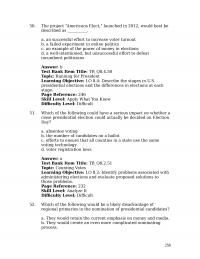
50. The project “Americans Elect,” launched in 2012, would best be described as __________. a. an successful efort to increase voter turnout b. a failed experiment in online politics c. an example of the power of money in elections d. […]
978-0133914689 Chapter 8 Part 4
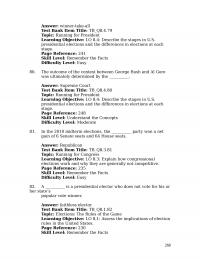
Answer: winner-take-all Test Bank Item Title: TB_Q8.4.79 Topic: Running for President Learning Objective: LO 8.4: Describe the stages in U.S. presidential elections and the diferences in elections at each stage. Page Reference: 241 Skill Level: Remember the Facts Diiculty Level: […]
978-0133914689 Chapter 8 Part 5
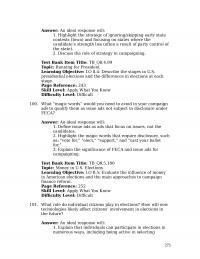
Answer: An ideal response will: 1. Highlight the strategy of ignoring/skipping early state contests (Iowa) and focusing on states where the candidate’s strength lies (often a result of party control of the state). 2. Discuss the role of strategy in […]
978-0133914689 Chapter 9 Part 1
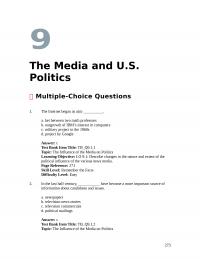
9 The Media and U.S. Politics Multiple–Choice Questions 1. The Internet began as a(n) __________. a. bet between two math professors b. outgrowth of IBM’s interest in computers c. military project in the 1960s d. project by Google Topic: […]
978-0133914689 Chapter 9 Part 2
Answer: b Test Bank Item Title: TB_Q9.1.27 Topic: The Influence of the Media on Politics Learning Objective: LO 9.1: Describe changes in the nature and extent of the political influence of the various news media. Page Reference: 271 Skill Level: […]
978-0133914689 Chapter 9 Part 3
Learning Objective: LO 9.2: Trace the evolution of the news media over the course of U.S. history. Page Reference: 277 Skill Level: Understand the Concepts Difficulty Level: Moderate 55. How did the penny press alter the content of news? a. […]
978-0133914689 Chapter 9 Part 4
Learning Objective: LO 9.4: Describe the media’s role in elections and the associated problems and benefits. Page Reference: 284 Skill Level: Analyze It Difficulty Level: Difficult Short Answer Questions 91. What forms of media make up news media, and […]