Archives: Quiz
978-0133507676 chapter 2 Part 3
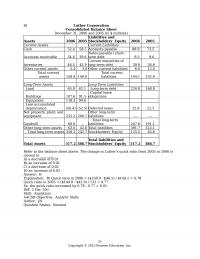
8) Luther Corporation Consolidated Balance Sheet December 31, 2006 and 2005 (in $ millions) Assets 2006 2005 Liabilities and Stockholders’ Equity 2006 2005 Current Assets Current Liabilities Cash 52.4 58.5 Accounts payable 88.9 73.5 Accounts receivable 54.6 39.6 Notes payable […]
978-0133546231 Chapter 04 Part 3
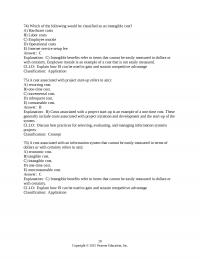
74) Which of the following would be classified as an intangible cost? A) Hardware costs B) Labor costs C) Employee morale D) Operational costs E) Internet service setup fee Classification: Application 75) A cost associated with project start-up refers to […]
978-0133546231 Chapter 04 Part 2
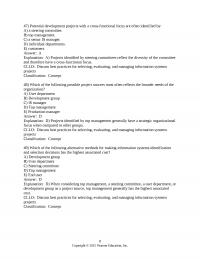
47) Potential development projects with a cross-functional focus are often identified by: A) a steering committee. B) top management. C) a senior IS manager. D) individual departments. E) customers. projects Classification: Concept 48) Which of the following possible project sources […]
978-0133507676 chapter 2 Part 2
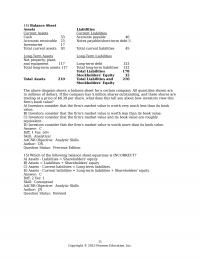
14) Balance Sheet Assets Liabilities Current Assets Current Liabilities Cash 53 Accounts payable 40 Accounts receivable 23 Notes payable/short-term debt 5 Inventories 17 Total current assets 93 Total current liabilities 45 Long-Term Assets Long-Term Liabilities Net property, plant, and equipment […]
978-0133546231 Chapter 04 Part 1
Essentials of Systems Analysis and Design, 6e (Valacich) Chapter 4 Systems Planning and Selection 1) Systems analysis is the first phase of the systems development life cycle. Classification: Concept 2) Requirements structuring is the first activity of the systems planning […]
978-0133507676 chapter 2 Part 1
Fundamentals of Corporate Finance, 3e (Berk/DeMarzo/Harford) Chapter 2 Introduction to Financial Statement Analysis 2.1 Firms’ Disclosure of Financial Information 1) In the United States, publicly traded companies can choose whether or not they wish to release periodic inancial statements. AACSB […]
978-0133546231 Chapter 03 Part 4
79) What would be the estimated time for completion if the time estimates for report design are as follows? optimistic = 3 weeks; pessimistic = 9 weeks; realistic = 6 weeks A) 3 weeks B) 5 weeks C) 36 weeks […]
978-0133507676 chapter 1 Part 3
9) What is the bid-ask spread? A) the diference in price available for an immediate sale of a stock and the immediate purchase of the stock B) all of the costs and fees that a stock exchange charges in order […]
978-0133546231 Chapter 03 Part 3
61) Indicating when and how written and oral reports will be provided by the team, how team members will coordinate work, what messages will be sent to announce the project to interested parties, and what kinds of information will be […]
978-0133507676 chapter 1 Part 2
4) Why in general do inancial managers make inancial decisions in a corporation, rather than the owners making these decisions themselves? A) It is best for the control of the inances of a corporation to be in the hands of […]
978-0133577396 Chapter 23
Fluency with Information Technology, 6e (Snyder) Chapter 23 A Fluency Summary: Click to Close 23.1 True/False Questions 1) When information is concerned, specifying structure is as essential as specifying content. 2) Organizing email correspondence, digital photos, and MP3 collections into […]
978-0133546231 Chapter 03 Part 2
36) Variable expenses are any person, group of people, piece of equipment, or material used in accomplishing an activity. CLLO: Discuss best practices for selecting, evaluating, and managing information systems projects Classification: Application AACSB: Information Technology, Application of Knowledge 37) […]
978-0133507676 chapter 1 Part 1
Fundamentals of Corporate Finance, 3e (Berk/DeMarzo/Harford) Chapter 1 Corporate Finance and the Financial Manager 1.1 Why Study Finance? 1) The Valuation Principle shows how to make the costs and beneits of a decision comparable so that we can evaluate them […]
978-0133577396 Chapter 22
Fluency with Information Technology, 6e (Snyder) Chapter 22 Limits to Computation: Computers Can Do Almost {□Everything, □Nothing} 22.1 True/False Questions 1) When Turing developed his test, researchers believed that “natural language” was beyond the abilities of computers. 2) The Universality […]
978-0133546231 Chapter 03 Part 1
Essentials of Systems Analysis and Design, 6e (Valacich) Chapter 3 Managing the Information Systems Project 1) The focus of project management is to ensure that systems development projects meet customer expectations and are delivered within budget and time constraints. CLLO: […]
978-0133577396 Chapter 21
Fluency with Information Technology, 6e (Snyder) Chapter 21 A Case Study in Algorithmic Problem Solving: The Smooth Motion Application 21.1 True/False Questions 1) The Decomposition Principle can only be applied to the main task, not to any subtasks. 2) You […]
978-0133546231 Chapter 02 Part 4
84) An organization’s approach to reuse must be matched to its: A) business process. B) strategic business goals. C) objectives. D) staffing. E) budget. CLLO: Compare and contrast different methods for developing information systems Classification: Application AACSB: Information Technology, Application […]
978-0133577396 Chapter 20
Fluency with Information Technology, 6e (Snyder) Chapter 20 Iteration Principles: Once Is Not Enough 20.1 True/False Questions 1) The control specification of the for loop includes three operations: <initialization>, <continuation>, and <next iteration>. 2) A for loop continues as long […]
978-0133546231 Chapter 02 Part 3
66) When an organization invests in carefully designing assets for reuse, choosing assets for domain or product line, they are said to be engaged in: A) ad hoc reuse. B) facilitated reuse. C) designed reuse. D) managed reuse. E) ex […]
978-0133577396 Chapter 19
Fluency with Information Technology, 6e (Snyder) Chapter 19 Programming Functions: Thinking Big 19.1 True/False Questions 1) Functions allow reuse of code but also result in increased complexity because parts of the solution are hidden. 2) Variables in the parameter list […]
978-0133546231 Chapter 02 Part 2
39) The primary concern about cloud computing is: A) cost. B) reliability. C) compliance with standards. D) dependability. E) sustainability. CLLO: Discuss best practices for selecting, evaluating, and managing information systems projects Classification: Application AACSB: Information Technology, Application of Knowledge […]
978-0133577396 Chapter 18
Fluency with Information Technology, 6e (Snyder) Chapter 18 A JavaScript Program: The Bean Counter 18.1 True/False Questions 1) JavaScript is designed for Web applications. 2) The variables of The Bean Counter JavaScript program are declared right before the <body> tag […]
978-0133546231 Chapter 02 Part 1
Essentials of Systems Analysis and Design, 6e (Valacich) Chapter 2 The Sources of Software 1) A company may consider outsourcing if it feels that its core mission does not involve managing an information systems unit and that it might achieve […]
978-0133577396 Chapter 17
Fluency with Information Technology, 6e (Snyder) Chapter 17 Fundamental Concepts Expressed in JavaScript: Get with the Program 17.1 True/False Questions 1) In programming, names for values are called variables. 2) The letter sequence that makes up a variable name is […]
978-0133546231 Chapter 01 Part 4
88) A systems development approach that originated in northern Europe, in which users and the improvement of their work lives are the central focus, best defines: A) participatory design (PD). B) rapid application development. C) joint application design. D) CASE. […]
978-0133577396 Chapter 16
Fluency with Information Technology, 6e (Snyder) Chapter 16 A Case Study in Database Organization: The iDiary Database 16.1 True/False Questions 1) In an XSL file, the <xsl:stylesheet…> tag is the root element and must be closed with the </xsl:stylesheet> tag […]
978-0133546231 Chapter 01 Part 3
71) The extent to which a system or subsystem performs a single function defines: A) modularity. B) coupling. C) decomposition. D) dependence. E) cohesion. CLLO: Describe the components of an information system (IS) Classification: Concept AACSB: Application of Knowledge, Information […]
978-0133577396 Chapter 15
Fluency with Information Technology, 6e (Snyder) Chapter 15 A Table with a View: Introduction to Database Concepts 15.1 True/False Questions 1) Inconsistency is the main reason to avoid redundancy of information in a database. 2) Relationships connect rows of one […]
978-0133546231 Chapter 01 Part 2
41) The final phase of the SDLC is: A) systems implementation and operation. B) systems analysis. C) systems planning. D) systems design. E) database design. CLLO: Discuss best practices for selecting, evaluating, and managing information systems projects Classification: Application AACSB: […]
978-0133577396 Chapter 14
Fluency with Information Technology, 6e (Snyder) Chapter 14 Advanced Spreadsheets for Planning: “What If” Thinking Helps 14.1 True/False Questions 1) Flexibility is an important characteristic of a spreadsheet. 2) Summary information should be placed at the top of a spreadsheet. […]
978-0133546231 Chapter 01 Part 1
Essentials of Systems Analysis and Design, 6e (Valacich) Chapter 1 The Systems Development Environment 1) The end user is not the person in the organization most involved in the systems analysis and design process. CLLO: Discuss the role of information […]
978-0133577396 Chapter 13
Fluency with Information Technology, 6e (Snyder) Chapter 13 The Basics of Spreadsheets: Fill in the Blank Computing 13.1 True/False Questions 1) Cell entries in spreadsheets can be formatted similarly to formatting in word processors. 2) Spreadsheets can only sort in […]
978-0133546231 Appendix B Part 3
78) Planning Game players include: A) business and development. B) facilitators, business, and development. C) scribes, sponsors, and business. D) development and scribes. E) sponsors and development. Classification: Concept 79) In the Planning Game, which of the following refers to […]
978-0133577396 Chapter 12
Fluency with Information Technology, 6e (Snyder) Chapter 12 Privacy and Digital Security: Shhh, It’s a Secret 12.1 True/False Questions 1) Information is generated when buying goods and services at a store. 2) The vast majority of business transactions are anonymous. […]
978-0133546231 Appendix B Part 2
54) The key principles of the Agile Methodologies does not include: A) a focus on adaptive rather than predictive methodologies. B) a focus on people rather than roles. C) a self-adaptive process. D) a focus on talented people E) a […]
978-0133577396 Chapter 11
Fluency with Information Technology, 6e (Snyder) Chapter 11 Social Implications of IT: Computers in Polite Society 11.1 True/False Questions 1) When communicating via email, it is important to remember that you aren’t there in person, so you should explain yourself […]
978-0133546231 Appendix B Part 1
Essentials of Systems Analysis and Design, 6e (Valacich) Appendix B Agile Methodologies 1) The developer-as-artist systems development era was marked by a lack of documentation and development tools and by a high degree of dependence on the developer for the […]
978-0133577396 Chapter 10
Fluency with Information Technology, 6e (Snyder) Chapter 10 Algorithmic Thinking: What’s the Plan? 10.1 True/False Questions 1) Algorithms are rare and seldom used outside of the field of computers. 2) The type of data, the amount of data, and the […]
978-0133546231 Appendix A Part 3
82) The technique of hiding the internal implementation details of an object from its external view is called: A) disassociation. B) encryption. C) encapsulation. D) generalization. E) simplification. Classification: Concept 83) A relationship between object classes best defines: A) encapsulation. […]
978-0133577396 Chapter 09
Fluency with Information Technology, 6e (Snyder) Chapter 9 Principles of Computer Operations: Following Instructions 9.1 True/False Questions 1) Rerunning a program with the same data produces exactly the same result every time. 2) Memory has a finite capacity. Answer: TRUE […]
978-0133546231 Appendix A Part 2
56) In which object-oriented systems development life cycle phase is the design implemented using a programming language and/or database management system? A) Analysis B) Design C) Implementation D) Selection E) Planning Classification: Concept 57) Which of the following is a […]
978-0133577396 Chapter 08
Fluency with Information Technology, 6e (Snyder) Chapter 8 Representing Multimedia Digitally: Light, Sound, Magic 8.1 True/False Questions 1) Each pixel on a computer display is formed from three colored lights: red, yellow, and blue. 2) RGB, the name for a […]
978-0133546231 Appendix A Part 1
Essentials of Systems Analysis and Design, 6e (Valacich) Appendix A Object-Oriented Analysis and Design 1) Structure charts, logic models, and data models are the major deliverables associated with the object-oriented modeling approach. Classification: Concept 2) Improved communication among users, analysts, […]
978-0133577396 Chapter 07
Fluency with Information Technology, 6e (Snyder) Chapter 7 Representing Information Digitally: Bits and the “Why” of Bytes 7.1 True/False Questions 1) A bit is larger than a byte. 2) The byte is the standard unit for computer memory. Answer: TRUE […]
978-0133577396 Chapter 06
Fluency with Information Technology, 6e (Snyder) Chapter 6 An Introduction to Debugging: To Err Is Human 6.1 True/False Questions 1) One of the first steps in debugging is to call tech support. 2) Perfectly safe software is possible through extensive […]
978-0133577396 Chapter 05
Fluency with Information Technology, 6e (Snyder) Chapter 5 Locating Information on the WWW: The Search for Truth 5.1 True/False Questions 1) The library has very little information which is not also available on-line. 2) As the query processor is putting […]
978-0133577396 Chapter 04
Fluency with Information Technology, 6e (Snyder) Chapter 4 A Hypertext Markup Language Primer: Marking Up with HTML 4.1 True/False Questions 1) All HTML tags come in pairs. 2) HTML5 is the current standard language for describing web pages. Answer: TRUE […]
978-0133577396 Chapter 03
Fluency with Information Technology, 6e (Snyder) Chapter 3 The Basics of Networking: Making the Connection 3.1 True/False Questions 1) In the mid-1990s, the Internet, long available to researchers, became generally available to the public. 2) Asynchronous communication requires that both […]
978-0133577396 Chapter 02
Fluency with Information Technology, 6e (Snyder) Chapter 2 Exploring the Human-Computer Interface: Face It, It’s a Computer 2.1 True/False Questions 1) Feedback is an indication that either the computer is still working or it is done. 2) When the completion […]
978-0133577396 Chapter 01
Fluency with Information Technology, 6e (Snyder) Chapter 1 Defining Information Technology: Terms of Endearment 1.1 True/False Questions 1) Software is a collective term for programs; the instructions computers perform to implement applications. 2) ARM, which stands for Advanced RISC Machine, […]