Archives: Quiz
978-0134479262 Test Bank Chapter 19
CHAPTER NINETEEN FIFTEENTH-CENTURY ART IN NORTHERN EUROPE 19 Multiple Choice 1. Who were the most powerful rulers and art patrons in northern Europe for most of the fifteenth century? A. dukes of Normandy B. earls of Hampden C. dukes of […]
978-0134479262 Test Bank Chapter 18
Copyright © 2018, 2014, 2011 Pearson Education, Inc. All rights reserved. 225 CHAPTER EIGHTEEN FOURTEENTH-CENTURY ART IN EUROPE 18 Multiple Choice 1. Which of the following is depicted in Ambrogio Lorenzetti’s Effects of Good Government in the City and in […]
Chapter 17 Two Of The Visual Hallmarks Of French Gothic Architecture Are
CHAPTER SEVENTEEN GOTHIC ART OF THE TWELFTH AND THIRTEENTH CENTURIES 17 Multiple Choice 1. In the Gothic period, which city did Thomas Aquinas make the intellectual center of Europe? A. Rome B. Milan C. Paris D. London Answer: C Learning […]
978-0134479262 Test Bank Chapter 16
CHAPTER SIXTEEN ROMANESQUE ART 16 Multiple Choice 1. The Church of Sant Vincenç (Fig. 16-3) is an example of the “First Romanesque” because A. it is laid out on a pilgrimage plan. B. it is laid out on a basilica […]
978-0134479262 Test Bank Chapter 15
CHAPTER FIFTEEN EARLY MEDIEVAL ART IN EUROPE 15 Multiple Choice 1. The Book of Kells (Fig. 15-1) was produced on A. papyrus. B. paper. C. deckles. D. vellum. Answer: D Learning Objective: 15.a Identify the visual hallmarks of Early Medieval […]
978-0134479262 Test Bank Chapter 14
CHAPTER FOURTEEN ARTS OF AFRICA TO THE SIXTEENTH CENTURY 14 Multiple Choice 1. The full, delicate lips and expressive eyes of Crowned Head of a Yoruba Ruler from Ife (Fig. 14-1) connect human anatomy with A. the oba. B. scarification. […]
978-0134479262 Test Bank Chapter 13
CHAPTER THIRTEEN ART OF THE AMERICAS BEFORE 1300 13 Multiple Choice 1. What was discovered at Olmec sites that is evidence of long-distance trade with other parts of Mesoamerica? A. jade B. textiles C. basalt D. limestone Answer: A Learning […]
978-0134479262 Test Bank Chapter 12
CHAPTER TWELVE JAPANESE ART BEFORE 1333 12 Multiple Choice 1. Which characteristic of Japanese art was evident in haniwa figures of the Kofun period? A. innovative glazing techniques B. technical sophistication C. a love of asymmetry D. the preference for […]
978-0134479262 Test Bank Chapter 11
CHAPTER ELEVEN CHINESE AND KOREAN ART BEFORE 1279 11 Multiple Choice 1. What is a distinguishing factor in the study of China’s history? A. Its geographical terrain is well suited for archaeological excavation. B. Its uninterrupted history that can be […]
978-0134479262 Test Bank Chapter 10
CHAPTER TEN ART OF SOUTH AND SOUTHEAST ASIA BEFORE 1200 10 Multiple Choice 1. In addition to their carved imagery and inscriptions, Ashokan pillars (Fig. 10-1) conveyed symbolic meaning as A. a flag-bearing standard. B. geographic markers. C. a stupa. […]
978-0134479262 Test Bank Chapter 9
CHAPTER NINE ISLAMIC ART 9 Multiple Choice 1. The Muslim place of worship is called the A. cathedral. B. basilica. C. mosque. D. temple. Answer: C Learning Objective: 9.d Apply the vocabulary and concepts relevant to Islamic art, artists, and […]
978-0134479262 Test Bank Chapter 8
CHAPTER EIGHT BYZANTINE ART 8 Multiple Choice 1. Near the end of the first century, what replaced the scroll as the primary form of recording texts? A. codex B. manuscript C. miniature D. vellum Answer: A Learning Objective: 8.c Relate […]
978-0134479262 Test Bank Chapter 7
CHAPTER SEVEN JEWISH AND EARLY CHRISTIAN ART 7 Multiple Choice 1. Which term describes the followers of Judaism, Christianity, and Islam that believe that only one god created and rules the universe? A. polytheistic B. monotheistic C. post theistic D. […]
978-0134479262 Test Bank Chapter 6
CHAPTER SIX ETRUSCAN AND ROMAN ART 6 Multiple Choice 1. The Etruscans often decorated their tombs to resemble A. royal palaces. B. rooms in their homes. C. outdoor environments. D. Greek temples. Answer: B Learning Objective: 6.b Interpret the meaning […]
978-0134479262 Test Bank Chapter 5
CHAPTER FIVE ART OF ANCIENT GREECE 5 Multiple Choice 1. The treatise by sculptor Polykleitos that specified a set of rules for constructing what he considered to be the ideal human figure was called A. the Doryphoros. B. the Canon. […]
978-0134479262 Test Bank Chapter 4
CHAPTER FOUR ART OF THE ANCIENT AEGEAN 4 Multiple Choice 1. What have archaeologists found most helpful in determining dates for their Aegean finds? A. pottery from Kamares B. the volcanic eruption on Thera C. geographic descriptions in the Iliad […]
978-0134479262 Test Bank Chapter 3
CHAPTER THREE ART OF ANCIENT EGYPT 3 Multiple Choice 1. King Tutankhamun’s mummified body was enclosed in three nested coffins; the innermost was made of A. silver. B. gold. C. wood. D. bronze. Answer: B Learning Objective: 3.a Identify the […]
978-0134479262 Test Bank Chapter 2
CHAPTER TWO ART OF THE ANCIENT NEAR EAST 2 Multiple Choice 1. The Sumerians invented the first system of writing called A. pictographs. B. hieroglyphics. C. cuneiform. D. inlay. Answer: C Learning Objective: 2.d Apply the vocabulary and concepts used […]
978-0134479262 Test Bank Chapter 1
1 CHAPTER ONE PREHISTORIC ART 1 Multiple Choice 1. Archaeologists link the emergence of image making to the arrival of A. Homo sapiens. B. Neanderthals. C. Homo sapiens sapiens. D. Homo erectus. Answer: C Learning Objective: 1.c Relate Paleolithic, Neolithic, […]
978-0073379296 Test Bank Chapter 16
Buildings Across Time: An Introduction to World Architecture, 4e (Fazio) Chapter 16 Modernism in the Mid- and Late Twentieth Century and Beyond 1) All of the following are Alvar Aalto designs EXCEPT: A) Tuberculosis Sanatorium, Paimio. B) Baker House, MIT […]
978-0073379296 Test Bank Chapter 15
Buildings Across Time: An Introduction to World Architecture, 4e (Fazio) Chapter 15 The Twentieth Century and Modernism 1) All of the following men wrote important books on modern architecture EXCEPT: A) Gustav Platz. B) Nikolaus Pevsner. C) Henry Russell Hitchcock. […]
978-0073379296 Test Bank Chapter 14
Buildings Across Time: An Introduction to World Architecture, 4e (Fazio) Chapter 14 Eclecticism, Industrialization, and Newness 1) The West Mill in Belper was distinctive for its: A) flexible plan made possible by a grid of interior iron columns. B) rolled […]
978-0073379296 Test Bank Chapter 13
Buildings Across Time: An Introduction to World Architecture, 4e (Fazio) Chapter 13 Neo-Classicism, Romanticism, and The Rococo 1) A leader of the Neo-Palladian movement was: A) Christopher Wren. B) James Gibbs. C) Inigo Jones. D) Colen Campbell. E) None of […]
978-0073379296 Test Bank Chapter 12
Buildings Across Time: An Introduction to World Architecture, 4e (Fazio) Chapter 12 Baroque Architecture 1) Il Gesù in Rome: A) was built as a preaching church. B) has a façade composition modeled on Alberti’s S. Maria Novella. C) has a […]
978-0073379296 Test Bank Chapter 11
Buildings Across Time: An Introduction to World Architecture, 4e (Fazio) Chapter 11 Renaissance Architecture 1) The Vitruvian Man is: A) an ideal ancient Roman man. B) a man’s figure inscribed inside a circle and a square. C) an ideal Renaissance […]
978-0073379296 Test Bank Chapter 10
Buildings Across Time: An Introduction to World Architecture, 4e (Fazio) Chapter 10 Indigenous Architecture in the Americas and Africa 1) Native American tribes of the Southwest included all of the following EXCEPT the: A) Pima. B) Navajo. C) Nez Perce. […]
Chapter 9 Fan Vaulting Was Most Common In Which Of The Following
Buildings Across Time: An Introduction to World Architecture, 4e (Fazio) Chapter 9 Gothic Architecture 1) The key elements of Gothic structures are the: A) pointed arches, ordinary buttresses, and transverse arches. B) pointed arches, rib vaults, and flying buttresses. C) […]
978-0073379296 Test Bank Chapter 8
Buildings Across Time: An Introduction to World Architecture, 4e (Fazio) Chapter 8 Early Medieval and Romanesque Architecture 1) In the context of Romanesque architecture, a tympanum refers to: A) a spherical triangle that transforms a square bay into a circle […]
978-0073379296 Test Bank Chapter 7
Buildings Across Time: An Introduction to World Architecture, 4e (Fazio) Chapter 7 Islamic Architecture 1) Islamic armies pressing east into France from Spain in 732 were repulsed by: A) Visigoth kings. B) Charles Martel. C) Charlemagne. D) Ostrogoth kings. E) […]
978-0073379296 Test Bank Chapter 6
Buildings Across Time: An Introduction to World Architecture, 4e (Fazio) Chapter 6 Early Christian and Byzantine Architecture 1) S. Marco in Venice was modeled on: A) Hadrian’s Pantheon in Rome. B) Constantine’s Basilica in Rome. C) Justinian’s Church of the […]
978-0073379296 Test Bank Chapter 5
Buildings Across Time: An Introduction to World Architecture, 4e (Fazio) Chapter 5 The Roman World 1) The main north-south and the east-west streets in a Roman castra are called the: A) cardo and the decumanus, respectively. B) foro and the […]
978-0073379296 Test Bank Chapter 4
Buildings Across Time: An Introduction to World Architecture, 4e (Fazio) Chapter 4 The Traditional Architecture of China and Japan 1) Chinese religious traditions were based on animism, which refers to: A) sacred animated movements. B) a reverence for natural features […]
978-0073379296 Test Bank Chapter 3
Buildings Across Time: An Introduction to World Architecture, 4e (Fazio) Chapter 3 The Architecture of Ancient India and Southeast Asia 1) Which of the following is true about the ancient architecture in India and Southeast Asia? A) There were very […]
978-0073379296 Test Bank Chapter 2
Buildings Across Time: An Introduction to World Architecture, 4e (Fazio) Chapter 2 The Greek World 1) The palace at Knossos was excavated by: A) Howard Carter. B) Heinrich Schliemann. C) Sir Arthur Evans. D) Lord Elgin. E) All of the […]
978-0073379296 Test Bank Chapter 1
Buildings Across Time: An Introduction to World Architecture, 4e (Fazio) Chapter 1 The Beginnings of Architecture 1) The orientation of the passageway at Newgrange seems to have been based on: A) ancient pathways. B) the direction of sunlight on the […]
978-0078112829 Test Bank Chapter 16
Chapter 16 Organizational Behavior across Cultures True/False Questions 1. Handling the social factors of operating a plant is easier than managing the technical factors of building it in the first place. Ans: False Feedback: Building a sophisticated new plant often […]
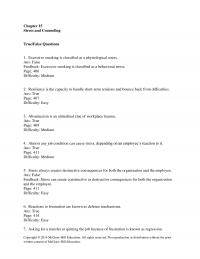
978-0078112829 Test Bank Chapter 15
Chapter 15 Stress and Counseling True/False Questions 1. Excessive smoking is classified as a physiological stress. Ans: False Feedback: Excessive smoking is classified as a behavioral stress. Page: 406 Difficulty: Medium 2. Resilience is the capacity to handle short-term tensions […]
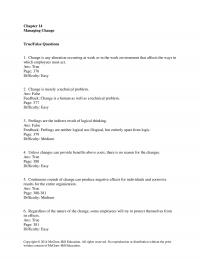
978-0078112829 Test Bank Chapter 14
Chapter 14 Managing Change True/False Questions 1. Change is any alteration occurring at work or in the work environment that affects the ways in which employees must act. Ans: True Page: 376 Difficulty: Easy 2. Change is merely a technical […]
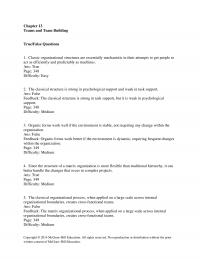
978-0078112829 Test Bank Chapter 13
Chapter 13 Teams and Team Building True/False Questions 1. Classic organizational structures are essentially mechanistic in their attempts to get people to act as efficiently and predictably as machines. Ans: True Page: 348 Difficulty: Easy 2. The classical structure is […]
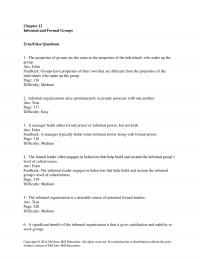
978-0078112829 Test Bank Chapter 12
Chapter 12 Informal and Formal Groups True/False Questions 1. The properties of groups are the same as the properties of the individuals who make up the group. Ans: False Feedback: Groups have properties of their own that are different from […]
978-0078112829 Test Bank Chapter 11
Chapter 11 Conflict, Power, and Organizational Politics True/False Questions 1. It is impossible for intrapersonal role conflict to emerge from within an individual. Ans: False Feedback: It is possible for intrapersonal role conflict to emerge from within an individual, as […]
978-0078112829 Test Bank Chapter 10
Chapter 10 Issues between Organizations and Individuals True/False Questions 1. If employees believe it is legitimate for managers to control the personal e-mails they send at work, they are unlikely to develop serious conflict with management about it. Ans: True […]
978-0078112829 Test Bank Chapter 9
Chapter 9 Employee Attitudes and Their Effects True/False Questions 1. The organizational costs associated with poor employee attitudes may severely reduce an organization’s competitiveness. Ans: True Page: 232 Difficulty: Easy 2. Job satisfaction is an affective attitude—a feeling of relative […]
978-0078112829 Test Bank Chapter 8
Chapter 8 Empowerment and Participation True/False Questions 1. Empowerment helps enhance employee feelings of self-efficacy. Ans: True Page: 206 Difficulty: Easy 2. Participative managers typically turn their management responsibilities over to empowered employees. Ans: False Feedback: Participative managers are not […]
978-0078112829 Test Bank Chapter 7
Chapter 7 Leadership True/False Questions 1. The primary role of a leader is to influence others to voluntarily seek defined objectives. Ans: True Page: 180 Difficulty: Easy 2. A person can be a weak leader and still be an effective […]
978-0078112829 Test Bank Chapter 6
Chapter 6 Appraising and Rewarding Performance True/False Questions 1. Base pay, performance rewards, and profit sharing are the incentive foundation of a complete pay program. Ans: True Page: 148 Difficulty: Easy 2. In the Herzberg model, pay is viewed primarily […]
978-0078112829 Test Bank Chapter 5
Chapter 5 Motivation True/False Questions 1. Motivation originates from within an individual. Ans: True Page: 116 Difficulty: Easy 2. High expectations sometimes make it difficult for achievement-oriented managers to delegate effectively. Ans: True Page: 118-119 Difficulty: Medium 3. People with […]
978-0078112829 Test Bank Chapter 4
Chapter 4 Social Systems and Organizational Culture True/False Questions 1. Cultures provide workers merely with indirect cues on how to succeed. Ans: False Feedback: Cultures provide workers with both direct and indirect cues on how to succeed. Page: 85 Difficulty: […]
978-0078112829 Test Bank Chapter 3
Chapter 3 Managing Communications True/False Questions 1. A back-and-forth conversation is always organized the same way as a formal report. Ans: False Feedback: Back-and-forth conversation usually is not organized the same way as a formal report. Page: 56 Difficulty: Easy […]
978-0078112829 Test Bank Chapter 2
Copyright © 2014 McGraw-Hill Education. All rights reserved. No reproduction or distribution without the prior written consent of McGraw-Hill Education. 1 Chapter 2 Models of Organizational Behavior True/False Questions 1. The philosophy of organizational behavior held by a manager stems […]