Archives: Quiz
ACCT 839 Midterm 1
1) Tracking price discounts by customer and by salesperson helps improve customer profitability. 2) As companies increase supply, the cost of producing an additional unit initially declines but eventually increases. Answer: TRUE 3) A cost function is a mathematical description […]
Acct 887 Midterm 2
1) Competence includes maintaining an appropriate level of professional expertise by continually developing knowledge and skills. 2) A refined costing system provides better measurement of the costs of indirect resources used by different cost objects, no matter how differently various […]
Accounting 134
1) A time driver is any factor that causes a change in the speed of an activity when the factor changes. 2) Companies that overcost products will most likely lose market share. Answer: TRUE 3) All cost functions are linear. […]
ACT 761
1) Activity-based costing analysis takes a long-run perspective and treats all activity costs as variable costs. 2) The objective of maximizing return on investment may induce managers of highly profitable divisions to reject projects that from the viewpoint of the […]
ACCT 553
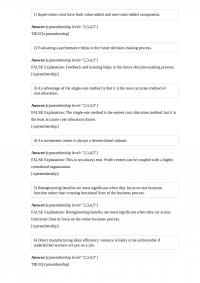
1) Supervision costs have both value-added and non-value-added components. 2) Evaluating a performance helps in the future decision-making process. Answer: FALSE Explanation: Feedback and learning helps in the future decision-making process. 3) An advantage of the single-rate method is that […]
ACC 510 Midterm 2
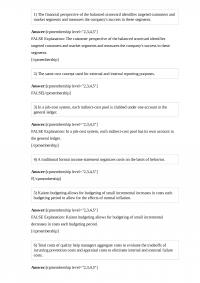
1) The financial perspective of the balanced scorecard identifies targeted customers and market segments and measures the company’s success in these segments. 2) The same cost concept used for external and internal reporting purposes. Answer: FALSE 3) In a job-cost […]
ACCT 786
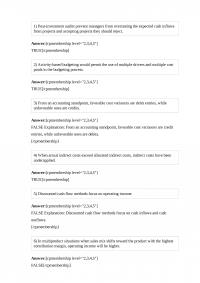
1) Post-investment audits prevent managers from overstating the expected cash inflows from projects and accepting projects they should reject. 2) Activity-based budgeting would permit the use of multiple drivers and multiple cost pools in the budgeting process. Answer: TRUE 3) […]
ACT 565
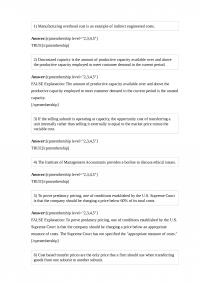
1) Manufacturing overhead cost is an example of indirect engineered costs. 2) Downsized capacity is the amount of productive capacity available over and above the productive capacity employed to meet customer demand in the current period. Answer: FALSE Explanation: The […]
ACCT 277 Test 2
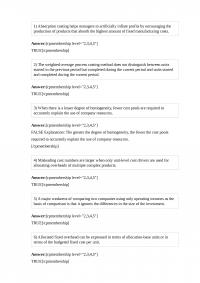
1) Absorption costing helps managers to artificially inflate profits by encouraging the production of products that absorb the highest amount of fixed manufacturing costs. 2) The weighted-average process costing method does not distinguish between units started in the previous period […]
Accounting 638 Quiz 3
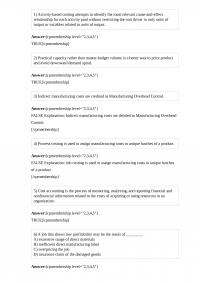
1) Activity-based costing attempts to identify the most relevant cause-and-effect relationship for each activity pool without restricting the cost driver to only units of output or variables related to units of output. 2) Practical capacity rather than master-budget volume is […]
Acct 224 Quiz
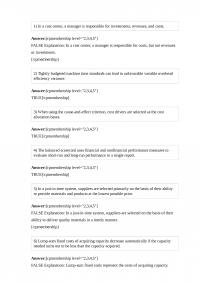
1) In a cost center, a manager is responsible for investments, revenues, and costs. 2) Tightly budgeted machine time standards can lead to unfavorable variable overhead efficiency variance. Answer: TRUE 3) When using the cause-and-effect criterion, cost drivers are selected […]
Acc 440
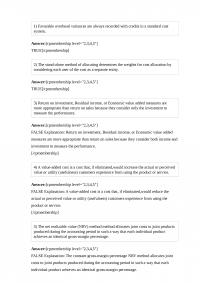
1) Favorable overhead variances are always recorded with credits in a standard cost system. 2) The stand-alone method of allocating determines the weights for cost allocation by considering each user of the cost as a separate entity. Answer: TRUE 3) […]
ACT 427 Homework
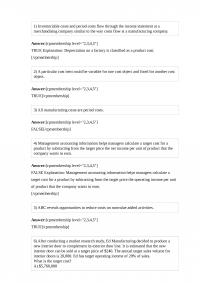
1) Inventoriable costs and period costs flow through the income statement at a merchandising company similar to the way costs flow at a manufacturing company. 2) A particular cost item could be variable for one cost object and fixed for […]
ACT 717 Test
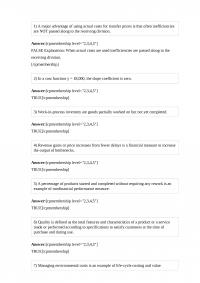
1) A major advantage of using actual costs for transfer prices is that often inefficiencies are NOT passed along to the receiving division. 2) In a cost function y = 18,000, the slope coefficient is zero. Answer: TRUE 3) Work-in-process […]
Acct 259
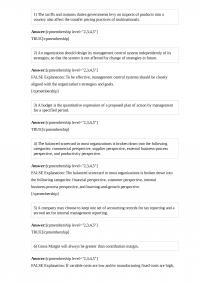
1) The tariffs and customs duties governments levy on imports of products into a country also affect the transfer pricing practices of multinationals. 2) An organization should design its management control system independently of its strategies, so that the system […]
Accounting 836
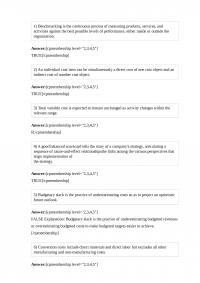
1) Benchmarking is the continuous process of measuring products, services, and activities against the best possible levels of performance, either inside or outside the organization. 2) An individual cost item can be simultaneously a direct cost of one cost object […]
Acct 589 Quiz 3
1) The two broad strategies that companies follow are cost leadership strategy and product differentiation strategy. 2) In a series of interdepartmental transfers, each department is regarded as separate and distinct for accounting purposes. Answer: TRUE 3) Management by exception […]
Acc 414 Test
1) The standard error of the estimated coefficient indicates how much the estimated value, b, is likely to be affected by random factors. 2) The single cost-allocation method makes no distinction between fixed and variable costs. Answer: TRUE 3) When […]
AC 250 Quiz 1
1) In markets with little or no competition, the key factor affecting price is the cost of production to the company. 2) One of the steps in planning is evaluating the performance and taking corrective measures. Answer: FALSE 3) The […]
SMG AC 118 Midterm 2
1) Companies operating in markets that are not competitive favor cost-based approaches. 2) Target cost per unit is arrived at by adding the target operating income to the target price of the product. Answer: FALSE Explanation: Target cost per unit […]
ACCT 809 Test 1
1) Management is primarily a human activity that should focus on encouraging individuals to do their jobs better. 2) As budgeting is not a cross-functional activity, it tends to be accurate and reliable with regard to forecasts. Answer: FALSE Explanation: […]
AC 205 Quiz 1
1) When the operating budget is used as a control device, managers are less likely to be motivated to budget higher sales than actually anticipated. 2) Bottom-up budgets entrusts senior managers to prepare budgets and lower-level managers to execute them. […]
SMG AC 895 Test
1) Using net book value as an investment base will result in a lower ROI than using gross book value as an investment base. 2) Management accountants help managers identify what information is relevant and what information is irrelevant that […]
Acc 537 Midterm 1
1) Companies implementing kaizen budgeting believe that employees who actually do the job have the best knowledge of how the job can be done better. 2) Proration is the spreading of underallocated or overallocated overhead among ending work in process, […]
ACCT 250 Test 2
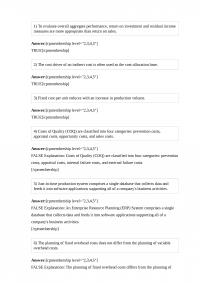
1) To evaluate overall aggregate performance, return on investment and residual income measures are more appropriate than return on sales. 2) The cost driver of an indirect cost is often used as the cost-allocation base. Answer: TRUE 3) Fixed cost […]
Accounting 672
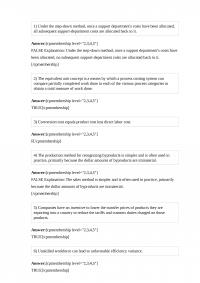
1) Under the step-down method, once a support department’s costs have been allocated, all subsequent support-department costs are allocated back to it. 2) The equivalent unit concept is a means by which a process costing system can compare partially completed […]
MET MG 128 Quiz 3
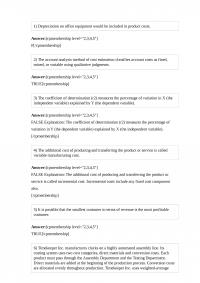
1) Depreciation on office equipment would be included in product costs. 2) The account analysis method of cost estimation classifies account costs as fixed, mixed, or variable using qualitative judgments. Answer: TRUE 3) The coefficient of determination (r2) measures the […]
Acc 460 Test 1
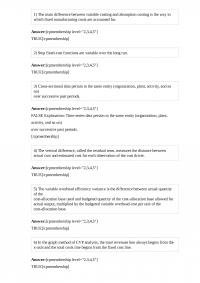
1) The main difference between variable costing and absorption costing is the way in which fixed manufacturing costs are accounted for. 2) Step fixed-cost functions are variable over the long run. Answer: TRUE 3) Cross-sectional data pertain to the same […]
ACC 305
1) ABC systems and department costing systems use totally different approaches towards indirect cost allocation and can never be used together. 2) A performance report compares actual performance to the amount budgeted. Answer: TRUE 3) Managers cannot use human resource […]
ACT 539
1) It is appropriate to incorporate expected learning-curve efficiencies when evaluating performance. 2) An organization which uses product differentiation strategy will charge higher prices. Answer: TRUE 3) After a budget is agreed upon and finalized by the management team, the […]
Acc 155 Homework
1) Implementing activity-based costing system involves use of different cost rates for different activities to compute indirect costs of a product. 2) Fixed costs for the period are by definition a lump sum of costs that remain unchanged and therefore […]
MET MG 580
1) With the use of a bar chart, the number of “unprofitable” customers and the magnitude of their losses are apparent. 2) Direct manufacturing labor includes plant rent and salaries paid to plant supervisors. Answer: FALSE 3) The last step […]
ACCT 255 Midterm
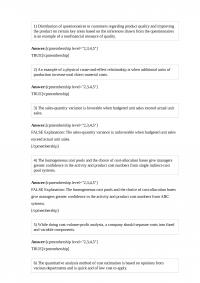
1) Distribution of questionnaires to customers regarding product quality and improving the product on certain key areas based on the inferences drawn from the questionnaires is an example of a nonfinancial measure of quality. 2) An example of a physical […]
Acct 544 Midterm
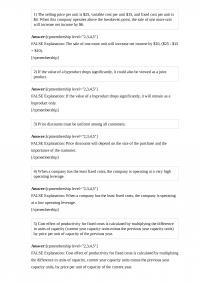
1) The selling price per unit is $25, variable cost per unit $15, and fixed cost per unit is $4. When this company operates above the breakeven point, the sale of one more unit will increase net income by $6. […]
MET MG 362
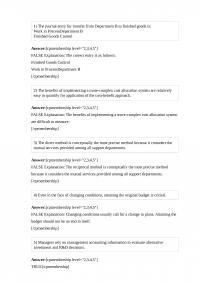
1) The journal entry for transfer from Department B to finished goods is: Work in ProcessDepartment B Finished Goods Control 2) The benefits of implementing a more-complex cost allocation system are relatively easy to quantify for application of the cost-benefit […]
Accounting 480 Homework
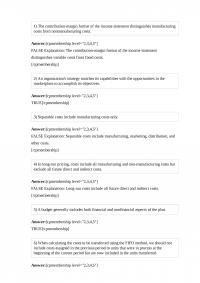
1) The contribution-margin format of the income statement distinguishes manufacturing costs from nonmanufacturing costs. 2) An organization’s strategy matches its capabilities with the opportunities in the marketplace to accomplish its objectives. Answer: TRUE 3) Separable costs include manufacturing costs only. […]
ACC 501 Test
1) The opportunity cost of the stockout includes lost contribution margin on the sale not made plus any contribution margin lost on future sales due to customer ill will. 2) Cost of quality financial measures will usually deteriorate when nonfinancial […]
SMG AC 843 Midterm 2
1) IMA’s overarching ethical principles include: Honesty, Fairness, Objectivity, and Responsibility. 2) The key to a company’s success is creating value for customers while differentiating itself from its competitors. Answer: TRUE 3) Companies operating in competitive markets should ideally use […]
Acct 807 Homework
1) The production method for recognizing byproducts reduces the cost of manufacturing the main or joint products in the income statement. 2) All costs other than direct materials and direct manufacturing labor are classified as indirect costs. Answer: TRUE 3) […]
Acc 213 Homework 1 If the
1) If the production planners set the budgeted machine hours standards too tight, one could anticipate there would be a favorable variable overhead efficiency variance. 2) Possible reasons for the larger actual materials-handling labor-hours per batch include the possibility of […]
SMG AC 215
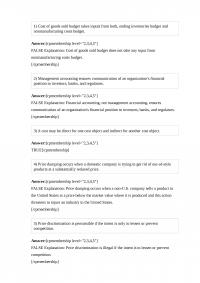
1) Cost of goods sold budget takes inputs from both, ending inventories budget and nonmanufacturing costs budget. 2) Management accounting ensures communication of an organization’s financial position to investors, banks, and regulators. Answer: FALSE Explanation: Financial accounting, not management accounting, […]
ACT 444 Test 2
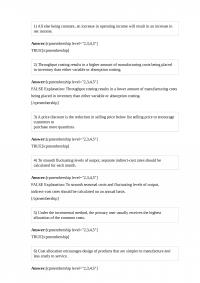
1) All else being constant, an increase in operating income will result in an increase in net income. 2) Throughput costing results in a higher amount of manufacturing costs being placed in inventory than either variable or absorption costing. Answer: […]
SMG AC 847 Test
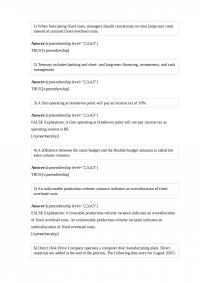
1) When forecasting fixed costs, managers should concentrate on total lump-sum costs instead of unitized fixed overhead costs. 2) Treasury includes banking and short- and long-term financing, investments, and cash management. Answer: TRUE 3) A firm operating at breakeven point […]
Accounting 614 Midterm 1
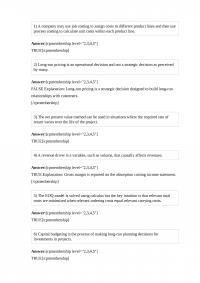
1) A company may use job costing to assign costs to different product lines and then use process costing to calculate unit costs within each product line. 2) Long-run pricing is an operational decision and not a strategic decision as […]
MET MG 846 Quiz
1) When a company has no opening or ending inventory during the month, the cost per unit is calculated by dividing the total costs incurred in the period by the total units produced during the period. 2) Activity-based budgeting provides […]
SMG AC 741 Quiz
1) The cost-allocation base is a systematic way to link an indirect cost or group of indirect costs to cost objects. 2) A cost driver is a variable, such as the level of activity or volume that causally affects costs […]
AC 202
1) An efficient management accounting system traces direct costs and allocates indirect costs to products. 2) Absorption costing enables managers to increase operating income by increasing the unit level of sales, as well as by producing more units. Answer: TRUE […]
ACC 349 Test 1
1) When actual cost-allocation rates are used, managers of the supplier division are motivated to improve efficiency. 2) Activity -based costing plays a more significant role in job costing as compared to process costing as companies using process costing have […]
SMG AC 298
1) The revenues budget is prepared after all other operating budgets are prepared. 2) Indirect labor and distribution costs would most likely be in the same activity-cost pool. Answer: FALSE Explanation: Indirect labor and distribution costs would not be in […]
ACCT 847 Quiz 3
1) The classification of costs as variable and fixed depends on the relevant range, the length of the time horizon, and the specific decision situation. 2) To determine outputs at each stage of production, MRP uses a bill of materials […]