1) Cost of goods sold budget takes inputs from both, ending inventories budget and
nonmanufacturing costs budget.
2) Management accounting ensures communication of an organization’s financial
position to investors, banks, and regulators.
3) A cost may be direct for one cost object and indirect for another cost object.
4) Price dumping occurs when a domestic company is trying to get rid of out-of-style
products at a substantially reduced price.
5) Price discrimination is permissible if the intent is only to lessen or prevent
competition.
6) Practical capacity is unattainable in the real world.
7) Insurance companies provide services or intangible products to their customers.
8) Under the cause and effect criterion, reasonableness is a matter of judgment rather
than an operational
criterion.
9) One of the reasons to allocate joint costs to individual products is to aid in the
preparation of tax returns.
10) Absorption-costing income statements do not need to differentiate between variable
and fixed costs.
11) The use of an accelerated method of depreciation for tax purposes would usually
decrease the present value of the investment.
12) For companies in which full allocation is not followed, corporate sustaining costs
are ________.
A) allocated to divisions using cause-and-effect relationship
B) allocated to customers using cause-and-effect relationship
C) added to aggregate operating incomes of the divisions
D) subtracted as a lump-sum amount after aggregating operating incomes of the
divisions
13) Which of the following is a performance measure?
A) retained earnings
B) market value
C) present value of cash flows
D) economic value added
14) The Mill Flow Company has two divisions. The Cutting Division prepares timber at
its sawmills. The Coating Division prepares the cut lumber into finished wood for the
furniture industry. No inventories exist in either division at the beginning of 20X5.
During the year, the Cutting Division prepared 60,000 cords of wood at a cost of
$660,000. All the lumber was transferred to the Coating Division, where additional
operating costs of $5 per cord were incurred. The 600,000 boardfeet of finished wood
were sold for $2,500,000.
Required:
a.Determine the operating income for each division if the transfer price from Cutting to
Coating is at cost – $11 a cord.
b.Determine the operating income for each division if the transfer price is $9 per cord.
c.Since the Cutting Division sells all of its wood internally to the Coating Division,
does the manager care what price is selected? Why? Should the Cutting Division be a
cost center or a profit center under the circumstances?
15) The primary user of financial accounting information is a ________.
A) factory shift supervisor
B) distribution manager
C) current shareholder
D) department manager
16) Presented below are the production data for the first six months of the year for the
mixed costs incurred by Vertise Company.
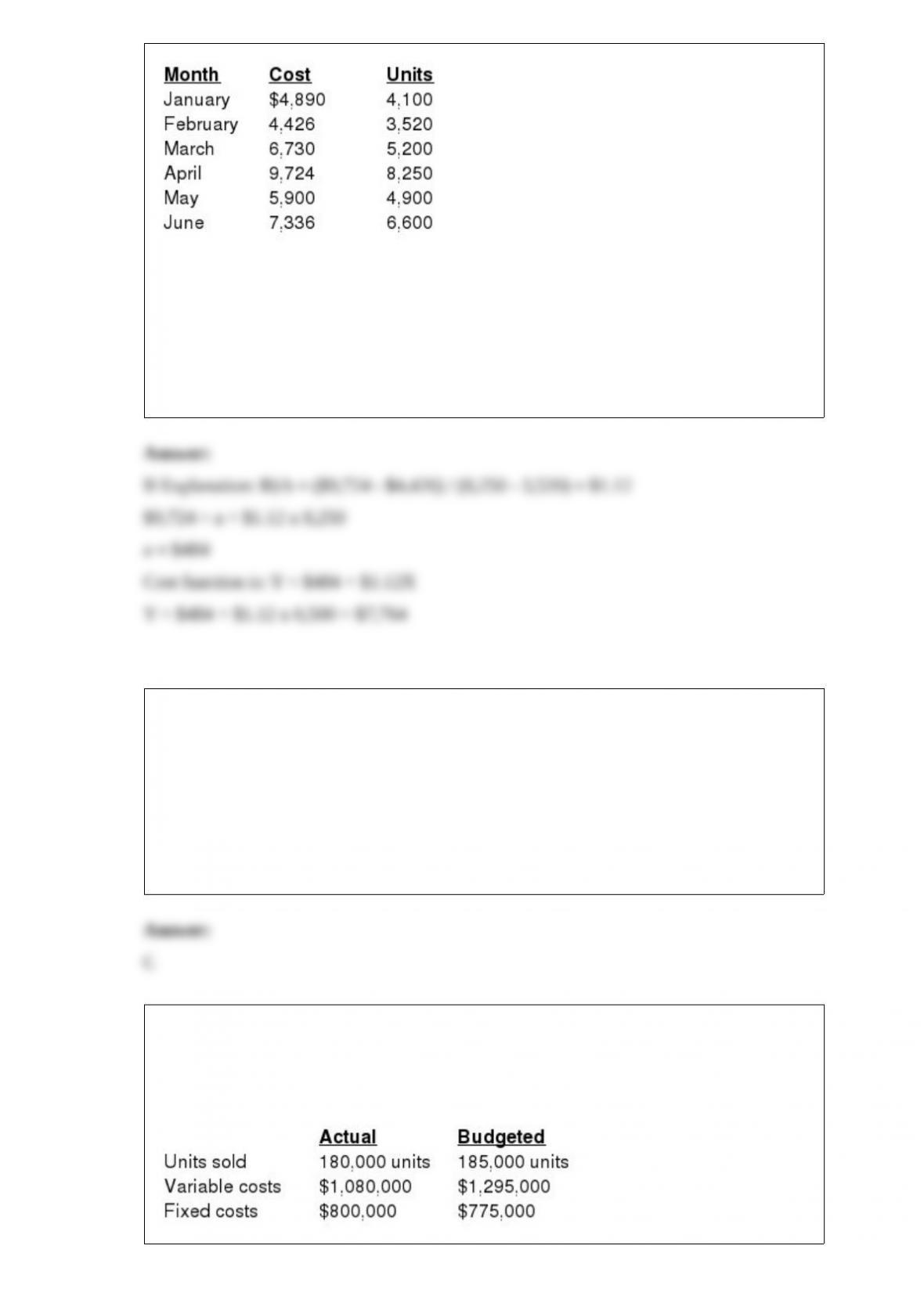
Vertise Company uses the high-low method to analyze mixed costs.
What is the estimated total cost at an operating level of 6,500 units?
A) $7,752.44
B) $7,764.00
C) $7,280.00
D) $7,661.33
17) Ventaz Corp has a variable demand. Historically, its demand has ranged from 30 to
50 windows per day with an average of 40. Alex works eight hours a day, five days a
week. Each order is one window and each window takes 11 minutes.
What is the average waiting time in minutes?
A) 12.00
B) 55.50
C) 60.50
D) 20.00
18) Contrafic Corporation used the following data to evaluate its current operating
system. The company sells items for $21 each and used a budgeted selling price of $21
per unit.
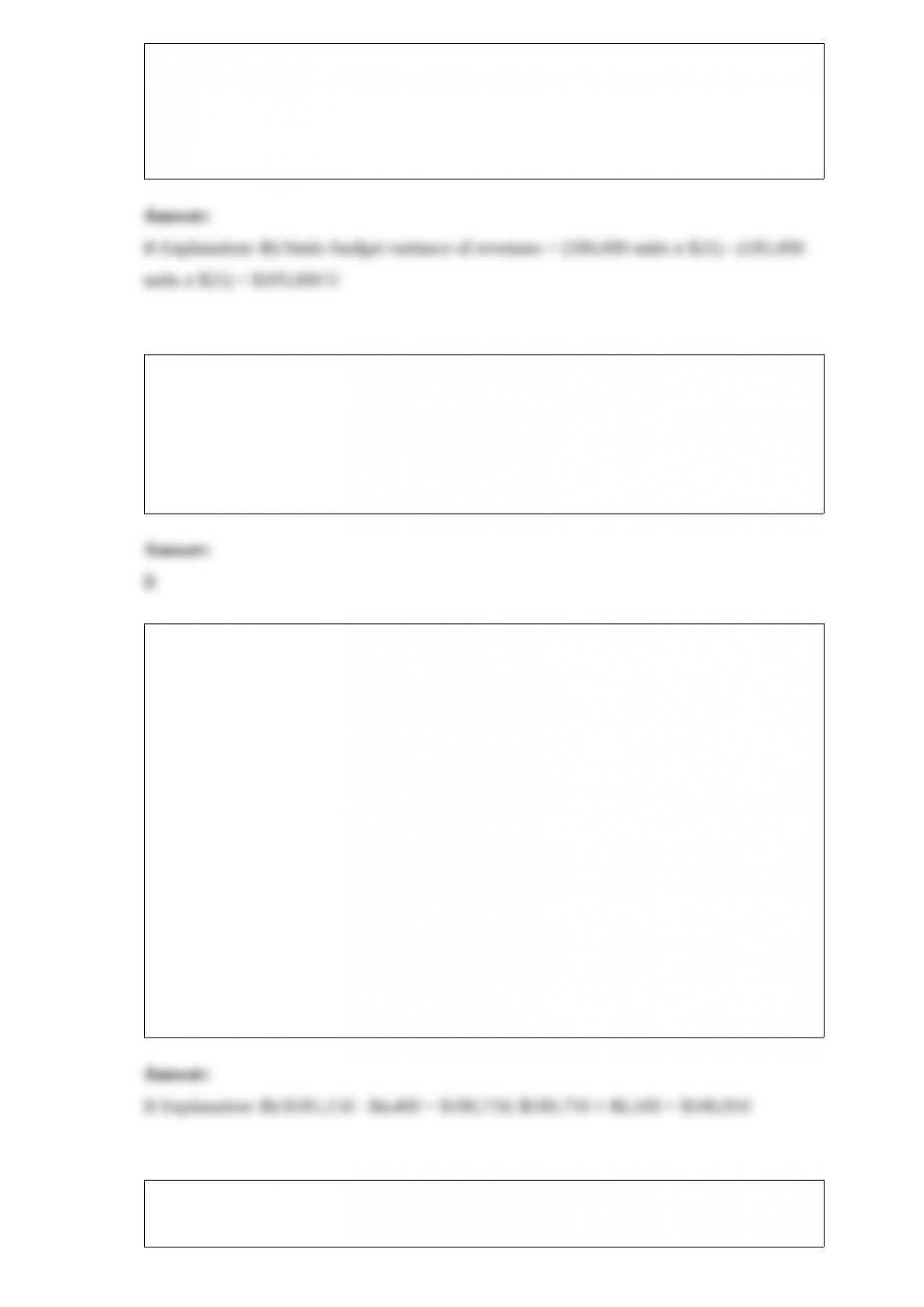
What is the static-budget variance of revenues?
A) $105,000 favorable
B) $105,000 unfavorable
C) $8,000 favorable
D) $8,000 unfavorable
19) A regional manager of a restaurant chain in charge of finding additional locations
for expansion is most likely responsible for a(n) ________.
A) revenue center
B) investment center
C) cost center
D) profit center
20) Genent Company manufactures tires. Some of the company’s data was misplaced.
Use the following information to replace the lost data:
Actual Results Flexible Budget Variances Flexible Budget Sales-Volume Variances
Static Budget
Units sold 495,000 495,000 453,750
Revenues $185,150 $4,400 F (A) $6,160 U (B)
Variable costs (C) $880 U $69,780 $10,300 F $88,080
Fixed costs $36,430 $3,770 F $40,200 0 $40,200
Operating income $78,060 (D) $70,770 (E) $66,630
What amounts are reported for revenues in the flexible-budget (A) and the static-budget
(B), respectively?
A) $164,320; $178,990
B) $180,750; $186,910
C) $185,150; $177,920
D) $178,990; $186,910
21) Which of the following is true of reverse engineering?
A) It is the process of building a new product by first determining the selling price of
the product.
B) It is the process by which a company analyzes its own process to reduce cost.
C) It is the process by which a company markets a product by analyzing competitors
marketing strategy.
D) It is the process by which the competitor’s products are disassembled and analyzed.
22) In April direct labor was 70% of conversion cost. If the manufacturing overhead for
the month was $42,000 and the direct materials cost was $28,000, the direct labor cost
was:
A) $98,000
B) $65,333
C) $18,000
D) $12,000
23) Golden Generator Supply is approached by Mr. Stephen, a new customer, to fulfill a
large one-time-only special order for a product similar to one offered to regular
customers. Golden Generator Supply has excess capacity. The following per unit data
apply for sales to regular customers:
For Golden Generator Supply, what is the minimum acceptable price of this
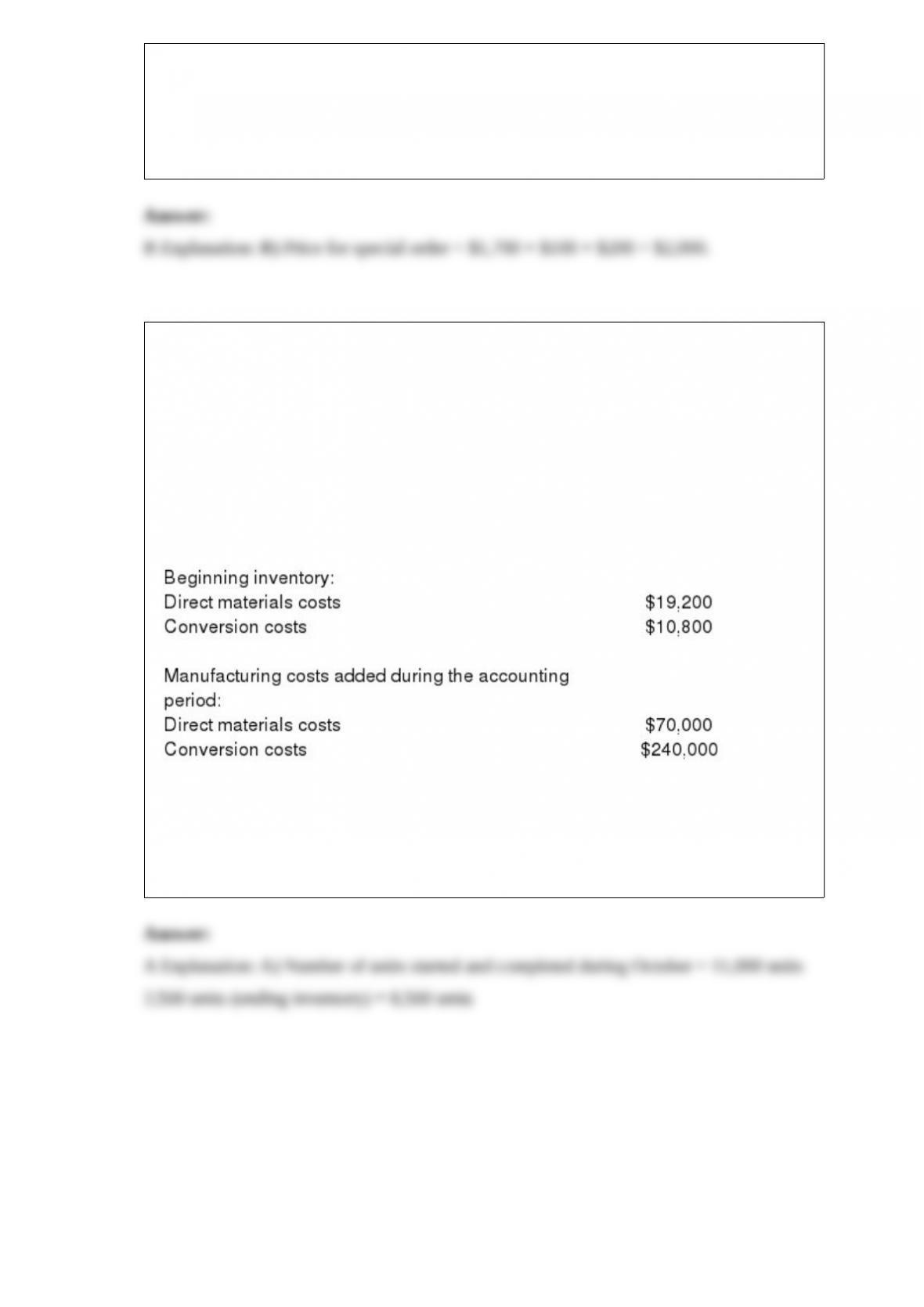
one-time-only special order?
A) $1,800
B) $2,000
C) $2,150
D) $2,580
24) Jane Industries manufactures plastic toys. During October, Jane’s Fabrication
Department started work on 10,000 models. During the month, the company completed
11,000 models, and transferred them to the Distribution Department. The company
ended the month with 1,500 models in ending inventory. There were 2,500 models in
beginning inventory. All direct materials costs are added at the beginning of the
production cycle and conversion costs are added uniformly throughout the production
process. The FIFO method of process costing is being followed. Beginning work in
process was 25% complete as to conversion costs, while ending work in process was
50% complete as to conversion costs.
What is the cost assigned to ending inventory during October?
A) $26,678
B) $31,536
C) $36,000
D) $38,000
25) Which of the following is true about designing an accounting-based performance
measure?
A) The decisions made in steps are followed in a hierarchial order.
B) The issues considered in each step are independent.
C) Management’s beliefs are not required during the analyses.
D) Behavioral criteria are important when evaluating the steps.
26) Judith Vending Company has invested $800,000 in a plant to make vending
machines. The target operating income desired from the plant is $120,000 annually. The
company plans annual sales of 1,200 vending machines at a selling price of $1,000
each.
What is the target rate of return on investment for Judith Vending Company?
A) 18.0%
B) 15.0%
C) 14.0%
D) 66.7%
27) A job-cost sheet details the ________.
A) direct materials purchased and paid
B) direct labor costs incurred
C) indirect labor costs incurred
D) actual indirect overhead costs incurred
28) In making product mix and pricing decisions, managers should focus on ________.
A) total costs
B) unit costs
C) variable costs
D) manufacturing costs
29) Which of the following capital budgeting methods uses discounted cash flows?
A) accrual accounting rate-of-return method
B) net present value method
C) projected income method
D) payback method
30) When companies do not want to use market prices or find it too costly, they
typically use ________ prices, even though suboptimal decisions may occur.
A) average-cost
B) full-cost
C) long-run cost
D) short-run average cost
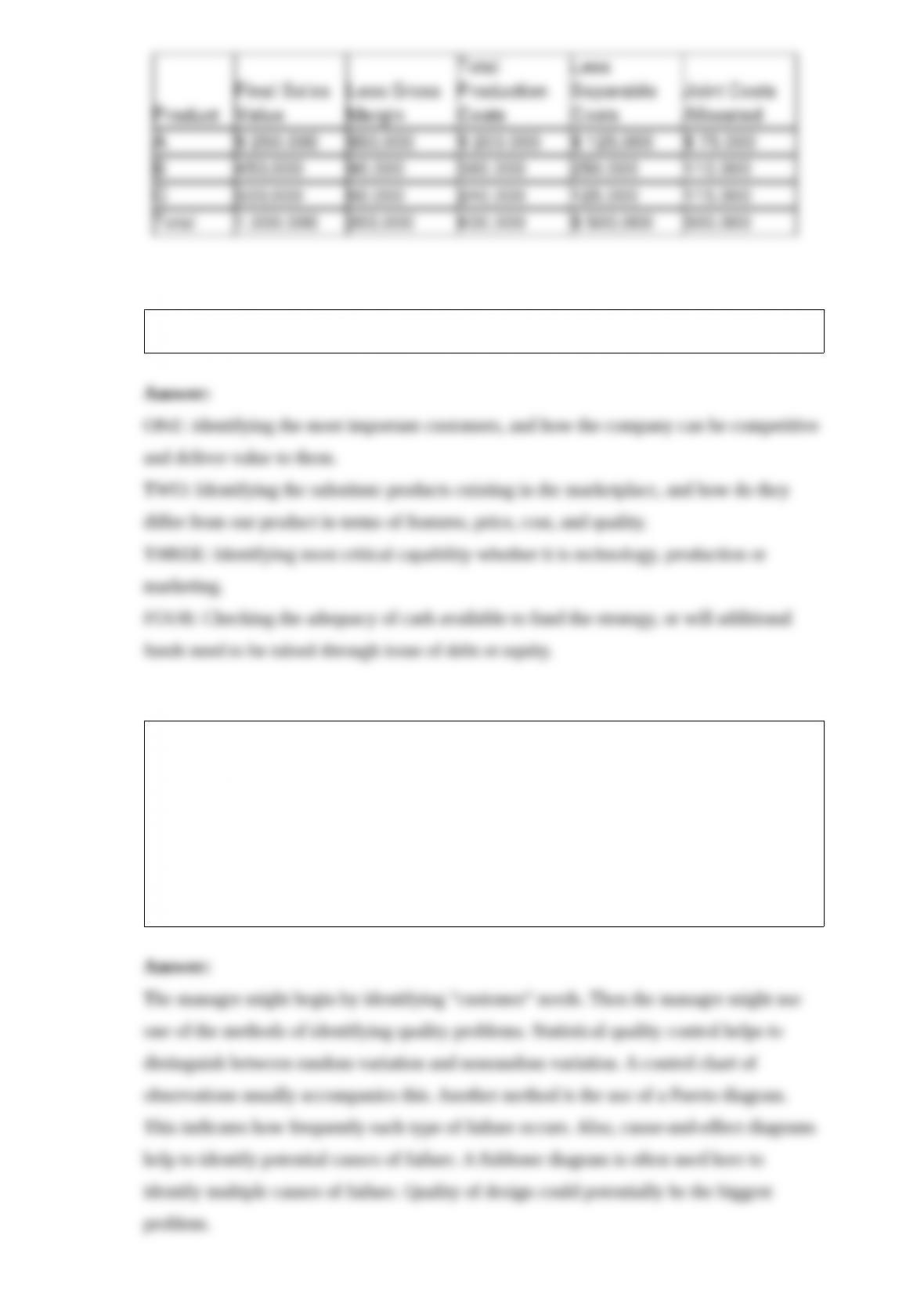
31) Calamata Corporation processes a single material into three separate products A, B,
and C. During September, the joint costs of processing were $300,000. Production and
sales value information for the month were as follows:
Required:
Determine the amount of joint cost allocated to each product if the constant
gross-margin percentage NRV method is used.
32) Briefly describe the list of items that managers undertake to formulate strategies.
33) Baby Care Products has just completed a very successful program of improving
quality in its manufacturing operations. The next step is to improve the operations of its
administrative functions, starting with the accounting information system. As the
manager of the accounting operations, you are requested to begin a quality
improvement program.
Required:
What are some possibilities of finding out about the current status of quality in the
accounting system?
34) Roger Moon has just purchased the film studio of a movie company that specializes
in comedies. He found that the company did not try to estimate the cost of making a
movie. Instead, it just gave the producer a budget and told him/her to make a movie
within budget. Mr. Moon does not like the former movie-budget concept and desires to
establish a formal cost estimation system.
Required:
What are some of the potential problems that may be encountered in changing from a
budget to a cost estimation movie making system?
35) How is inflation related to capital budgeting? Discuss.
36) What is a supply chain, and what are the benefits of a supply chain analysis?
Provide an example of these benefits.