1) All else being constant, an increase in operating income will result in an increase in
net income.
2) Throughput costing results in a higher amount of manufacturing costs being placed
in inventory than either variable or absorption costing.
3) A price discount is the reduction in selling price below list selling price to encourage
customers to
purchase more quantities.
4) To smooth fluctuating levels of output, separate indirect-cost rates should be
calculated for each month.
5) Under the incremental method, the primary user usually receives the highest
allocation of the common costs.
6) Cost allocation encourages design of products that are simpler to manufacture and
less costly to service.
7) If a company increases fixed costs, then the breakeven point will be lower.
8) Which of the following is a component of net-initial-investment cash flows?
A) original cost of an old equipment
B) cash outflow to purchase a new equipment
C) depreciation cost
D) after-tax cash flow from operations
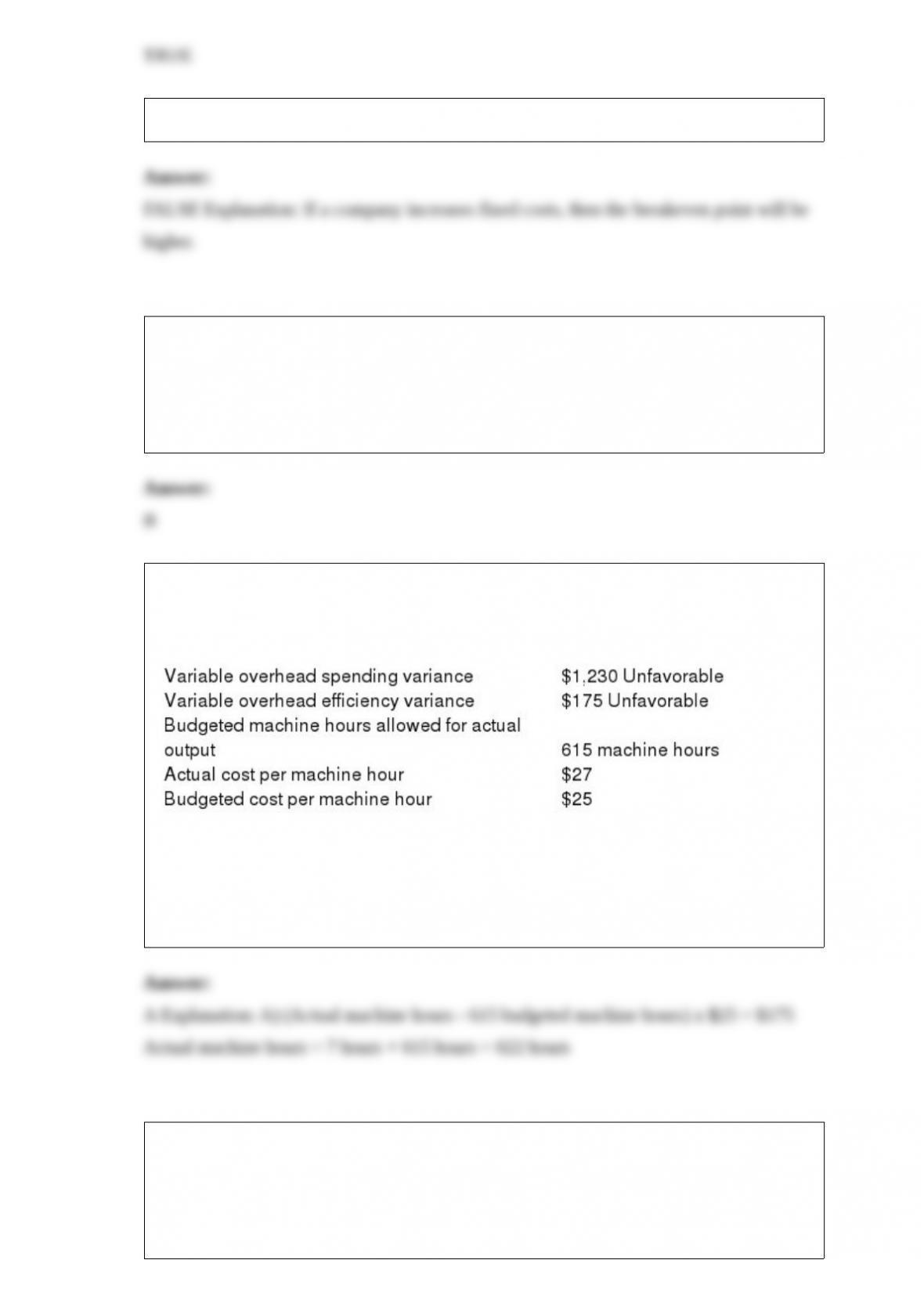
9) Ecocomfort Corporation manufactured 1,000 coolers during October. The following
variable overhead data relates to October:
Calculate the actual machine hours used by Stark during October.
A) 622 hours
B) 615 hours
C) 608 hours
D) 620 hours
10) Manufacturing overhead costs are also referred to as ________.
A) indirect manufacturing costs
B) prime costs
C) direct manufacturing costs
D) direct material
11) Managers usually use the return on investment to evaluate ________.
A) the performance of a subdivision
B) the accounting principles followed
C) the size of the investment
D) the balance of working capital
12) To discourage producing for inventory, management can ________.
A) discourage using nonfinancial measures such as units in ending inventory compared
to units in sales
B) evaluate performance over a quarterly period rather than a single year
C) incorporate a carrying charge for inventory in the internal accounting system
D) implement absorption costing across all departments
13) A company has a policy “investigate all variances exceeding $3,000 or 15% of the
budgeted cost, whichever is lower.” There is a variance of $2,000 in repair and
maintenance costs of $12,000. What does the company do in the given situation?
A) It should be ignored as it is less than $3,000.
B) It deserves more attention as it is more than 15% of total repair cost.
C) It should be considered an in-control occurrence.
D) It should be investigated as all variances are equally important.
14) In performance evaluations ________.
A) managers should use the swap exchange rate prevailing at the end of a financial
period
B) managers should use the average exchange rate prevailing at the end of a financial
period
C) managers should use the exchange rate prevailing on the date the assets were
acquired
D) managers should use the exchange rate prevailing at the end of a financial period
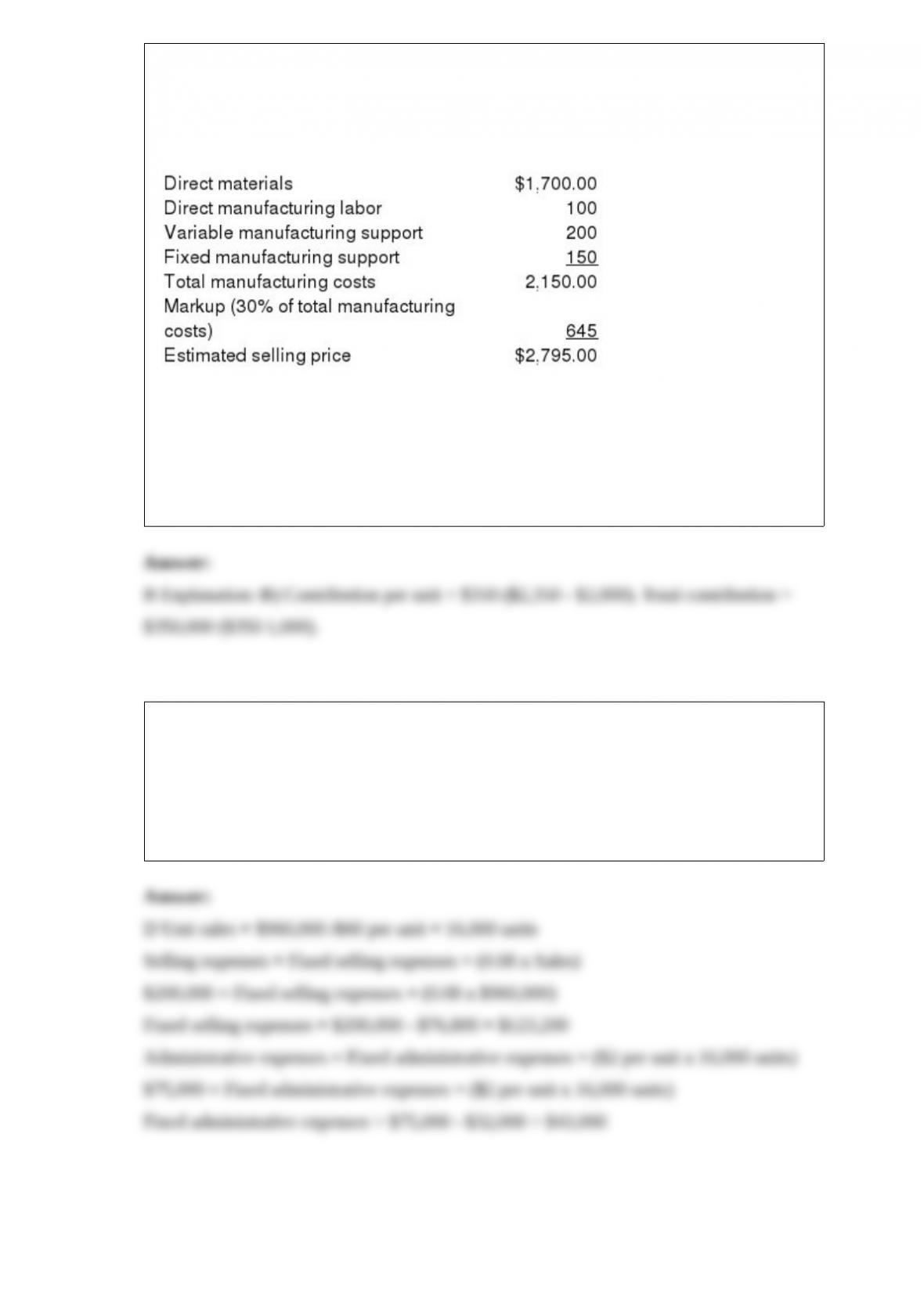
15) Golden Generator Supply is approached by Mr. Stephen, a new customer, to fulfill a
large one-time-only special order for a product similar to one offered to regular
customers. Golden Generator Supply has excess capacity. The following per unit data
apply for sales to regular customers:
If Golden Generator Supply accepts the order at $2,350, what is the amount contributed
towards fixed costs and profit on a sales order of 1,000 units?
A) $200,000
B) $350,000
C) $795,000
D) $1,000,000
16) Bee Company’s net operating income for the second quarter using the contribution
approach is:
A) $156,200
B) $685,000
C) $431,200
D) $265,000
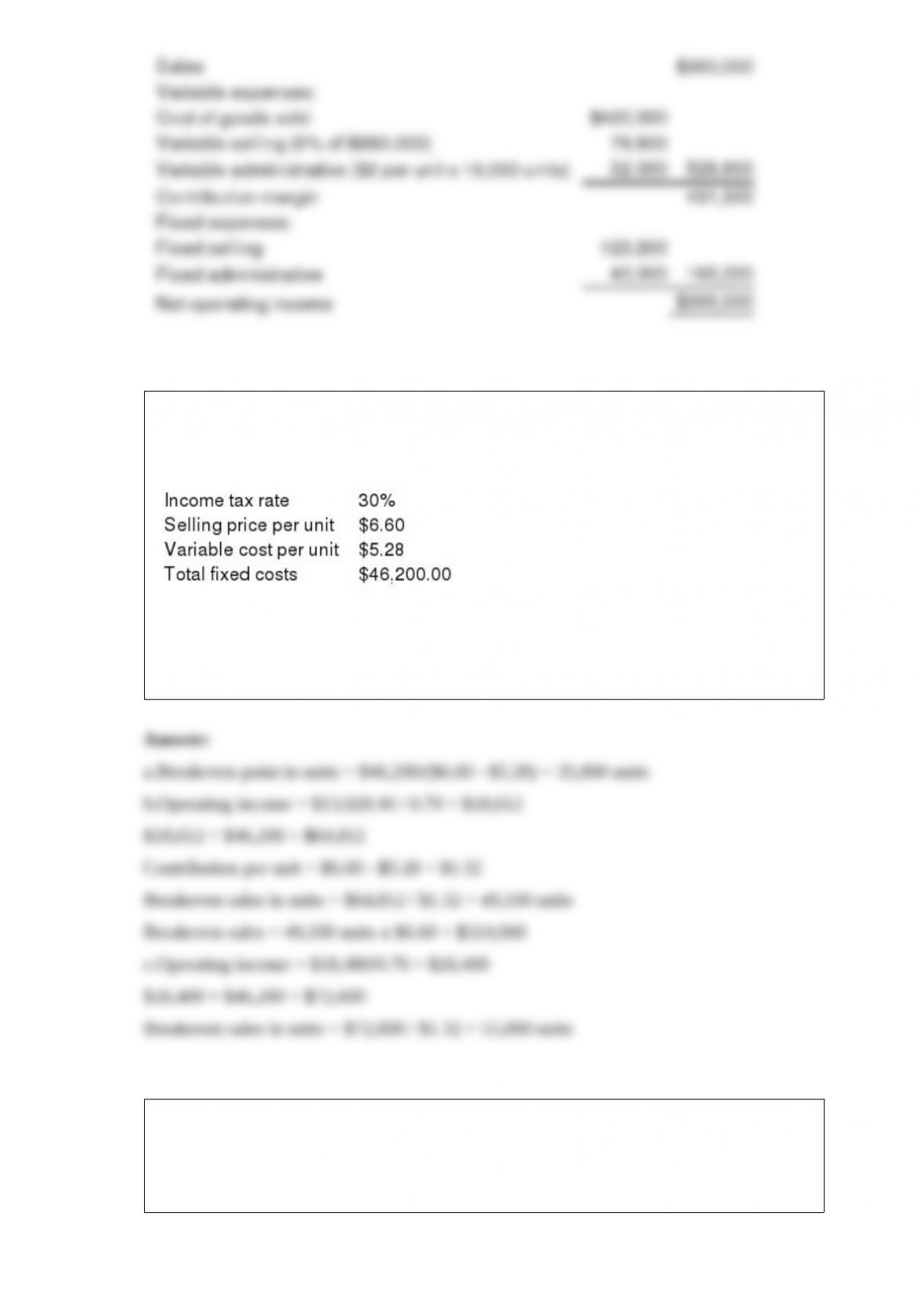
17) The Holiday Card Company, a producer of specialty cards, has asked you to
complete several calculations based upon the following information:
Required:
a.What is the breakeven point in cards?
b.What sales volume is needed to earn an after-tax net income of $13,028.40?
c.How many cards must be sold to earn an after-tax net income of $18,480?
18) Russo Corporation manufactured 16,000 air conditioners during November. The
overhead cost-allocation base is $31.50 per machine-hour. The following variable
overhead data pertain to November:
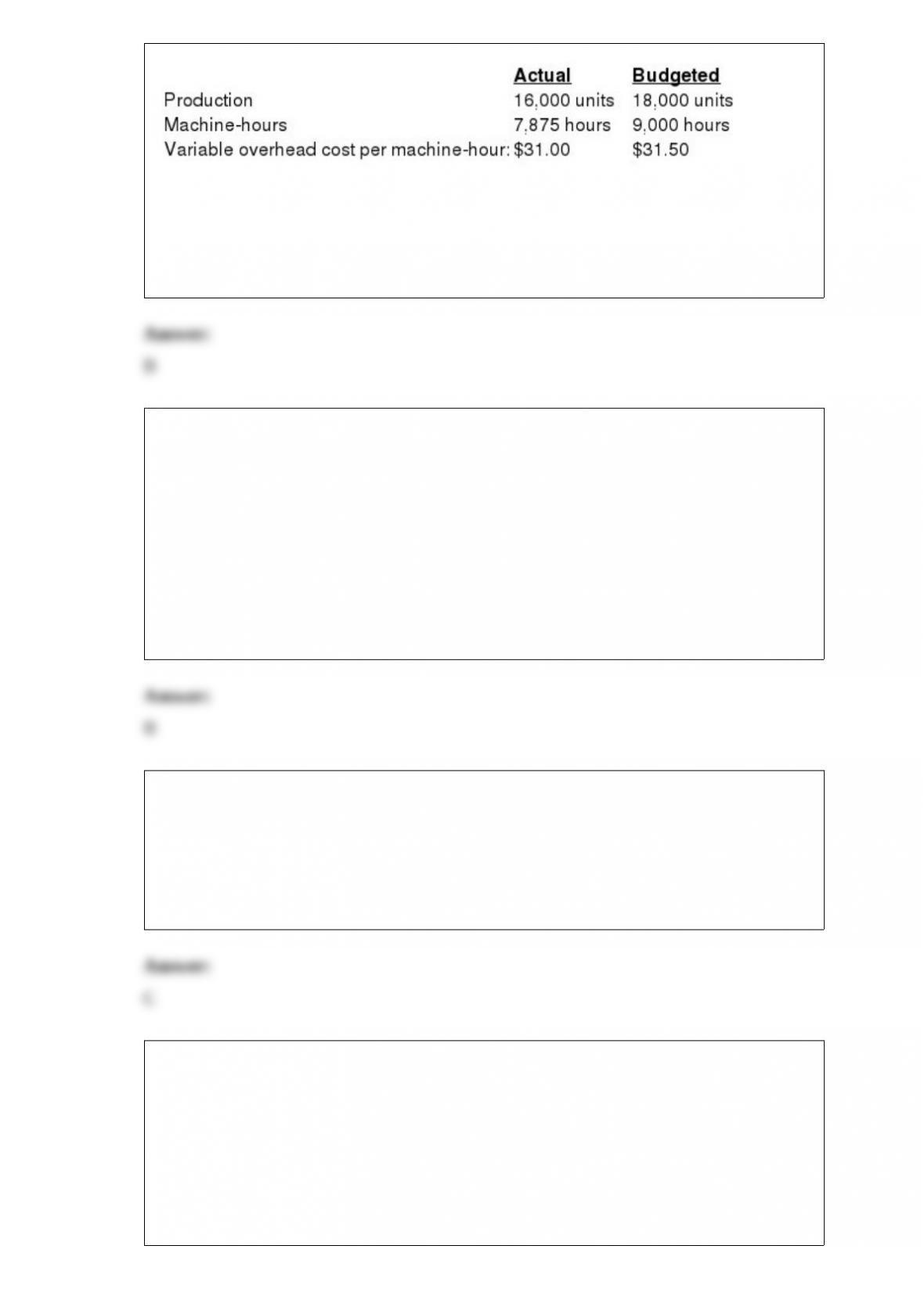
What is the flexible-budget amount?
A) $248,033
B) $252,000
C) $248,000
D) $279,000
19) Which of the following is a reason that has accelerated the demand for refinements
to the costing system?
A) The declining demand for customized products has led managers to decrease the
variety of products and services their companies offer.
B) The use of product and process technology has led to an increase in indirect costs
and a decrease in direct costs.
C) The increased of automated processes has led to the increase in direct manufacturing
cost leading to a decrease in breakeven point.
D) The increasing competition in product markets has led to an increase in contribution
margin resulting in a decrease of breakeven point.
20) Which one of the following activities would most likely be considered a long-run
pricing decision?
A) one-time-only special order pricing
B) product mix adjustments in a competitive market
C) setting prices to generate a reasonable rate of return on investment
D) changing prices in response to weak demand
21) Which of the following is true of long-run pricing?
A) It is fixed at a level that recovers the variable cost of the company and a
pre-determined profit markup.
B) It is generally a function of the market factors and the cost involved in production is
generally not a consideration.
C) It is a strategic decision designed to build long-run relationships with customers
based on stable and predictable prices.
D) It is based only on internal requirements like cost and estimated rate of return as in
the long run these requirements are the driving factors of any organization.
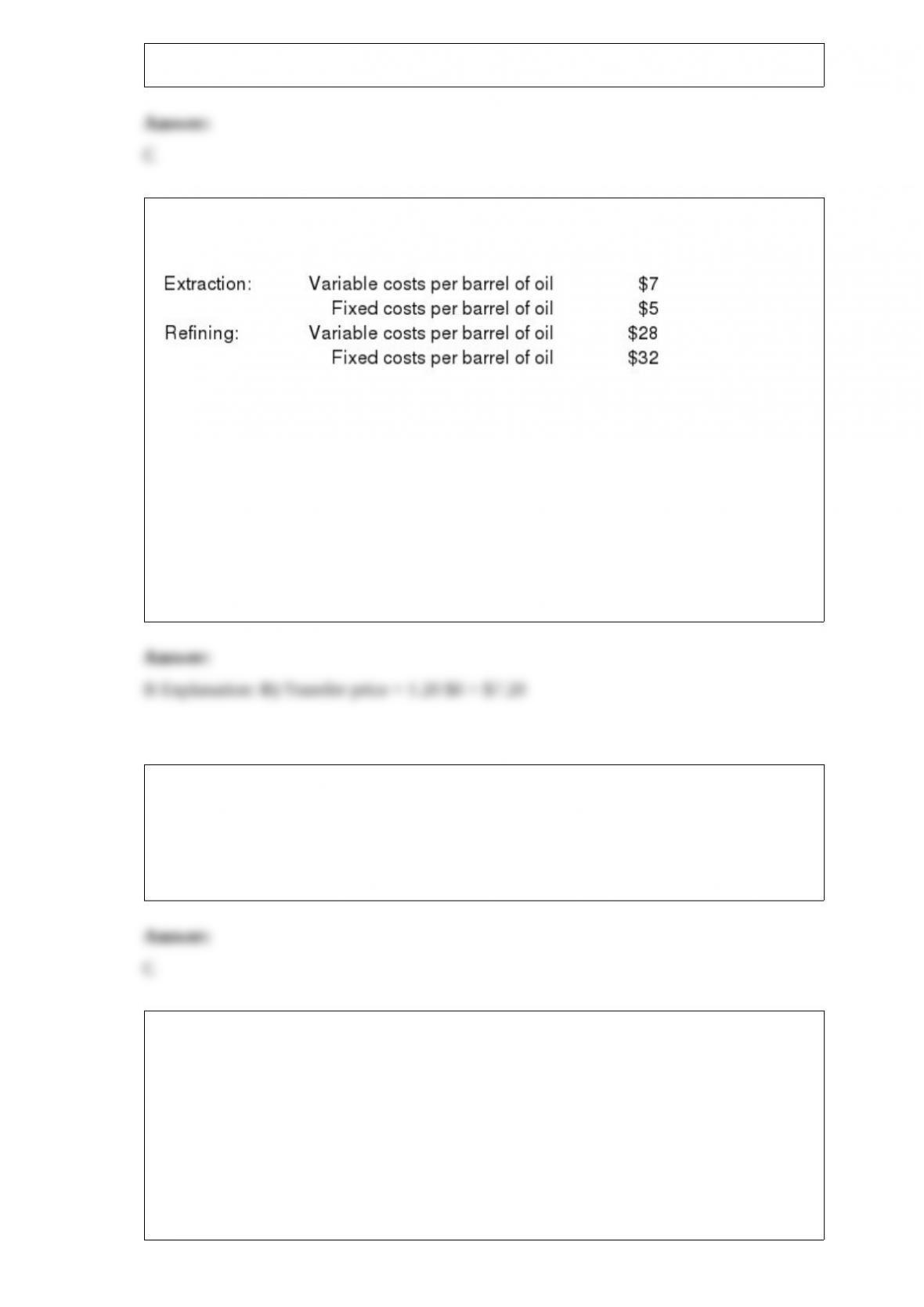
22) Axelia Corporation has two divisions, Refining and Extraction. The company’s
primary product is Luboil Oil. Each division’s costs are provided below:
The Refining Division has been operating at a capacity of 40,000 barrels a day and
usually purchases 25,000 barrels of oil from the Extraction Division and 15,000 barrels
from other suppliers at $60 per barrel.
What is the transfer price per watch from the Manufacturing Division to the
Distribution Division, assuming the method used to place a value on each transfer is
120% of full costs?
A) $6.00
B) $7.20
C) $9.00
D) $11.00
23) The focus of joint costing is on allocating costs to individual products ________.
A) before the splitoff point
B) after the splitoff point
C) at the splitoff point
D) at the end of production
24) Value chain and classification of costs, car company.
General Motors incurs the following costs:
a. Electricity costs for the plant assembling the Chevrolet Camaro
b. Transportation costs for shipping the Camaro to dealers
c. Payment to Shelby Designs for the design of the Camaro.
d. Salary of an engineer working on the next generation of Camaros
e. Cost of GM employees’ visit to an auto show to demonstrate the Camaro
f. Testing the Camaro at the GM track
g. Payment to television network for running Camaro advertisements
h. Cost of brake pads purchased from outside supplier to be installed on the Camaro
Required:
Classify each of the cost items (a-h) into one of the business functions of the value
chain.
1. Research and development
2. Design of products and processes
3. Production
4. Marketing and sales
5. Distribution
6. Customer service
25) Explain three methods under absorption costing that managers can use to improve
operating income.
26) Complete a performance report for the month of May, 2014, for Times Corp, a
regional newspaper showing four columns: 1) Actual Result; 2) Budgeted Amount; 3)
Difference: Actual Result minus Budgeted Amount; 4) Difference as a Percentage of
Budgeted Amount, given the following data:
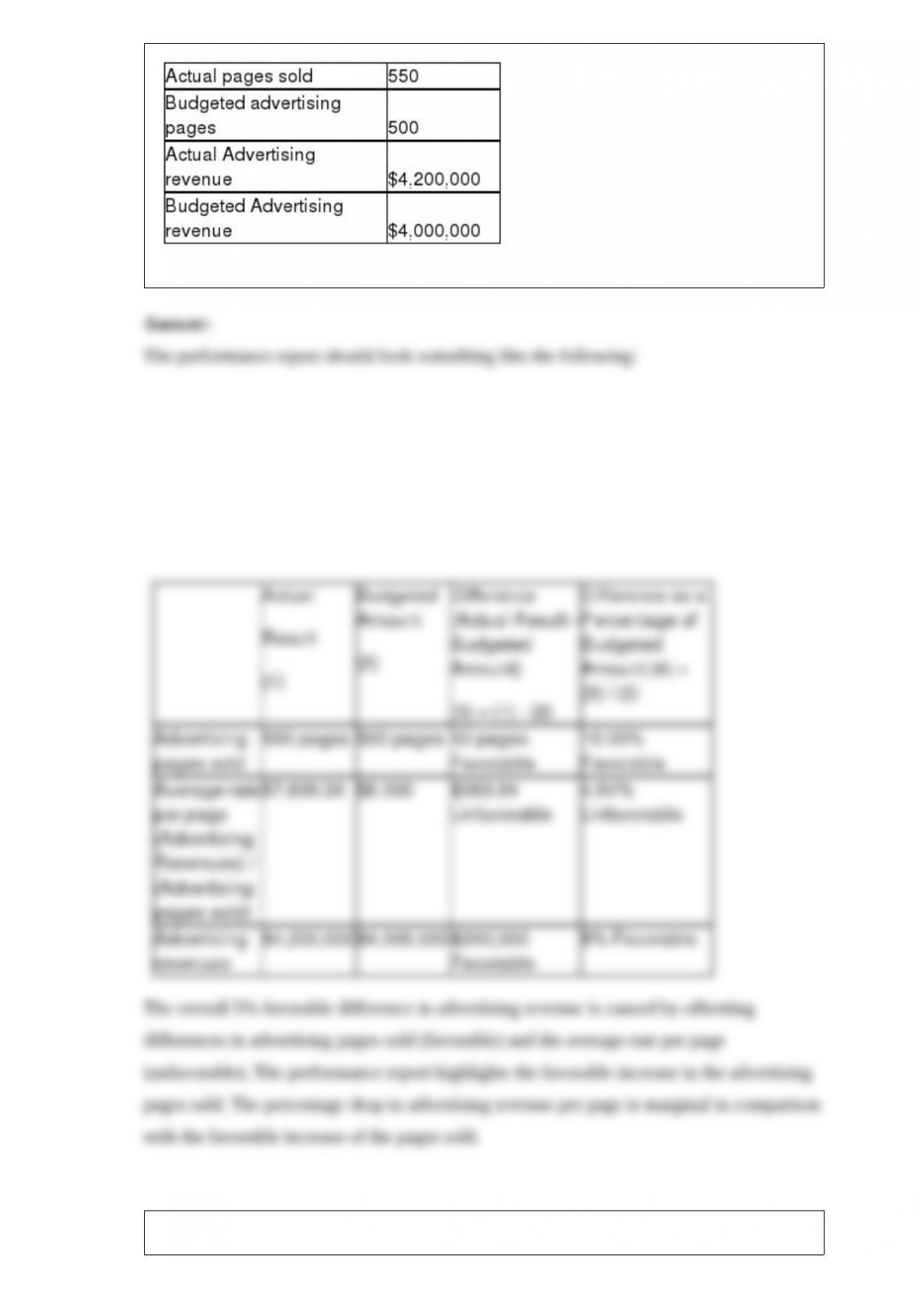
Does the report indicate any cause for managerial investigation?
27) Explain the term cost leadership. What are the possible ways through which a
company would try to become a cost leader? How far is it desirable to implement cost
reduction measures?
28) List the capital budgeting methods used to analyze financial information.
29) What are the arguments for prorating a production-volume variance that has been
deemed to be material among work-in-process, finished goods, cost and cost of goods
sold as opposed to writing it all off to cost of goods sold?
30) An important element in designing accounting-based performance measures is
choosing the time horizon of the performance measures. Discuss.
31) Explain why managers of small businesses prefer 3-variance analysis over
4-variance analysis.