
1) When the operating budget is used as a control device, managers are less likely to be
motivated to budget higher sales than actually anticipated.
2) Bottom-up budgets entrusts senior managers to prepare budgets and lower-level
managers to execute them.
3) ABC system is likely to provide high benefits to a company whose products that the
company is well-suited to make and show small profits.
4) When evaluating alternatives to improve quality, both the relevant benefits as well as
the relevant costs should be considered.
5) The fixed setup overhead flexible-budget variance is calculated as actual costs –
flexible-budget variance.
6) Emerging Dock Company manufactures boat docks on an assembly line. Its standard
costing system uses two cost categories, direct materials and conversion costs. Each
product must pass through the Assembly Department and the Finishing Department.
Direct materials are added at the beginning of the production process. Conversion costs
are allocated evenly throughout production.
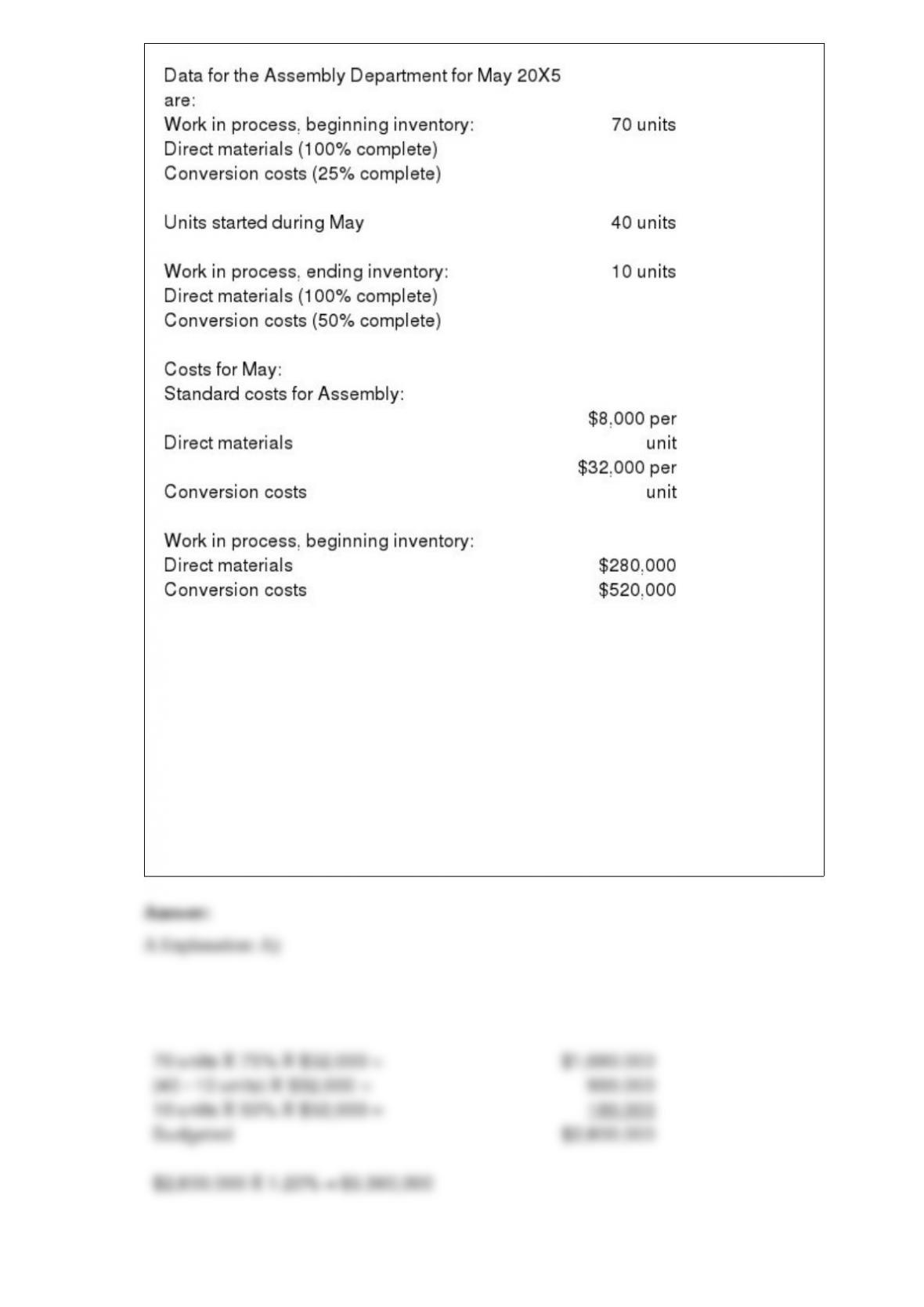
Which of the following journal entries records the Assembly Department’s conversion
costs at actual costs for the month, assuming conversion costs are 20% higher than
expected?
A) Assembly Department Conversion Cost Control 3,360,000
Various accounts 3,360,000
B) Materials Inventory 3,360,000
Assembly Department Conversion Cost Control 3,360,000
C) Assembly Department Conversion Cost Control 2,800,000
Materials Inventory 2,800,000
D) Materials Inventory 3,360,000
Work in Process Assembly 3,360,000
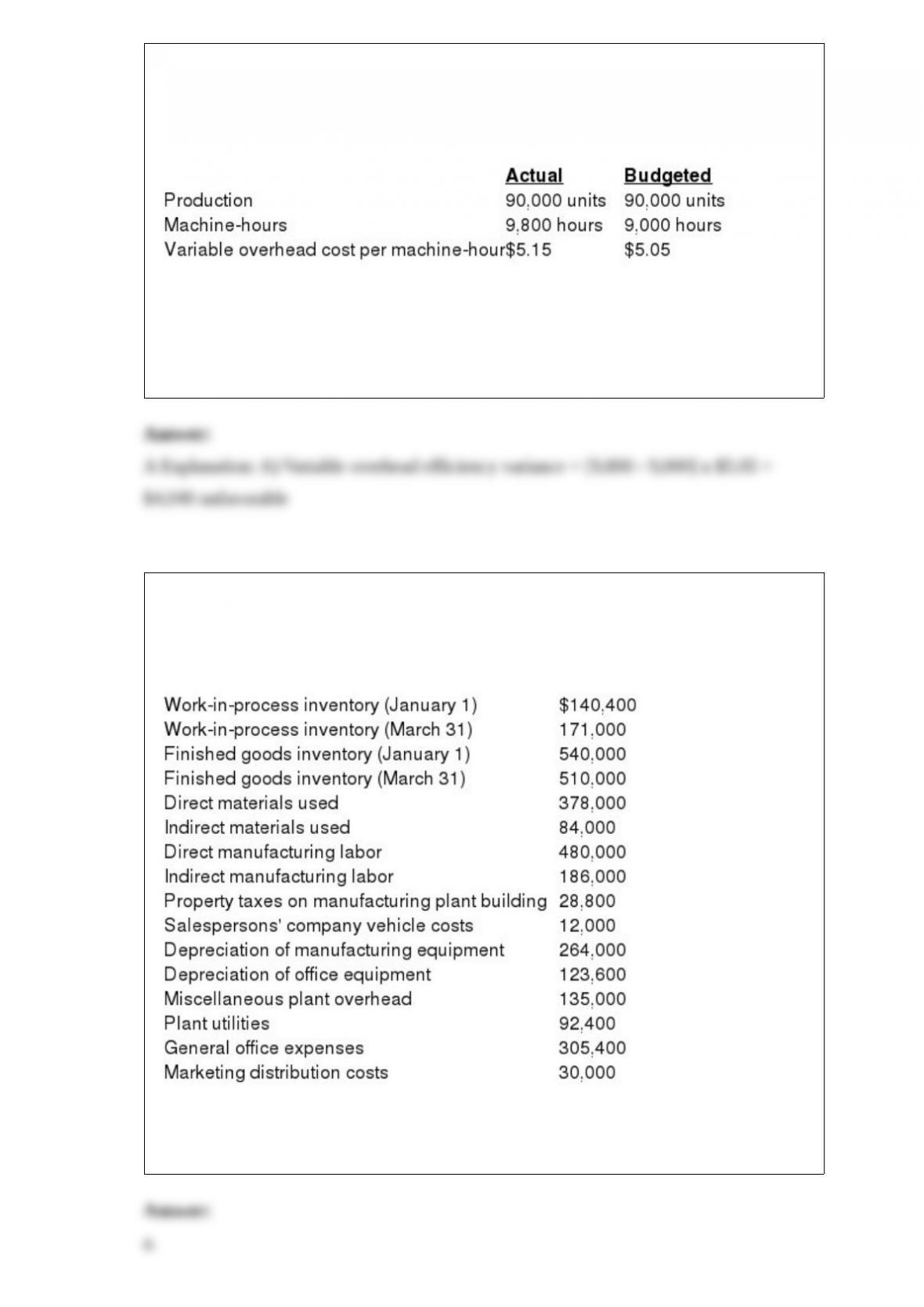
7) Zitrik Corporation manufactured 90,000 buckets during February. The variable
overhead cost-allocation base is $5.05 per machine-hour. The following variable
overhead data pertain to February:
What is the variable overhead efficiency variance?
A) $4,040 unfavorable
B) $4,120 favorable
C) $4,040 favorable
D) $4,120 unfavorable.
8) Messinger Manufacturing Company had the following account balances for the
quarter ending March 31, unless otherwise noted:
Required:
a.Prepare a cost of goods manufactured schedule for the quarter.
b.Prepare a cost of goods sold schedule for the quarter.
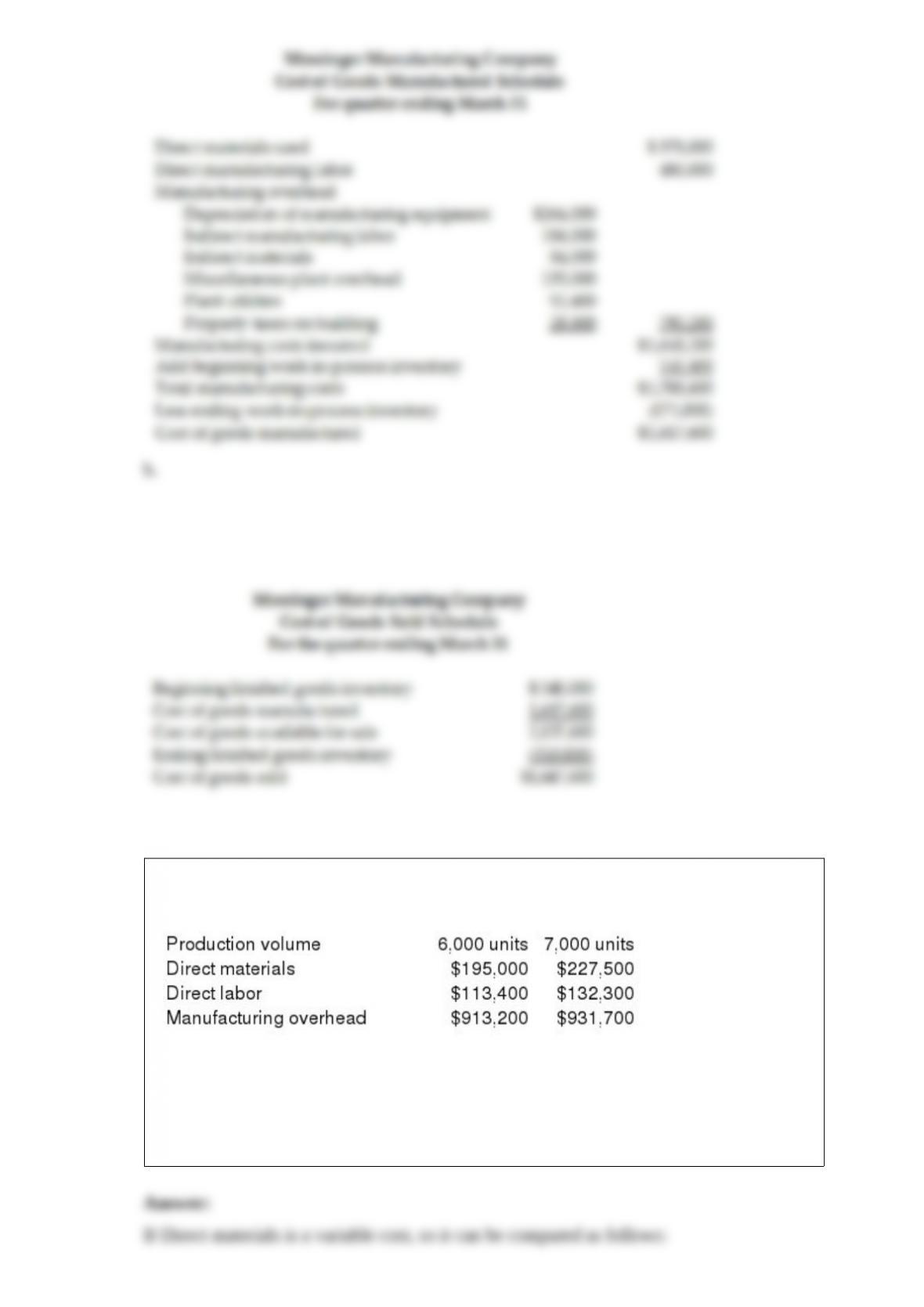
9) Farmington Corporation has provided the following production and total cost data
for two levels of monthly production volume. The company produces a single product.
The best estimate of the total cost to manufacture 6,300 units is closest to:
A) $1,162,350
B) $1,242,570
C) $1,222,515
D) $1,282,680
10) Which of the following elements are used in calculating revenue in a flexible
budget?
A) budgeted selling price and actual quantity of output
B) actual selling price and budgeted quantity of output
C) budgeted selling price and budgeted quantity of output
D) actual selling price and actual quantity of output
11) Which of the following statements is true of costs and pricing decisions?
A) Companies get profit from selling products only when they are the price makers.
B) Companies supply products as long as the price the customer is willing to pay for its

products exceeds the price that is charged by the competitor.
C) Companies supply products as long as there is a demand for the product in the
market regardless of the price at which the products are sold.
D) Companies supply products as long as the revenues from selling the additional units
exceed the cost of producing them.
12) Which of the following statements is true of productivity measures?
A) Partial productivity and total factor productivity measures never work best together.
B) Partial productivity explicitly considers gains from using fewer physical inputs as
well as substitution among inputs.
C) All productivity measures are physical measures lacking financial content.
D) Total factor productivity considers the trade-offs across various inputs based on
current input prices.
13) A transfer price based on the full cost plus a markup may lead to suboptimal
decisions because ________.
A) it leads the buying division to regard the fixed costs and the markup of the selling
division as a variable cost
B) it leads the buying division to regard the variable costs and the markup of the selling
division as a fixed cost
C) it leads the buying division to regard the fixed costs and the markup of the selling
division as total costs
D) it leads the buying division to regard the variable costs and the markup of the selling
division as total costs
14) A local accounting firm employs 20 full-time professionals. The budgeted annual
compensation per employee is $40,500. The average chargeable time is 500 hours per
client annually. All professional labor costs are included in a single direct-cost category
and are allocated to jobs on a per-hour basis.
Other costs are included in a single indirect-cost pool, allocated according to
professional labor-hours. Budgeted indirect costs for the year are $787,500, and the
firm expects to have 90 clients during the coming year.
What is the budgeted direct labor cost rate per hour?
A) $18.00 per hour
B) $17.50 per hour
C) $4.05 per hour
D) $2,000 per hour
15) Which of the following is a stage of the capital budgeting process that determines
which investment
yields the greatest benefit and the least cost to an organization?
A) make decisions by choosing among alternatives stage
B) make predictions stage
C) identify projects stage
D) implement the decision, evaluate performance, and learn stage
16) A manufacturing firm produces multiple families of products requiring various
combinations of different types of parts. Of the following, the most appropriate cost
driver for assigning materials handling costs to the various products is ________.
A) direct labor hours
B) number of units produced
C) number of parts used
D) number of suppliers involved