1) The main difference between variable costing and absorption costing is the way in
which fixed manufacturing costs are accounted for.
2) Step fixed-cost functions are variable over the long run.
3) Cross-sectional data pertain to the same entity (organization, plant, activity, and so
on)
over successive past periods.
4) The vertical difference, called the residual term, measures the distance between
actual cost and estimated cost for each observation of the cost driver.
5) The variable overhead efficiency variance is the difference between actual quantity
of the
cost-allocation base used and budgeted quantity of the cost-allocation base allowed for
actual output, multiplied by the budgeted variable overhead cost per unit of the
cost-allocation base.
6) In the graph method of CVP analysis, the total revenues line always begins from the
x-axis and the total costs line begins from the fixed cost line.
7) Improvements in information-gathering technologies are making it possible to trace
more costs as direct.
8) Return on sales measures how effectively costs are managed.
9) Using practical capacity as the denominator level sets the cost of capacity at the cost
of supplying the capacity, regardless of the demand for the capacity.
10) A company may choose to use budgeted rates to allocate direct labor accounts if
direct labor costs are difficult to trace to jobs as they are completed.
11) Line management is directly responsible for attaining the goals of the organization.
12) The costs that result when a company runs out of a particular item for which there is
a customer demand are ________.
A) shrinkage costs
B) shortage costs
C) stockout costs
D) EOQ estimation costs
13) The Brital Company processes unprocessed milk to produce two products, Butter
Cream and Condensed Milk. The following information was collected for the month of
June:
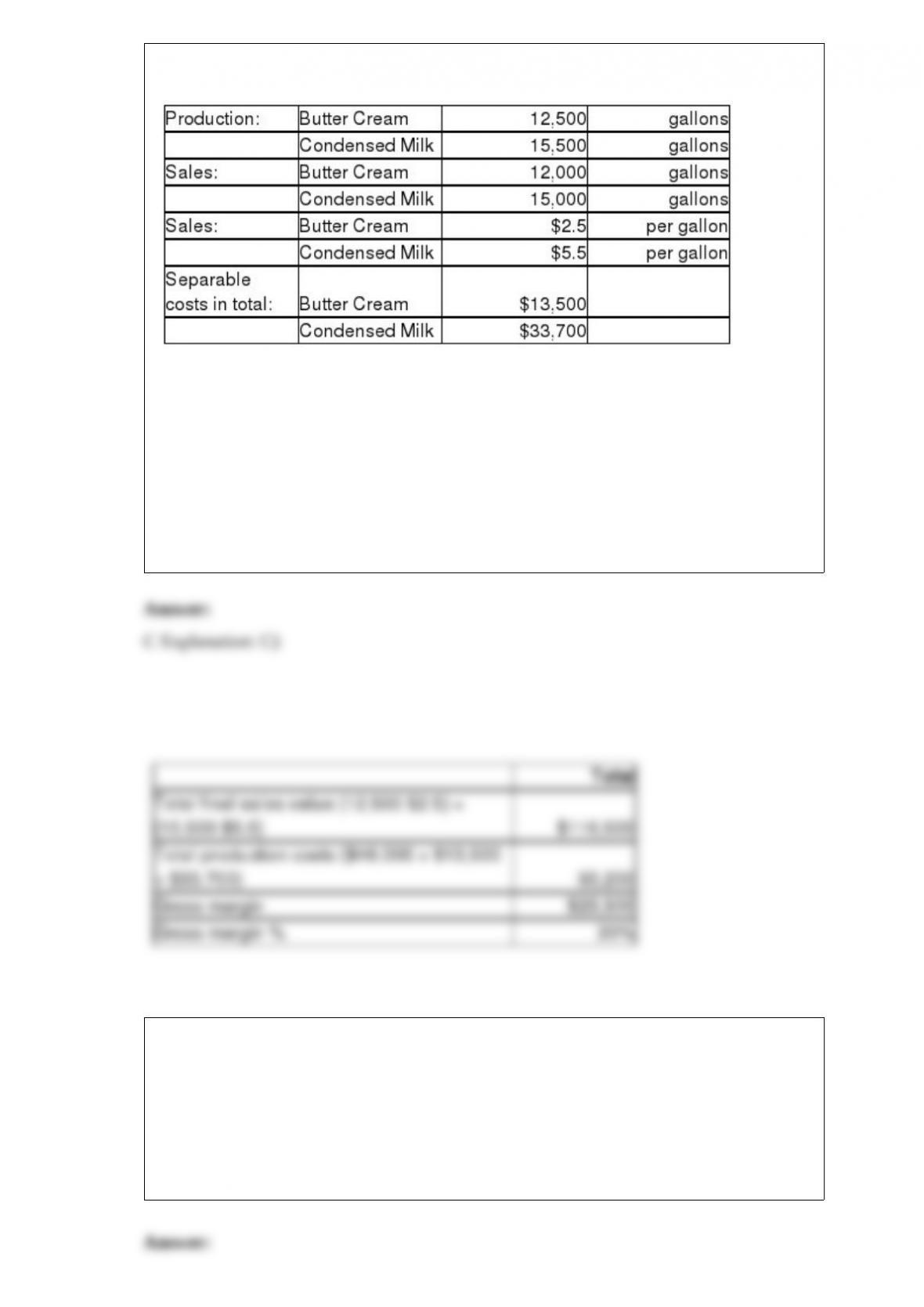
Direct Materials processed:28,000 gallons
The costs of purchasing the of unprocessed milk and processing it up to the splitoff
point to yield a total of 28,000 gallons of saleable product was $46,000.
The company uses constant gross-margin percentage NRV method to allocate the joint
costs of production.
What is the constant gross margin percent for Brital?
A) 15%
B) 22%
C) 20%
D) 30%
14) Standard material cost per kg of raw material is $5. Standard material allowed per
unit is 2 Kg. Actual material used per unit is 2.5 Kg. Actual cost per kg is $4.5. What is
the standard cost per output unit?
A) $9
B) $11.25
C) $10
D) $12.5
15) A well-conceived plan allows managers the ability to ________.
A) not make decisions again until the next planning session
B) keep lower-level managers from implementing change
C) underestimate costs so that actual operating results will be favorable when
comparisons are made
D) take advantage of unforeseen opportunities
16) Due to unprecedented growth during the year, Flowers by Kelly decided to use
some of its surplus cash to increase the size of several inventory order quantities that
had been previously determined using an EOQ model.
Required:
Identify whether increasing the size of inventory orders will increase, decrease, or have
no effect on each of the following items.
________a.Average inventory
________b.Cost of goods sold
________c.Number of orders per year
________d.Total annual carrying costs
________e.Total annual carrying and ordering costs
________f.Total annual ordering costs
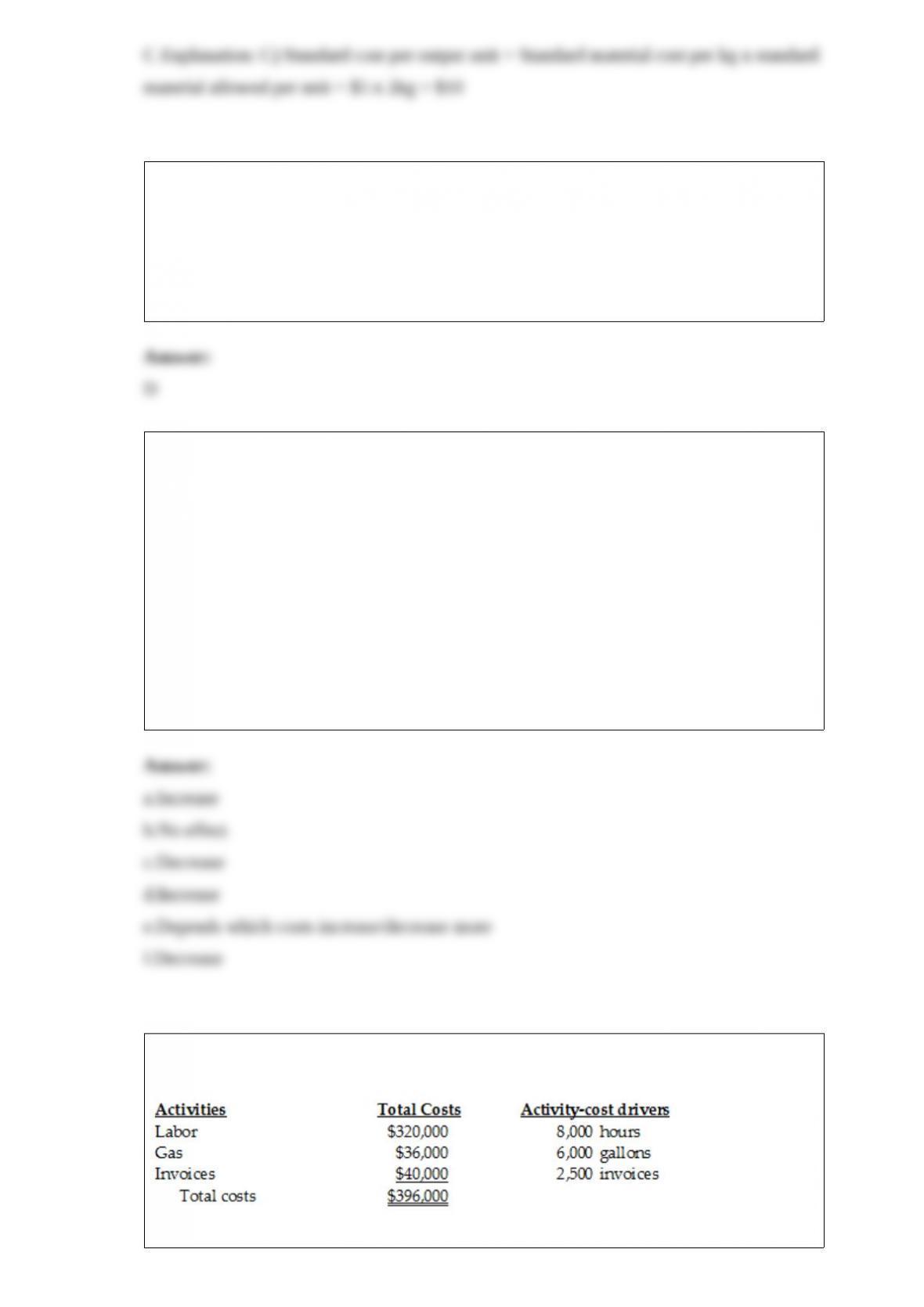
17) Teecorp Company provides the following ABC costing information:
The above activities used by their three departments are:
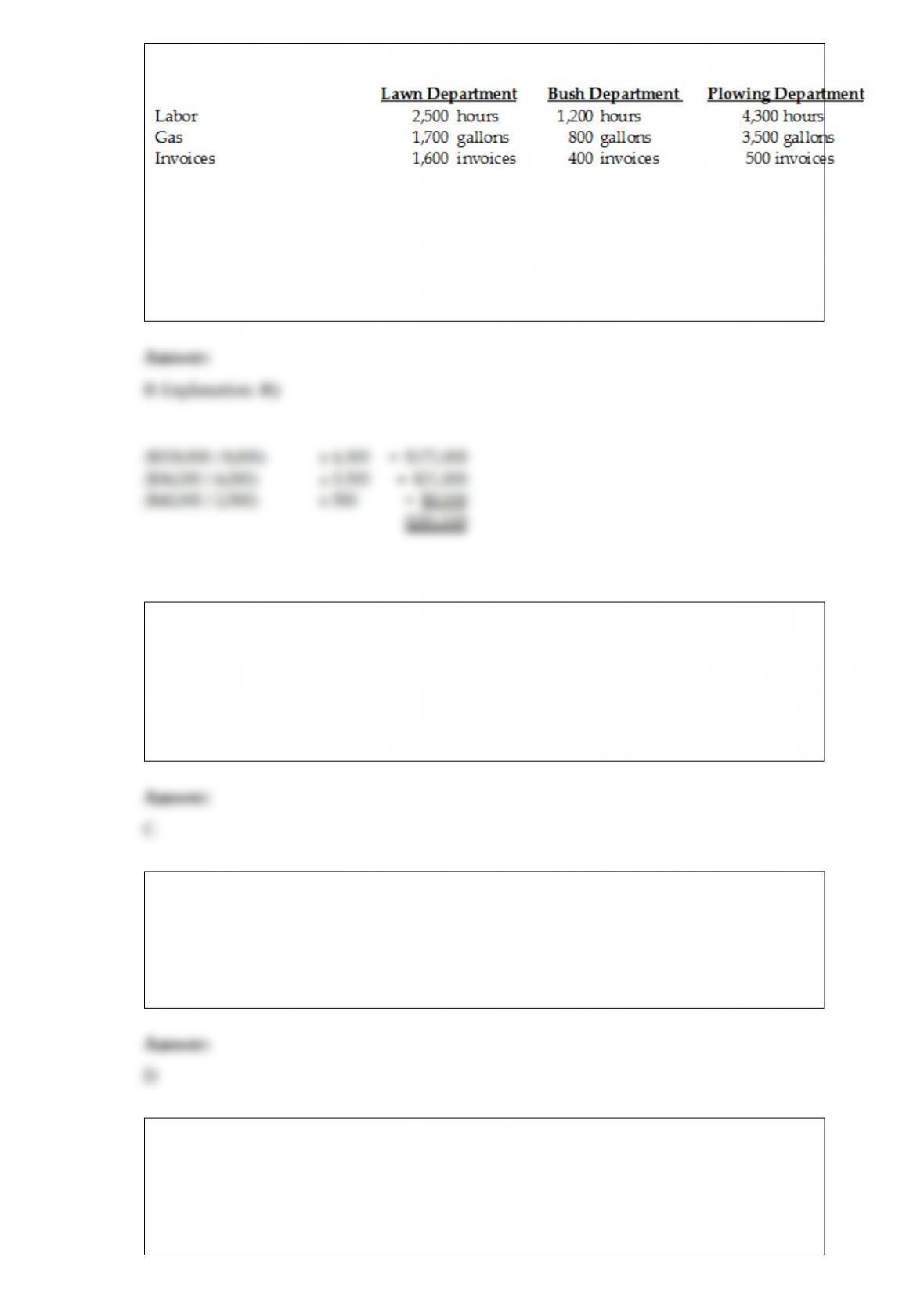
How much of the total cost will be assigned to the Plowing Department?
A) $396,000
B) $201,000
C) $134,600
D) $172,000
18) Among different types of costs associated with inventory, four categories of quality
costs are ________.
A) control costs, inspection costs, internal failure costs, and external failure costs
B) prevention costs, inspection costs, internal failure costs, and external failure costs
C) prevention costs, appraisal costs, internal failure costs, and external failure costs
D) prevention costs, control costs, internal failure costs, and external failure costs
19) Traditional normal and standard costing systems use ________.
A) backflush costing
B) delayed costing
C) variable tracking
D) sequential tracking
20) The basic source document for direct manufacturing labor is the ________.
A) job-cost record
B) materials-requisition record
C) labor-time record
D) labor-requisition record
21) A unit cost is computed by ________.
A) multiplying total cost by the number of units produced
B) dividing total cost by the number of units produced
C) dividing variable cost by the number of units produced
D) dividing fixed cost by the number of units produced
22) Which of the following is an assumption of CVP analysis?
A) Total costs can be divided into a fixed component and a component that is variable
with respect to the level of output.
B) When graphed, total costs curve upward.
C) The unit-selling price is variable as it is subject to demand and supply.
D) Total costs can be divided into inventoriable and period costs with respect to the
level of output.
23) The after-tax average cost of all the long-term funds used by a corporation equals
________.
A) economic value added
B) cost of goodwill
C) interest cost of the capital
D) weighted-average cost of capital
24) For each of the following methods of allocating joint costs, give a positive or a
negative aspect of selecting each one to allocate joint costs.
a.sales value at splitoff
b.estimated net realizable value method
c.the constant gross margin method
d.a physical measure such as volume
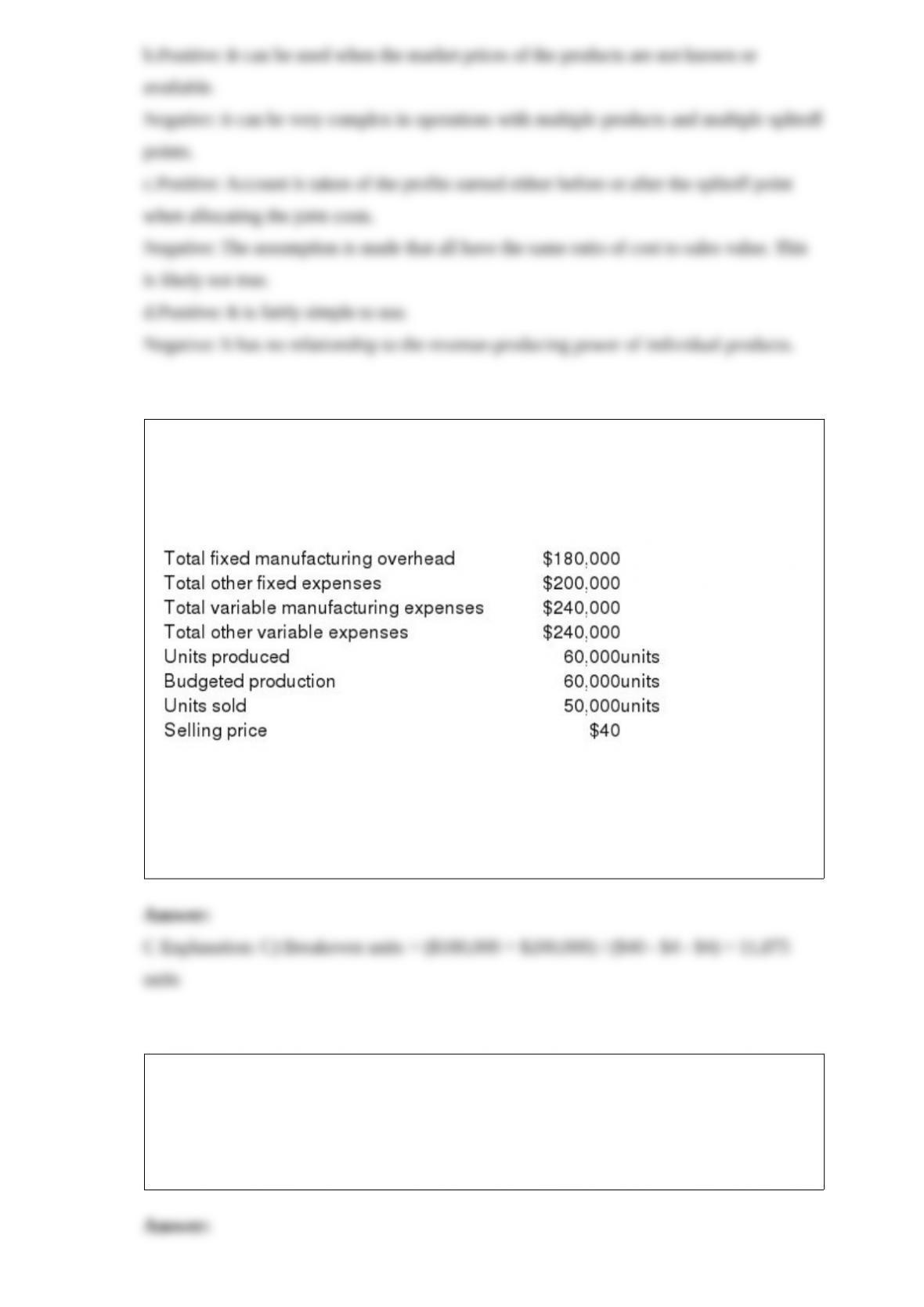
25) Ms. Janice Meyers, the company president, has heard that there are multiple
breakeven points for every product. She does not believe this and has asked you to
provide the evidence of such a possibility. Some information about the company for
2011 is as follows:
What are breakeven sales in units using variable costing?
A) 5,625 units
B) 5,769 units
C) 11,875 units
D) 12,180 units
26) Which of the following is an output measure for a hospital?
A) number of doctors needed to cater to patients
B) number of patients admitted every day in a hospital
C) number of days spent by a patient in a hospital
D) charges applicable on the number of days spent by a patient in a hospital
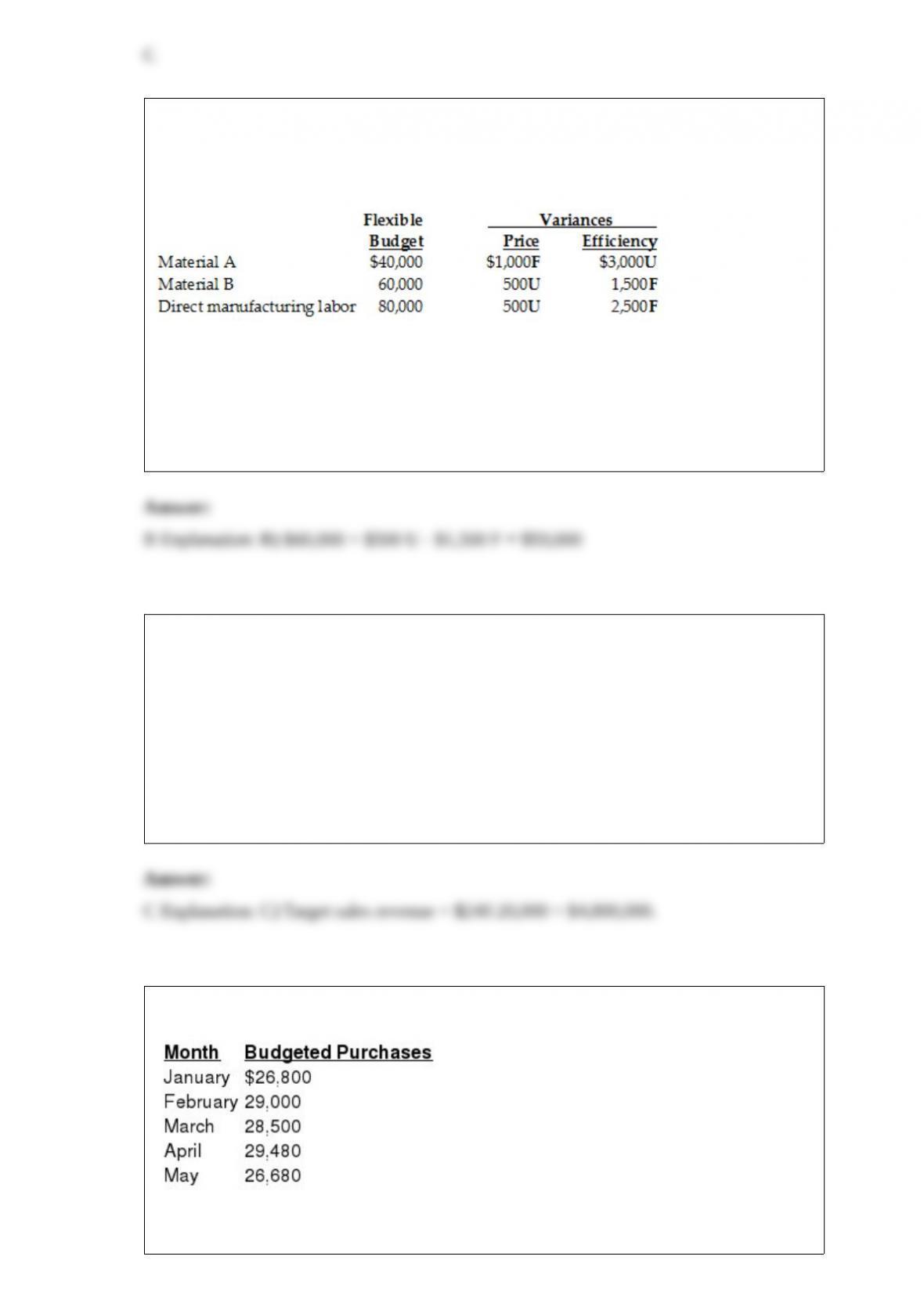
27) Berman’s Camera Shop has prepared the following flexible budget for September
and is in the process of interpreting the variances. F denotes a favorable variance and U
denotes an unfavorable variance.
The actual amount spent for Material B was ________.
A) $58,000
B) $59,000
C) $60,000
D) $61,000
28) After conducting a market research study, Ed Manufacturing decided to produce a
new interior door to complement its exterior door line. It is estimated that the new
interior door can be sold at a target price of $240. The annual target sales volume for
interior doors is 20,000. Ed has target operating income of 20% of sales.
What are target sales revenues?
A) $960,000
B) $3,840,000
C) $4,800,000
D) $5,760,000
29) Estate Corp., has the following information:
Purchases are paid for in the following manner:
10% of the purchase amount in the month of purchase
50% of the purchase amount in the month after purchase
40% of the purchase amount in the second month after purchase
What is the expected balance in Accounts Payable as of April 30?
A) $37,250
B) $37,932
C) $28,500
D) $17,688