Archives
ANT 15339
In Federalist No. 10 and No. 51, Madison argued in favor of a large republic, which went against the ideas of this political philosopher. a. John Locke b. Thomas Hobbes c. Plato d. Montesquieu e. None of the above is […]
ANT 17953
Under the Articles of Confederation, delegates to the national legislature were a. elected by the people. b. selected by state governors. c. appointed by state committees. d. chosen by the state legislatures. e. None of the above is true. The […]
ANT 21422
Many scholars argue that the foremost factor in determining how people vote is a. debate performance. b. perception of the best candidate. c. campaign spending. d. a candidate’s image. e. party identification. Political polarization among the American public is/was a […]
ANT 24639
According to the text, the first president to raise cultivation of the media to an art form was a. Theodore Roosevelt. b. Woodrow Wilson. c. Herbert Hoover. d. Franklin Roosevelt. e. William McKinley. The author of the Declaration of Independence […]
ANT 29345
In the Dred Scott Case (Scott v. Sanford), the Supreme Court ruled a. that the separate-but-equal facilities were constitutional. b. that busing to mandate integration was constitutional c. that Congress had no authority to ban slavery in a territory and […]
ANT 32629
In a typical survey, who is more likely to support the use of military force? a. Germans b. the French c. Russians d. Italians e. Americans Which of the following statements regarding turnout of the youth vote (those under thirty) […]
ANT 34969
In Great Britain’s parliamentary system, candidates for Parliament are selected by a. other members of Parliament, as in a private club. b. the people, through primary elections. c. delegates to the party conventions. d. the party. e. the prime minister. […]
ANT 37225
A categorical grant is a transfer of federal funds designed for a. the private sector. b. discretionary use by a state. c. the accomplishment of broad goals. d. programs with matching grants. e. specific purposes. Much of the nation’s laws […]
ANT 38653
Military draft laws exempted “conscientious objectors” from military service. The Supreme Court ruled that conscientious objectives are individuals that a. belong to an established Christian religion. b. identify with the Judeo-Christian heritage. c. participate in some recognized religion. d. hold […]
ANT 46649
When the purpose of the organization will benefit nonmembers, it is customary to call the group a(n) a. public-interest lobby. b. ideological interest group. c. political party. d. public-interest law firm. e. pressure group. This author’s book, The Jungle, dramatized […]
ANT 57277
During the early years of the Republic, this department, under the direction of Alexander Hamilton, was “the principal federal office.” a. War Department b. State Department c. Treasury Department d. Interior Department e. Navy Department The dual court system of […]
ANT 59557
When entrepreneurial politics shapes foreign policy, the central political arena is a. the State Department. b. Congress. c. the president. d. the United Nations. e. the courts. Which of the following involves the government’s paying part of the cost of […]
ANT 76041
Which of the following statements concerning the Pendleton Act is incorrect? a. It was passed during a Republican administration. b. It was, in part, a response to public outrage over abuses of the spoils system. c. It was, in part, […]
ANT 96990
In an important recent decision, the Supreme Court upheld a voucher program for students attending religious and other private schools in Cleveland, Ohio, because a. the schools promised to teach no course involving religion. b. the aid was not given […]
CGS SS 11710
According to presidential scholar Richard Neustadt, the president’s most important audience is a. heads of state from around the world. b. fellow politicians in Washington, D.C. c. party activists. d. the public. e. officeholders outside of D.C. This method of […]
CGS SS 20896
This plan presented at the Constitutional Convention called for a bicameral legislative body with states’ representation in each house based on population. a. Connecticut Plan b. New Jersey Plan c. Maryland Plan d. Virginia Plan e. Great Compromise Democrats who […]
CGS SS 22010
Studies of how casualty rates affect public opinion show that as death rates rise, people a. develop more favorable attitudes toward the war. b. support withdrawal from the war. c. support surrender. d. support escalation in the fighting to defeat […]
CGS SS 37669
Unlike the Civil Rights Act, the Americans with Disabilities Act (ADA) considers a. the impact on local communities. b. qualifications and standards. c. quotas. d. reverse discrimination. e. excessive costs and undue hardships. According to the text, a degree of […]
CGS SS 38617
__________ are today the nation’s largest minority group with more than 50 million people. a. African Americans b. Latinos c. Asian Americans d. Native Americans e. Persians Pork-barrel legislation is an example of this type of politics. a. Interest group […]
CGS SS 57149
One explanation given by the text for the decline in U.S. voter participation in presidential elections after 1900 is that a. parties began functioning to mobilize mass voter turnout. b. fewer citizens were directly affected by the outcome of presidential […]
CGS SS 74888
Which statement best summarizes Madison’s view of federalism? a. He was a consistent supporter of the notion of a supreme national government. b. He was a consistent supporter of the notion of the supremacy of state governments. c. He was […]
CGS SS 78838
This procedure, which is in effect in over 20 states, permits voters to remove an elected official fromoffice. a. Initiative b. Referendum c. Recall d. Logrolling e. Rollback Which president considered himself an “outsider” and boasted of it? a. John […]
CGS SS 89245
The text argues that the U.S. Constitution had to reconcile a. the work ethic with the existence of a leisure class. b. a religious establishment with the quest for religious freedom. c. personal liberty with the need for social control. […]
Chapter 1 The Study American government multiple Choice1 The Financial
CHAPTER 1 The Study of American Government MULTIPLE CHOICE 1. The financial position of the state and national governments under the Articles of Confederation could be best described as © 2015 Cengage Learning. All Rights Reserved. May not be copied, […]
Chapter 10 After the last two census adjustments, which state has
CHAPTER 10 Elections and Campaigns MULTIPLE CHOICE 1. Originally, presidential candidates were chosen by © 2015 Cengage Learning. All Rights Reserved. May not be copied, scanned, or duplicated, in whole or in part, except for use as permitted in a […]
Chapter 11 the fact that they are less sensitive to the free-rider
CHAPTER 11 Interest Groups MULTIPLE CHOICE 1. An interest group is © 2015 Cengage Learning. All Rights Reserved. May not be copied, scanned, or duplicated, in whole or in part, except for use as permitted in a license distributed with […]
Chapter 12 News coverage by the Associated Press had
CHAPTER 12 The Media MULTIPLE CHOICE 1. The liberal Daily Kos and the conservative Power Line are examples of © 2015 Cengage Learning. All Rights Reserved. May not be copied, scanned, or duplicated, in whole or in part, except for […]
Chapter 13 The overriding political question throughout the evolution
CHAPTER 13 Congress MULTIPLE CHOICE 1. Richard F. Fenno described this paradox about Congress. © 2015 Cengage Learning. All Rights Reserved. May not be copied, scanned, or duplicated, in whole or in part, except for use as permitted in a […]
Chapter 14 Alexander Hamilton stood at the Constitutional Convention
CHAPTER 14 The Presidency MULTIPLE CHOICE 1. The Framers of the Constitution generally expected that the __________ would ultimately decide the winner of presidential elections. © 2015 Cengage Learning. All Rights Reserved. May not be copied, scanned, or duplicated, in […]
Chapter 15 the president and Congress acting together
CHAPTER 15 The Bureaucracy MULTIPLE CHOICE 1. The definition of bureaucracy includes all of the following notions EXCEPT © 2015 Cengage Learning. All Rights Reserved. May not be copied, scanned, or duplicated, in whole or in part, except for use […]
Chapter 16 Maryland, the Supreme Court held that
CHAPTER 16 The Judiciary MULTIPLE CHOICE 1. In Federalist paper No. 78, Alexander Hamilton described the Supreme Court as © 2015 Cengage Learning. All Rights Reserved. May not be copied, scanned, or duplicated, in whole or in part, except for […]
Chapter 17 Domestic Policy 45 Which The Following Statements Regarding
CHAPTER 17 Domestic Policy MULTIPLE CHOICE 1. The text describes the nation’s political agenda as being © 2015 Cengage Learning. All Rights Reserved. May not be copied, scanned, or duplicated, in whole or in part, except for use as permitted […]
Chapter 18 When voting behavior and economic conditions correlate
CHAPTER 18 Economic Policy MULTIPLE CHOICE 1. The amount the government spends in excess of what it takes in each year is called the __________. © 2015 Cengage Learning. All Rights Reserved. May not be copied, scanned, or duplicated, in […]
Chapter 19 Edward Corwin describes the Constitution’s treatment of
CHAPTER 19 Foreign and Military Policy MULTIPLE CHOICE 1. This president sent the U.S. navy to fight the Barbary Pirates. © 2015 Cengage Learning. All Rights Reserved. May not be copied, scanned, or duplicated, in whole or in part, except […]
Chapter 2 May not be copied, scanned, or duplicated, in whole
CHAPTER 2 The Constitution MULTIPLE CHOICE 1. This famous Revolutionary leader was not at the Constitutional Convention held in Philadelphia in 1787. © 2015 Cengage Learning. All Rights Reserved. May not be copied, scanned, or duplicated, in whole or in […]
Chapter 20 prevented the government from levying an income tax
CHAPTER 20 American Democracy, Then and Now MULTIPLE CHOICE 1. The text suggests that the Supreme Court’s restriction of the government’s authority was probably © 2015 Cengage Learning. All Rights Reserved. May not be copied, scanned, or duplicated, in whole […]
Chapter 3 He was a consistent supporter of the notion of the supremacy of state
CHAPTER 3 Federalism MULTIPLE CHOICE 1. When the Framers drafted the Constitution, the Antifederalist opposed it primarily on the grounds that the new government © 2015 Cengage Learning. All Rights Reserved. May not be copied, scanned, or duplicated, in whole […]
Chapter 4 Catholics And People From The South Southern
CHAPTER 4 American Political Culture MULTIPLE CHOICE 1. This author wrote Democracy in America based on his observations of America from his two years of traveling across the country to research its prison systems. © 2015 Cengage Learning. All Rights […]
Chapter 5 avoiding rulings on constitutionality and consigning
CHAPTER 5 Civil Liberties MULTIPLE CHOICE 1. A person treating the U.S. flag contemptuously is © 2015 Cengage Learning. All Rights Reserved. May not be copied, scanned, or duplicated, in whole or in part, except for use as permitted in […]
Chapter 6 implemented with due concern for public safety
CHAPTER 6 Civil Rights MULTIPLE CHOICE 1. An example of a difference in treatment toward certain groups that qualifies as reasonable is © 2015 Cengage Learning. All Rights Reserved. May not be copied, scanned, or duplicated, in whole or in […]
Chapter 7 The Framers wanted the United States to be a direct
CHAPTER 7 Public Opinion MULTIPLE CHOICE 1. According to the results from a fiU.S. Citizenship Test” administered by Newsweek magazine, only __________ of the test takers knew that the U.S. House of Representatives had 435 members. © 2015 Cengage Learning. […]
Chapter 8 During The Nineteenth Century The Term Floaters
CHAPTER 8 Political Participation MULTIPLE CHOICE 1. Which is NOT an example of political participation? © 2015 Cengage Learning. All Rights Reserved. May not be copied, scanned, or duplicated, in whole or in part, except for use as permitted in […]
Chapter 9 Political Parties multiple Choice 1 The 2012 Election
CHAPTER 9 Political Parties MULTIPLE CHOICE 1. The 2012 election produced the following outcome: © 2015 Cengage Learning. All Rights Reserved. May not be copied, scanned, or duplicated, in whole or in part, except for use as permitted in a […]
SOC 13805
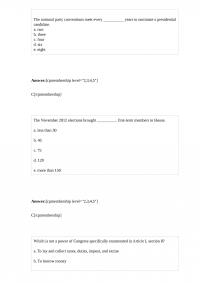
The national party conventions meet every __________ years to nominate a presidential candidate. a. two b. three c. four d. six e. eight The November 2012 elections brought __________ first-term members to House. a. less than 30 b. 45 c. […]
SOC 14038
Andrew Jackson established the precedent that a president’s veto can be used a. only on constitutional grounds. b. without first having a law declared unconstitutional by the Supreme Court. c. even when Congress is still in session. d. on policy […]
SOC 16923
In the aftermath of the Great Depression, well-educated politically active people began demanding federal policies regarding a. civil rights. b. public welfare. c. environmental protection. d. consumer safety. e. All of the above are true. Since 1934, in every off-year […]
SOC 18141
Which founding father was the nation’s first secretary of state under George Washington? a. Alexander Hamilton b. John Adams c. Thomas Jefferson d. John Jay e. James Monroe Since its decision in Roe, the Supreme Court struck down a state […]
SOC 43206
The majoritarian component of foreign policy includes those decisions that a. narrowly distribute benefits and cost. b. narrowly distribute benefits and widely distribute cost. c. widely distribute benefits and cost. d. widely distribute benefits and narrowly distribute cost. e. None […]
SOC 43613
The text states that the media typically report presidential elections as horse races. This means thatthey a. have an instinctive desire to expose scandals. b. play the roles of gatekeeper, scorekeeper, and watchdog in a presidential campaign. c. seek opportunities […]
SOC 51291
According to the text, block grants have enjoyed only marginal success, in part because a. the federal government steadily increased the number of strings attached to such grants. b. money from categorical grants shrank so low as to make these […]
SOC 54594
The increase in political action committees (PACs) might actually reduce the probability that members of Congress can be bought easily because a. there are so many restrictions on PACs. b. PACs have such a poor reputation among legislators. c. PACs […]
SOC 72564
Since 1992, having a member of the clergy offer a prayer or an invocation at a public school graduation ceremony is a. unconstitutional. b. unconstitutional only if read from the Bible. c. constitutional. d. constitutional if not read from the […]
SSCI 29747
Applying the principles of Thomas Jefferson to current political issues would probably dispose one to a. favor the decentralization of government power. b. oppose the decentralization of government power. c. favor seven-year terms for presidents. d. oppose seven-year terms for […]
SSCI 30381
The authors suggest one way of describing the New System is to call it a(n) __________ government. a. restrictive b. activist c. counter-majoritarian d. top-heavy e. bottoms-up The principal goal of the American Revolution was a. equality. b. financial betterment. […]
SSCI 36632
Lyndon Johnson was able to get his Great Society programs through Congress because a. most of the public favored the programs. b. Democrats controlled both houses of Congress by large margins. c. most Republicans worked with him on these issues. […]
SSCI 48627
When the Framers drafted the Constitution, the Antifederalist opposed it primarily on the grounds that the new government a. empowered state governments. b. created a bicameral Congress. c. gave states the power to coin money. d. created a navy. e. […]
SSCI 73442
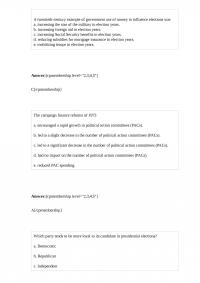
A twentieth-century example of government use of money to influence elections was a. increasing the size of the military in election years. b. increasing foreign aid in election years. c. increasing Social Security benefits in election years. d. reducing subsidies […]
SSCI 90488
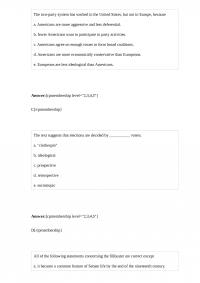
The two-party system has worked in the United States, but not in Europe, because a. Americans are more aggressive and less deferential. b. fewer Americans want to participate in party activities. c. Americans agree on enough issues to form broad […]