Archives
978-1111822354 Chapter 1 Lecture Note
CHAPTER 1 WHAT IS ECONOMICS? MASTERY GOALS The objectives of this chapter are to: 1. Define economics and describe the link between scarcity, opportunity cost and the need to make choices. 2. Define opportunity cost including the difference between explicit […]
978-1111822354 Chapter 1 Solution Manual
ANSWERS AND SOLUTIONS PROBLEM SET 1. a. This is a statement of how the economy works, and does not involve value b. The appearance of the word “should” signals that this is a normative statement. It involves a value judgment […]
978-1111822354 Chapter 10 Lecture Note
CHAPTER 10 ECONOMIC FLUCTUATIONS MASTERY GOALS The objectives of this chapter are to: THE CHAPTER IN A NUTSHELL Actual GDP fluctuates above and below the classical model’s predictions. GDP rises in an expansion and falls in a recession. A boom […]
978-1111822354 Chapter 10 Solution Manual
ANSWERS, SOLUTIONS, AND EXERCISES PROBLEM SET 2. According to Table 1 in the text, the recessions of 1974, 1980, 1990 and 2008 were associated with increases in oil prices. But there were many other recessions for which changes in oil […]
978-1111822354 Chapter 11 Lecture Note
CHAPTER 11 THE SHORT-RUN MACRO MODEL MASTERY GOALS The objectives of this chapter are to: 1. Explain the usefulness of the short-run macro model. 2. List the four components of aggregate expenditure included in the simple macro model of this […]
978-1111822354 Chapter 11 Solution Manual
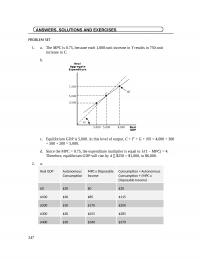
ANSWERS, SOLUTIONS AND EXERCISES PROBLEM SET b. 3,000 5,000 8,000 Real Aggr egat e Expenditure Real GDP 7,250 5,000 3,500 EAE 45° c. Equilibrium GDP is 5,000. At this level of output, C + IP + G + NX = […]

978-1111822354 Chapter 12 Lecture Note
CHAPTER 12 FISCAL POLICY MASTERY GOALS The objectives of this chapter are to: 1. Explain the concept of countercyclical fiscal policy. 2. Understand the mechanics of countercyclical fiscal policy. 3. Describe the problems associated with countercyclical fiscal policy. 4. Summarize […]
978-1111822354 Chapter 12 Solution Manual
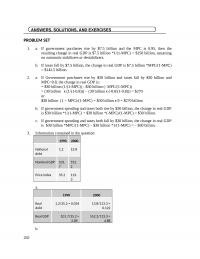
ANSWERS, SOLUTIONS, AND EXERCISES PROBLEM SET 1. a. If government purchases rise by $7.5 billion and the MPC is 0.95, then the 2. a. If Government purchases rise by $30 billion and taxes fall by $30 billion and MPC=0.8, the […]
978-1111822354 Chapter 13 Lecture Note
CHAPTER 13 MONEY, BANKS, AND THE FEDERAL RESERVE MASTERY GOALS The objectives of this chapter are to: 1. Define money and its functions. 2. Define liquidity. 3. Explain why credit cards, gold bars, and stocks and bonds are not money. […]
978-1111822354 Chapter 13 Solution Manual
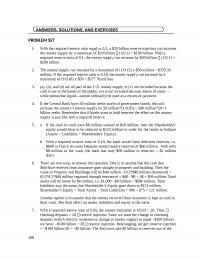
ANSWERS, SOLUTIONS, AND EXERCISES PROBLEM SET 1. With the required reserve ratio equal to 0.2, a $20 billion reserve injection can increase 2. The money supply can increase by a maximum of (1/0.15) x $50 million = $333.33 million. If […]
978-1111822354 Chapter 14 Lecture Note
CHAPTER 14 THE MONEY MARKET AND MONETARY POLICY MASTERY GOALS The objectives of this chapter are to: 1. Explain how individuals’ wealth limits their demand for money. 2. Describe the tradeoff between holding money and holding bonds. 3. List the […]
978-1111822354 Chapter 14 Solution Manual
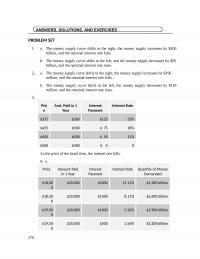
ANSWERS, SOLUTIONS, AND EXERCISES PROBLEM SET 1. a. The money supply curve shifts to the right, the money supply increases by $100 b. The money supply curve shifts to the left, and the money supply decreases by $50 billion, and […]
978-1111822354 Chapter 15 Lecture Note
CHAPTER 15 AGGREGATE DEMAND AND AGGREGATE SUPPLY MASTERY GOALS The objectives of this chapter are to: 1. Use an aggregate demand (AD) curve to illustrate how price level changes affect equilibrium GDP. 2. List the variables that cause the AD […]
978-1111822354 Chapter 15 Solution Manual
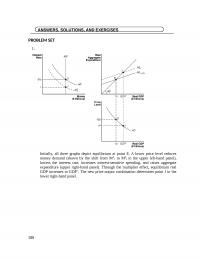
ANSWERS, SOLUTIONS, AND EXERCISES PROBLEM SET 1. Initially, all three graphs depict equilibrium at point E. A lower price level reduces money demand (shown by the shift from Md1 to Md2 in the upper left-hand panel), lowers the interest rate, […]
978-1111822354 Chapter 16 Lecture Note
CHAPTER 16 INFLATION AND MONETARY POLICY MASTERY GOALS The objectives of this chapter are to: 1. Describe how the Fed’s objectives have changed over time, and state its current objectives. 2. Explain why a low rate of in”ation is important. […]
978-1111822354 Chapter 16 Solution Manual
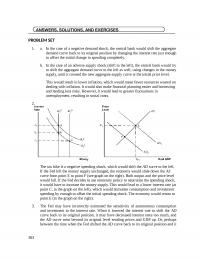
ANSWERS, SOLUTIONS, AND EXERCISES PROBLEM SET 1. a. In the case of a negative demand shock, the central bank would shift the aggregate b. In the case of an adverse supply shock (shift to the left), the central bank would […]
978-1111822354 Chapter 17 Lecture Note
CHAPTER 17 EXCHANGE RATES AND MACROECONOMIC POLICY MASTERY GOALS The objectives of this chapter are to: 1. Describe what a foreign exchange market is. 2. Explain what an exchange rate is, and why it is helpful to define the exchange […]
978-1111822354 Chapter 17 Solution Manual
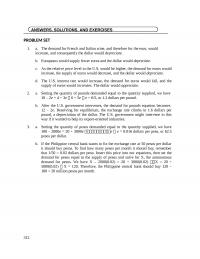
ANSWERS, SOLUTIONS, AND EXERCISES PROBLEM SET 1. a. The demand for French and Italian wine, and therefore for the euro, would increase, and consequently the dollar would depreciate. 2. a. Setting the quantity of pounds demanded equal to the quantity […]
978-1111822354 Chapter 2 Lecture Note
CHAPTER 2 SCARCITY, CHOICE, AND ECONOMIC SYSTEMS MASTERY GOALS The objectives of this chapter are to: 1. Construct a production possibilities frontier and use it to explain the concepts of productive inefficiency, recessions, the law of increasing opportunity cost, and […]
978-1111822354 Chapter 2 Solution Manual
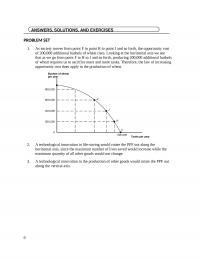
ANSWERS, SOLUTIONS, AND EXERCISES PROBLEM SET 1. As society moves from point F to point H to point J and so forth, the opportunity cost of 200,000 additional bushels of wheat rises. Looking at the horizontal axis we see Tanks […]
978-1111822354 Chapter 3 Lecture Note
CHAPTER 3 SUPPLY AND DEMAND MASTERY GOALS The objectives of this chapter are to: 1. Describe the characteristics that define a market including the use of aggregation. 2. Distinguish between product markets and resource markets using the circular flow model. […]
978-1111822354 Chapter 3 Solution Manual
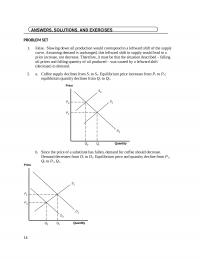
ANSWERS, SOLUTIONS, AND EXERCISES PROBLEM SET 1. False. Slowing down oil production would correspond to a leftward shift of the supply curve. Assuming demand is unchanged, this leftward shift in supply would lead to a 2. a. Coffee supply declines […]
978-1111822354 Chapter 4 Lecture Note
CHAPTER 4 WORKING WITH SUPPLY AND DEMAND MASTERY GOALS The objectives of this chapter are to: 1. Apply the supply and demand model to actual markets and government policies. 2. Describe the various actions governments take to affect market outcomes. […]
978-1111822354 Chapter 4 Solution Manual
ANSWERS, SOLUTIONS, AND EXERCISES PROBLEM SET 1. a. 40 units will be traded since that is all that buyers are willing and able to buy at the 2. a. With the $2 price ceiling people would still demand 60,000 bottles […]
978-1111822354 Chapter 5 Lecture Note
CHAPTER 5 WHAT MACROECONOMICS TRIES TO EXPLAIN MASTERY GOALS The objectives of this chapter are to: 1. List the three important macroeconomic goals, and explain why each is important. 2. Explain how economists track economic growth using real GDP. 3. […]
978-1111822354 Chapter 5 Solution Manual
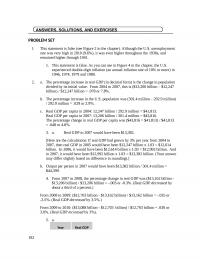
ANSWERS, SOLUTIONS, AND EXERCISES PROBLEM SET 1 This statement is false (see Figure 2 in the chapter). Although the U.S. unemployment 1. This statement is false. As you can see in Figure 4 in the chapter, the U.S. experienced double-digit […]
978-1111822354 Chapter 6 Lecture Note
CHAPTER 6 PRODUCTION, INCOME, AND EMPLOYMENT MASTERY GOALS The objectives of this chapter are to: 1. State the definition of Gross Domestic Product (GDP) and describe the problems with GDP. 4. Explain why actual private investment spending might not equal […]
978-1111822354 Chapter 6 Solution Manual
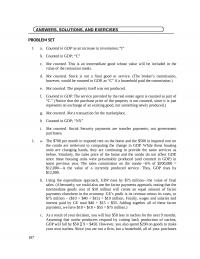
ANSWERS, SOLUTIONS, AND EXERCISES PROBLEM SET 1 a. Counted in GDP as an increase in inventories; “I” e. Not counted. The property itself was not produced. f. Counted in GDP. The service provided by the real estate agent is counted […]
978-1111822354 Chapter 7 Lecture Note
CHAPTER 7 THE PRICE LEVEL AND INFLATION MASTERY GOALS The objectives of this chapter are to: 1. Describe how index numbers are calculated. 2. Discuss how the Consumer Price Index (CPI) is compiled and how it is used. 3. Describe […]
978-1111822354 Chapter 7 Solution Manual
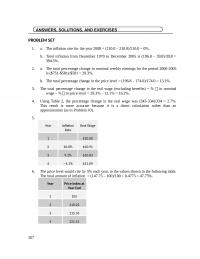
ANSWERS, SOLUTIONS, AND EXERCISES PROBLEM SET 1. a. The inflation rate for the year 2008 = (210.0 – 210.0)/210.0 = 0%. 2. a. The total percentage change in nominal weekly earnings for the period 2000-2005 is ($751-$581)/$581 = 29.3%. b. […]
978-1111822354 Chapter 8 Lecture Note
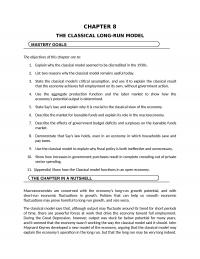
CHAPTER 8 THE CLASSICAL LONG-RUN MODEL MASTERY GOALS The objectives of this chapter are to: 1. Explain why the classical model seemed to be discredited in the 1930s. 2. List two reasons why the classical model remains useful today. 3. […]
978-1111822354 Chapter 8 Solution Manual
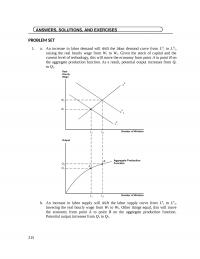
ANSWERS, SOLUTIONS, AND EXERCISES PROBLEM SET 1. a. An increase in labor demand will shift the labor demand curve from LD1 to LD2, raising the real hourly wage from W1 to W2. Given the stock of capital and the b. […]
978-1111822354 Chapter 9 Lecture Note
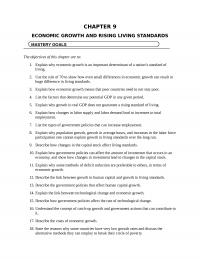
CHAPTER 9 ECONOMIC GROWTH AND RISING LIVING STANDARDS MASTERY GOALS The objectives of this chapter are to: 1. Explain why economic growth is an important determinant of a nation’s standard of living. 2. Use the rule of 70 to show […]
978-1111822354 Chapter 9 Solution Manual
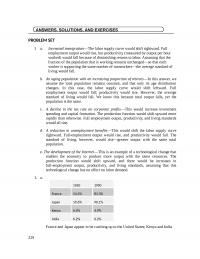
ANSWERS, SOLUTIONS, AND EXERCISES PROBLEM SET 1 a. Increased immigration—The labor supply curve would shift rightward. Full employment output would rise, but productivity (measured by output per hour worked) would fall because of diminishing returns to labor. Assuming that the […]
BUS 106
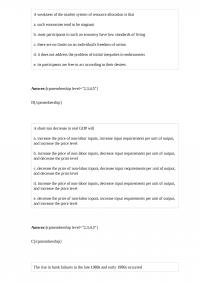
A weakness of the market system of resource allocation is that a. such economies tend to be stagnant b. most participants in such an economy have low standards of living c. there are no limits on an individual’s freedom of […]
BUS 122 Test 2
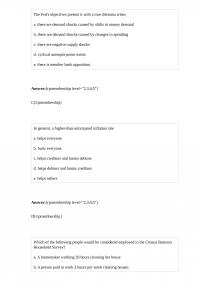
The Fed’s objectives present it with a true dilemma when a. there are demand shocks caused by shifts in money demand b. there are demand shocks caused by changes in spending c. there are negative supply shocks d. cyclical unemployment […]
BUS 141 In mid2009 the
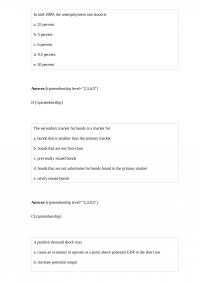
In mid-2009, the unemployment rate stood at a. 25 percent b. 5 percent c. 6 percent d. 9.5 percent e. 20 percent The secondary market for bonds is a market for a. bonds that is smaller than the primary market […]
BUS 145 Homework
If real consumption spending increases by $400 billion each time real disposable income rises by $1,000 billion, the marginal propensity to consume is a. 40 b. 4 c. 0.4 d. 0.04 e. 0.004 Which of the following would lead to […]
BUS 156 Final
Microeconomics involves the analysis of smaller, less developed economies while macroeconomics is concerned with the analysis of larger developed economies. Which of the following would lead to an increase in the supply of Russian rubles? a. An increase in the […]
BUS 162 Midterm 2
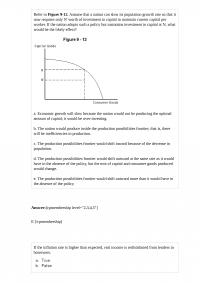
Refer to Figure 9-12. Assume that a nation can slow its population growth rate so that it now requires only N’ worth of investment in capital to maintain current capital per worker. If the nation adopts such a policy but […]
Bus 237 Which of the following is a
Which of the following is a normative statement? a. Fifteen percent of Americans go without health insurance in a year. b. The Consumer Price Index rose three-tenths of one percent in May. c. An increase in the minimum wage will […]
BUS 238 If Greg uses a special glue
If Greg uses a special glue to make model planes that he sells and the price of his model planes increases, then one would expect that the equilibrium price of the special glue would _______ and the equilibrium quantity would […]
BUS 290 Quiz
If there is an excess supply of money in the economy, a. there is also an excess demand for money b. there is also an excess demand for bonds c. there is also an excess supply of bonds d. the […]
BUS 348 Test
Real consumption spending is inversely related to a. real disposable income b. the amount of common stock owned c. the amount of real estate owned d. expectations of future income e. the interest rate Microeconomics deals with which of the […]
BUS 433
Since a long run consists of many short runs, the classical model is a. incorrect every time we look at output data b. accurate during the short run c. paradoxically quite accurate in the long run; however, it is not […]
BUS 441 Quiz 3
Those who prefer that the Fed react to negative supply shocks by tolerating higher rates of inflation as a means of moderating a recession are called a. inflation doves b. inflation hawks c. monetarists d. Keynesians e. hard headed and […]
BUS 441 Test 2 Rapid economic
Rapid economic growth, stable prices and __________ are the three important macroeconomic goals about which most economists agree. a. an unemployment rate of zero b. zero inflation c. full employment d. a high exchange rate e. low interest rates The […]
BUS 476 Homework
Which of the following can happen? a. Prices are rising and the inflation rate is negative but rising. b. Prices are falling and the inflation rate is positive and falling. c. Prices are falling and the inflation rate is positive […]
BUS 518 Quiz 1
Economic growth a. involves both benefits and costs b. is beneficial to the economy only if it arises from population growth c. is beneficial to the economy only if it arises from technological change d. involves costs that usually outweigh […]
BUS 545 Test 2
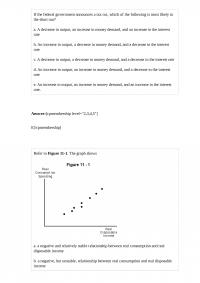
If the federal government announces a tax cut, which of the following is most likely in the short run? a. A decrease in output, an increase in money demand, and an increase in the interest rate b. An increase in […]
BUS 624 Test 1
Which of the following could lead to an increase in the equilibrium quantity of a good? a. a decrease in supply and a decrease in demand b. an increase in the price of an input c. an increase in demand […]
BUS 636 Midterm 1
The ultimate purpose of an economic model is to a. explain reality as completely as possible b. establish assumptions that closely resemble reality c. help us understand economic behavior d. determine what each decision maker wants to maximize e. guide […]
BUS 681 Final
The three methods for computing GDP include a. the expenditure approach, the value-added approach, and the factor payments approach b. the expenditure approach, the value-added approach, and the productivity approach c. the productivity approach, the value-added approach, and the factor […]
BUS 715 Quiz 2 Full employment
Full employment occurs when a. everyone has a job b. everyone who wants a job has one c. there is no frictional unemployment d. there is no cyclical unemployment e. there is no structural, frictional, and seasonal unemployment Assuming the […]
BUS 770
According to Say’s Law, in the aggregate a. demand creates its own supply b. the production of output will generate exactly enough income to purchase what has been produced c. the economy is incapable of producing output fast enough to […]
BUS 794 Midterm 2
The slope of the production function reflects a. capital expenditures. b. government expenditures. c. Constant returns to labor. d. Increasing returns to labor. e. Diminishing returns to labor. Characterizing a market involves a. counting the number of demanders and measuring […]
ECB 139 Midterm
An aggregate production function, when shown on a graph, a. is linear and slopes upward b. is linear and slopes downward c. is horizontal d. is vertical e. slopes upward, and flattens out as more labor is used The highest […]
ECB 214
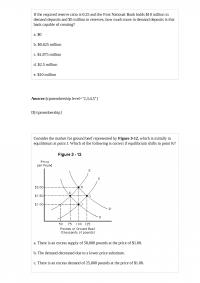
If the required reserve ratio is 0.25 and the First National Bank holds $10 million in demand deposits and $5 million in reserves, how much more in demand deposits is this bank capable of creating? a. $0 b. $0.625 million […]
ECB 221 Quiz
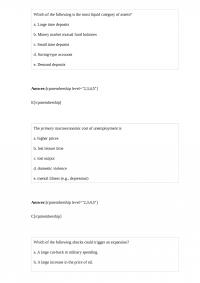
Which of the following is the most liquid category of assets? a. Large time deposits b. Money market mutual fund balances c. Small time deposits d. Saving-type accounts e. Demand deposits The primary macroeconomic cost of unemployment is a. higher […]
ECB 230
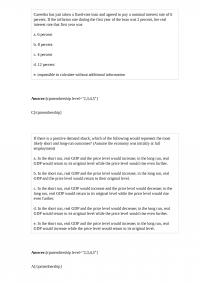
Careetha has just taken a fixed-rate loan and agreed to pay a nominal interest rate of 6 percent. If the inflation rate during the first year of the loan was 2 percent, her real interest rate that first year was […]
ECB 262 Midterm
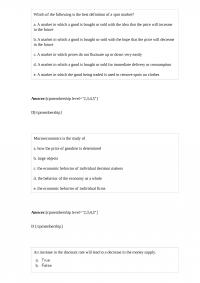
Which of the following is the best definition of a spot market? a. A market in which a good is bought or sold with the idea that the price will increase in the future b. A market in which a […]
ECB 266 Final
If the CPI for 2008 was 112, the typical market basket purchased that year would cost a. 12 percent more than the same market basket purchased the previous year b. 112 percent more than the same market basket purchased the […]
ECB 372 Test 1
The Fed typically decreases the money supply by a. selling government bonds b. buying government loans c. selling government loans d. printing more currency e. buying government bonds Supply curves are usually assumed to slope upward because a. profits fall […]
ECB 380
Suppose the current interest rate is 5% and you pay $250 for a bond. What is the total payment that should be made to you in one year? a. $12.50 b. $262.50 c. $237.50 d. $255.00 e. $267.50 From 1929 […]
ECB 402
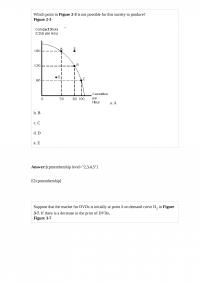
Which point in Figure 2-3 is not possible for this society to produce? Figure 2-3 a. A b. B c. C d. D e. E Suppose that the market for DVDs is initially at point A on demand curve D2 […]
ECB 446 Quiz 3
Countries like _________ have no reserve requirements at all. a. England b. Canada c. Australia d. all of the above e. none of the above. In a typical economy, the dollar value of the total output for a period will […]
ECB 479
A reliable indicator of a healthy economy is an appreciating currency. In the following index: 2003 = 123.3; 2004 = 143; 2005 = 111.4; 2006 = 100; 2007 = 94.3, what is the rate of change from 2006 to 2007? […]
ECB 510
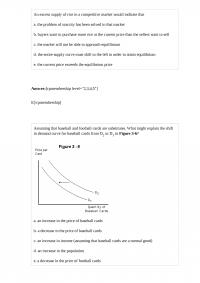
An excess supply of rice in a competitive market would indicate that a. the problem of scarcity has been solved in that market b. buyers want to purchase more rice at the current price than the sellers want to sell […]
ECB 531
Suppose that a labor union leader is trying to bargain for an increase in union workers’ real wages of 5 percent. If he expected the price level to rise at a rate of 3 percent this year, how much would […]
ECB 599 Quiz 1
The Full Employment and Balanced Growth Act of 1978 set the target unemployment rate for the United States economy at 4 percent. Which of the following most accurately describes the aggregate supply curve? a. It shows the price level associated […]
ECB 708
If 130 million individuals are employed and 6 million are unemployed, what is the unemployment rate? a. 4.8 percent b. 3.0 percent c. 4.4 percent d. 4.6 percent e. 9.6 percent Increases in the general price level are primarily a […]
ECB 803 Final
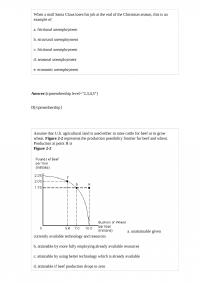
When a mall Santa Claus loses his job at the end of the Christmas season, this is an example of a. frictional unemployment b. structural unemployment c. frictional unemployment d. seasonal unemployment e. economic unemployment Assume that U.S. agricultural land […]
ECB 805
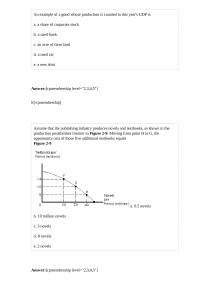
An example of a good whose production is counted in this year’s GDP is a. a share of corporate stock b. a used book c. an acre of farm land d. a used car e. a new shirt Assume that […]
ECB 866 Test 2
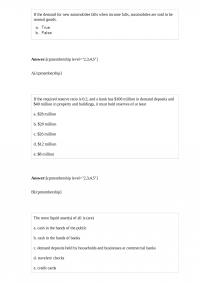
If the demand for new automobiles falls when income falls, automobiles are said to be normal goods. If the required reserve ratio is 0.2, and a bank has $100 million in demand deposits and $40 million in property and buildings, […]
ECB 870 Midterm 1
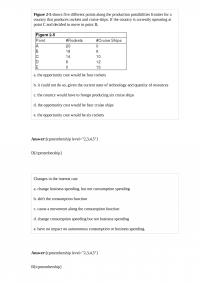
Figure 2-5 shows five different points along the production possibilities frontier for a country that produces rockets and cruise ships. If the country is currently operating at point C and decided to move to point B, a. the opportunity cost […]
ECB 883
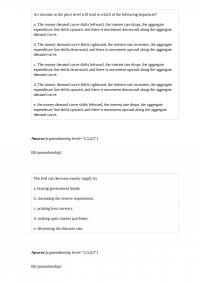
An increase in the price level will lead to which of the following sequences? a. The money demand curve shifts leftward, the interest rate drops, the aggregate expenditure line shifts upward, and there is movement downward along the aggregate demand […]
ECB 885 Final
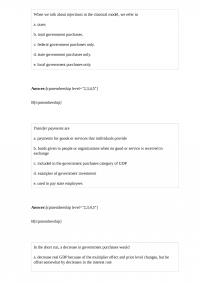
When we talk about injections in the classical model, we refer to a. taxes b. total government purchases. c. federal government purchases only. d. state government purchases only. e. local government purchases only. Transfer payments are a. payments for goods […]
ECB 897
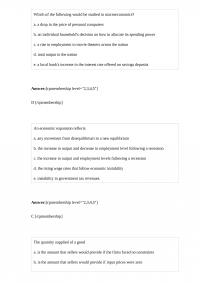
Which of the following would be studied in macroeconomics? a. a drop in the price of personal computers b. an individual household’s decision on how to allocate its spending power c. a rise in employment in movie theaters across the […]
ECON 215 Homework
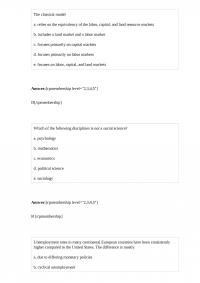
The classical model a. relies on the equivalency of the labor, capital, and land resource markets b. includes a land market and a labor market c. focuses primarily on capital markets d. focuses primarily on labor markets e. focuses on […]
ECON 238 Test
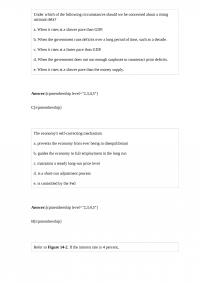
Under which of the following circumstances should we be concerned about a rising national debt? a. When it rises at a slower pace than GDP. b. When the government runs deficits over a long period of time, such as a […]
ECON 256
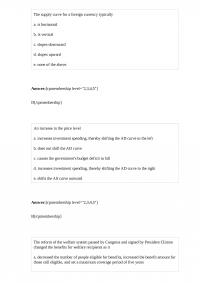
The supply curve for a foreign currency typically a. is horizontal b. is vertical c. slopes downward d. slopes upward e. none of the above. An increase in the price level a. increases investment spending, thereby shifting the AD curve […]
ECON 260 Quiz 2
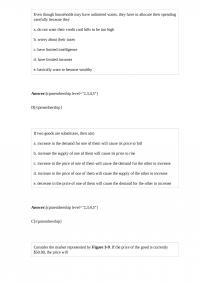
Even though households may have unlimited wants, they have to allocate their spending carefully because they a. do not want their credit card bills to be too high b. worry about their taxes c. have limited intelligence d. have limited […]
ECON 287 Midterm 2
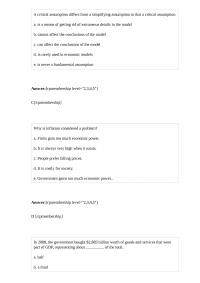
A critical assumption differs from a simplifying assumption in that a critical assumption a. is a means of getting rid of extraneous details in the model b. cannot affect the conclusions of the model c. can affect the conclusions of […]
ECON 317 Quiz 2
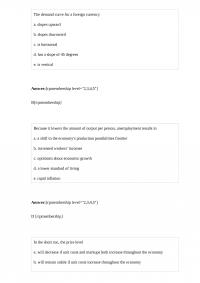
The demand curve for a foreign currency a. slopes upward b. slopes downward c. is horizontal d. has a slope of 45 degrees e. is vertical Because it lowers the amount of output per person, unemployment results in a. a […]
ECON 318
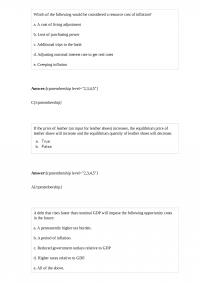
Which of the following would be considered a resource cost of inflation? a. A cost of living adjustment b. Loss of purchasing power c. Additional trips to the bank d. Adjusting nominal interest rate to get real rates e. Creeping […]
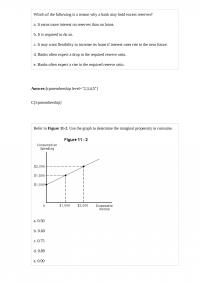
ECON 322 Test
Which of the following is a reason why a bank may hold excess reserves? a. It earns more interest on reserves than on loans. b. It is required to do so. c. It may want flexibility to increase its loans […]
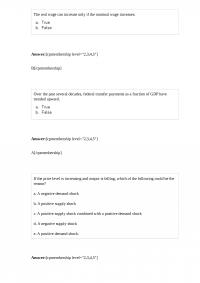
ECON 329 Quiz 1
The real wage can increase only if the nominal wage increases. Over the past several decades, federal transfer payments as a fraction of GDP have trended upward. Answer: A If the price level is increasing and output is falling, which […]
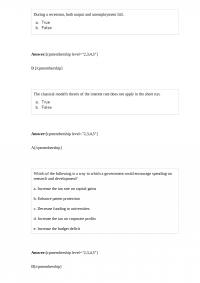
ECON 331 Quiz 2
During a recession, both output and unemployment fall. The classical model’s theory of the interest rate does not apply in the short run. Answer: A Which of the following is a way in which a government could encourage spending on […]
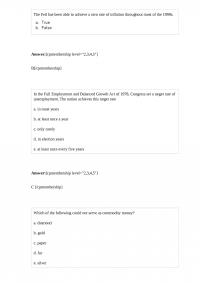
ECON 386 Midterm 2
The Fed has been able to achieve a zero rate of inflation throughout most of the 1990s. In the Full Employment and Balanced Growth Act of 1978, Congress set a target rate of unemployment. The nation achieves this target rate […]
ECON 440 Quiz 3
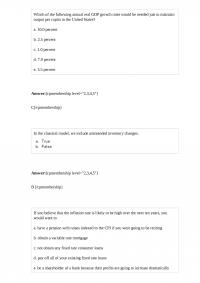
Which of the following annual real GDP growth rates would be needed just to maintain output per capita in the United States? a. 10.0 percent b. 2.5 percent c. 1.0 percent d. 7.0 percent e. 3.5 percent In the classical […]
ECON 444 Homework
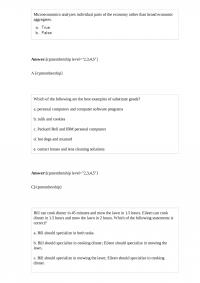
Microeconomics analyzes individual parts of the economy rather than broad economic aggregates. Which of the following are the best examples of substitute goods? a. personal computers and computer software programs b. milk and cookies c. Packard Bell and IBM personal […]
ECON 468 Quiz 2
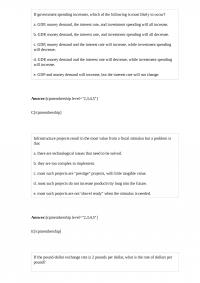
If government spending increases, which of the following is most likely to occur? a. GDP, money demand, the interest rate, and investment spending will all increase. b. GDP, money demand, the interest rate, and investment spending will all decrease. c. […]
ECON 499 Quiz 1
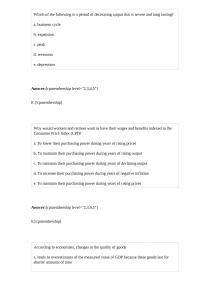
Which of the following is a period of decreasing output that is severe and long lasting? a. business cycle b. expansion c. peak d. recession e. depression Why would workers and retirees want to have their wages and benefits indexed […]
ECON 520
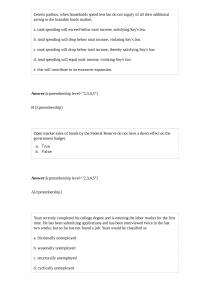
Ceteris paribus, when households spend less but do not supply of all their additional saving to the loanable funds market, a. total spending will exceed below total income, satisfying Say’s law. b. total spending will drop below total income, violating […]
ECON 554 Homework
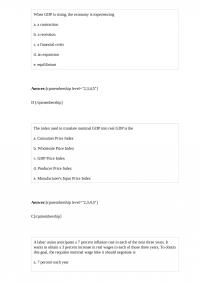
When GDP is rising, the economy is experiencing a. a contraction b. a recession c. a financial crisis d. an expansion e. equilibrium The index used to translate nominal GDP into real GDP is the a. Consumer Price Index b. […]
ECON 577
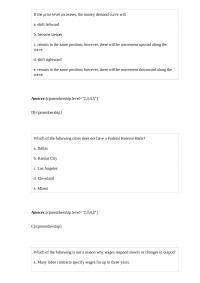
If the price level increases, the money demand curve will a. shift leftward b. become steeper c. remain in the same position; however, there will be movement upward along the curve d. shift rightward e. remain in the same position; […]
ECON 701 Test 1
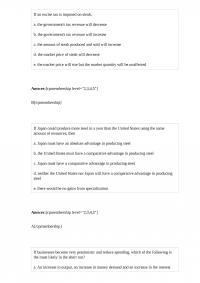
If an excise tax is imposed on steak, a. the government’s tax revenue will decrease b. the government’s tax revenue will increase c. the amount of steak produced and sold will increase d. the market price of steak will decrease […]
ECON 707 Quiz 3
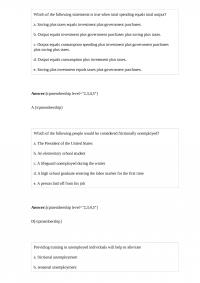
Which of the following statements is true when total spending equals total output? a. Saving plus taxes equals investment plus government purchases. b. Output equals investment plus government purchases plus saving plus taxes. c. Output equals consumption spending plus investment […]
ECON 708
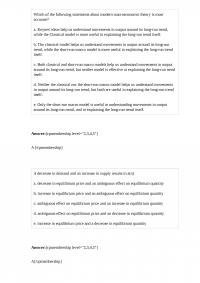
Which of the following statements about modern macroeconomic theory is most accurate? a. Keynes’ ideas help us understand movements in output around its long-run trend, while the Classical model is more useful in explaining the long-run trend itself. b. The […]
ECON 722 Quiz 2
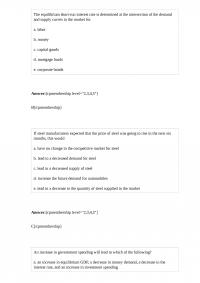
The equilibrium short-run interest rate is determined at the intersection of the demand and supply curves in the market for a. labor b. money c. capital goods d. mortgage funds e. corporate bonds If steel manufacturers expected that the price […]
ECON 752 Test
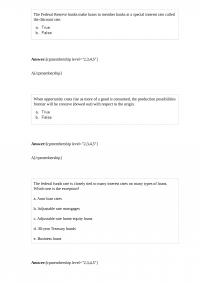
The Federal Reserve banks make loans to member banks at a special interest rate called the discount rate. When opportunity costs rise as more of a good is consumed, the production possibilities frontier will be concave (bowed out) with respect […]
ECON 837 Quiz 2
Which of the following is the definition of a capital gain? a. An increase in a firm’s capital stock b. Profit earned from selling a financial asset c. The dividend earned from a company’s stock d. Taxes saved by selling […]
ECON A 133 Midterm
When analyzing the housing market, the supply curve a. will be upward sloping because the higher the price of a house the more that will exist b. will be horizontal to illustrate that the supply of housing is a stock […]
ECON A 152 Final
If the base year for an index is 2005 and the value of the index in 2008 is 165.1, by what percent has the measure grown over those 3 years? a. 165.1 percent b. 100.0 percent c. 6.51 percent d. […]
ECON A 169
Many less developed countries have low rates of economic growth because a. high population growth rates reduce living standards b. low population growth rates result in an inadequate labor supply c. high current output per capita reduces incentives for growth […]
ECON A 314
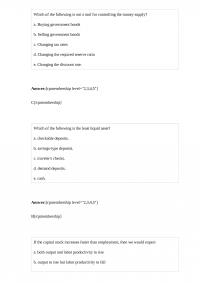
Which of the following is not a tool for controlling the money supply? a. Buying government bonds b. Selling government bonds c. Changing tax rates d. Changing the required reserve ratio e. Changing the discount rate. Which of the following […]
ECON A 358 Quiz 2
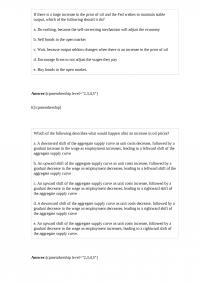
If there is a large increase in the price of oil and the Fed wishes to maintain stable output, which of the following should it do? a. Do nothing, because the self-correcting mechanism will adjust the economy b. Sell bonds […]
ECON A 392 Homework
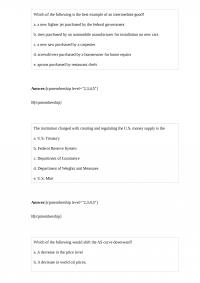
Which of the following is the best example of an intermediate good? a. a new fighter jet purchased by the federal government b. tires purchased by an automobile manufacturer for installation on new cars c. a new saw purchased by […]
ECON A 414 Quiz
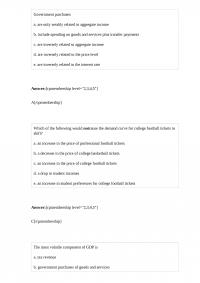
Government purchases a. are only weakly related to aggregate income b. include spending on goods and services plus transfer payments c. are inversely related to aggregate income d. are inversely related to the price level e. are inversely related to […]
ECON A 430 Homework
A rise in the interest rate tends to a. reduce many kinds of spending b. stimulate investment in high-profit industries c. cause bond prices to increase d. encourage confidence in the Fed’s control over the economy e. suggest a downturn […]
ECON A 471 Final
Susie grows corn in her backyard garden to feed her family. The corn she grows is not counted in GDP because a. it was not produced for the marketplace b. it is an intermediate good that Susie will process further […]
ECON A 482 Final
All cash within the geographical boundaries of the United States is counted as part of the U.S. money supply. Managed floats are only effective in the long run. Answer: B A monetary system is what allows us to a. earn […]
ECON A 529 Quiz 2
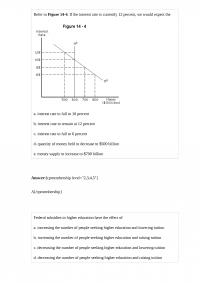
Refer to Figure 14-4. If the interest rate is currently 12 percent, we would expect the a. interest rate to fall to 10 percent b. interest rate to remain at 12 percent c. interest rate to fall to 6 percent […]
ECON A 530 Quiz 2
For the two year period ending in 2008-2009, what has been the number of bank failures? a. About 500 b. About 2,000 c. Fewer than 150 d. More than 5,000 e. Fewer than 1,000 According to the law of increasing […]
ECON A 531
The level of detail in an economic model a. is as close as possible to the level of detail in reality b. depends on the purpose of the model c. is as complex as possible d. is the same regardless […]
ECON A 606 Midterm 1
Due to society’s overall scarcity of resources, a. only households are constrained by income b. only government agencies are constrained by limited budgets c. only business firms are constrained by the cost of buying their inputs d. households, business firms […]
ECON A 630 Quiz 3
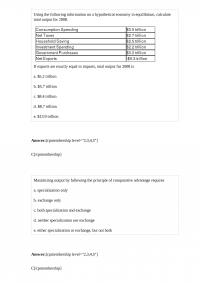
Using the following information on a hypothetical economy in equilibrium, calculate total output for 2008. If exports are exactly equal to imports, total output for 2008 is a. $5.2 trillion b. $5.7 trillion c. $8.4 trillion d. $8.7 trillion e. […]
ECON A 663
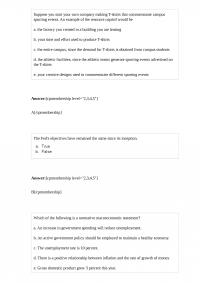
Suppose you start your own company making T-shirts that commemorate campus sporting events. An example of the resource capital would be a. the factory you created in a building you are leasing b. your time and effort used to produce […]
ECON A 689 If the Federal Reserve
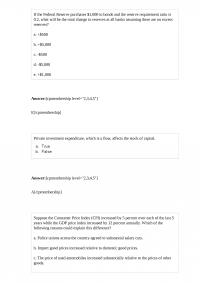
If the Federal Reserve purchases $1,000 in bonds and the reserve requirement ratio is 0.2, what will be the total change in reserves at all banks assuming there are no excess reserves? a. +$500 b. +$5,000 c. -$500 d. -$5,000 […]
ECON A 788 Quiz
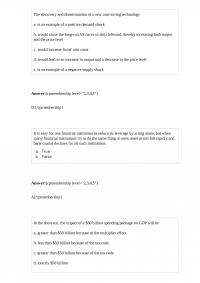
The discovery and dissemination of a new cost-saving technology a. is an example of a positive demand shock b. would cause the long-run AS curve to shift leftward, thereby increasing both output and the price level c. would increase firms’ […]
ECON A 848 Test 1
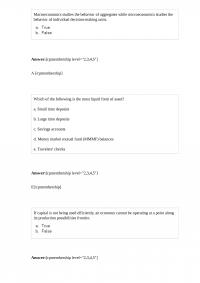
Macroeconomics studies the behavior of aggregates while microeconomics studies the behavior of individual decision-making units. Which of the following is the most liquid form of asset? a. Small time deposits b. Large time deposits c. Savings accounts d. Money market […]
ECON A 849 Quiz 1
In the classical view, all markets clear, except the labor market. Suppose that equilibrium in the dollar-pound market occurs where 300 million pounds are demanded at a price of $1.75 per pound. If the current exchange rate is $1.60 per […]
ECON A 854 Homework
Which of the following best defines the specialization of resources? a. Workers are compensated as individuals. b. Special resources are needed to produce most goods. c. Each resource is paid for in full. d. Each resource is paid the most […]
ECON A 869 Final
Oil and Natural Gas can each be used as a source of energy and are, for many purposes interchangeable. Which of the following best explains the increase in the price of natural gas that accompanied the increase in the price […]
ECON E 110 Quiz
In the U.S. over the past century, increases in labor a. supply have outpaced increases in labor demand, causing the average wage rate to fall b. supply have outpaced increases in labor demand, causing the average wage rate to rise […]
ECON E 122 Test 2
If the price of bonds rises, a. the Fed will decrease the money supply b. the Fed will increase the money supply c. the interest rate will rise d. the interest rate will fall e. inflation must be accelerating An […]
ECON E 151 Quiz 2
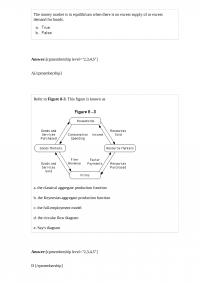
The money market is in equilibrium when there is no excess supply of or excess demand for bonds. Refer to Figure 8-3. This figure is known as a. the classical aggregate production function b. the Keynesian aggregate production function c. […]
ECON E 168 Quiz 2
The law of supply says that a. supply and income are inversely related b. supply follows demand c. quantity supplied equals quantity demanded d. price and quantity supplied are inversely related e. price and quantity supplied are directly related Suppose […]
ECON E 237 Homework
Whenever prices are rising, the inflation rate is rising. The Federal Reserve Banking Act of 1978 a. attempted to guarantee stability of the banking system b. was a reaction to the savings and loan crisis c. added full employment to […]
ECON E 290
Which of the following would be the best example of a spot market? a. the market for fine art b. the market for bananas c. the market for stocks and bonds d. the market for baseball cards Which of the […]
ECON E 333 Quiz
Carl is considering attending a concert with a ticket price of $35. He estimates that the cost of driving to the concert and parking there will total an additional $20. In order to attend the concert, Carl will have to […]
ECON E 372 Test
Which combination of government policies would be most likely to increase labor supply? a. Increasing income tax rates and cutting transfer payments to the needy b. Decreasing income tax rates and cutting transfer payments to the needy c. Decreasing income […]
ECON E 372 Test 1
In what way is the result of an excise tax imposed on either demanders or suppliers similar to the result of a price ceiling? a. The amount that consumers pay for the good will be less than they previously paid […]
ECON E 421
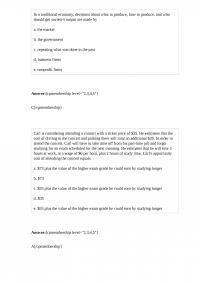
In a traditional economy, decisions about what to produce, how to produce, and who should get society’s output are made by a. the market b. the government c. repeating what was done in the past d. business firms e. nonprofit […]
ECON E 426 Quiz
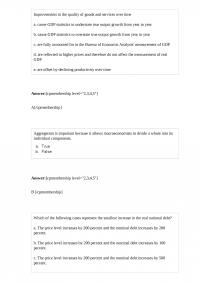
Improvements in the quality of goods and services over time a. cause GDP statistics to understate true output growth from year to year b. cause GDP statistics to overstate true output growth from year to year c. are fully accounted […]
ECON E 437 Midterm 1
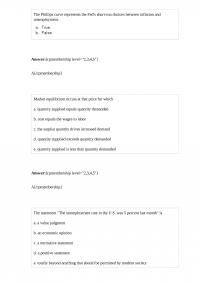
The Phillips curve represents the Fed’s short-run choices between inflation and unemployment. Market equilibrium occurs at that price for which a. quantity supplied equals quantity demanded b. cost equals the wages to labor c. the surplus quantity drives increased demand […]
ECON E 452 Homework
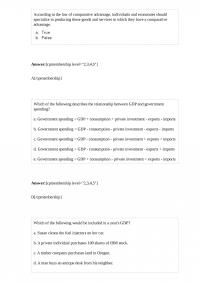
According to the law of comparative advantage, individuals and economies should specialize in producing those goods and services in which they have a comparative advantage. Which of the following describes the relationship between GDP and government spending? a. Government spending […]
ECON E 490 Homework
If the Federal Reserve unexpectedly raised its interest rate target, which of the following would most likely occur? a. The interest rate would increase and bond prices would rise. b. The interest rate would decrease and bond prices would rise. […]
ECON E 555 Final
An increase in government spending leads to a(n) a. downward shift of the aggregate expenditure line and a leftward shift of the money demand curve b. upward shift of the aggregate expenditure line and a rightward shift of the money […]
ECON E 559 Midterm 1
The AD curve is derived by adding up demand curves for all goods and services. If inflation is higher than anticipated and benefits are not indexed, which group loses purchasing power? a. Borrowers and lenders b. Lenders and retirees c. […]
ECON E 565 Homework
Suppose that the United States has an absolute advantage over Mexico in producing both agricultural and manufactured goods. In the U. S., the opportunity cost of 1 unit of agricultural output is 2 units of manufactured goods. In Mexico, the […]
ECON E 583 Midterm 2
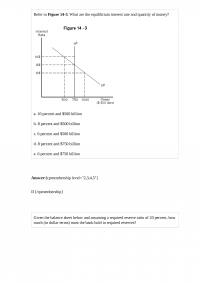
Refer to Figure 14-3. What are the equilibrium interest rate and quantity of money? a. 10 percent and $500 billion b. 8 percent and $500 billion c. 6 percent and $500 billion d. 8 percent and $750 billion e. 6 […]
ECON E 590 Midterm 2
In macroeconomics, a. we study one market at a time b. we try to understand how the entire economy behaves c. we focus on large, important products and ignore the rest d. we study one nation’s economy only e. we […]
ECON E 615 Quiz 2
An economic model a. uses equations to understand normative economic phenomena b. often omits crucial elements c. simplifies reality in order to focus on crucial elements d. tries to make simple concepts more complex e. cannot be proven wrong The […]
ECON E 674 Test
Where is the interest rate determined in the classical model? a. In the goods market b. In the loanable funds market c. By the federal government d. By the Fed e. Where aggregate expenditure equals GDP. If a change in […]
ECON E 687 Quiz 1
All production involves an opportunity cost because a. to produce costs money b. costs of production are sky rocketing c. to produce more of one thing, we must produce more of everything d. to produce more of one thing, we […]
ECON E 807 Midterm
For society as a whole, producing more of one good or service has an opportunity cost because a. human wants are limited and resources are unlimited b. both human wants and resources are unlimited c. resources are limited; human wants […]
ECON E 853 Midterm 1
Congress created the Federal Deposit Insurance Corporation to a. sell insurance to individuals who have bank accounts b. inject reserves into the economy more quickly c. develop a better working relationship between bank managers and government officials d. charge higher […]
ECON E 856 Test 1
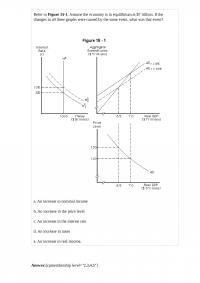
Refer to Figure 15-1. Assume the economy is in equilibrium at $7 trillion. If the changes in all three graphs were caused by the same event, what was that event? a. An increase in nominal income b. An increase in […]
ECON E 884 Quiz
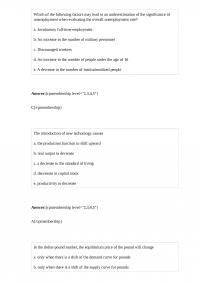
Which of the following factors may lead to an underestimation of the significance of unemployment when evaluating the overall unemployment rate? a. Involuntary full-time employment b. An increase in the number of military personnel c. Discouraged workers d. An increase […]
Economics 211 Quiz 2 By driving
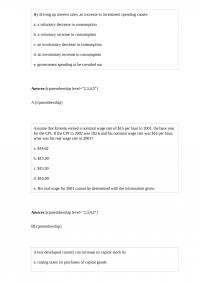
By driving up interest rates, an increase in investment spending causes a. a voluntary decrease in consumption b. a voluntary increase in consumption c. an involuntary decrease in consumption d. an involuntary increase in consumption e. government spending to be […]
Economics 307 Midterm
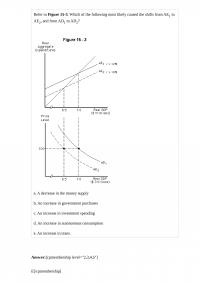
Refer to Figure 15-3. Which of the following most likely caused the shifts from AE1 to AE2, and from AD1 to AD2? a. A decrease in the money supply b. An increase in government purchases c. An increase in investment […]
Economics 308
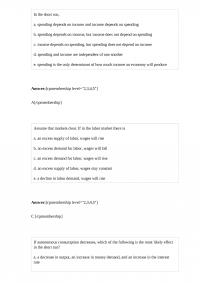
In the short run, a. spending depends on income and income depends on spending b. spending depends on income, but income does not depend on spending c. income depends on spending, but spending does not depend on income d. spending […]
Economics 337 Test 1
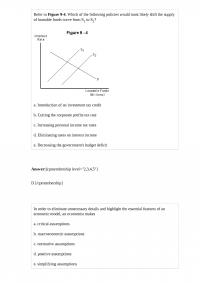
Refer to Figure 9-4. Which of the following policies would most likely shift the supply of loanable funds curve from S1 to S2? a. Introduction of an investment tax credit b. Cutting the corporate profits tax rate c. Increasing personal […]
Economics 438 Midterm 2
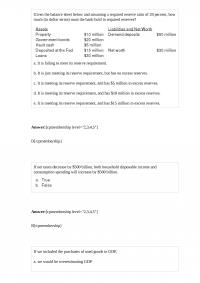
Given the balance sheet below and assuming a required reserve ratio of 20 percent, how much (in dollar terms) must the bank hold in required reserves? a. It is failing to meet its reserve requirement. b. It is just meeting […]
Economics 449 Test 2
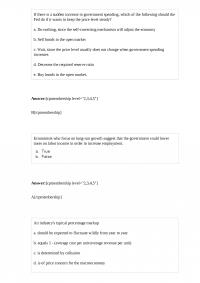
If there is a sudden increase in government spending, which of the following should the Fed do if it wants to keep the price level steady? a. Do nothing, since the self-correcting mechanism will adjust the economy b. Sell bonds […]
Economics 571
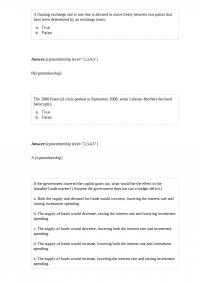
A floating exchange rate is one that is allowed to move freely between two points that have been determined by an exchange treaty. The 2008 financial crisis peaked in September 2008, when Lehman Brothers declared bankruptcy. Answer: A If the […]
Economics 599 Midterm
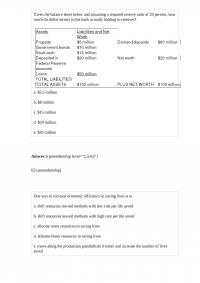
Given the balance sheet below and assuming a required reserve ratio of 20 percent, how much (in dollar terms) is this bank actually holding in reserves? a. $3.5 million b. $8 million c. $15 million d. $20 million e. $35 […]
Economics 641
The money demand curve indicates the total quantity of money demanded in the economy at each a. price level b. level of GDP c. quantity of money supplied d. level of income e. interest rate “The Consumer Price Index increased […]
Economics 771
Stagflation a. is caused by a negative demand shock b. is theoretically impossible c. is a long-run phenomenon d. was rampant during the Great Depression e. is the combination of rising price levels and negative GDP growth Suppose that the […]
Economics 824 Midterm 2
Macroeconomics studies the determination of a. total output, total employment, the general price level, and the general level of interest rates b. total output and the general level of interest rates only c. total employment and the general level of […]
Economics 883 Test 1
In the long-run AS-AD model, a. the position of the AD curve determines output b. the self-correcting mechanism of the economy is irrelevant c. the AS curve shifts leftward whenever the economy is growing d. the position of the AD […]
MicroEconomic 102 Midterm
If people work longer or harder, a. they are unambiguously worse off b. living standards will rise but nonmarket activities must be sacrificed c. living standards will fall d. more output can be produced, but living standards will fall e. […]
MicroEconomic 111 Midterm 2
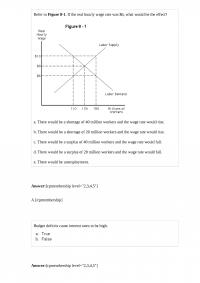
Refer to Figure 8-1. If the real hourly wage rate was $6, what would be the effect? a. There would be a shortage of 40 million workers and the wage rate would rise. b. There would be a shortage of […]
MicroEconomic 182 Quiz 1
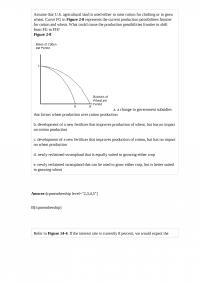
Assume that U.S. agricultural land is used either to raise cotton for clothing or to grow wheat. Curve FG in Figure 2-8 represents the current production possibilities frontier for cotton and wheat. What could cause the production possibilities frontier to […]
MicroEconomic 216 Test 1
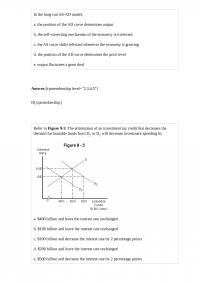
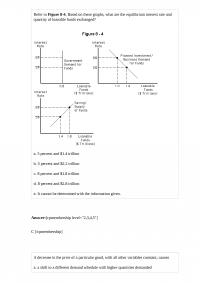
Refer to Figure 8-4. Based on these graphs, what are the equilibrium interest rate and quantity of loanable funds exchanged? a. 5 percent and $1.4 trillion b. 5 percent and $2.2 trillion c. 8 percent and $1.8 trillion d. 8 […]
MicroEconomic 234
Which of the following is a definition of the consumption function? a. A functional relationship between real consumption spending and real disposable income b. A functional relationship between real consumption spending and the interest rate c. A functional relationship between […]
MicroEconomic 249
Stagflation is caused by a. a negative supply shock. b. a positive supply shock. c. a negative demand shock. d. a positive demand shock. e. none of the above. If Cathy has a bond that will pay $1,000 one year […]
MicroEconomic 251 Midterm
To approximate the percentage change in real income over any period of time, a. we need to subtract the percentage change in nominal income from the inflation rate b. we need to subtract the rate of inflation from the percentage […]
MicroEconomic 264
We say there is productive inefficiency in saving lives if a. there is some way to save more lives b. there is some way to save more lives without sacrificing any other goods or services c. all resources are devoted […]
MicroEconomic 313 Final
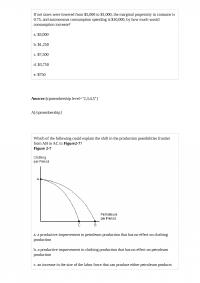
If net taxes were lowered from $5,000 to $1,000, the marginal propensity to consume is 0.75, and autonomous consumption spending is $10,000, by how much would consumption increase? a. $3,000 b. $1,250 c. $7,500 d. $3,750 e. $750 Which of […]
MicroEconomic 389 Final
Of the following, which is true of the relationship between the quantity of a good supplied and its price? a. As price increases, the quantity supplied usually decreases. b. As price increases, the quantity supplied usually increases. c. As price […]
MicroEconomic 402
As its capital stock increases, a nation will a. move rightward along a fixed production function b. move leftward along a fixed production function c. find its production function shifting upward d. find its production function shifting downward e. experience […]
MicroEconomic 473
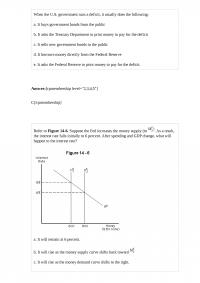
When the U.S. government runs a deficit, it usually does the following: a. It buys government bonds from the public b. It asks the Treasury Department to print money to pay for the deficit c. It sells new government bonds […]
MicroEconomic 485 Test 2
If inflation is perfectly anticipated, benefits are indexed, and there are no restrictions on contracts, which group loses purchasing power because of inflation? a. Borrowers, lenders and retirees b. Only borrowers c. Neither lenders, borrowers, nor retirees d. Only lenders […]
MicroEconomic 503
If people start to use cash because of an increase in credit card fraud, which of the following would we expect to happen under a neutralization policy? a. The money supply would decrease, real GDP would not change, and the […]
MicroEconomic 523 Quiz
The difference between microeconomics and macroeconomics is that a. microeconomics deals with only small numbers while macroeconomics is always dealing with numbers in the billions and trillions b. microeconomics deals with the economy as a whole while macroeconomics deals with […]
MicroEconomic 524 Quiz 3
A decrease in the interest rate reduces the opportunity cost of holding money. Open market sales of bonds by the Federal Reserve reduce the money supply and a. reduce aggregate expenditures b. increase real aggregate expenditures c. are helpful in […]
MicroEconomic 528 Final
Suppose the Federal Reserve wants to increase the money supply. Which combination of actions would lead to the appropriate effect? a. Increase the discount rate, decrease the reserve ratio, sell bonds. b. Increase the discount rate, decrease the reserve ratio, […]
MicroEconomic 566 Test 2
Inflation will generally redistribute purchasing power when a. it is fully expected b. it is completely unexpected c. it is greater than 3 percent d. it is greater than 5 percent e. it is greater than 10 percent Which of […]
MicroEconomic 571 Test 2
The real interest rate on a loan a. is the amount that the consumer agrees to pay b. is always the same as the nominal rate c. is always greater than the nominal rate d. is only of concern when […]
MicroEconomic 622
If the Fed has a goal of stable real GDP and the government announces a tax cut, which of the following would occur? a. Money demand would not change, real GDP would not change, the interest rate would decrease, and […]
MicroEconomic 634 Quiz
The economy’s money supply curve is vertical. In the classical model, beginning from an equilibrium in which the government is running a budget surplus a. the supply of loanable funds will be horizontal b. an increase in government spending will […]
MicroEconomic 674 Quiz 3
As long as the loanable funds market clears, Say’s law holds.. Of the following, which could cause the demand curve for personal computers to shift to the left? a. a decrease in the price of personal computers b. an increase […]
MicroEconomic 729 Midterm
If inflation is correctly anticipated, in a transaction between borrowers and lenders, inflation a. will not reduce purchasing power of the money paid back b. will redistribute purchasing power from borrowers to lenders c. will not redistribute purchasing power d. […]
MicroEconomic 750 Midterm 2
If a ship-building company purchases $250 million worth of steel in one year but does not use it, this is considered investment spending. Which of the following is a weakness in trying to get the wealthy to bear more of […]
MicroEconomic 785 Midterm 2
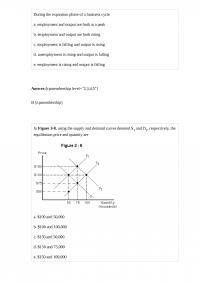
During the expansion phase of a business cycle a. employment and output are both at a peak b. employment and output are both rising c. employment is falling and output is rising d. unemployment is rising and output is falling […]
MicroEconomic 797
If the Fed has a goal of stable real GDP and government spending increased, which of the following would occur? a. The money demand would not change, real GDP would not change, the interest rate would decrease, and there would […]
MicroEconomic 819 Midterm 1
The inflation rate for a given year is found by taking the percentage change in the Consumer Price Index (CPI) from the base year to the year in question. The idea of opportunity cost suggests that the cost of a […]
MicroEconomic 858 Midterm
Thomas Malthus argued that population grows geometrically and the food supply grows arithmetically. The labor supply curve a. slopes upward to illustrate that more people will want to work as the real wage increases b. slopes upward to illustrate that […]
MicroEconomic 877
In the long run, supply shocks a. are of no concern b. are automatically offset so that the full-employment level of output is restored c. cause the long-run AS curve to shift d. have no effect on the wage rate […]
MicroEconomic 891 Midterm 1
If the U.S. inflation rate is 3 percent annually and the Japanese inflation rate is 1 percent annually, by what percent would the dollar price of the yen need to change according to purchasing power parity? a. Appreciate by 2 […]
MicroEconomic 898 Quiz 2
The marginal propensity to consume is greater than zero but less than one. The consumption function shows the relationship between real consumption spending and a. real wealth b. the interest rate c. expectations d. real disposable income e. debt Answer: […]