
Stagflation is caused by
a. a negative supply shock.
b. a positive supply shock.
c. a negative demand shock.
d. a positive demand shock.
e. none of the above.
If Cathy has a bond that will pay $1,000 one year from now and its current price is
$800, what is the current interest rate?
a. 10 percent
b. 25 percent
c. 20 percent
d. 200 percent
e. 2 percent
Suppose you are the president of a large bank. In which situation would you be most
reluctant to loan money to a country?
a. Its nominal debt is $10 trillion.
b. Its nominal debt is 1 percent of nominal GDP.
c. Its nominal deficit is $150 billion.
d. Its real deficit is 100 percent of real GDP.
e. Its real debt is 1 percent of real GDP.
A decrease in the government’s budget deficit will
a. increase the supply of loanable funds, lower the interest rate, and increase investment
spending
b. reduce the supply of loanable funds, raise the interest rate, and reduce investment
c. increase the demand for loanable funds, raise the interest rate, and reduce investment
spending
d. reduce the demand for loanable funds, lower the interest rate, and increase
investment spending
e. increase the supply of loanable funds, reduce the demand for loanable funds, leave
the interest rate unchanged, and increase investment spending
Aggregation is important because it allows many individual variables to be combined
into one larger whole.

Inventory changes (that is, goods produced but not sold) are important in calculating
GDP because
a. they are the least volatile component of investment
b. these changes mean the economy has extra goods available for purchase
c. they are an example of transfer payments
d. GDP includes all possible sources for goods and services
e. we want to measure all current production when computing GDP
Which of the following would be example(s) of the resource cost of inflation?
a. Shopping several web sites to check prices
b. Changing price tags
c. Re-printing menus
d. The wear and tear on your car from additional trips to the bank
e. All of the above

Transfer payments are important for society because
a. the government needs to perform acts of goodwill to maintain citizens’ support
b. we could not count GDP without them
c. they serve to redistribute money from one group of citizens to another
d. government investment is an important component of GDP
e. they result in lower taxes for citizens
Which of the following is a transfer payment?
a. The federal government’s budget deficit
b. Unemployment compensation payments
c. Military spending
d. Wages of government employees
e. The excise tax on gasoline.
If Chris can produce a service using fewer resources than Pat would, then Chris
a. has an absolute advantage in producing that service
b. has a comparative advantage in producing that service
c. has both an absolute advantage and a comparative advantage in producing that
service
d. is productively efficient
e. cannot have a comparative advantage in producing that service
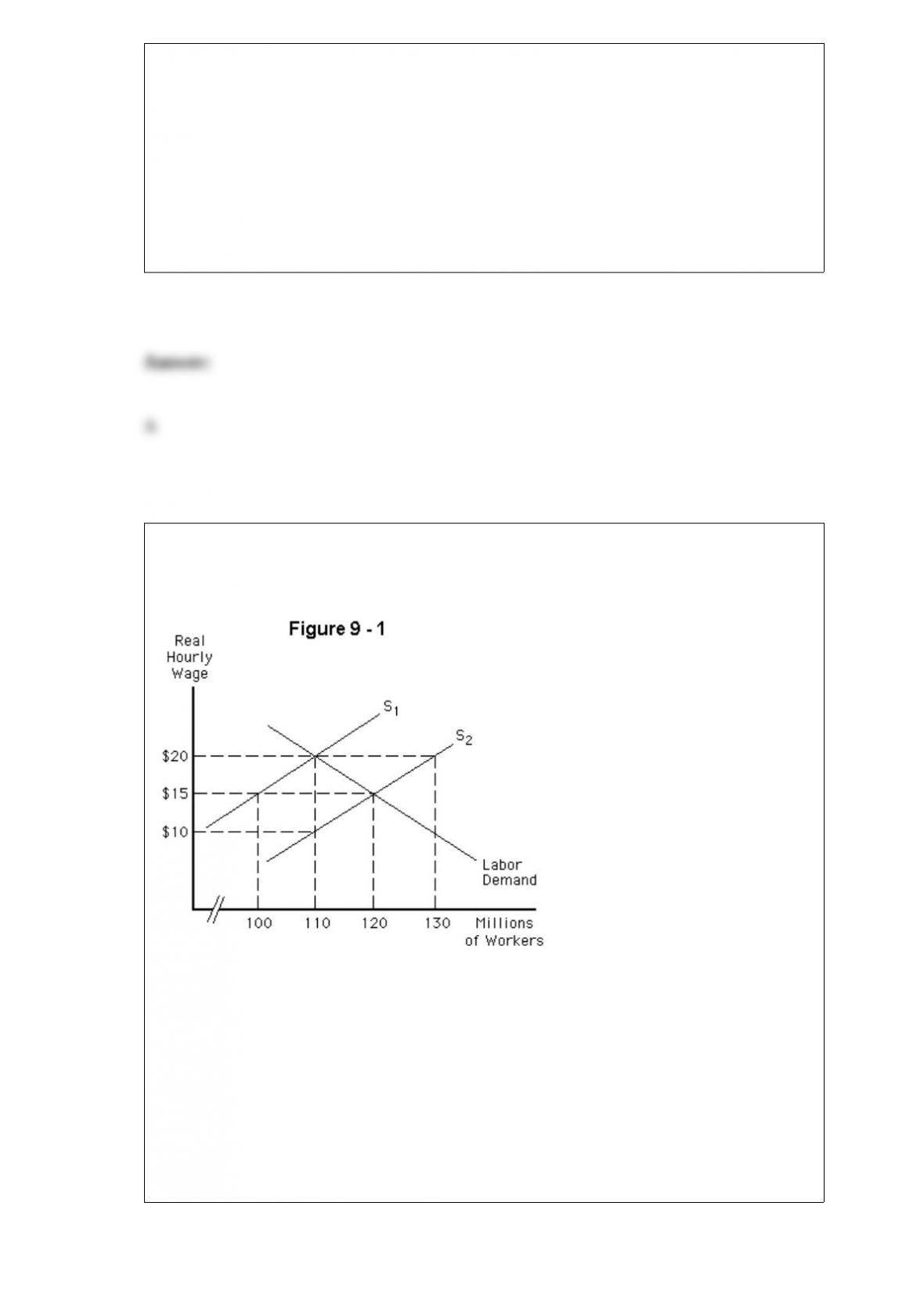
Refer to Figure 9-1. If labor supply shifts from S1 to S2, what will happen to the real
hourly wage rate?
a. It will remain constant and employment will increase to 130 million
b. It will fall to $15 and employment will increase to 120 million
c. It will fall to $10 and employment will remain at 110 million
d. It will fall to $15 and employment will remain at 110 million
e. It will fall to $15 and employment will fall to 100 million

Even though households do not actually purchase certain items, the government
estimates and adds to the consumption component what the household would pay for
these items in the marketplace. An example of this type of item is
a. a car that an individual builds from parts of old cars
b. food that a farm family grows for themselves
c. a pond that a household member digs by hand
d. police and fire protection
e. a barn that a household builds on their own property
Which of the following would be classified as a consumer nondurable?
a. New clothing
b. A new central heating system
c. A new car
d. A new bedroom suite
e. A new riding mower

The two phases of the business cycle are
a. high economic growth and low economic growth
b. expansion and contraction
c. expansion and depression
d. high inflation and low inflation
e. potential economic growth and actual economic growth