
An increase in the price level will lead to which of the following sequences?
a. The money demand curve shifts leftward, the interest rate drops, the aggregate
expenditure line shifts upward, and there is movement downward along the aggregate
demand curve.
b. The money demand curve shifts rightward, the interest rate increases, the aggregate
expenditure line shifts downward, and there is movement upward along the aggregate
demand curve.
c. The money demand curve shifts leftward, the interest rate drops, the aggregate
expenditure line shifts downward, and there is movement upward along the aggregate
demand curve.
d. The money demand curve shifts rightward, the interest rate increases, the aggregate
expenditure line shifts upward, and there is movement downward along the aggregate
demand curve.
e. the money demand curve shifts leftward, the interest rate drops, the aggregate
expenditure line shifts upward, and there is movement upward along the aggregate
demand curve.
The Fed can decrease money supply by
a. buying government bonds.
b. increasing the reserve requirement.
c. printing less currency.
d. making open market purchases.
e. decreasing the discount rate.

If GDP is $1,000, consumption is $750, interest payments are $200, rent payments are
$400, and profits are $200, what must wages and salaries equal?
a. $800
b. $400
c. $250
d. $0
e. $200
Which of the following is true for a market that clears?
a. An excess supply of anything traded will lead to a fall in its price.
b. An excess demand of anything traded will lead to a fall in its price.
c. An excess supply of anything traded will lead to a rise in its price.
d. An excess demand of anything traded will not lead to a price change.
e. A high price will lead to a high demand.
The chief economic cost of unemployment is
a. the value of the leisure that is lost when people are unemployed
b. the cost to employed citizens of paying unemployment benefits
c. money spent on the job search process
d. the chance that the unemployed might turn to crime to support themselves
e. the value of output that could have been produced, but is not
The Federal Open Market Committee (FOMC) controls the U.S. money supply by
buying and selling loans in the public loan market.
Under market capitalism, resources are allocated by
a. command and owned privately
b. the market and owned privately
c. command and owned by the state
d. the market and owned by the state
e. tradition and owned by all
The rise in equilibrium GDP shifts the money demand curve to the left.
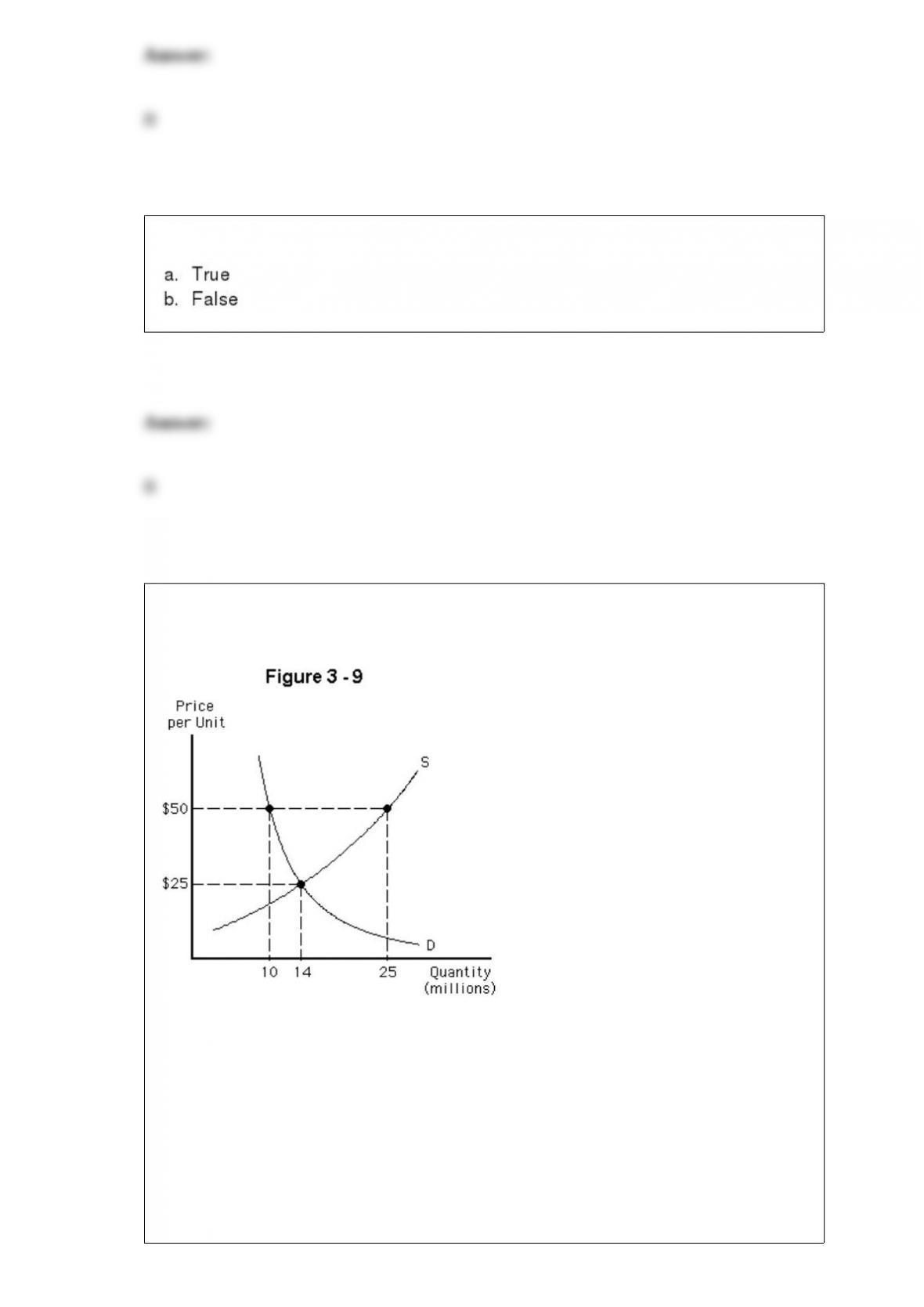
Which of the following statements about the market represented by Figure 3-9 is
correct?
a. At a price of $50.00, there is an excess supply of 11 million units.
b. At a price of $50.00, there is an excess demand of 11 million units.
c. At a price of $50.00, there is an excess supply of 15 million units.
d. At a price of $50.00, there is an excess demand of 15 million units.
e. At a price of $50.00, there is an excess demand of 25 million units.

If the government thinks the price that a consumer has to pay for a good is too high,
then which of the following would solve this problem?
a. a price ceiling or an excise tax
b. a price floor or an excise tax
c. a price ceiling or a subsidy
d. a price floor or a subsidy
e. none of the above will lower the price a consumer has to pay for a good
Which of the following is the most volatile component of private investment?
a. Plant and equipment purchases
b. New home construction
c. Purchases of services
d. Changes in business inventories
e. Consumption of nondurables

All of the following are examples of stock variables except one. Which one?
a. The amount of currency in circulation
b. The amount of money earned each week
c. The amount of money needed to construct a new building
d. The amount of money in a person’s savings account
e. The amount of money at the Fed
In calculating total spending, after adding together Consumption, Investment, and
Government Purchases, we must
a. add imports and subtract exports
b. add exports and subtract imports
c. compute net consumption and net investment by subtracting products produced
abroad
d. compute net consumption and net investment by adding products produced abroad
e. compute net consumption and net investment by add products consumed abroad
The ultimate purpose of building an economic model is to
a. challenge college students
b. constrain economic agents
c. predict behavior
d. change behavior
e. prevent behavior
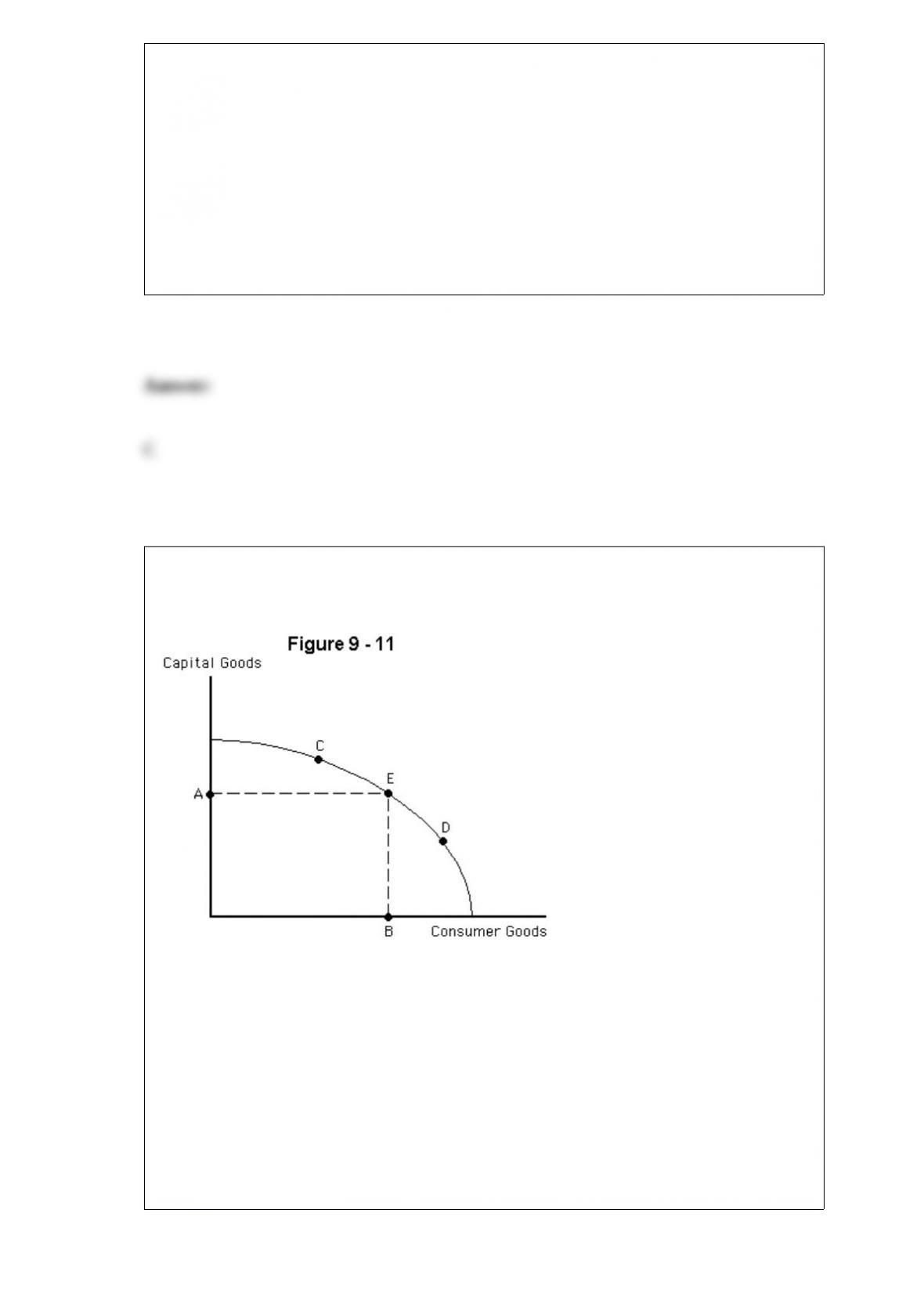
Refer to Figure 9-11. Which of the following would be most likely to move a less
developed country from point E to point C?
a. forcing the wealthy to reduce their consumption without reducing consumption for
the rest of the population
b. reducing the population growth rate
c. a consumption tax
d. a tax on financial transactions
e. decreasing the interest rate