Archives
978-0136088554 Appendix Appendix
Appendix A FINAL PROJECT, “APPLYING COMPUTER TECHNIQUES” This project works great. Students learn so much about the powerful tools for business communication: word processing and computer presentations. I emphasize that the students: Must teach the class, not just say a […]
978-0136088554 Chapter 1 Solution Manual
Chapter 1 WHAT IS GOOD WRITING? Chapter overview This brief chapter introduces Plain English and shows that it isn’t a simplistic, third-grade style of writing. Instead, it’s the way most professionals — in and out of business — write. And […]
978-0136088554 Chapter 10 Solution Manual
Chapter 10 MAKING THE MOST OF E-MAIL Chapter overview This chapter gives practical advice to students on how to use e-mail in a business-like way. It has four suggestions. Brief outline of the chapter I. Be brief. Readers of e-mail […]
978-0136088554 Chapter 11 Solution Manual
Chapter 11 WRITING FOR THE WEB Chapter overview This chapter acknowledges that the Web is too diverse to have one set of rules for writing for it. However, there are some principles Web authors should consider—because they apply most of […]
978-0136088554 Chapter 12 Solution Manual
Chapter 12 PREPARING A RESUME AND COVER LETTER Chapter overview This chapter tells students how to prepare a resume and cover letter — two documents of practical value to many students. Brief outline of the chapter I. Preparing a resume. […]
978-0136088554 Chapter 13 Solution Manual
Chapter 13 DOCUMENTING YOUR SOURCES Chapter overview This chapter covers the basics for both formal and informal documentation. My emphasis is on taking the mystery out of a relatively straightforward process. Brief outline of the chapter I. Identifying borrowed material. […]
978-0136088554 Chapter 14 Solution Manual
Chapter 14 WHAT IS BUSINESS SPEAKING? Chapter overview This brief chapter introduces business speaking. The emphasis is that most presentations succeed or fail long before the speaker stands up. The design of the presentation and proper rehearsal make all the […]
978-0136088554 Chapter 15 Solution Manual
Chapter 15 USING GOOD TECHNIQUES OF DELIVERY Chapter overview This chapter covers the fundamentals of delivering a presentation — eye contact and such. These fundamentals are important, of course, and most good speakers have them. But later chapters cover what […]
978-0136088554 Chapter 16 Solution Manual
Chapter 16 DEVELOPING A CLEAR STRUCTURE Chapter overview Most business presentations benefit from having an absolutely clear structure — a structure that members of the audience simply cannot get lost in. Brief outline of the chapter I. The introduction. Speakers […]
978-0136088554 Chapter 17 Solution Manual
Chapter 17 DESIGNING VISUAL AIDS Chapter overview This chapter gives detailed, practical advice for choosing and — especially — designing visual aids. Brief outline of the chapter I. Design your body slides using Master Slides. That way, the design will […]
978-0136088554 Chapter 18 Solution Manual
Chapter 18 GIVING A PRESENTATION USING A COMPUTER Chapter overview This chapter motivates students to use a computer presentation — and gives practical advice on how. Brief outline of the chapter I. What equipment do you need? This section briefly […]
978-0136088554 Chapter 19 Solution Manual
Chapter 19 REHEARSING, SETTING UP THE ROOM, AND OVERCOMING NERVOUSNESS Chapter overview This chapter takes students from the end of the design stage to the day of the presentation. Brief outline of the chapter I. Rehearsing, rehearsing. This section suggests […]
978-0136088554 Chapter 2 Solution Manual
Chapter 2 DEVELOPING A GOOD STYLE Chapter overview This chapter looks closely at the first key element of Plain English: writing clear, readable sentences. Most students will probably be surprised at how different Plain English is from typical academic writing. […]
978-0136088554 Chapter 20 Solution Manual
Chapter 20 PREPARING AN ANNOTATED PRESENTATION Chapter overview This chapter brings the book full circle—from Plain English writing to presentations to using Plain English writing for a paper (or electronic) copy of their presentations. Brief outline of the chapter I. […]
978-0136088554 Chapter 3 Solution Manual
Chapter 3 USING EXAMPLES AND COMPARISONS Chapter overview This chapter gives your students a crucial tool for doing the writing exercises: examples and comparisons. And what makes writing exercises communicate better also makes business writing communicate better. Brief outline of […]
978-0136088554 Chapter 4 Solution Manual
Chapter 4 MAKING YOUR PAGE LOOK INVITING Chapter overview This chapter looks closely at the second key element of Plain English: using an inviting layout that shows the underlying structure of the document. Brief outline of the chapter I. Choose […]
978-0136088554 Chapter 5 Solution Manual
Chapter 5 MAKING YOUR MAIN POINT EASY TO FIND Chapter overview This chapter looks closely at the third and final key element of Plain English: using a clear structure. Brief outline of the chapter I. Start with your main point. […]
978-0136088554 Chapter 6 Solution Manual
Chapter 6 PREPARING EXECUTIVE SUMMARIES Chapter overview This chapter looks closely at the most important part of almost any report—the executive summary. Brief outline of the chapter I. What is a report? Most reports have common elements in them—such as […]
978-0136088554 Chapter 7 Solution Manual
Chapter 7 ILLUSTRATING YOUR IDEAS Chapter overview This chapter shows how students can convert paragraphs full of words into images readers can understand more quickly. Brief outline of the chapter I. Tables. Tables aren’t really graphics, but they are a […]
978-0136088554 Chapter 8 Solution Manual
Chapter 8 GETTING BEYOND THE PERIOD AND COMMA Chapter overview Most students are at least a little uncomfortable with punctuation (and some, with good reason, are very uncomfortable!). This chapter helps with that discomfort, but the goal is more: to […]
978-0136088554 Chapter 9 Solution Manual
Chapter 9 LEARNING COMMONSENSE RULES Chapter overview This chapter helps students understand that some rules (like not ending sentences with prepositions) are myths — not even in most rule books. The chapter also covers three rules that students do need […]
CAS 31332
Because of space limitations, examples are normally inappropriate in an executive summary. a. true b. false Answer: Examples can be presented as bullet points. a. true b. false Answer: a Your cover slide should usually include: a. subtitle b. date […]
CAS 40923
When you’re showing a bullet slide: a. the first image should normally include the title but no bullets b. the first image should normally include the title and the first bullet c. the first image should normally include the title […]
COM CM 24656
Where is the most common place for a blueprint in a document? a. at the beginning b. near the beginning, just before you start your main discussion c. at the end d. near the end Answer: In e-mail, it’s generally […]
COMM 54062
Where is a good place for the bottom line in e-mail? a. at the bottom (or end) of the document b. near the bottom of the document c. in the subject line d. none of the above Answer: The following […]
COMM 64083
Navigation pages: a. take you to other pages b. don’t usually have a lot of content c. both of the above d. none of the above Answer: The Web can help you find fascinating information but it can also help […]
COMM 88476
Uppercase is good to use in e-mail: a. for headings b. for bullets c. both of the above d. none of the above Answer: Craftsmen include cabinetmakers, tile layers, and they include floor layers. a. correct sentence b. pronoun agreement […]
COMU 13479
Resumes and cover letters are mainly important for helping you: a. get a job b. get an interview c. get reviewers to read your cover letter d. none of the above Answer: You should normally try to stay under what […]
COMU 79430
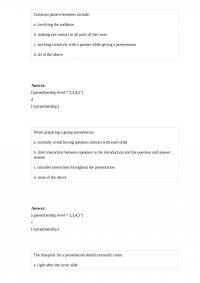
Common pattern-breakers include: a. involving the audience b. making eye contact to all parts of the room c. working creatively with a partner while giving a presentation d. all of the above Answer: When preparing a group presentation: a. normally […]
STM 15147
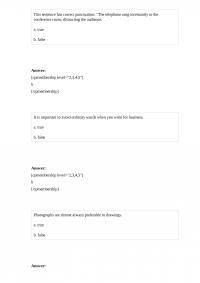
This sentence has correct punctuation: “The telephone rang incessantly in the conference room; distracting the audience. a. true b. false Answer: It is important to avoid ordinary words when you write for business. a. true b. false Answer: b Photographs […]