Archives
Civil Engineering Chapter 1 The copper and aluminum can be eliminated because they have stresses
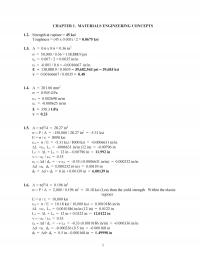
1 CHAPTER 1. MATERIALS ENGINEERING CONCEPTS 1.3. A = 0.6 x 0.6 = 0.36 in2 V = 50,000 / 0.36 = 138,888.9 psi Ha= 0.007 / 2 = 0.0035 in/in Hl = -0.001 / 0.6 = -0.0016667 in/in E = […]
Civil Engineering Chapter 10 I would choose sample B because higher specific gravity indicates more cellulose
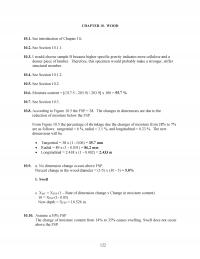
122 CHAPTER 10. WOOD 10.2. See Section 10.1.1. 10.3. I would choose sample B because higher specific gravity indicates more cellulose and a denser piece of lumber. Therefore, this specimen would probably make a stronger, stiffer structural member. 10.4. See […]
Civil Engineering Chapter 11 Increasing the steel fibers did not change the modulus of elasticity
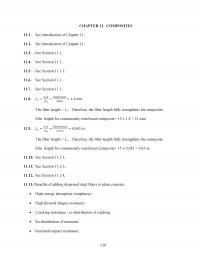
130 CHAPTER 11. COMPOSITES 11.2. See introduction of Chapter 11. 11.3. See Section 11.1. 11.4. See Section 11.1. 11.5. See Section 11.1.1. 11.6. See Section 11.1. 11.7. See Section 11.1. 11.8. The fiber length > Lc. Therefore, the fiber length […]
Civil Engineering Chapter 2 If the atomic masses and radii are the same, then the material that crystalizes into a lattice
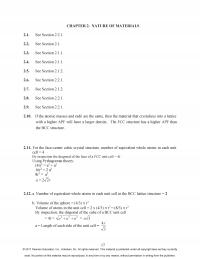
17 Volume of atoms in the unit cell = 2 x (4/3) Sr3= (8/3) S r3 By inspection, the diagonal of the cube of a BCC unit cell = 4r = aaa 222 = a3 a = Length of […]
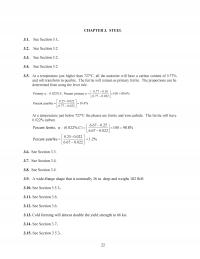
Civil Engineering Chapter 3 At a temperature just higher than 727C, all the austenite will have a carbon content
22 CHAPTER 3. STEEL 3.1See Section 3.1. 3.3See Section 3.2. 3.4See Section 3.2. 3.5. At a temperature just higher than 727qC, all the austenite will have a carbon content of 0.77% and will transform to pearlite. The ferrite will remain […]
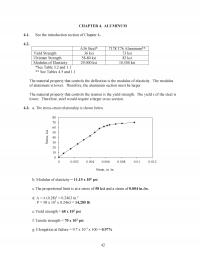
Civil Engineering Chapter 4 The material property that controls the deflection is the modulus of elasticity
42 CHAPTER 4. ALUMINUM 4.2. A36 Steel* 7178 T76 Aluminum** Yield Strength 36 ksi 73 ksi Ultimate Strength 58-80 ksi 83 ksi Modulus of Elasticity 29,000 ksi 10,500 ksi *See Table 3.2 and 1.1 ** See Tables 4.5 and 1.1 […]
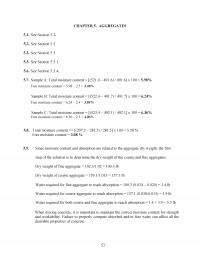
Civil Engineering Chapter 5 Since moisture content and absorption are related to the aggregate dry weight
53 5.1. See Section 5.2. 5.2. See Section 5.5. 5.3. See Section 5.5. 5.5. See Section 5.5.1. 5.6. See Section 5.5.4. 5.7. Sample A: Total moisture content = [(521.0 –491.6) / 491.6] x 100 = 5.98% Free moisture content = […]
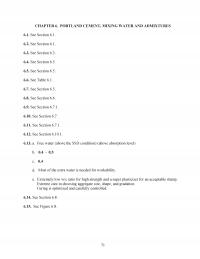
Civil Engineering Chapter 6 The two batches are expected to have about the same compressive strength
71 CHAPTER 6. PORTLAND CEMENT, MIXING WATER AND ADMIXTURES 6.2. See Section 6.1 6.3. See Section 6.3 6.4. See Section 6.5 6.5. See Section 6.5. 6.6. See Table 6.1 6.7. See Section 6.5 6.8. See Section 6.6 6.9. See Section […]
Civil Engineering Chapter 7 Assume the nominal maximum size of coarse aggregate
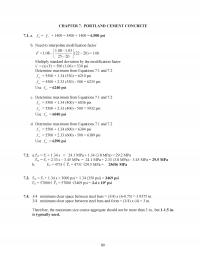
80 CHAPTER 7. PORTLAND CEMENT CONCRETE 7.1. a. f c r ‘ = f c ‘ + 1400 = 5500 + 1400 = 6,900 psi b. Need to interpolate modification factor 2025 03.108.1 ¹ · © § Multiply […]
Civil Engineering Chapter 7 The third point loading ensures that the following two conditions
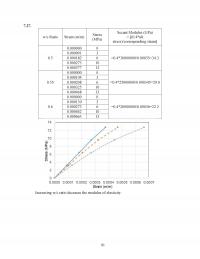
91 0.55 =0.4*25000000/0.000345=29.0 0.000208 6 0.000325 10 0.000468 13 0.6 0.000000 0 =0.4*20000000/0.00036=22.2 0.000130 3 0.000273 6 0.000442 10 0.000663 13 Increasing w/c ratio deceases the modulus of elasticity. 7.27 w/c Ratio Strain (m/m) Stress (MPa) Secant Modulus (GPa) = […]
Civil Engineering Chapter 8 To reduce the effect of weathering and to limit the amount of shrinkage
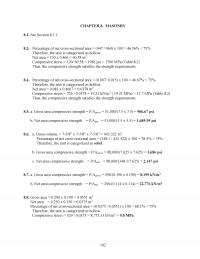
102 CHAPTER 8. MASONRY 8.1. See Section 8.1.1. 8.3. Percentage of net cross-sectional area = (447 / 960) x 100 = 46.56% < 75% Therefore, the unit is categorized as hollow. 8.4. Percentage of net cross-sectional area = (0.007/ 0.015) […]
Civil Engineering Chapter 9 Meeting specification requirements quality control and quality assurance
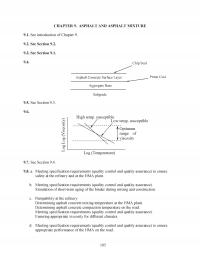
105 appropriate performance of the HMA on the road. CHAPTER 9. ASPHALT AND ASPHALT MIXTURE 9.1. See introduction of Chapter 9. 9.2. See Section 9.2. 9.3. See Section 9.1. 9.4. 9.5. See Section 9.3. 9.6. 9.7. See Section 9.4. 9.8. […]