80
CHAPTER 7. PORTLAND CEMENT CONCRETE
7.1. a.
f
c
r
‘
=
f
c
‘
+ 1400 = 5500 + 1400 = 6,900 psi
b. Need to interpolate modification factor
2025
03.108.1
¹
·
©
§
Multiply standard deviation by the modification factor
Determine maximum from Equations 7.1 and 7.2
r
r
f
c
r
c. Determine maximum from Equations 7.1 and 7.2
f
c
r
‘
= 5500 + 1.34 (400) = 6036 psi
f
c
r
‘
= 5500 + 2.33 (400) – 500 = 5932 psi
Use
f
c
r
‘
=6040 psi
d. Determine maximum from Equations 7.1 and 7.2
f
r
f
f
r
r
7.2. a.f’cr = f’c+ 1.34 s = 24.1 MPa + 1.34 (3.8 MPa) = 29.2 MPa
7.3. f’cr = f’c+ 1.34 s = 3000 psi + 1.34 (350 psi) = 3469 psi
7.4. 3/4 minimum clear space between steel bars = (3/4) x (6-0.75) = 3.9375 in.
81
7.5. Assume the nominal maximum size of coarse aggregate is 1 in.
7.6. a. Required compressive strength = f’c+ 1.34s = 4000 + 1.34 x (1.08 x 200) = 4289.44 psi
7.7. Wwater = 0.45 x 565 = 254 lb/yd3
82
Summary
Batch ingredients required for 1 yd3concrete mix
Water
232 lb
Cement
565 lb
Fine Aggregate
1195.8 lb
Coarse Aggregate
1994.4 lb
7.8. 1. Required strength = 27.6 MPa
S = 2.1 MPa
2.
Water-Cement
Ratio
Strength requirement (Table 7.1):
6.274.30
·
§
3. Coarse aggregate requirements
Minimum dimension = 150 mm
Minimum space between rebar = 40 mm
4. Air Content
Only air entrainer is allowed
5. Workability Requirements
6. Water Content
83
7. Cement content
8. Admixture
9. Fine Aggregate Requirements
Water volume = 141 / (1 x 1000) = 0.141 m3/m3
10. Moisture Corrections
Coarse aggregate in dry condition = 1145 kg/m3
Summary
Batch ingredients required for 1 m3PCC
Water
143 kg
Cement
320 kg
Fine Aggregate
741 kg
Coarse Aggregate
1174 kg
Admixture
71 ml
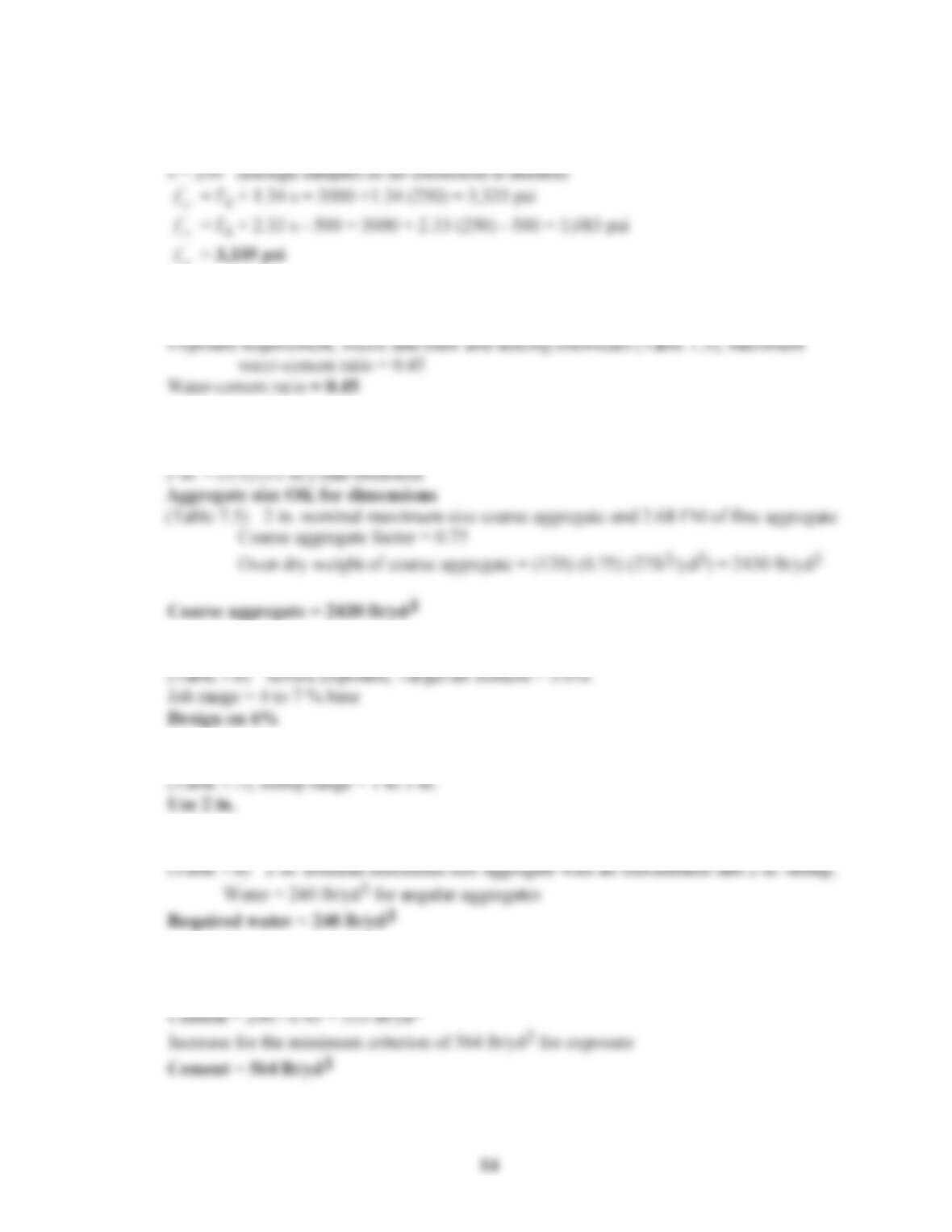
7.9. 1. Required Strength
‘
c
f
=3000 psi
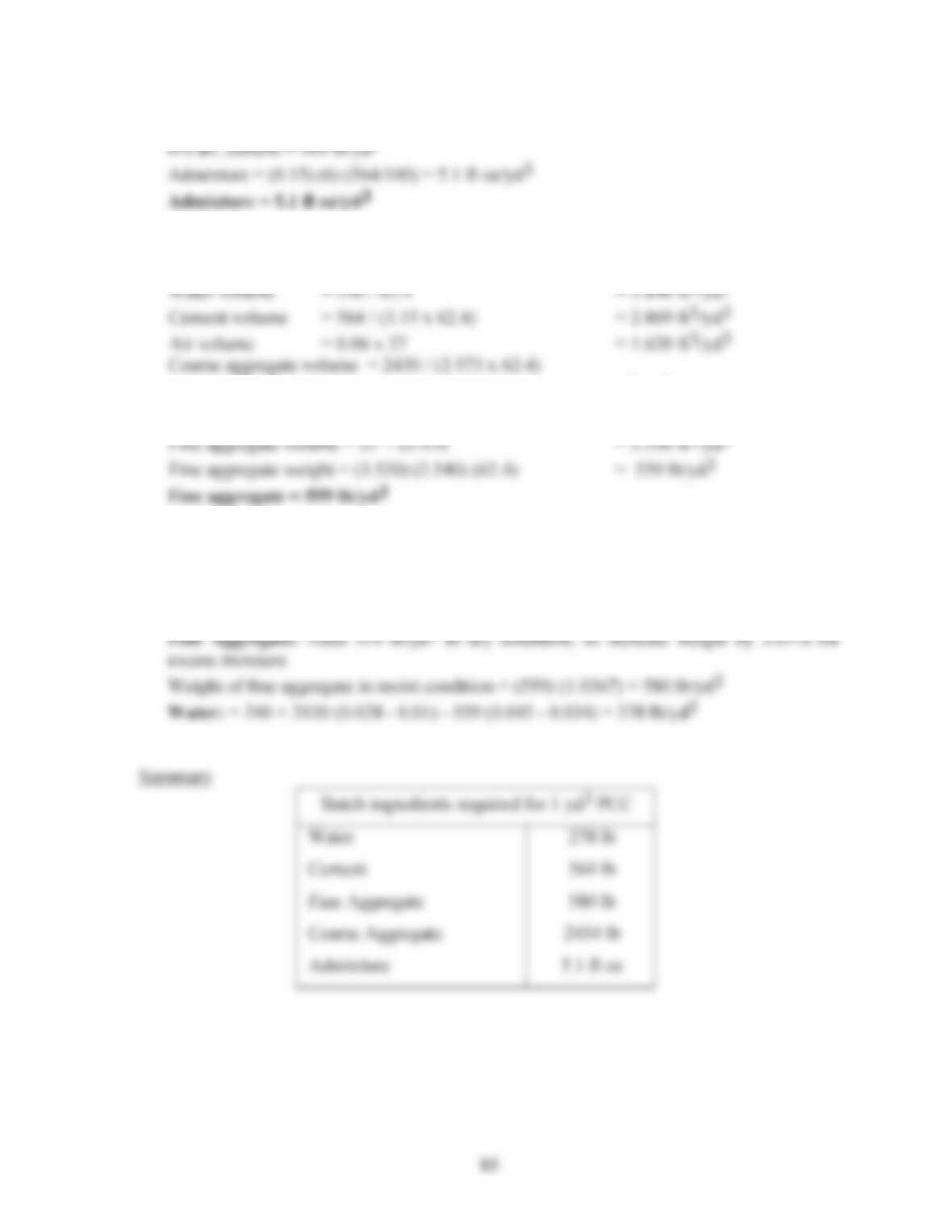
8. Admixture
9. Fine Aggregate Requirements
Find fine aggregate content – Use the absolute volume method
= 15.135 ft3/yd3
Subtotal volume = 23.470 ft3/yd3
10. Moisture Corrections
Coarse Aggregate: Need 2430 lb/yd3 in dry condition, so increase weight by 1.0% for
moisture
Weight of moist coarse aggregate = (2430) (1.01) = 2454 lb/yd3
86
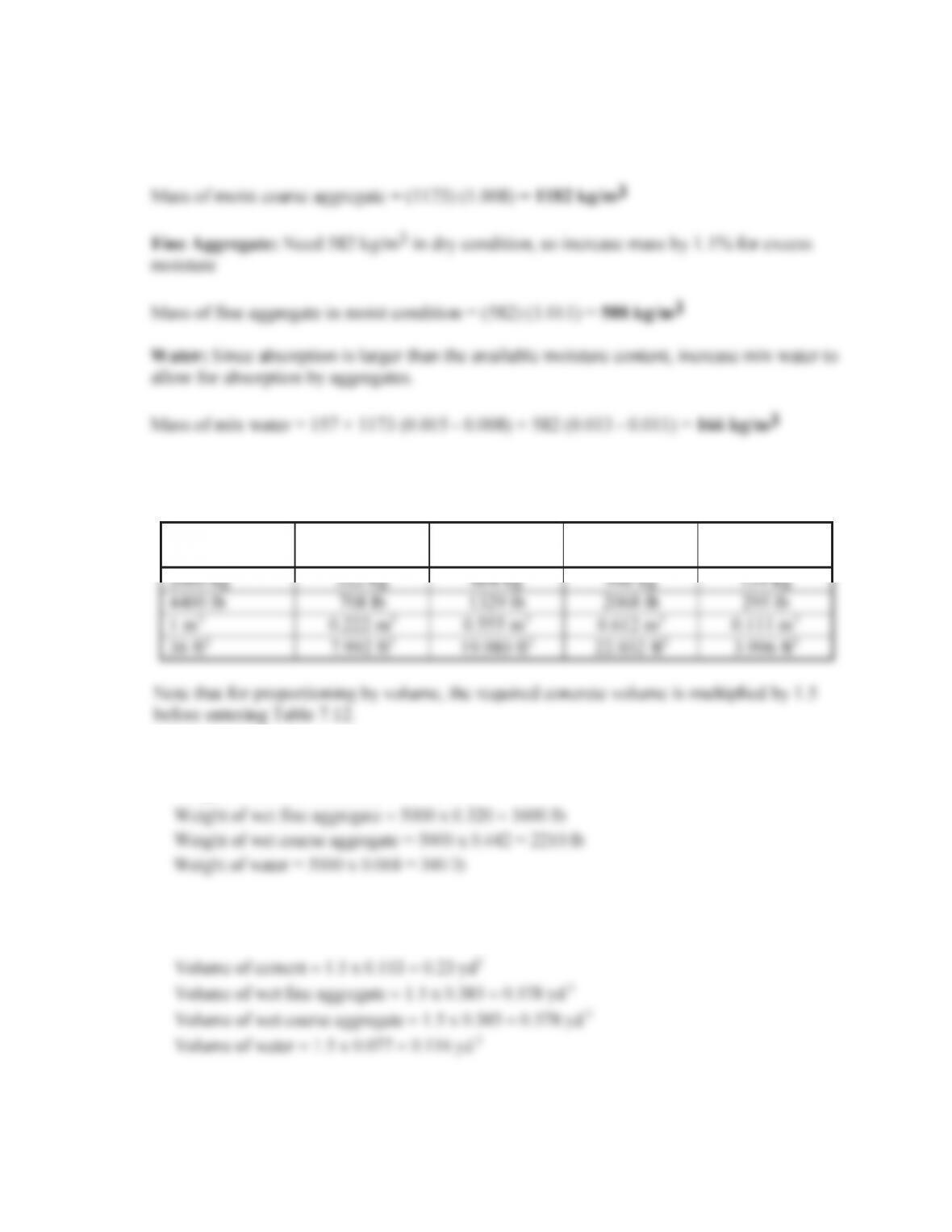
7.10. Coarse Aggregate: Need 1173 kg/m3in dry condition, so increase mass by 0.8% for
excess moisture
7.11. Using Tables 7.11 and 7.12:
Amount of
Concrete
Cement
Wet Fine
Aggregate
Wet Course
Aggregate
Water
2000 kg
322 kg
604 kg
940 kg
134 kg
4400 lb
708 lb
1329 lb
2068 lb
295 lb
1 m3
0.222 m3
0.555 m3
0.612 m3
0.111 m3
36 ft3
7.992 ft3
19.980 ft3
22.032 ft3
3.996 ft3
Note that for proportioning by volume, the required concrete volume is multiplied by 1.5
before entering Table 7.12.
7.12. a.
From Table 7.11
Weight of cement 5000 x 0.170 850 lb
b. Sum of the original bulk volumes of the components = 1 x 1.5 = 1.5 yd
3
From Table 7.12:
3
Volume of water 1.5 x 0.077 0.116 yd
87
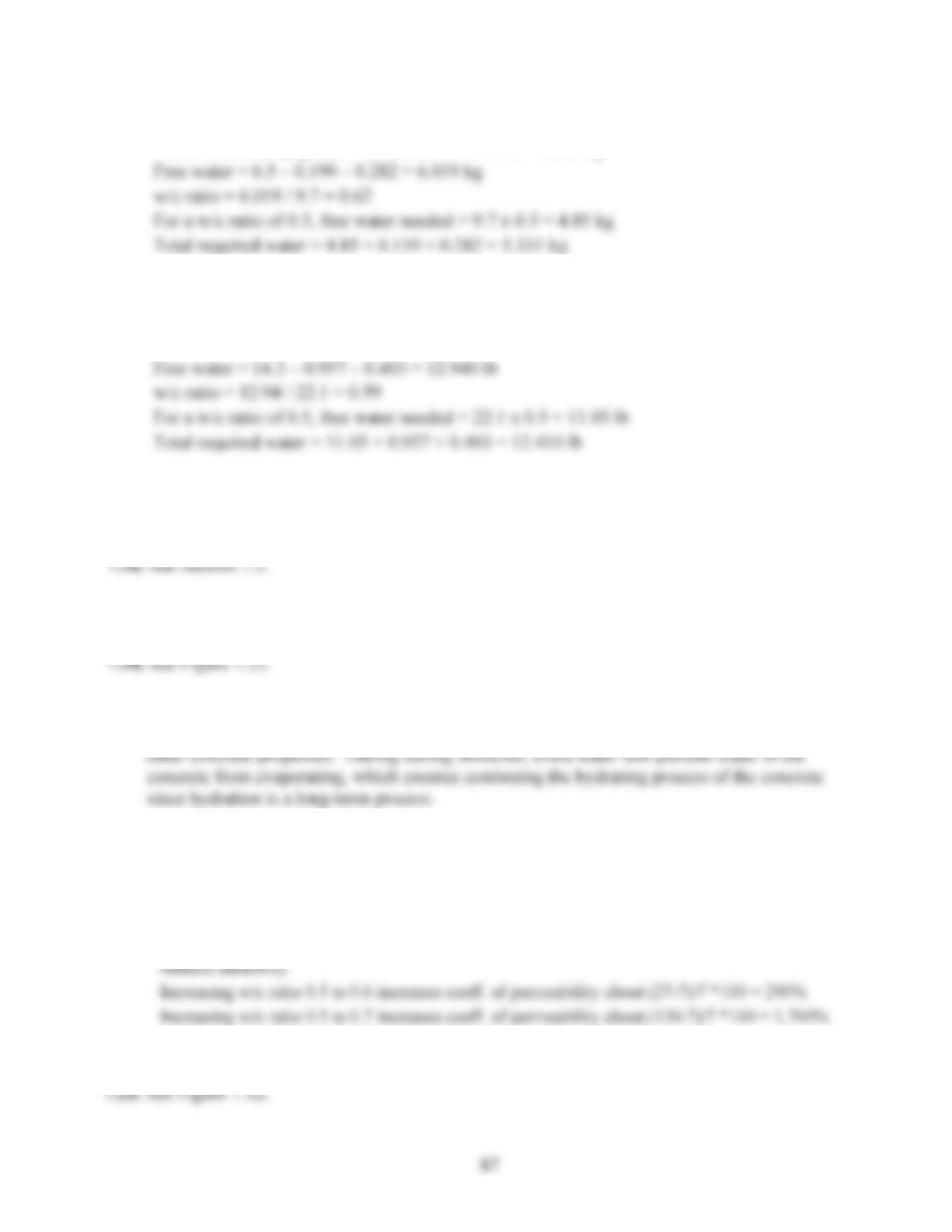
7.13. Water absorbed by sand = 18.1 (0.042 –0.031) = 0.199 kg
Water absorbed by gravel = 28.2 (0.044 –0.034) = 0.282 kg
7.14. Water absorbed by sand = 41.6 (0.055 –0.032) = 0.957 lb
Water absorbed by gravel = 57.5 (0.046 –0.039) = 0.403 lb
7.15. See Section 7.2.7.
7.17. See Section 7.3.
7.19. Concrete requires a small amount of water for hydration (see Section 6.8). Extra mixing
water will leave air voids in place when it sets, which reduces the strength and worsenV
7.20. See Section 7.4.1.
7.21. See Section 7.4.2.
Increasing w/c ratio increases permeability of hardened concrete. Increasing permeability
88
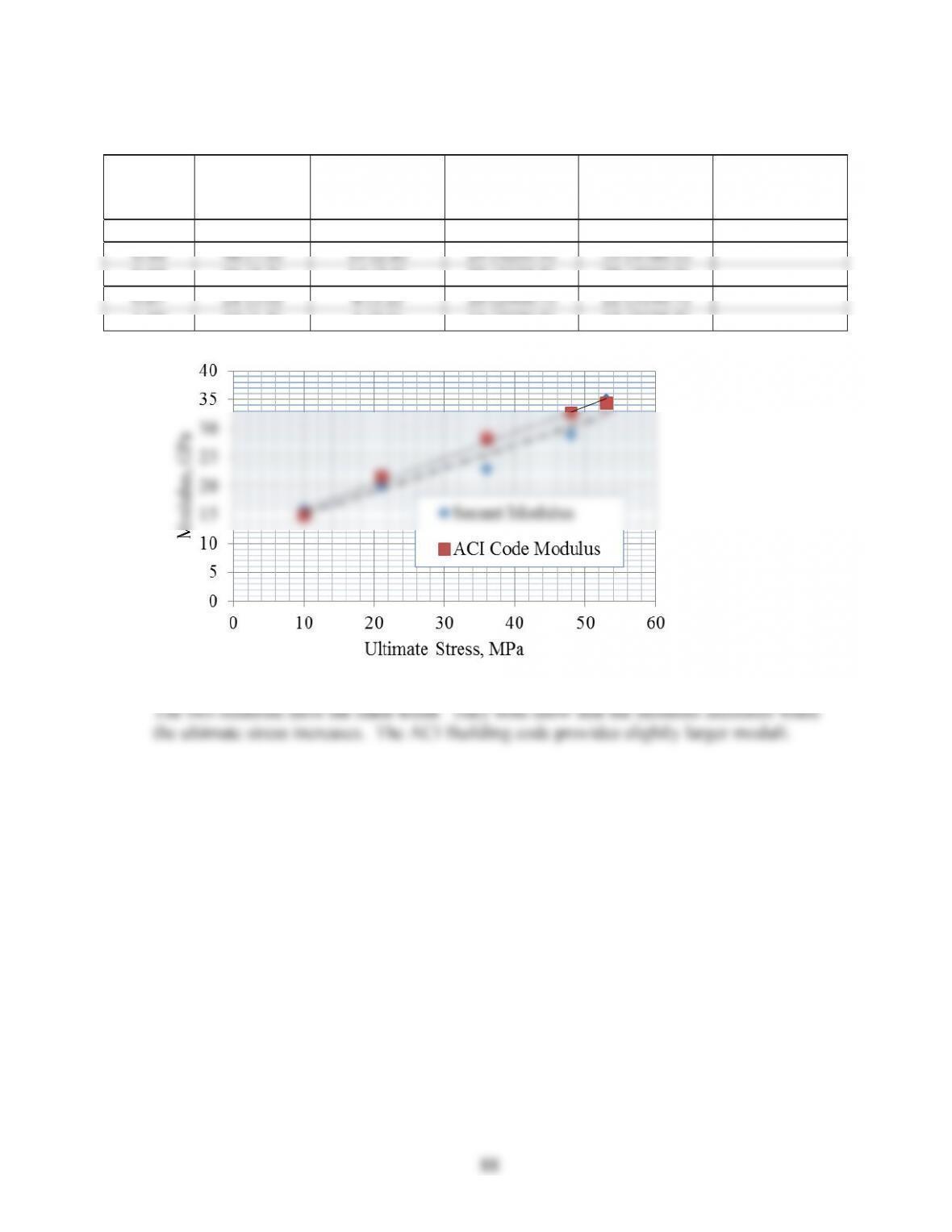
7.24.
Water-
Cement
Ratio
Ultimate
Stress (f
c
’),
MPa (ksi)
40% Ultimate
Stress, M
Pa
(ksi)
Secant
Modulus, GPa
(ksi)
Modulus from
ACI Equation,
GPa (ksi)
Toughness
0.33
53 (7.7)
21 (3.0)
35 (5076.1)
34 (4931.1)
0.40
48 (7.0)
19 (2.8)
29 (4205.9)
33 (4786.1)
0.50
36 (5.2)
14 (2.0)
23 (3335.8)
28 (4060.9)
0.67
21 (3.0)
8 (1.2)
20 (2900.7)
22 (3190.7)
1.00
10 (1.5)
4 (0.6)
16 (2320.5)
15 (2175.5)
3
10
6
75
2
10.0
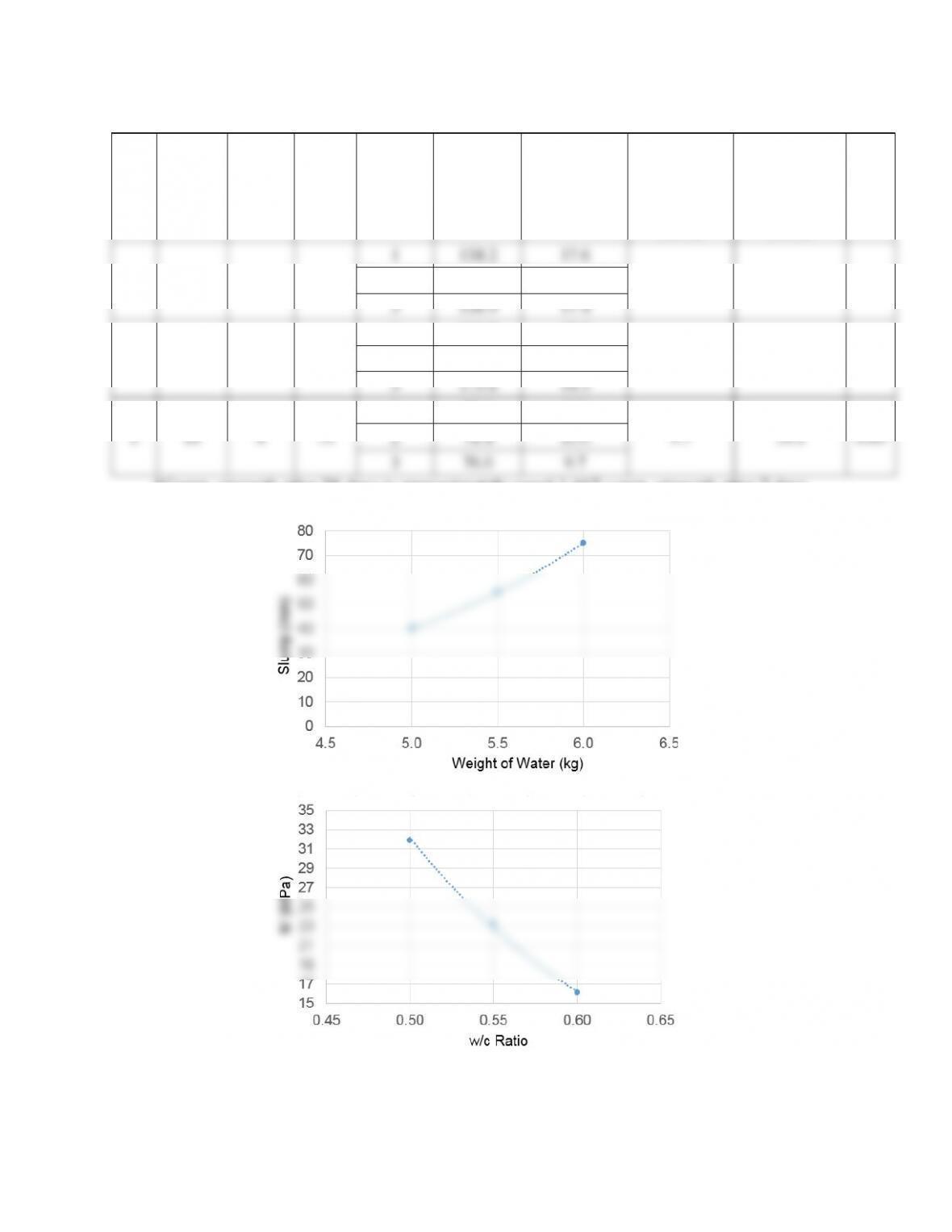
7.25.
Mix
No.
Weight
of
Cement
(kg)
Weight
of
Water*
(kg)
Slump
(mm)
Cylinder
No.
Max.
Load
(kN)
Compressive
Strength
after 7 Days
(MPa)
Average
Compressive
Strength
after 7 Days
(MPa)
Estimated
Compressive
Strength after
28 Days*
(MPa)
w/c
Rati
o
1
10
5
40
1
138.2
17.6
19.2 31.9
0.50
2
175.9
22.4
3
136.9
17.4
2
10
5.5
55
1
100.7
12.8
14.0 23.3
0.55
2
115.2
14.7
3
113.6
14.5
1
73.3
9.3
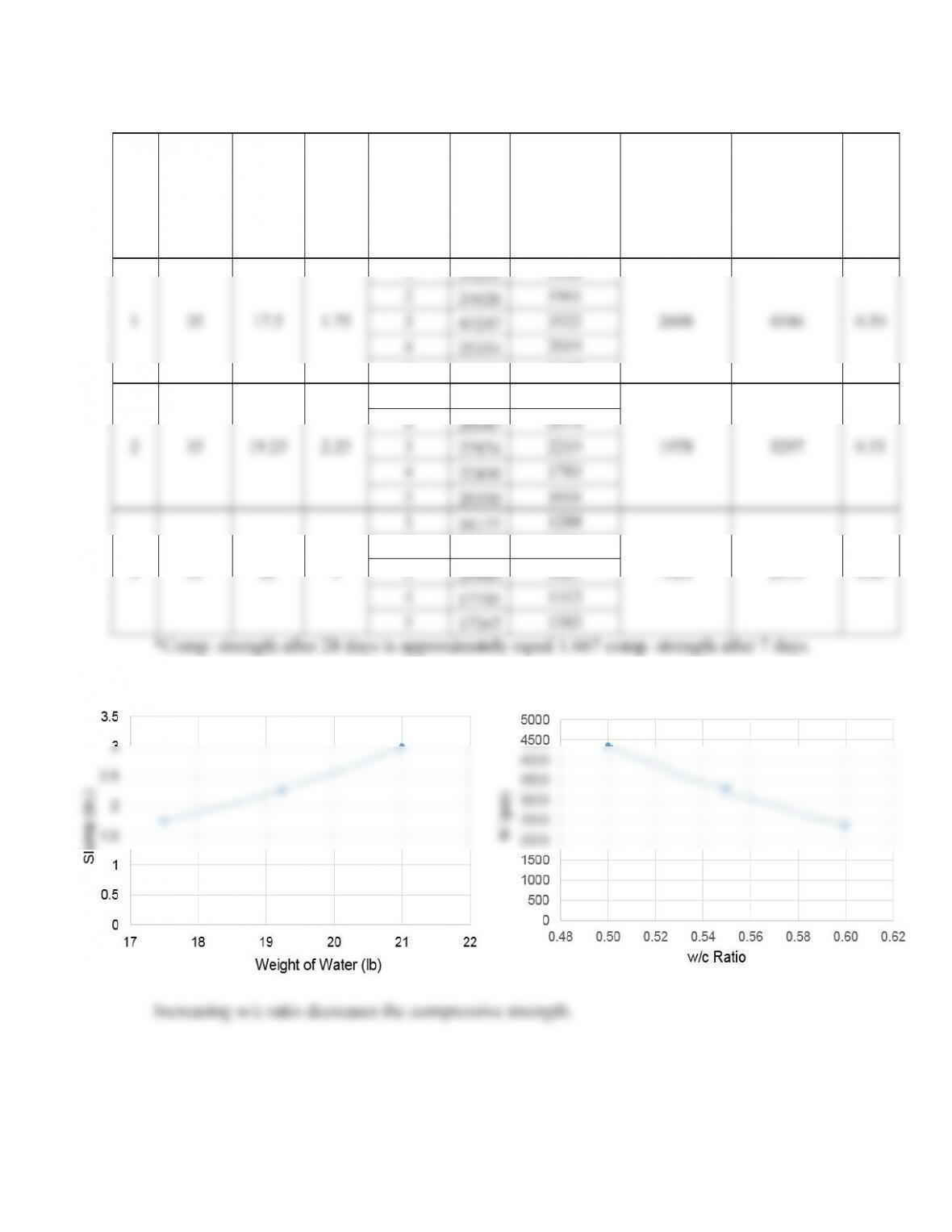
7.26.
Mix
No.
Weight
of
Cement
(lb)
Weight
of
Water*
(lb)
Slump
(in.)
Cylinder
No.
Max.
Load
(lb)
Compressive
Strength after
7 Days (psi)
Average
Compressive
Strength after
7 Days (psi)
Estimated
Compressive
Strength after
28 Days (psi)
w/c
Ratio
1
35
17.5
1.75
1
31255
2488
2608 4346
0.50
2
24626
1961
3
44247
3523
4
25354
2019
5
38276
3047
27874
22400
3
35
3
1
16177
1288
20440
5
17367
1383
1
27601
2198
2
26047
2074