Archives
Human Resources Chapter 1 1 The instrumental argument for the stakeholder theory of the firm says that companies perform better if they consider the rights and concerns of multiple groups in society
Chapter 01 – The Corporation and Its Stakeholders 1. (p. 3) General Motors has been called a “template for 21st century capitalism.” FALSE 2. (p. 4) A business is any organization that is engaged in making a product or providing […]
Human Resources Chapter 10 1 The paradox of the commons is that if all individuals attempt to maximize their own private advantage in the short term, the commons will still remain productive in the long run
Chapter 10 – Ecology and Sustainable Development in Global Business 1. (p. 222) Ecology is the study of how living things – plants and animals – interact with one another in an ecosystem. TRUE 2. (p. 222) A commons is […]
Human Resources Chapter 11 1 By setting a common standard for all firms, government can take the cost of pollution control out of competition
Chapter 11 – Managing Environmental Issues 1. (p. 245) By setting a common standard for all firms, government can take the cost of pollution control out of competition. TRUE 2. (p. 245) The first United States federal laws to protect […]
Human Resources Chapter 12 1 Nations have tended to move sequentially through each phase of technology, beginning with the lowest technology and moving higher with each step
Chapter 12 – Technology, Organizations, and Society 1. (p. 268) Technology is an unmistakable ethical force, but not an economic or social force, in the world where we live. FALSE 2. (p. 269) Future shock means change will happen too […]
Human Resources Chapter 13 1 Many businesses have developed a privacy policy, which explains what use of the company’s technology is permissible.
Chapter 13 – Managing Technology and Innovation 1. (p. 293) Many businesses have developed a privacy policy, which explains what use of the company’s technology is permissible. TRUE 2. (p. 293) Most Americans mistakenly believe that if a Web site […]
Human Resources Chapter 14 1 The three types of stockholders that own shares of stock in U.S. corporations are individuals, institutions, and government
Chapter 14 – Stockholder Rights and Corporate Governance 1. (p. 317 – 318) The three types of stockholders that own shares of stock in U.S. corporations are individuals, institutions, and government. FALSE 2. (p. 318) Since the 1960s, there has […]
Human Resources Chapter 15 1 As business firms grow in size and market power, they have increasingly lost the ability to dominate marketplace transactions with their customers.
Chapter 15 – Consumer Protection 1. (p. 342) The Latin phrase, caveat emptor, meaning “let the seller beware” has put sellers on alert to look after their own interests. FALSE 2. (p. 342) Consumer advocacy groups in the United States […]
Human Resources Chapter 16 1 Some labor unions have departed from their traditional adversarial approach to work cooperatively with employers for their mutual benefit
Chapter 16 – Employees and the Corporation 1. (p. 364) The employment relationship confers rights and duties on both sides. TRUE 2. (p. 364) Employees in the United States have the right to organize and bargain collectively. TRUE 3. (p. […]
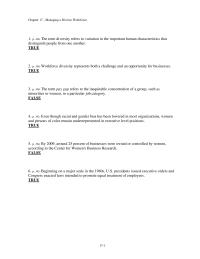
Human Resources Chapter 17 1 The term pay gap refers to the inequitable concentration of a group, such as minorities or women, in a particular job category
Chapter 17 – Managing a Diverse Workforce 1. (p. 386) The term diversity refers to variation in the important human characteristics that distinguish people from one another. TRUE 2. (p. 386) Workforce diversity represents both a challenge and an opportunity […]
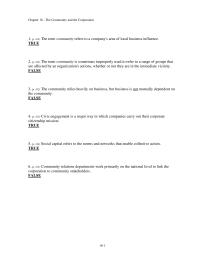
Human Resources Chapter 18 1 Community relations departments work primarily on the national level to link the corporation to community stakeholders
Chapter 18 – The Community and the Corporation 1. (p. 412) The term community refers to a company’s area of local business influence. TRUE 2. (p. 412) The term community is sometimes improperly used to refer to a range of […]
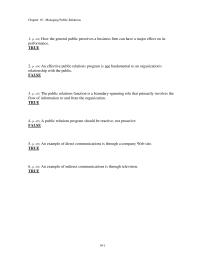
Human Resources Chapter 19 1 The public relations function is a boundary-spanning role that primarily involves the flow of information to and from the organization
Chapter 19 – Managing Public Relations 1. (p. 432) How the general public perceives a business firm can have a major effect on its performance. TRUE 2. (p. 434) An effective public relations program is not fundamental to an organization’s […]
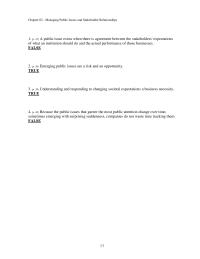
Human Resources Chapter 2 1 according to a recent survey of top executives, the issue most likely to gain public and political attention over the next five years is
Chapter 02 – Managing Public Issues and Stakeholder Relationships 1. (p. 25) A public issue exists when there is agreement between the stakeholders’ expectations of what an institution should do and the actual performance of those businesses. FALSE 2. (p. […]
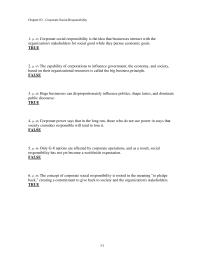
Human Resources Chapter 3 1 The capability of corporations to influence government, the economy, and society, based on their organizational resources is called the big business principle
Chapter 03 – Corporate Social Responsibility 1. (p. 45) Corporate social responsibility is the idea that businesses interact with the organization’s stakeholders for social good while they pursue economic goals. TRUE 2. (p. 47) The capability of corporations to influence […]
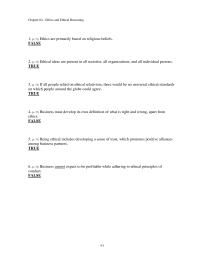
Human Resources Chapter 4 1 If all people relied on ethical relativism, there would be no universal ethical standards on which people around the globe could agree
Chapter 04 – Ethics and Ethical Reasoning 1. (p. 71) Ethics are primarily based on religious beliefs. FALSE 2. (p. 72) Ethical ideas are present in all societies, all organizations, and all individual persons. TRUE 3. (p. 72) If all […]
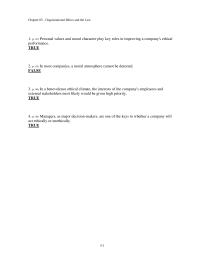
Human Resources Chapter 5 1 In a benevolence ethical climate, the interests of the company’s employees and external stakeholders most likely would be given high priority
Chapter 05 – Organizational Ethics and the Law 1. (p. 95) Personal values and moral character play key roles in improving a company’s ethical performance. TRUE 2. (p. 95) In most companies, a moral atmosphere cannot be detected. FALSE 3. […]
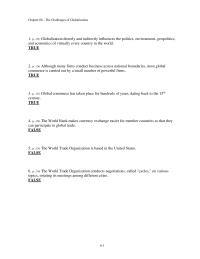
Human Resources Chapter 6 1 Globalization directly and indirectly influences the politics, environment, geopolitics, and economics of virtually every country in the world
Chapter 06 – The Challenges of Globalization 1. (p. 125) Globalization directly and indirectly influences the politics, environment, geopolitics, and economics of virtually every country in the world. TRUE 2. (p. 126) Although many firms conduct business across national boundaries, […]
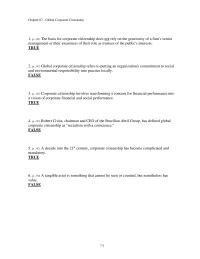
Human Resources Chapter 7 1 The basis for corporate citizenship does not rely on the generosity of a firm’s senior management or their awareness of their role as trustees of the public’s interests
Chapter 07 – Global Corporate Citizenship 1. (p. 145) The basis for corporate citizenship does not rely on the generosity of a firm’s senior management or their awareness of their role as trustees of the public’s interests. TRUE 2. (p. […]
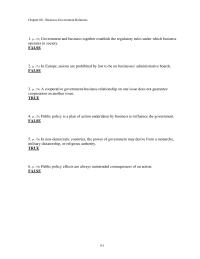
Human Resources Chapter 8 1 In non-democratic countries, the power of government may derive from a monarchy, military dictatorship, or religious authority.
Chapter 08 – Business-Government Relations 1. (p. 173) Government and business together establish the regulatory rules under which business operates in society. FALSE 2. (p. 173) In Europe, unions are prohibited by law to be on businesses’ administrative boards. FALSE […]
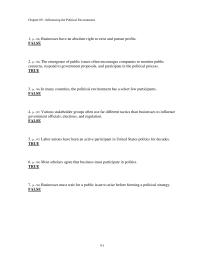
Human Resources Chapter 9 1 The emergence of public issues often encourages companies to monitor public concerns, respond to government proposals, and participate in the political process
Chapter 09 – Influencing the Political Environment 1. (p. 196) Businesses have an absolute right to exist and pursue profits. FALSE 2. (p. 196) The emergence of public issues often encourages companies to monitor public concerns, respond to government proposals, […]