Archives: Quiz
978-1118873700 Test Bank Chapter 35
Chapter: Chapter 35: Flexibility True/False 1. Regardless of the level of uncertainty, it is possible to value assets or a project using a standard discounted cash flow (DCF) approach or a stochastic simulation. However, in cases when managers can decide […]
978-1118873700 Test Bank Chapter 34
Chapter: Chapter 34: Banks Multiple Choice 1. For financial institutions, which of the following is NOT true concerning trading income? a) It has been on the decline over the past 30 years. b) It is typically fairly volatile from year […]
978-1118873700 Test Bank Chapter 33
Chapter: Chapter 33: Cyclical Companies Multiple Choice 1. Which of the following are true concerning the properties of consensus earnings forecasts for cyclical companies? I. They account for the cyclical nature of the firm. II. Discounted cash flow (DCF) models […]
978-1118873700 Test Bank Chapter 32
Chapter: Chapter 32: Valuing High-Growth Companies Multiple Choice 1. When looking into the future, the analyst should define a point in the future where the company’s performance is likely to stabilize. The conditions at that point should be defined and […]
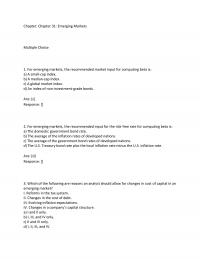
978-1118873700 Test Bank Chapter 31
Chapter: Chapter 31: Emerging Markets Multiple Choice 1. For emerging markets, the recommended market input for computing beta is: a) A small-cap index. b) A median-cap index. c) A global market index. d) An index of non-investment-grade bonds. 2. For […]
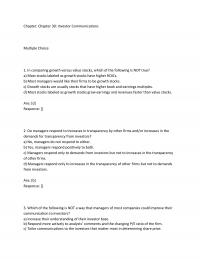
978-1118873700 Test Bank Chapter 30
Chapter: Chapter 30: Investor Communications Multiple Choice 1. In comparing growth versus value stocks, which of the following is NOT true? a) Most stocks labeled as growth stocks have higher ROICs. b) Most managers would like their firms to be […]
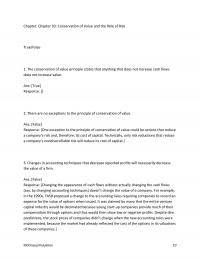
978-1118873700 Test Bank Chapter 3
McKinsey/Valuation 10 Chapter: Chapter 03: Conservation of Value and the Role of Risk True/False 1. The conservation of value principle states that anything that does not increase cash flows does not increase value. Ans: [True] Response: [] 2. There are […]
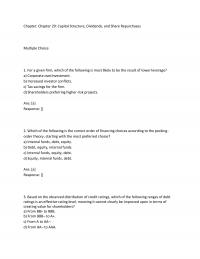
978-1118873700 Test Bank Chapter 29
Chapter: Chapter 29: Capital Structure, Dividends, and Share Repurchases Multiple Choice 1. For a given firm, which of the following is most likely to be the result of lower leverage? a) Corporate overinvestment. b) Increased investor conflicts. c) Tax savings […]
978-1118873700 Test Bank Chapter 28
Chapter: Chapter 28: Divestitures 1. Which of the following is the best name for a distribution of all shares in a subsidiary to existing shareholders of the parent company? a) Carve-out. b) Spin-off. c) Split-off. d) Tracking stock. Ans: [b] […]
978-1118873700 Test Bank Chapter 27
Chapter: Chapter 27: Mergers and Acquisitions Multiple Choice 1. The analysis of cost savings requires an industry-specific business system. Which of the following are requirements of an insightful industry-specific business system? I. It uses a top-down approach. II. It uses […]
978-1118873700 Test Bank Chapter 26
Chapter: Chapter 26: Performance Management Multiple Choice 1. Which of the following value drivers is a short-term driver as opposed to a medium-term driver? a) Asset health. b) Commercial health. c) Capital productivity. d) Cost structure health. 2. Which of […]
978-1118873700 Test Bank Chapter 25
Chapter: Chapter 25: Corporate Portfolio Strategy 1. Which of the following are valid reasons a given firm might be the best owner of a particular business? I. Unique links with other businesses (e.g., distribution lines). II. Distinctive skills such as […]
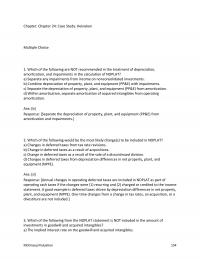
978-1118873700 Test Bank Chapter 24
McKinsey/Valuation 154 Chapter: Chapter 24: Case Study: Heineken Multiple Choice 1. Which of the following are NOT recommended in the treatment of depreciation, amortization, and impairments in the calculation of NOPLAT? a) Separate any impairments from income on nonconsolidated investments. […]
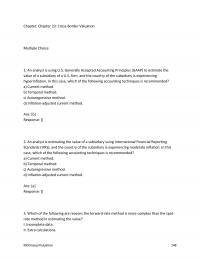
978-1118873700 Test Bank Chapter 23
McKinsey/Valuation 148 Chapter: Chapter 23: Cross-Border Valuation 1. An analyst is using U.S. Generally Accepted Accounting Principles (GAAP) to estimate the value of a subsidiary of a U.S. firm, and the country of the subsidiary is experiencing hyperinflation. In this […]
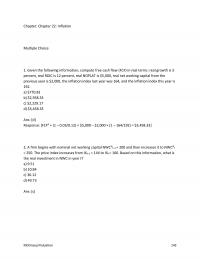
978-1118873700 Test Bank Chapter 22
McKinsey/Valuation 143 Chapter: Chapter 22: Inflation Multiple Choice 1. Given the following information, compute free cash flow (FCF) in real terms: real growth is 3 percent, real ROIC is 12 percent, real NOPLAT is $5,000, real net working capital from […]
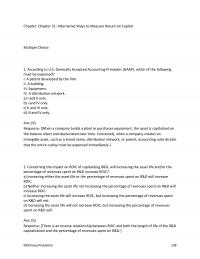
978-1118873700 Test Bank Chapter 21
McKinsey/Valuation 138 Chapter: Chapter 21: Alternative Ways to Measure Return on Capital Multiple Choice 1. According to U.S. Generally Accepted Accounting Principles (GAAP), which of the following must be expensed? I. A patent developed by the firm. II. A building. […]
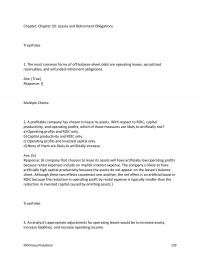
978-1118873700 Test Bank Chapter 20
McKinsey/Valuation 129 Chapter: Chapter 20: Leases and Retirement Obligations True/False 1. The most common forms of off-balance-sheet debt are operating leases, securitized receivables, and unfunded retirement obligations. 2. A profitable company has chosen to lease its assets. With respect to […]
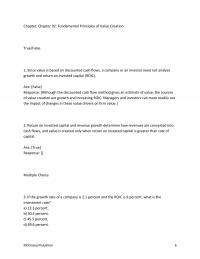
978-1118873700 Test Bank Chapter 2
McKinsey/Valuation 6 Chapter: Chapter 02: Fundamental Principles of Value Creation True/False 1. Since value is based on discounted cash flows, a company or an investor need not analyze growth and return on invested capital (ROIC). 2. Return on invested capital […]
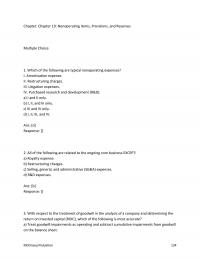
978-1118873700 Test Bank Chapter 19
McKinsey/Valuation 124 Chapter: Chapter 19: Nonoperating Items, Provisions, and Reserves Multiple Choice 1. Which of the following are typical nonoperating expenses? I. Amortization expense. II. Restructuring charges. III. Litigation expenses. IV. Purchased research and development (R&D). a) I and II […]
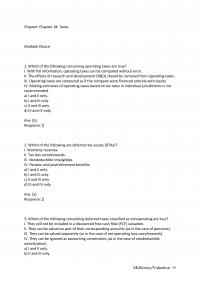
978-1118873700 Test Bank Chapter 18
McKinsey/Valuation 119 Chapter: Chapter 18: Taxes Multiple Choice 1. Which of the following concerning operating taxes are true? I. With full information, operating taxes can be computed without error. II. The effects of research and development (R&D) should be removed […]
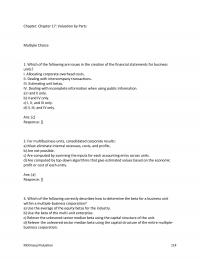
978-1118873700 Test Bank Chapter 17
McKinsey/Valuation 114 Chapter: Chapter 17: Valuation by Parts Multiple Choice 1. Which of the following are issues in the creation of the financial statements for business units? I. Allocating corporate overhead costs. II. Dealing with intercompany transactions. III. Estimating unit […]
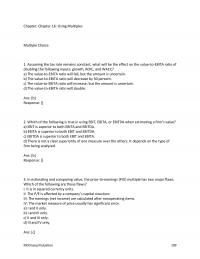
978-1118873700 Test Bank Chapter 16
McKinsey/Valuation 109 Chapter: Chapter 16: Using Multiples Multiple Choice 1. Assuming the tax rate remains constant, what will be the effect on the value–to-EBITA ratio of doubling the following inputs: growth, ROIC, and WACC? a) The value-to-EBITA ratio will fall, […]
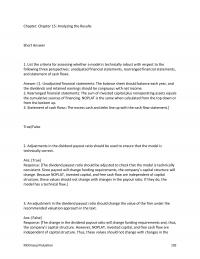
978-1118873700 Test Bank Chapter 15
McKinsey/Valuation 102 Chapter: Chapter 15: Analyzing the Results Short Answer 1. List the criteria for assessing whether a model is technically robust with respect to the following three perspectives: unadjusted financial statements, rearranged financial statements, and statement of cash flows. […]
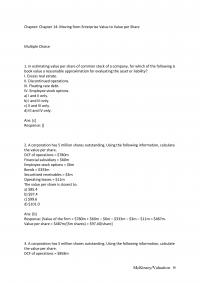
978-1118873700 Test Bank Chapter 14
McKinsey/Valuation 96 Chapter: Chapter 14: Moving from Enterprise Value to Value per Share Multiple Choice 1. In estimating value per share of common stock of a company, for which of the following is book value a reasonable approximation for evaluating […]
978-1118873700 Test Bank Chapter 13
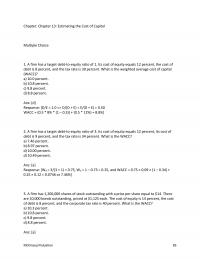
McKinsey/Valuation 85 Chapter: Chapter 13: Estimating the Cost of Capital Multiple Choice 1. A firm has a target debt-to-equity ratio of 1. Its cost of equity equals 12 percent, the cost of debt is 8 percent, and the tax rate […]
978-1118873700 Test Bank Chapter 12
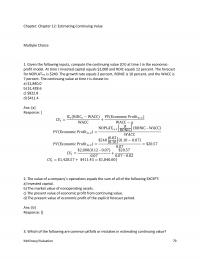
McKinsey/Valuation 79 Chapter: Chapter 12: Estimating Continuing Value Multiple Choice 1. Given the following inputs, compute the continuing value (CV) at time t in the economic- profit model. At time t invested capital equals $2,000 and ROIC equals 12 percent. […]
978-1118873700 Test Bank Chapter 11
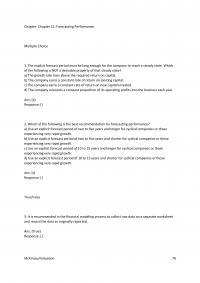
McKinsey/Valuation 70 Chapter: Chapter 11: Forecasting Performance Multiple Choice 1. The explicit forecast period must be long enough for the company to reach a steady state. Which of the following is NOT a desirable property of that steady state? a) […]
978-1118873700 Test Bank Chapter 10
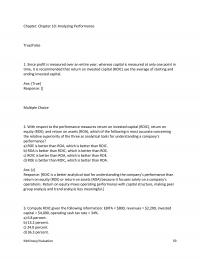
McKinsey/Valuation 59 Chapter: Chapter 10: Analyzing Performance True/False 1. Since profit is measured over an entire year, whereas capital is measured at only one point in time, it is recommended that return on invested capital (ROIC) use the average of […]
978-1118873700 Test Bank Chapter 1
McKinsey/Valuation 1 Chapter: Chapter 01: Why Value Value? Multiple Choice 1. Which one of the following actions would help a company create long-term value? a) Focus on keeping costs at a minimum. b) Find the optimal debt-to-equity ratio. c) Seek […]
978-1111349103 Test Bank Chapter 9
Chapter 9—Nonverbal Communication: The Messages of Action, Space, Time, and Silence MULTIPLE CHOICE 1. If you scowl because you are angry, or frown because you are sad, what function of nonverbal communication are you engaged in? a. expressing internal states […]
978-1111349103 Test Bank Chapter 8
Chapter 8—Verbal Messages: Exchanging Ideas Through Language MULTIPLE CHOICE 1. The functions of language include: a. social interaction b. social cohesion c. expressions of identity d. A and B e. A, B, and C 2. Identify the correct term that […]
978-1111349103 Test Bank Chapter 7
Chapter 7—Culture and Identity: Situating the Individual MULTIPLE CHOICE 1. Identity is ____. a. abstract b. unidimensional c. dynamic d. A and C e. A, B, and C 2. Identity has been defined as: ANS: D PTS: 1 REF: p. […]
978-1111349103 Test Bank Chapter 6
Chapter 6—Cultural Values: Guidelines for Behavior MULTIPLE CHOICE 1. Perception is considered selective because ____. a. there are too many stimuli competing for the attention of your senses b. life’s lessons teach you to see the world in a particular […]
978-1111349103 Test Bank Chapter 5
Chapter 5—Worldview: Cultural Explanations of Life and Death MULTIPLE CHOICE 1. Worldview deals with all of the following types of questions except: a. what is the purpose of life? b. what is the right way to live? c. where did […]
978-1111349103 Test Bank Chapter 4
Chapter 4—Cultural History: Our Antecedents MULTIPLE CHOICE 1. What is sometimes referred to as the first multicultural nation in the world? a. the East India Trading Company b. the United States c. Egypt d. Rome e. Islam 2. Which of […]
978-1111349103 Test Bank Chapter 3
Chapter 3—The Deep Structure of Culture: Lessons from the Family MULTIPLE CHOICE 1. A culture’s unconscious assumptions about how the world operates is referred to as its: a. subculture b. foundation c. deep structure d. matrix e. protoculture 2. The […]
978-1111349103 Test Bank Chapter 2
Chapter 2—Communication and Culture: The Voice and the Echo MULTIPLE CHOICE 1. Which explanation accurately reflects the “Interpersonal needs” use of communication? a. it assists in helping us learn about other people b. it helps us decide how to present […]
978-1111349103 Test Bank Chapter 10
Chapter 10—Cultural Influences on Communication Contexts: Responding to the Setting MULTIPLE CHOICE 1. The shared understanding of the meaning of communication and the behaviors appropriate for specific situations reflect what basic assumption? a. communication is culturally determined b. communication is […]
978-1111349103 Test Bank Chapter 1
Chapter 1—Intercultural Communication: Interaction in a Multicultural World MULTIPLE CHOICE 1. Which of the following is an example of global interconnectedness presented in the text? a. the 2011 Great Eastern Japan Tsunami b. The European Union’s Sovereign Debt crisis c. […]
978-0393123524 Test Bank Chapter 9
Chapter 9 : Health MULTIPLE CHOICE 1. The World Health Organization (WHO) defines health as: a. the absence of illness or disability that prevents one from engaging in normal functions. b. a condition of physical well-being, consistent with the standards […]
978-0393123524 Test Bank Chapter 8
Chapter 8 : Education MULTIPLE CHOICE 1. Grade survival rates estimate: a. how many children actually complete a certain grade level. b. how many children die from disease and malnutrition at each grade level. c. how many grades of school […]
978-0393123524 Test Bank Chapter 7
Chapter 7 : Population MULTIPLE CHOICE 1. By 2008, Finland had reached the fourth stage of its demographic transition, in which its population growth had fallen close to: a. 5 percent. c. 0 percent. b. 2.2 percent. d. –7.5 percent. […]
978-0393123524 Test Bank Chapter 6
Chapter 6 : Inequality and Poverty MULTIPLE CHOICE 1. The single most important variable explaining the number of people in poverty in a given country is: a. the literacy rate. c. per capita income. b. the HDI. d. population. 2. […]
978-0393123524 Test Bank Chapter 5
Chapter 5 : States and Markets MULTIPLE CHOICE 1. After David Ricardo and Karl Marx, economists shifted to trying to understand how markets worked, and economic growth was: a. taken for granted. b. taken to a higher level of research. […]
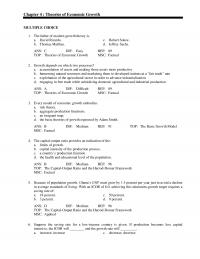
978-0393123524 Test Bank Chapter 4
Chapter 4 : Theories of Economic Growth MULTIPLE CHOICE 1. The father of modern growth theory is: a. David Ricardo. c. Robert Solow. b. Thomas Malthus. d. Jeffrey Sachs. 2. Growth depends on which two processes? ANS: C DIF: Easy […]
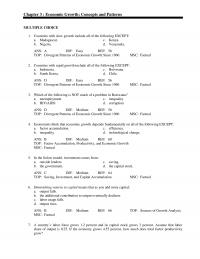
978-0393123524 Test Bank Chapter 3
Chapter 3 : Economic Growth: Concepts and Patterns MULTIPLE CHOICE 1. Countries with slow growth include all of the following EXCEPT: a. Madagascar. c. Kenya. b. Nigeria. d. Venezuela. 2. Countries with rapid growth include all of the following EXCEPT: […]
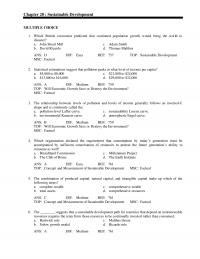
978-0393123524 Test Bank Chapter 20
Chapter 20 : Sustainable Development MULTIPLE CHOICE 1. Which British economist predicted that continued population growth would bring the world to disaster? a. John Stuart Mill c. Adam Smith b. David Ricardo d. Thomas Malthus 2. Statistical estimations suggest that […]
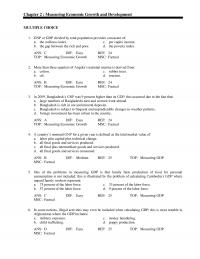
978-0393123524 Test Bank Chapter 2
Chapter 2 : Measuring Economic Growth and Development MULTIPLE CHOICE 1. GNP or GDP divided by total population provides a measure of: a. the wellness index. c. per capita income. b. the gap between the rich and poor. d. the […]
978-0393123524 Test Bank Chapter 19
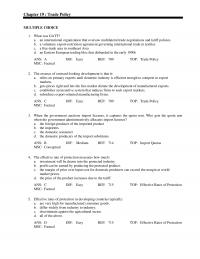
Chapter 19 : Trade Policy MULTIPLE CHOICE 1. What was GATT? a. an international organization that oversaw multilateral trade negotiations and tariff policies b. a voluntary export-restriction agreement governing international trade in textiles c. a free-trade area in southeast Asia […]
978-0393123524 Test Bank Chapter 18
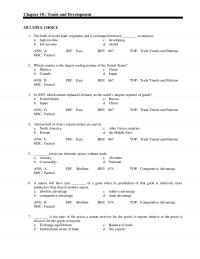
Chapter 18 : Trade and Development MULTIPLE CHOICE 1. The bulk of world trade originates and is exchanged between ________ economies. a. high-income c. developing b. low-income d. closed 2. Which country is the largest trading partner of the United […]