Archives
Business Ethics Chapter 1 1 A quick way to think about morals is as what occurs “above the neck” and ethics as what occurs “below the neck.”
Introduction and Chapter 1 Ethics and Moral Reasoning Fill-in-the-Blank Questions The “W’s and H” list 1. What’s _________ _________________? 2. Why not __________ ____________ _______________? 3. Who ________, who _____________ ? 4. What’s ______ __________________? 5. Who’s ______________________ __________ ____________ […]
Business Ethics Chapter 1 Homework The best success at using a framework to make ethical decisions begins with being able to describe the problem in all its nuances
© Taylor & Francis 22 The First Question: What’s Your Problem? Spell out, in some detail, what makes this situation a moral dilemma. Leave yourself with a clearly stated question to be answered. hapter 1 is built around the first […]
Business Ethics Chapter 10 1 Clifford Christians and others argue that teleology is inappropriate because it does not take a person’s motives or moral obligations into account
Chapter 10 Consequentialism and Utility Fill-in-the-Blank Questions 1. Teleological or utilitarianism are two terms that define ________-based ethical thinking. 2. ________________ took the theories of Jeremy Bentham with a more nuanced set of insights for people using teleological thought. 3. […]
Business Ethics Chapter 10 Homework Care and reciprocity—a focus on relationships. Carol Gilligan’s feminist consideration of care, and the Golden Rule’s consideration of reciprocity, are introduced.
© Taylor & Francis 88 The Fifth Question: Who’s Whispering in Your Ear? In general—and specifically in this case—which school of philosophy or set of moral principles provides you with a moral compass? he fifth question of Doing Ethics in […]
Business Ethics Chapter 11 1 A proper following of deontological ethical principles could lead us to accurately say we did the right thing even if our “right action” fails to produce a good result
Chapter 11 Deontology and Moral Rules Fill-in-the-Blank Questions 1. Deontology is the logical analysis of our ______________. 2. Rules that on their face appear to be reasonable are known by the Latin phrase as _______ __________ rules. 3. Once we […]
Business Ethics Chapter 11 Homework An introduction to Immanuel Kant’s strict deontology, with a focus on hypothetical and categorical imperatives, and perfect and imperfect duties
© Taylor & Francis 100 Chapter 11 Deontology and Moral Rules t’s possible that Chapter 10 overwhelmed some of your students, as we introduced principles of ends-based thinking—and then subtly said that, while it may be the default approach for […]
Business Ethics Chapter 12 1 Use of the “veil of ignorance” might lead mass communicators to consider stakeholders they might not otherwise consider
Chapter 12 Virtue, Justice, and Care Fill-in-the-Blank Questions 1. The notion that we should be good, and not just do good, is an example of _____________ ethics espoused by Aristotle. 2. The “veil of ignorance” approach to doing ethics is […]
Business Ethics Chapter 12 Homework Appreciate the pros and cons of each ethical approach, especially through the lens of mass media ethics
© Taylor & Francis 111 Chapter 12 Virtue, Justice, and Care e admit it: Chapter 12’s selection of these three whisperers is idiosyncratic. We have chosen three sets of philosophies we believe offer the best insight into issues that deserve […]
Business Ethics Chapter 13 1 When a person or group seeks to hold a media organization accountable, the media organization’s response often is determined by the power held by the party seeking the accountability
Chapter 13 Accountability, Transparency, and Credibility Fill-in-the-Blank Questions 1. The proper time to think about ethical accountability is _____________ making a decision. 2. Media _____________ Systems are ways mass communicators can be held to justify their messages and methods. 3. […]
Business Ethics Chapter 13 Homework Understand the philosophical and mass communication definitions of accountability, transparency, and credibility account ability, transparency, and credibility
© Taylor & Francis 117 The Sixth Question: How’s Your Decision Going to Look? State your conclusion, and imagine what your friends and people you respect will think about your decision making. he sixth and final question of Doing Ethics […]
Business Ethics Chapter 2 1 Law is similar to minimalistic ethics in that it outlines a bottom line below which we should not fall, but it does not elevate us to a higher level of moral development.
Chapter 2 Codes of Ethics and Justification Models Fill-in-the-Blank Questions 1. The item in the “W’s and H” justification model that asks you to think about ethics codes and law is: “Why not ____________ ________ ________?” 2. The ____________ ___________ […]
Business Ethics Chapter 2 Homework Mass media also are shaped by the rules of their practitioners, who develop the written and unwritten rules that fellow practitioners are expected to follow
© Taylor & Francis 27 The Second Question: Why Not Follow the Rules? Are there some precedents, guidelines, codes, or laws you should keep in mind? If so, are there reasons your dilemma can’t be resolved by them? hapters 2 […]
Business Ethics Chapter 3 1 John Milton argued that media needed to be censored to protect the people whom God put in positions of authority. Libertarian systems of government tend to
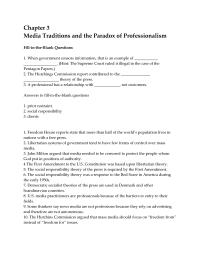
Chapter 3 Media Traditions and the Paradox of Professionalism Fill-in-the-Blank Questions 1. When government censors information, that is an example of ____________ _________________. (Hint: The Supreme Court ruled it illegal in the case of the Pentagon Papers.) 2. The Hutchings […]
Business Ethics Chapter 3 Homework Various ways to understand the impact that government structure has on mass media—and, the extent to which mass media can influence the government
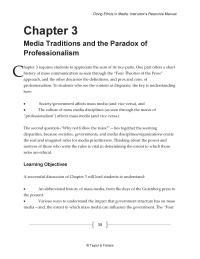
© Taylor & Francis 35 Chapter 3 Media Traditions and the Paradox of Professionalism hapter 3 requires students to appreciate the sum of its two parts. One part offers a short history of mass communication as seen through the “Four […]

Business Ethics Chapter 4 1 The Gilligan and Belenky theories of moral development argue that lower levels of development involve people who are powerless
Chapter 4 Moral Development and the Expansion of Empathy Fill-in-the-Blank Questions 1. Kohlberg might argue that people such as Jesus, the Rev. Martin Luther King Jr. or Gandhi operated at Level ________ in his theory. 2. The belief that everyone’s […]
Business Ethics Chapter 4 Homework See the difficulties in choosing loyalties while showing respect to all—including people and groups to whom the decision maker feels lower levels of loyalty
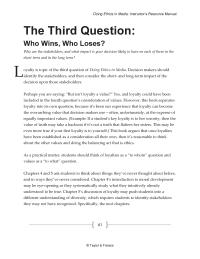
Doing Ethics in Media: Instructor’s Resource Manual 41 The Third Question: Who Wins, Who Loses? Who are the stakeholders, and what impact is your decision likely to have on each of them in the short term and in the long […]
Business Ethics Chapter 5 1 News media at lower levels of development tend to cover ethnic minorities in stereotypical and integrated ways. The concepts of loyalty and reciprocity are related
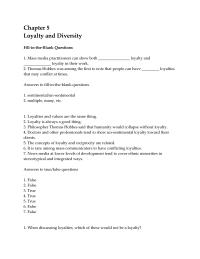
Chapter 5 Loyalty and Diversity Fill-in-the-Blank Questions 1. Mass media practitioners can show both ________________ loyalty and ______________ loyalty in their work. 2. Thomas Hobbes was among the first to note that people can have _________ loyalties that may conflict […]
Business Ethics Chapter 5 Homework Find ethically appropriate strategies that help them determine to whom they owe loyalty as they “do ethics” in a moral dilemma
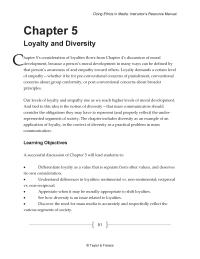
© Taylor & Francis 51 Chapter 5 Loyalty and Diversity hapter 5’s consideration of loyalties flows from Chapter 4’s discussion of moral development, because a person’s moral development in many ways can be defined by that person’s awareness of and […]
Business Ethics Chapter 6 1 The United Nations tried, but failed to define a set of core universal values because it was impossible to reach agreement. A moral dilemma exists when values conflict
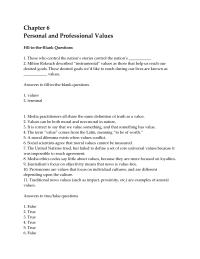
Chapter 6 Personal and Professional Values Fill-in-the-Blank Questions 1. Those who control the nation’s stories control the nation’s ___________. 2. Milton Rokeach described “instrumental” values as those that help us reach our desired goals. Those desired goals we’d like to […]
Business Ethics Chapter 6 Homework Consider truth as a value. Clearly, much of mass communication is about “truth,” but its definitions the practical implications of truth telling raise issues worthy of discussion
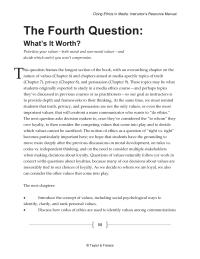
© Taylor & Francis 58 The Fourth Question: What’s It Worth? Prioritize your values—both moral and non-moral values—and decide which one(s) you won’t compromise. his question frames the longest section of the book, with an overarching chapter on the nature […]
Business Ethics Chapter 7 1 Most liars and deceivers tend to overestimate the forces that push them to lie, according to the book Lying: Moral Choice in Public and Private Life
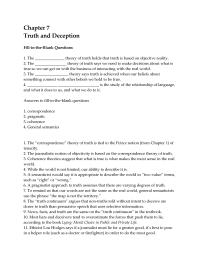
Chapter 7 Truth and Deception Fill-in-the-Blank Questions 1. The _______________ theory of truth holds that truth is based on objective reality. 2. The ________________ theory of truth says we need to make decisions about what is true so we can […]
Business Ethics Chapter 7 Homework Appreciate differences in “truth” based on students’ mass media disciplines, and the care that must be taken to ensure that a communicator’s message is not deceptive
© Taylor & Francis 65 Chapter 7 Truth and Deception ou would expect a media ethics book to talk a great deal about truth, which is obviously among the more important values of a mass communicator. And as we noted […]
Business Ethics Chapter 8 1 Most media organizations see privacy as a “prima facie” value that should be considered against competing values
Chapter 8 Privacy and Public Life Fill-in-the-Blank Questions 1. Search engines and other websites use _____________, or small files that work with your Web browser, to track who you are and where you’ve been online. 2. Philosophers and others say […]
Business Ethics Chapter 8 Homework Think through questions about what amount of privacy is worth giving up in order to gain something of potentially greater value
© Taylor & Francis 72 Chapter 8 Privacy and Public Life ur students lead public lives. On Facebook they share the most intimate details and images of the lives. They have advertising aimed at them solely because of what they […]
Business Ethics Chapter 9 1 Asymmetrical models of persuasion are more likely to be ethical than two-way symmetrical models of persuasion. Propaganda we agree with often leads to cognitive dissonance
Chapter 9 Persuasion and Propaganda Fill-in-the-Blank Questions 1. Advertisements designed to look like news stories are called _____________. 2. Caveat emptor means let the _____________ beware. 3. Milton Rokeach said the extent to which a person has an _______ mind […]
Business Ethics Chapter 9 Homework Appreciate that persuasion is not unethical on its face, and that “selective truth telling” can be an ethically appropriate action
© Taylor & Francis 80 Chapter 9 Persuasion and Propaganda f you teach this course with students across all communication disciplines, this chapter may be the most fun—and challenging—of the semester. It can be a sight to behold when smug […]
Business Ethics Introduction Homework Do the case again—this time, by giving roles to students and asking them to act out those roles and to interact with each other
© Taylor & Francis 16 Introduction …and the First Class Meeting avid Lee Roth once said that the first five minutes of a Van Halen concert should be like a pornographic movie—it had better have some action. Our virgin eyes […]