Chapter 11
Deontology and Moral Rules
Fill-in-the-Blank Questions
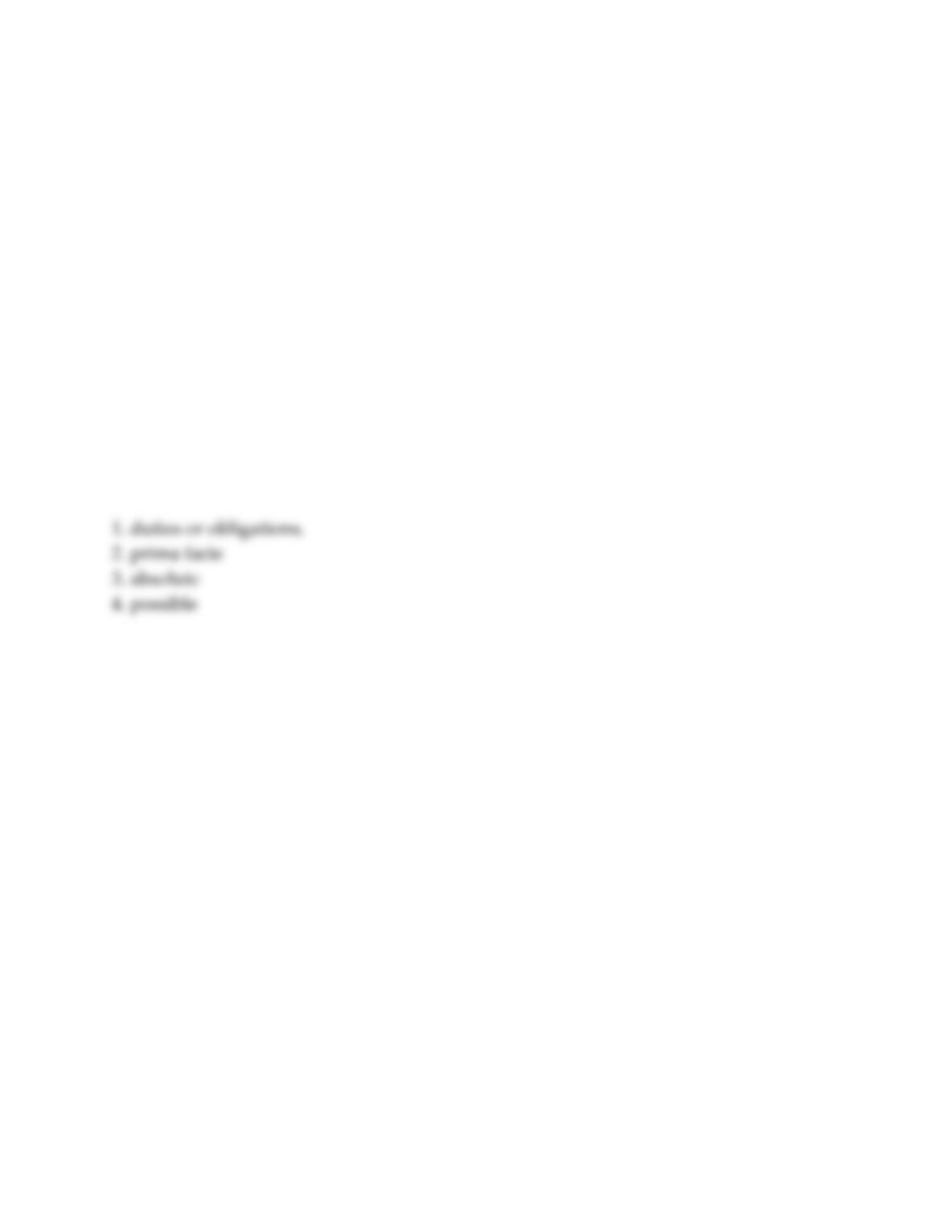
1. Deontology is the logical analysis of our ______________.
2. Rules that on their face appear to be reasonable are known by the Latin phrase as
_______ __________ rules.
3. Once we have decided that one prima facie duty is more important than others, that
prima facie becomes an _____________ duty.
4. Immanuel Kant would say that it is _____________ (possible, or impossible) to
legitimately exploit some people for the benefit of others.
Answers to fill-in-the-blank questions
1. Duties that you might have that others might not have (such as attending class or not
cheating on this test) are known as particularist duties.
2. A “prima facie” duty is another term for an “actual” duty.
3. While Immanuel Kant advocated “pure rules,” William David Ross focused on prima
facie and actual duties.
4. William David Ross’ provided a rank-ordered listing of prima facie duties, so people
would know which duty is most important.
5. If no actual duty exists, then William David Ross says that we should follow the
appropriate prima facie duty when making a moral decision.
6. An example of a supererogatory duty is telling the truth to a boss who asks you a
work-related question.
7. Immanuel Kant insisted that when you make an ethical rule, it should be
universalized.
8. Applying the ethical theory of William David Ross in our media-related job would
require us to have a fairly well-honed level of “ethical intuition.”
9. A proper following of deontological ethical principles could lead us to accurately say
we did the right thing even if our “right action” fails to produce a good result.
10. Bernard Gert’s 10 moral rules are focused more on doing good than eliminating evil.

11. Immanuel Kant argued that a categorical imperative should be obeyed only by
people in the same category, such as “all bosses” or “all employees.”
12. Immanuel Kant’s “perfect duty,” like William David Ross’ “actual duty,” is
something they claimed that we must always observe in order to be ethical.
13. Immanuel Kant supplied a ranking ordering of duties that an ethical person should
follow.
Answers to true/false questions
1. William David Ross considered all of the following EXCEPT:
A. What does it mean to be a good person?
B. What makes right acts right?
C. Which acts are right in one society that are immoral in another?
2. “Performing a particular act is good but not obligatory” (such as helping a classmate
study for this test) is known as a ________ act.
A. supererogatory
B. morally neutral
C. teleological
D. relativistic
E. deontological
3. According to the ethical philosophy from _____________________, good ethical
judgments are best made by appealing to a broad general principle that should be
universally applied, while treating as people as ends unto themselves.
A. John Stuart Mill
B. Immanuel Kant
C. Jeremy Bentham
D. John Rawls
E. William David Ross
4. William David Ross’ list of prima facie duties includes all of these EXCEPT:
A. non-maleficence
B. fidelity
C. veracity
D. reparation
E. justice
5. Bernard Gert’s list of 10 moral rules includes all of these EXCEPT:
A. Do not fail to do good.
B. Do not cause death.
C. Do not cause pain.
D. Do not deceive.
E. Do not cause loss of freedom.
6. Which of these statements about Bernard Gert’s modern approach to moral rules is
NOT true?
A. It is better to focus on evil than on good.
B. Rules should be obeyed impartially.
C. It is always irrational to disobey a moral rule.
D. It is sometimes rational to disobey a moral rule.
E. Decision makers should focus on the correct “moral attitude.”
7. Immanuel Kant’s discussion of “pure reason” is related to:
A. doing the right thing for the purest reason.
B. doing the most ethically pure act.
C. his notion that purity is essential to acting ethically.
D. his notion that we are not moral unless we make autonomous use of ethical rules;

that is, having “pure reason” instead of following authority’s rules.
E. the fact that his theory is 99.44 percent pure.
8. This example – if we want a cookie, then we should be nice to our mom – is what
Kant would call an example of:
A. a hypothetical imperative.
B. a categorical imperative.
C. a maxim.
D. an imperfect duty.
E. a perfect duty.
9. The duty to not harm others is known as:
A mercy.
B. reparation.
C. a perfect duty.
D. beneficence.
E. non-maleficence.
Answers to multiple choice questions
1. List the seven prima facie duties described by William David Ross. Did he place them
in an ascending or descending order of importance? Why or why not?
2. Describe Immanuel Kant’s approach to ethical decision making. Might it be difficult
to apply in a mass media environment? Why or why not?
3. Are Bernard Gert’s 10 moral rules more focused on doing good or eliminating evil?
What is the reasoning for his focus?