Chapter 12
Virtue, Justice, and Care
Fill-in-the-Blank Questions
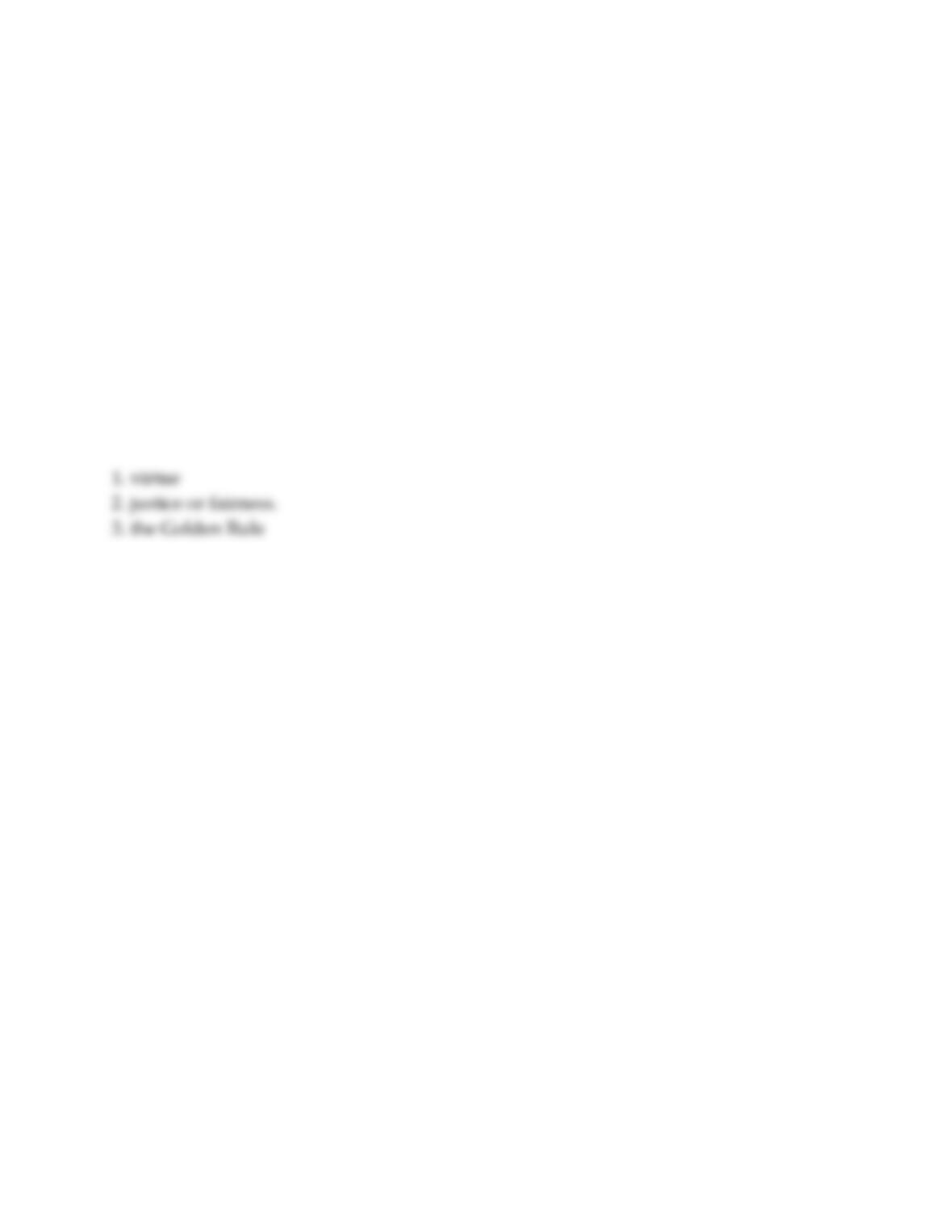
1. The notion that we should be good, and not just do good, is an example of
_____________ ethics espoused by Aristotle.
2. The “veil of ignorance” approach to doing ethics is focused on _________.
3. Versions of __________ ____________, which focuses on reciprocity, can be found in
most cultures and religions.
Answers to fill-in-the-blank questions
1. The Golden Rule is an example of moral reciprocity.
2. Aristotle said moral virtue lies at the precise midpoint between deficiency and excess.
3. Aristotle said that anyone could become a fully developed person of virtue.
4. One problem with virtue-based ethics is that you can do the right thing for the wrong
reason.
5. The “original position” in the veil of ignorance requires a person to decide whether a
person’s original ethical decision is the correct one.
6. John Rawls’ theory of justice relies heavily on Immanuel Kant’s ethical theories.
7. Mentions of “justice” are mentioned in public relations codes of ethics more than in
journalism codes of ethics.
8. One feminist criticism of John Rawls’ ethical approach is that its focus on justice
ignores the ethics of care.
9. Use of the “veil of ignorance” might lead mass communicators to consider
stakeholders they might not otherwise consider.
10. Ethics of care approaches can be used to justify media stereotypes.
11. Carol Gilligan’s theory of ethics suggests that mass communicators should “talk
with” their audiences, not “talk at” them.
12. The “Golden Rule” is, at its heart, a call for moral empathy.
Answers to true/false questions

For 1 through 5, match the category of ethical principle with its description.
1. “I believe in doing what my moral heroes and my own virtuous character motivate
me to do.”
2. “I believe in doing whatever brings about the best results for the most people.”
3. “I believe in caring about everyone, and I hope they care about me.”
4. “I believe that right is right and wrong is wrong; and I should always do my moral
duty.”
5. “I believe the playing field should be level, and that everyone should be treated
fairly.”
A. Moral reciprocity/feminist theory
B. Justice
C. Deontology
D. Virtue
E. Teleology
6. Virtue ethics is mostly focused on:
A. rules.
B. making decisions that create the most happiness.
C. motivation of the decision maker.
D. applying decisions in all situations.
E. none of the above.
7. The “veil of ignorance” is used to help a decision maker focus on:
A. justice.
B. reciprocity.
C. duties.
D. care.
E. finding ethical absolutes.
8. The “veil of ignorance” approach to doing ethics assumes that people who use it
would:
A. make an ethical decision that would seek to best protect the weakest stakeholder.
B. focus on the way to help the most ignorant stakeholder.
C. ask every stakeholder to make an ethical decision.
D. never allow anyone to have more “primary goods” than others, because that would
be unequal and therefore immoral.
E. never do it in real life.
9. Ethics of care theory has among its chief considerations:
A. justice.
B. equality.
C. fairness.
D. relationships.
E. utility.
10. The Golden Rule can be best seen as:
A. a utilitarian theory, since it focuses on creating the most happiness.
B. a deontological theory, since it focuses on creating the most happiness.
C. a consistency principle, since it calls us to be fair.
D. an ethical justification to punish people who do not follow the rules.
E. the easiest way to make ethical decisions.
11. Terms such as “arête” and “eudaimonia” are connected to:
A. deontological ethics.
B. virtue ethics.
C. ethics of care.
D. the “veil of ignorance” approach to ethics.
E. ethics of reciprocity.

Answers to multiple choice questions
1. Describe an application of the “veil of ignorance” to solve a moral dilemma in your
mass media discipline.
2. How would a person using principles of virtue make ethical decisions in a mass
media discipline? Provide an example of a decision and discuss the principles and
considerations that would be key for a virtue ethicist.