Introduction and Chapter 1
Ethics and Moral Reasoning
Fill-in-the-Blank Questions
The “W’s and H” list
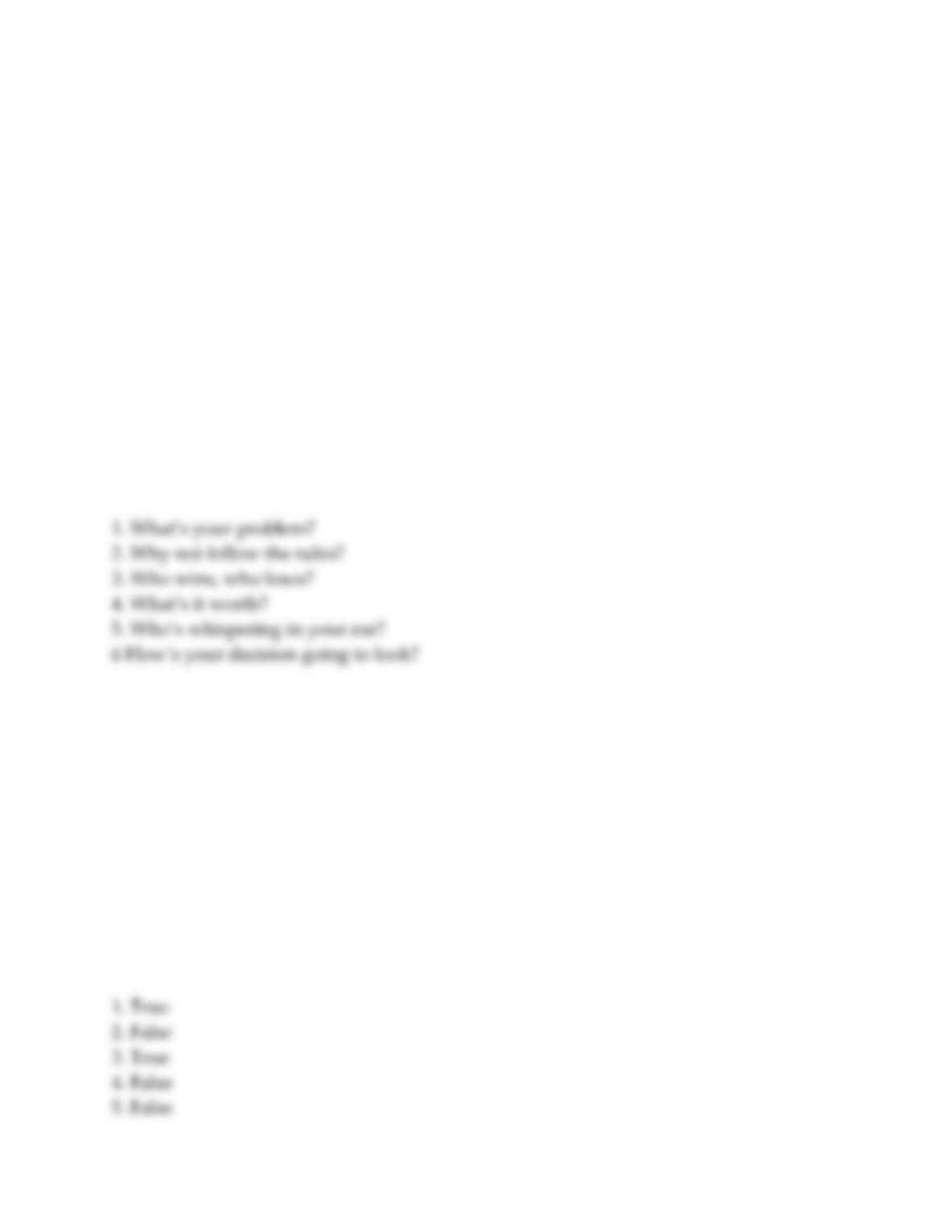
1. What’s _________ _________________?
2. Why not __________ ____________ _______________?
3. Who ________, who _____________ ?
4. What’s ______ __________________?
5. Who’s ______________________ __________ ____________ ________?
6. How’s _____ ______________ _________ ____________ ___________ ?
Answers to fill-in-the-blank questions
1. The Greek word for “ethics” translates into a word meaning “character.”
2. A quick way to think about morals is as what occurs “above the neck” and ethics as
what occurs “below the neck.”
3. Charles Peirce said we “fix our beliefs” in four hierarchal ways: tenacity, authority,
intuition, and science.
4. There is no difference between what is legal and what is ethical.
5. An amoral act is, by definition, not ethically justifiable.
6. A good moral philosopher works best when using ad hoc moralizing techniques.
Answers to true/false questions

For 1 through 4, match the category of ethics with its description.
1. Descriptive
2. Non-theoretic
3. Normative ethical theory
4. Meta-ethics
5. Applied ethics
A. Broad, general moral statements that help explain why some actions are right and
some actions are wrong.
B. Ethics that chronicles what sorts of beliefs that people or cultures hold.
C. Using normative ethics to solve a specific problem.
D. Discussions about how you (or others) feel about a moral topic.
E. Efforts to define moral terminology, such as what is “truth” or “loyalty.”
6. If you choose to join the Society of Professional Journalists or the Public Relations
Society of America, then you are taking on ______________ relationship with that
group.
A. an assigned
B. a contracted
C. a legal
D. an assumed
E. an amoral
7. According to Peirce’s list of how we fix our beliefs, the use of a code of ethics to make
moral decisions would be an example of appealing to ___________.
A. tenacity
B. authority.
C. autonomy.
D. intuition.
E. science.
8. The ability to make ethical decisions based on your own careful thinking is known as:
A. ad hoc moralizing.

B. rules-based ethics.
C. moral autonomy.
D. moral pragmatism.
E. ethical absolutism.
9. When someone resolves an ethical problem by offering specific, narrow, and
dogmatic advice rather than thoughtful analysis of the problem, then that person is
relying on:
A. a priori.
B. intuition.
C. science.
D. moralizing.
E. moral philosophy
Answers to multiple choice questions
1. Describe the similarities and differences between law and ethics.
2. Discuss the differences between assigned, contracted, and assumed relationships.
Include an example of each in a mass media context.