Archives
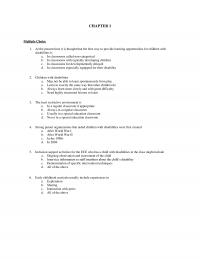
978-0135204450 Chapter 1
CHAPTER 1 Multiple Choice 1. At the present time it is thought that the best way to provide learning opportunities for children with disabilities is a. In classrooms called non-categorical b. In classrooms with typically developing children c. In classrooms […]
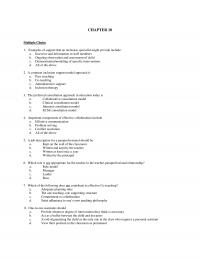
978-0135204450 Chapter 10
CHAPTER 10 Multiple Choice 1. Examples of support that an inclusion specialist might provide include: a. Inservice and information to staff members b. Ongoing observation and assessment of child c. Demonstration/modeling of specific interventions d. All of the above 2. […]
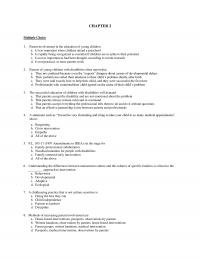
978-0135204450 Chapter 2
CHAPTER 2 Multiple Choice 1. Parent involvement in the education of young children a. Is less important when children attend a preschool b. Is rapidly being recognized as essential if children are to achieve their potential c. Is not as […]
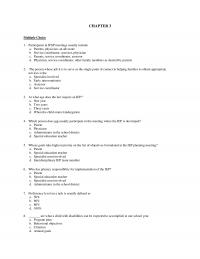
978-0135204450 Chapter 3
CHAPTER 3 Multiple Choice 1. Participants in IFSP meetings usually include a. Parents, physician, an advocate b. Service coordinator, assessor, physician c. Parents, service coordinator, assessor d. Physician, service coordinator, other family members as desired by parents 2. The person […]
978-0135204450 Chapter 4
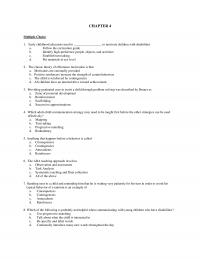
CHAPTER 4 Multiple Choice 1. Early childhood educators need to _________________ to motivate children with disabilities a. Follow the curriculum guide b. Identify high-preference people, objects, and activities c. Establish turn taking d. Put materials at eye level 2. The […]
978-0135204450 Chapter 5
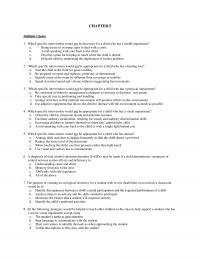
CHAPTER 5 Multiple Choice 1. Which specific intervention would not be necessary for a child who has a health impairment? a. Being aware of warning signs to deal with a crisis b. Avoid speaking with your back to the child […]
978-0135204450 Chapter 6
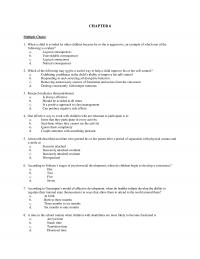
CHAPTER 6 Multiple Choice 1. When a child is avoided by other children because he or she is aggressive, an example of which one of the following is evident? a. Logical consequences b. Unavoidable consequences c. Logical connections d. Natural […]
978-0135204450 Chapter 7
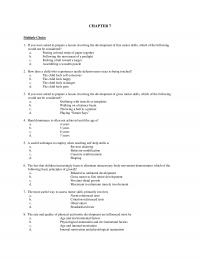
CHAPTER 7 Multiple Choice 1. If you were asked to prepare a lesson involving the development of fine motor skills, which of the following would not be considered? a. Pasting colored strips of paper together b. Following the movement of […]
978-0135204450 Chapter 8
CHAPTER 8 Multiple Choice 1. When working with a child who is severely disabled and nonverbal, one of the first steps in designing a communication training program is a. Assessing speech production skills b. Teaching receptive vocabulary c. Identifying high-preference […]
978-0135204450 Chapter 9
CHAPTER 9 Multiple Choice 1. Piaget identified the sensorimotor period of development as a. Between birth and age 5 b. Between ages 2 and 6 c. Between birth and age 2 d. After age 3 2. The three basic cognitive […]
Curriculum & Instruction Chapter 1 Educating Young Children With Disabilities The Challenge Outline Viewing The Child
Chapter 1 EDUCATING YOUNG CHILDREN WITH DISABILITIES THE CHALLENGE OUTLINE I. Viewing the Child with Disabilities as a Child First II. Inclusion of Young Children with Disabilities in Community-Based Settings III. Philosophy of This Text IV. Early Childhood Special Education: […]
Curriculum & Instruction Chapter 2 Partnership With Families Outline Emotional Supports For Families With Children Who
CHAPTER 2 IN PARTNERSHIP WITH FAMILIES OUTLINE I. Emotional Supports for Families with Children Who Have Disabilities A. The Need for Professionals to Respect Families B. The Need for Emotional Support II. Parental Reactions: Dealing with Grief and Other Feeling […]
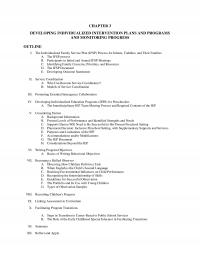
Curriculum & Instruction Chapter 3 Developing Individualized Intervention Plans And Programs And Monitoring Progress Outline The
CHAPTER 3 DEVELOPING INDIVIDUALIZED INTERVENTION PLANS AND PROGRAMS AND MONITORING PROGRESS OUTLINE I. The Individualized Family Service Plan (IFSP) Process for Infants, Toddlers, and Their Families A. The IFSP process B. Participants in Initial and Annual IFSP Meetings II. Service […]
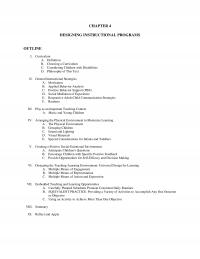
Curriculum & Instruction Chapter 4 Designing Instructional Programs Outline Curriculum Definition Choosing Curriculum Considering Children With
CHAPTER 4 DESIGNING INSTRUCTIONAL PROGRAMS OUTLINE I. Curriculum II. General Instructional Strategies A. Motivation B. Applied Behavior Analysis C. Positive Behavior Support (PBS) D. Social Mediation of Experience E. Responsive Adult-Child Communication Strategies F. Routines III. Play as an Important […]
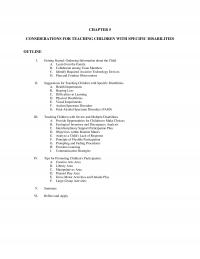
Curriculum & Instruction Chapter 5 Considerations For Teaching Children With Specific Disabilities Outline Getting Started Gathering
CHAPTER 5 CONSIDERATIONS FOR TEACHING CHILDREN WITH SPECIFIC DISABILITIES OUTLINE I. Getting Started: Gathering Information about the Child A. Learn from the Family II. Suggestions for Teaching Children with Specific Disabilities A. Health Impairments B. Hearing Loss C. Difficulties in […]
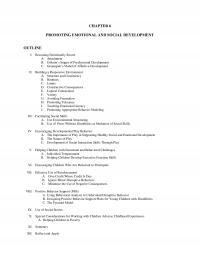
Curriculum & Instruction Chapter 6 Promoting Emotional And Social Development Outline Becoming Emotionally Secure Attachment Eriksons
CHAPTER 6 PROMOTING EMOTIONAL AND SOCIAL DEVELOPMENT OUTLINE I. Becoming Emotionally Secure A. Attachment B. Erikson’s Stages of Psychosocial Development C. Greenspan’s Model of Affective Development II. Building a Responsive Environment A. Structure and Consistency B. Routines C. Limits D. […]
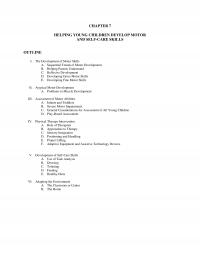
Curriculum & Instruction Chapter 7 Helping Young Children Develop Motor And Selfcare Skills Outline The Development
CHAPTER 7 HELPING YOUNG CHILDREN DEVELOP MOTOR AND SELF-CARE SKILLS OUTLINE I. The Development of Motor Skills A. Sequential Trends of Motor Development B. Helping Parents Understand C. Reflexive Development II. Atypical Motor Development A. Problems in Muscle Development III. […]
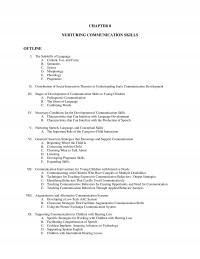
Curriculum & Instruction Chapter 8 Nurturing Communication Skills Outline The Subskills Language Content Use And Form
CHAPTER 8 NURTURING COMMUNICATION SKILLS OUTLINE I. The Subskills of Language A. Content, Use, and Form B. Semantics II. Contribution of Social Interaction Theories to Understanding Early Communication Development III. Stages of Development of Communication Skills in Young Children A. […]
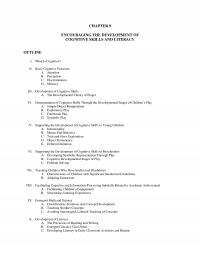
Curriculum & Instruction Chapter 9 Encouraging The Development Cognitive Skills And Literacy Outline What Cognition Basic
CHAPTER 9 ENCOURAGING THE DEVELOPMENT OF COGNITIVE SKILLS AND LITERACY OUTLINE I. What Is Cognition? II. Basic Cognitive Processes A. Attention B. Perception III. Development of Cognitive Skills A. The Developmental Theory of Piaget IV. Demonstration of Cognitive Skills Through […]