CHAPTER 7
HELPING YOUNG CHILDREN DEVELOP MOTOR
AND SELF-CARE SKILLS
OUTLINE
I. The Development of Motor Skills
A. Sequential Trends of Motor Development
B. Helping Parents Understand
C. Reflexive Development
II. Atypical Motor Development
A. Problems in Muscle Development
III. Assessment of Motor Abilities
A. Infants and Toddlers
B. Severe Motor Impairments
C. General Considerations for Assessment of All Young Children
D. Play-Based Assessment
IV. Physical Therapy Intervention
A. Role of Therapists
B. Approaches to Therapy
VI. Adapting the Environment
A. The Classroom or Center
B. The Home
VII. Movement Education
A. Movement Skills and Music
B. Movement Skills and Imagination
C. Adaptations in Movement Education
ESSENTIAL CONCEPTS AND VOCABULARY
Athetoid movement patterns
Backward chaining
Cephalocaudal pattern
Chaining
Fine motor skills
Fluctuating muscle tone
Forward chaining
Functional skills
Gross motor skills
Handedness
Quadriplegia
Reverse chaining
Self-regulation
Sensorimotor observations
Sensory defensiveness
DISCUSSION TOPICS AND ACTIVITIES
1. Select three developmental checklists and conduct a thorough review of them. Pay special attention to the
sequential order of the motor skills. Adopt a checklist that seems to be complete or compile your own.
2. Take a major skill such as throwing a ball and break it into subskills. Sequence these skills. After your task
analysis is complete, try to teach the skill to a friend or a child. What subskills did you leave out? Did the
order of your skills need to be changed? With adults, skipping is a good skill to analyze.
3. Interview or ask a PT and OT to visit class. Ask about positioning techniques, adaptive equipment, and
4. Investigate the relationship between motor skills and body awareness. Begin a file of developmentally
5. Explain the sequential trends of motor development to another person using specific examples. If you can
explain them clearly, you must understand them.
6. Research and discuss the various disabling conditions such as cerebral palsy, muscular dystrophy, and
7. Plan a motor activity. Be creative. Consider parachutes, isometric exercises, and dances. Do this activity
8. Select a typical preschool game or action song, for example, “Duck, Duck Goose” or “Hokey, Pokey,” and
10. Conduct an online search of adaptive equipment and assistive technology devices that are appropriate for
preschoolers with motor disabilities. Develop a PowerPoint presentation with images of selected devices
ACTIVITY: PRACTICING TASK ANALYSIS
Task analysis of the directions for this activity:
1. Choose a task from a preschool classroom (examples: blowing nose appropriately, creating collage art activity,
2. Write it in space provided
4. Write each step in the space provided
6. Write them down in space provided
7. Write adaptations for specific steps to help support students with the two disabilities (some steps might not
need adaptations)
Note: Try to have the child be as independent as possible without too much physical assistance. Physical assistance
is an overused strategy in many classrooms.
Task Analysis for: ___________________________________
Smaller Teachable Steps
Adaptations for Disability 1:
_________________
Adaptations for Disability 2:
__________________
1.
2.
3.
4.
5.
6.
7.
8.
COURSE ASSIGNMENT
TASK ANALYSIS ASSIGNMENT AND RUBRIC GRADING SHEET
Students will synthesize their learning by creating a four-page paper consisting of a task analysis embedded into a
lesson plan with appropriate adaptations. Students will need to choose one specific task that can be broken down
steps)
Lesson Plan (page 2)
D. List the daily activity of the classroom schedule that you have chosen to teach the task analysis. A daily
activity is a natural occurring opportunity throughout the day such as art activities, transitions, cleanup,
learning centers, cooking or mealtimes in which the task analysis can be embedded and taught.
E. Write a short description of the activity: (one paragraph)
F. List all materials needed.
G. Explain the teaching sequence and procedures based on the task analysis: (you might want to use a chart)
see page 213 for example
Adaptations (page 3)
H. Create and explain some adaptations (materials or prompts) based on your task analysis that might be
needed for a variety of different disabilities. The student will make and show at least one of the adaptations
during the presentation.
Data Collection (page 4)
I. Create a data collection chart with a designated key to monitor the progress that students are making on the
task analysis. See page 214 for example.
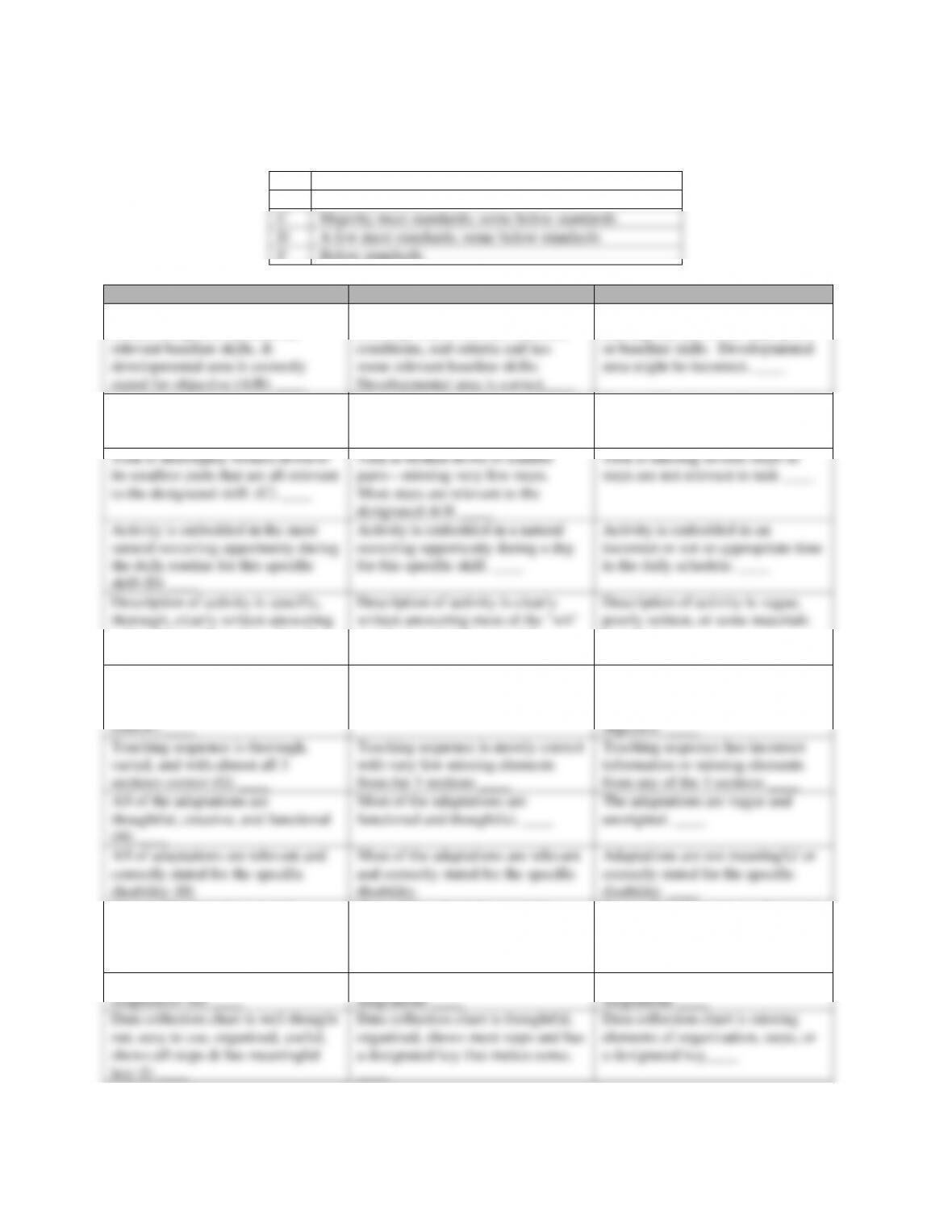
Task Analysis Rubric Grading Sheet
Name: ________________________________________
A
Exceeds standards
B
Meets standards
F
Below standards
Exceeds Standards
Meets standards
Below standards
Terminal objective is correctly
stated, thoughtful, includes all
relevant baseline skills, &
developmental area is correctly
stated for objective (A/B) ____
Terminal behavioral objective is
correctly stated with the behavior,
conditions, and criteria and has
some relevant baseline skills:
Developmental area is correct____
Terminal behavioral objective is
missing any one of the main parts
or baseline skills. Developmental
area might be incorrect. ____
All of the steps in the enroute
behavioral objective are in correct
sequential order (C) ____
Most of the steps in the enroute
behavioral objective are in correct
sequential order ____
Some of the steps are in sequential
order ____
Task is thoroughly broken down to
its smallest parts that are all relevant
to the designated skill. (C) ____
Task is broken down to smaller
parts—missing very few steps.
Most steps are relevant to the
designated skill. ____
Task is missing several steps or
steps are not relevant to task ____
Activity is embedded in the most
natural occurring opportunity during
the daily routine for this specific
skill (D) ____
Activity is embedded in a natural
occurring opportunity during a day
for this specific skill. ____
Activity is embedded in an
incorrect or not so appropriate time
in the daily schedule. ____
Description of activity is specific,
thorough, clearly written answering
-what, when, where, how, list all
materials (E/F). ___
Description of activity is clearly
written answering most of the “wh”
questions and states materials
needed. ____
Description of activity is vague,
poorly written, or some materials
are missing. ____
Activity is relevant to and consistent
with the specific skill of the
terminal behavioral objective
(D/E/F) ____
Activity is somewhat relevant with
the specific skill of the terminal
behavioral objective. ____
Activity is not relevant or does not
specifically work on the skill listed
in the terminal behavioral
objective. ____
Teaching sequence is thorough,
varied, and with almost all 3
sections correct (G) ____
Teaching sequence is mostly correct
with very few missing elements
from the 3 sections ____
Teaching sequence has incorrect
information or missing elements
from any of the 3 sections ____
All of the adaptations are
thoughtful, creative, and functional
(H) ____
Most of the adaptations are
functional and thoughtful. ____
The adaptations are vague and
unoriginal. ____
All of adaptations are relevant and
correctly stated for the specific
disability (H)
Most of the adaptations are relevant
and correctly stated for the specific
disability.
Adaptations are not meaningful or
correctly stated for the specific
disability. ____
Almost all adaptations remain
within the realm of the terminal
behavioral objective and
developmental area (H). ____
Most of the adaptations remain
within the realm of the terminal
behavioral objective and
developmental area. ____
Some adaptations are too far away
from the terminal objective or
actually change the scope to a
different skill. ____
At least 7 disabilities had
adaptations (H) ____
At least 5 disabilities had
adaptations ____
4 or less disabilities had
adaptations ____
Data collection chart is well thought
out, easy to use, organized, useful,
shows all steps & has meaningful
key (I) ____
Data collection chart is thoughtful,
organized, shows most steps and has
a designated key that makes sense.
____
Data collection chart is missing
elements of organization, steps, or
a designated key____
C
Majority meet standards; some below standards
D
A few meet standards; some below standards
COURSE ASSIGNMENT:
MOTOR DEVELOPMENT ACTIVITY WITH ADAPTATIONS
Directions: Review EXHIBIT 7.3: A Gross Motor Activity with Adaptations. You will choose a gross or fine motor
activity that you would like to teach the children. You will create an activity plan following the example as listed in
Exhibit 7.3 including all of the components below:
Objectives: create smaller, more specific, behavioral targets that children will do on their way to achieve
the overall goal.
o Note: for further information about goals and objectives see Chapter 3: Exhibit 3.2: Appropriate
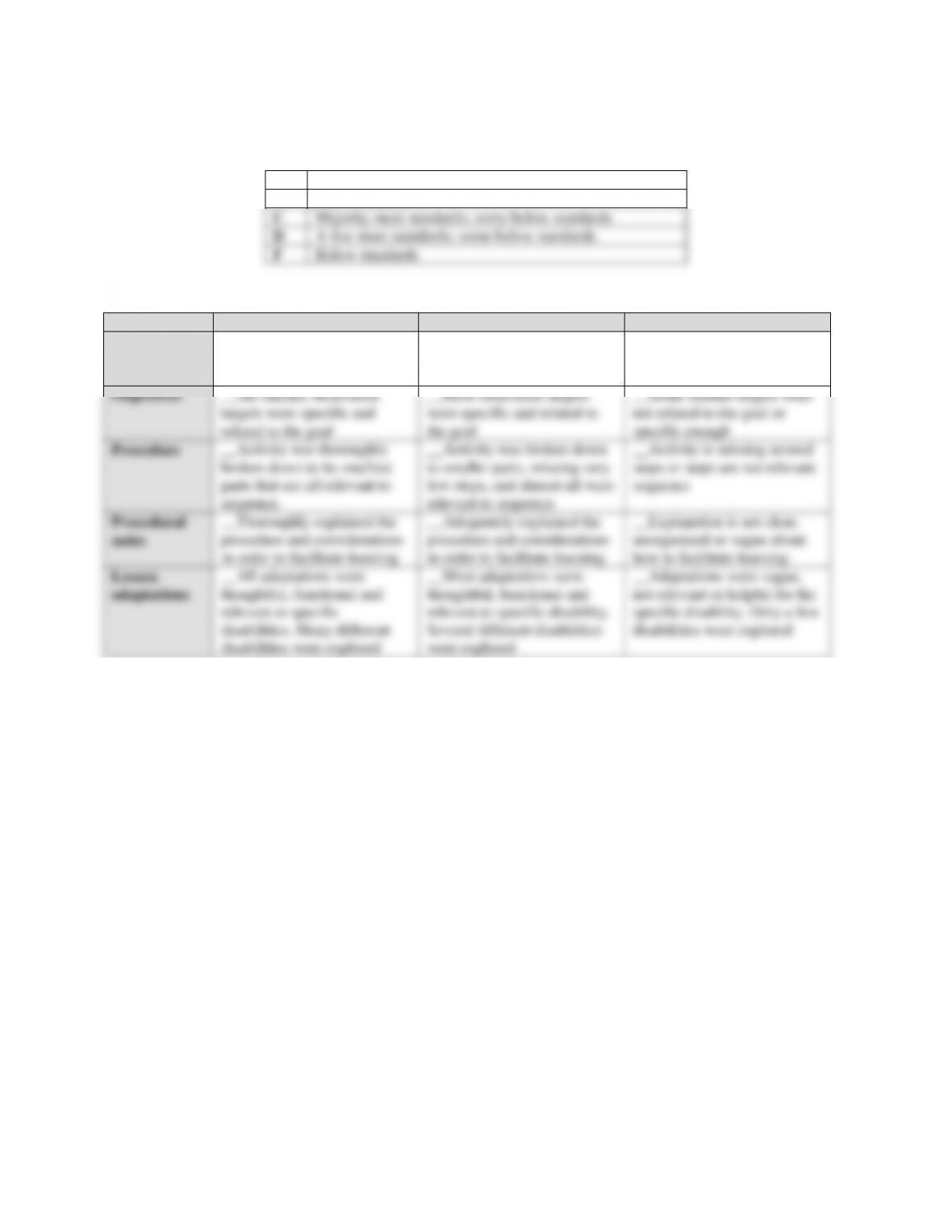
MOTOR DEVELOPMENT ACTIVITY WITH ADAPTATIONS RUBRIC
Exceeds standards
Meet standards
Below standards
Goal
__Created one appropriate
fine or gross motor goal
__Goal was not appropriately
stated for fine or gross motor
skills
Objectives
__All smaller, behavioral
targets were specific and
related to the goal
__Most behavioral targets
were specific and related to
the goal
__Some smaller targets were
not related to the goal or
specific enough
Procedure
__Activity was thoroughly
broken down to its smallest
parts that are all relevant to
sequence.
__Activity was broken down
to smaller parts, missing very
few steps, and almost all were
relevant to sequence
__Activity is missing several
steps or steps are not relevant
sequence
Procedural
notes
__Thoroughly explained the
procedure and considerations
in order to facilitate learning
__Adequately explained the
procedure and considerations
in order to facilitate learning
__Explanation is not clear,
unorganized or vague about
how to facilitate learning
Lesson
adaptations
__All adaptations were
thoughtful, functional and
relevant to specific
disabilities. Many different
disabilities were explored
__Most adaptations were
thoughtful, functional and
relevant to specific disability.
Several different disabilities
were explored
__Adaptations were vague,
not relevant or helpful for the
specific disability. Only a few
disabilities were explored
A
Exceeds standards
B
Meet standards
C
Majority meet standards; some below standards
D
A few meet standards; some below standards
F
Below standards