CHAPTER 6
PROMOTING EMOTIONAL AND SOCIAL DEVELOPMENT
OUTLINE
I. Becoming Emotionally Secure
A. Attachment
B. Erikson’s Stages of Psychosocial Development
C. Greenspan’s Model of Affective Development
II. Building a Responsive Environment
A. Structure and Consistency
B. Routines
C. Limits
D. Constructive Consequences
E. Logical Connections
F. Variety
A. Use Environmental Structuring
B. Use of Peers Without Disabilities as Mediators of Social Skills
IV. Encouraging Developmental Play Behavior
A. The Importance of Play in Supporting Healthy Social and Emotional Development
A. Individual Temperament
B. Helping Children Develop Executive Function Skills
VI. Encouraging Children Who Are Reluctant to Participate
VII. Effective Use of Reinforcement
A. Give Credit Where Credit Is Due
VIII. Positive Behavior Support (PBS)
A. Using Behavioral Analysis to Understand Disruptive Behavior
B. Designing Positive Behavior Support Plans for Young Children with Disabilities
C. The Pyramid Model
IX. Use of Social Stories
X. Special Considerations for Working with Children Adverse Childhood Experiences
A. Helping Children in Poverty
ESSENTIAL CONCEPTS AND VOCABULARY
Affect attunement
Affective domain
Attachment
Bonding
Distal communication
Ecological perspective
Emotional literacy
Reactive attachment disorder
Reward-to-punishment ratio
Self-regulation
Social stories
Temperament
DISCUSSION TOPICS AND ACTIVITIES
1. Make a list of necessary center limits or rules. Be certain that each is definable, reasonable, and
3. Develop a workable classroom schedule that provides a balance between active and passive involvement,
4. Make a chart of as many natural and logical consequences for behavioral difficulties as you can think of.
5. Role-play how you would deal with a parent who insists that his or her child should settle arguments by
fighting.
7. Develop a repertoire of techniques to effect smooth transitions. Role-play some of these with classmates.
8. Study one of the many excellent texts on behavior management techniques. Conduct a behavior
9. Participate with colleagues in the development of a positive behavior support plan.
10. Visit a school supply center or obtain catalogs from toy companies. Develop a list of “social” toys and a list
of “isolate” toys. Share with your classmates in order to develop a master list for all to keep.
.
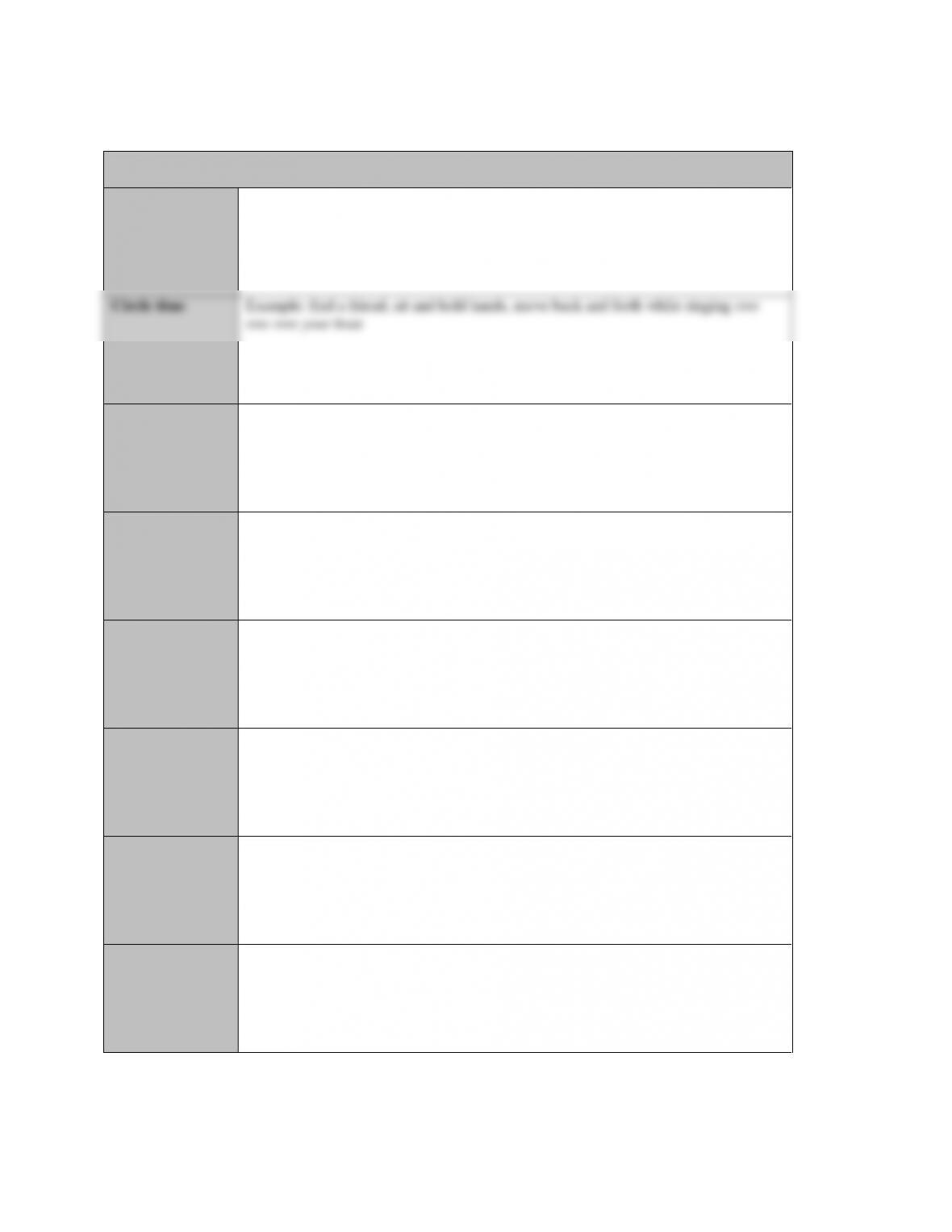
ACTIVITY: Facilitating Social Skills During the Daily Schedule
Create specific activities during the daily schedule below that helps children with disabilities develop
social skills and build relationships with their peers.
Art time
Example: paint at the easel with a friend
Circle time
Example: find a friend, sit and hold hands, move back and forth while singing row
row row your boat
Snack time
Transitions
Cleanup time
Outside time
Learning centers
time:
manipulatives
area (puzzles,
Legos, pegs)
Learning centers
time: pretend
play area (dress-
up,
transportation)
ACTIVITY: ARTICLE REVIEWS
Topic: Social Emotional Development and Improving Challenging Behaviors
Go to the National Center for Pyramid Model Innovations (NCPMI): scroll down to For Families and click
Students will come prepared to share the following information about the articles in small groups of 3 to 4
students during class time.
COURSE ASSIGNMENT
Social Emotional Poster Rubric Grading Sheet
Assignment directions:
Students will obtain catalogues from toy companies by visiting school supply centers or accessing catalogues online
in order to find toys/materials that help to develop social and emotional skills that are appropriate for a preschool
Social emotional poster will consist of:
Section 1: pictures of toys/materials that develop social skills
Section 2: pictures of toys/materials that develop emotional literacy skills
Section 3: pictures of toys/materials that develop either social and/or emotional literacy skills that are
Rubric:
C
Majority meet standards; some below standards
D
A few meet standards; some below standards
F
Below standards
A
Exceeds standards
B
Meets standards
Exceeds Standards
Meet Standards
Below Standards
___ Poster shows a deep level of
thinking and is very clear and
well organized
___ Poster is sometimes
thoughtful and organized
___ Poster is mostly “surface
level,” lacks thoughtfulness, and
is disorganized
___ Each section has a good
variety of appropriate
toys/materials
___ Each section has an adequate
amount and variety of appropriate
toy/materials
___ Some sections do not have
enough examples and may not be
appropriate
___ All pictures are labeled with
the correct specific skill(s) to be
developed
___ Almost all pictures are
labeled with the correct specific
skill(s) to be developed
___ A few pictures are labeled
and/or the skills to be developed
might be incorrect or not specific
___ All of the adaptations are
thoughtful, creative, and
functional
___ Most of the adaptations are
functional and thoughtful
___ The adaptations are vague
and unoriginal
___ A toy/material from section 1
& 2 has adaptations for 5
disabilities
___ A toy/material from section 1
& 2 has adaptations for 3
disabilities
___ Only one section has
adaptations or has adaptations for
two or less disabilities
___ All of the adaptations are
relevant and correctly stated for
the specific disability
___ Most of the adaptations are
relevant and most are correctly
stated for the specific disability
___ Adaptations are not
meaningful or correctly stated for
the specific disability