CHAPTER 5
CONSIDERATIONS FOR TEACHING CHILDREN WITH SPECIFIC DISABILITIES
OUTLINE
I. Getting Started: Gathering Information about the Child
A. Learn from the Family
II. Suggestions for Teaching Children with Specific Disabilities
A. Health Impairments
B. Hearing Loss
C. Difficulties in Learning
III. Teaching Children with Severe and Multiple Disabilities
A. Provide Opportunities for Children to Make Choices
B. Ecological Inventory and Discrepancy Analysis
C. Interdisciplinary Support Participation Plan
D. Objectives within Routine Matrix
IV. Tips for Promoting Children’s Participation
A. Creative Arts Area
B. Library Area
C. Manipulatives Area
D. Pretend Play Area
E. Gross Motor Activities and Outside Play
F. Large-Group Activities
V. Summary
ESSENTIAL CONCEPTS AND VOCABULARY
Accommodations
Hand-under-hand guidance
Hierarchy of prompts
Interdisciplinary support participation plan
Least-to-most prompting
Match-to-sample
Most-to-least prompting
DISCUSSION TOPICS AND ACTIVITIES
1. Observe a child with a multiple disability in routine activities. Identify the child’s strengths, preferences,
and needs based on your observation.
3. Interview a teacher of a child with multiple disabilities. Ask about the adaptations that he or she uses to
promote the child’s learning and participation.
4. Identify a child with severe or multiple disabilities. Develop a list of questions you would ask a service
5. Develop an interdisciplinary support participation plan for a selected preschool activity for a hypothetical
7. Develop a plan to embed specific learning objectives found on a particular child’s IEP within the daily
routine. Be prepared to explain how the embedded activity is related to the learning objectives.
8. Conduct an online search of Web sites (e.g., National Autism Center, www.nationalautismcenter.org, or
9. In pairs, students could take turns playing a child and a teacher. The child puts on a blindfold, and the
10. Ask students to bring a game or a toy to class that preschool-aged children would typically become
involved with. They should, then, describe the potential learning that could result from the use of each toy.
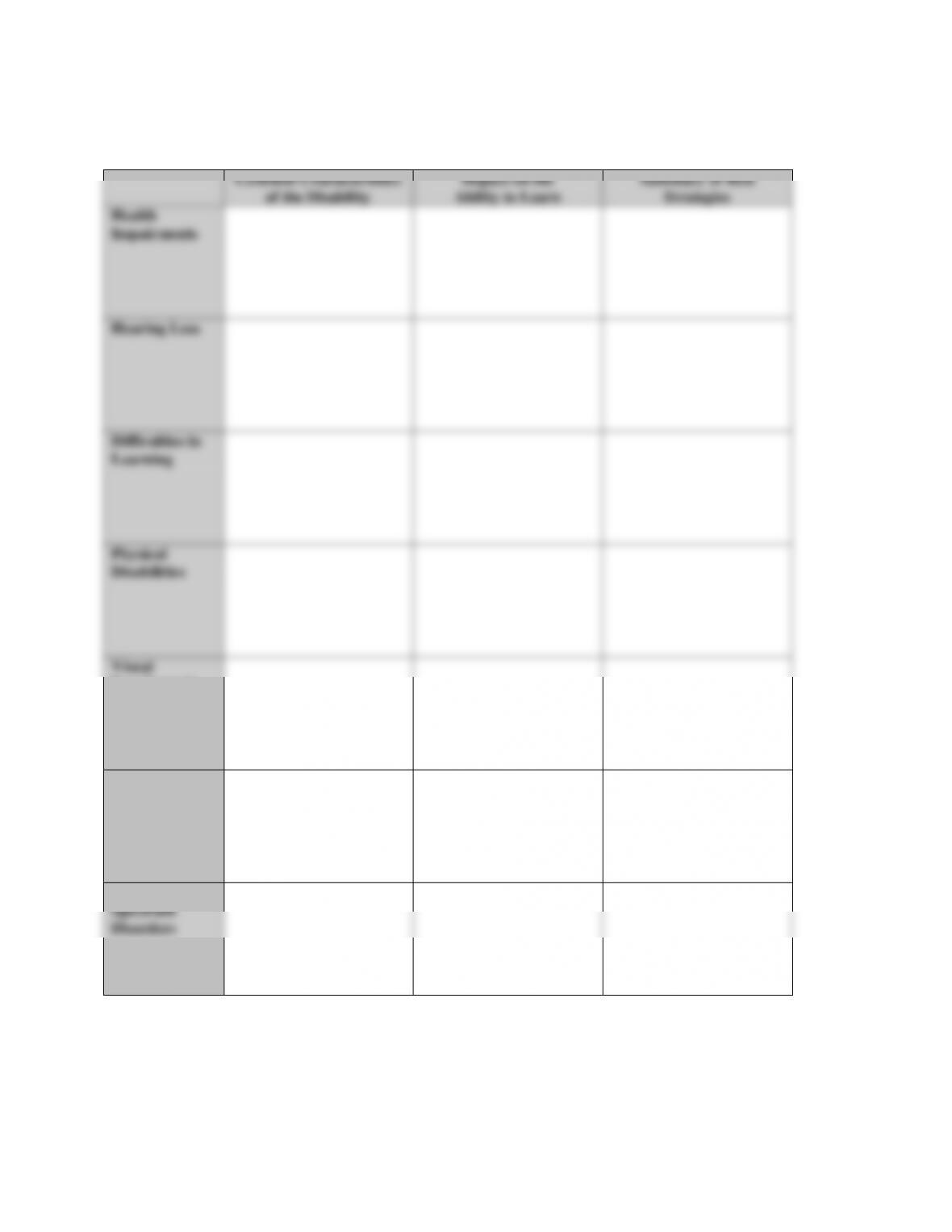
ACTIVITY: Specific Disabilities Note Taking Chart
Common Characteristics
of the Disability
Impact on the
Ability to Learn
Summary of Best
Strategies
Health
Impairments
Hearing Loss
Difficulties in
Learning
Physical
Disabilities
Visual
Impairments
Autism
Spectrum
Disorders
Fetal Alcohol
Spectrum
Disorders
COURSE ASSIGNMENT
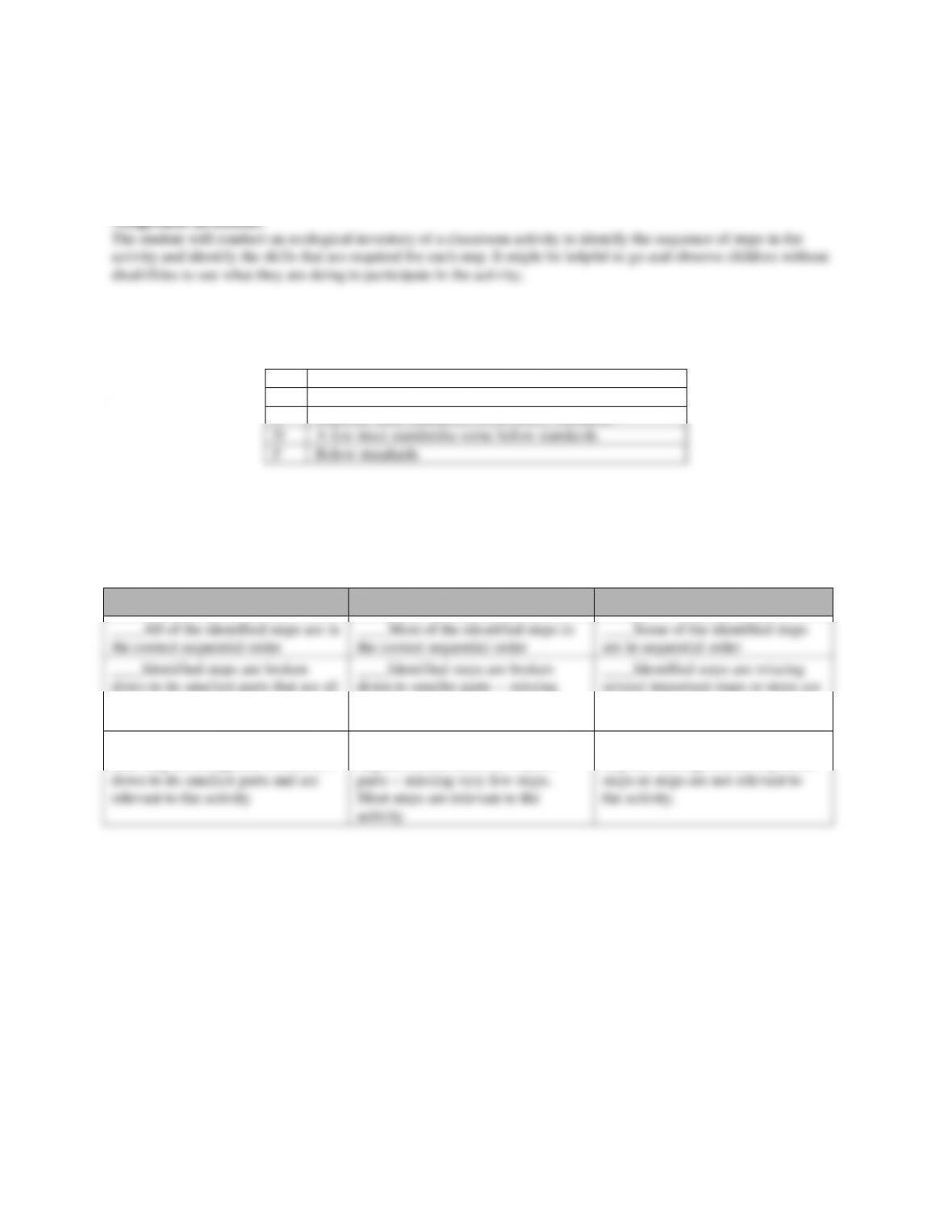
Ecological Inventory Rubric Rating Sheet
Rubric:
A
Exceeds standards
B
Meets standards
C
Majority meet standards; some below standards
D
A few meet standardss some below standards
F
Below standards
Exceeds Standards
Meets standards
Below standards
____All of the identified steps are in
the correct sequential order
____Most of the identified steps in
the correct sequential order
____Some of the identified steps
are in sequential order
____Identified steps are broken
down to its smallest parts that are all
relevant to the activity
____Identified steps are broken
down to smaller parts — missing
very few steps. Most steps are
relevant to the activity
____Identified steps are missing
several important steps or steps are
not relevant to the activity
____ All of the skills required for
each step are thoughtful and broken
down to its smallest parts and are
relevant to the activity
____ The skills required for each
step are broken down to smaller
parts — missing very few steps.
Most steps are relevant to the
activity
____ The skills required for each
step are missing several important
steps or steps are not relevant to
the activity.

Ecological Inventory Chart
Students Name: ________________________________________
Classroom Activity: __________________________________
Identified Steps
Skills Required for Each Step
Course Assignment: Interventions for Children with Autism
(Can do with a partner or as a small group)
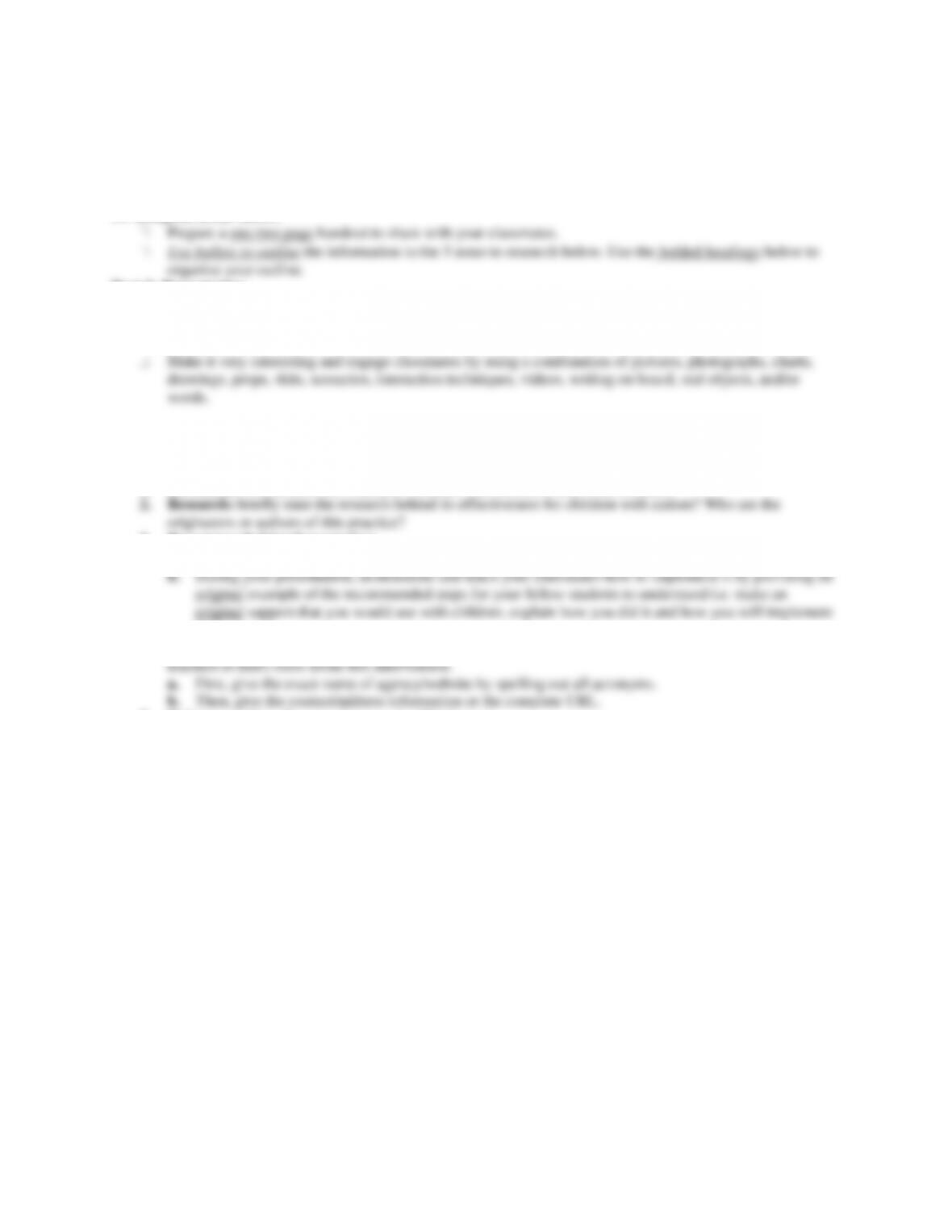
Part 1: Handout: Thoroughly research one of the selected interventions for children with autism in Exhibit
5.1 using the areas below.
Part 2: Presentation.
You will do a presentation and demonstrate your selected intervention by using Universal Design for
Learning (UDL) multiple means of engagement, representation, and expression to support your
presentation.
AREAS TO RESEARCH
1. Definition: briefly describe what your selected intervention is and what it means?
3. Recommended implementation:
a. Identify and list the recommended steps for implementation.
it.
4. Resources: Make a list of online resources including books, articles, videos, blogs, and agencies for
5. References: List all your references in APA format
Interventions for Children with Autism Rubrics
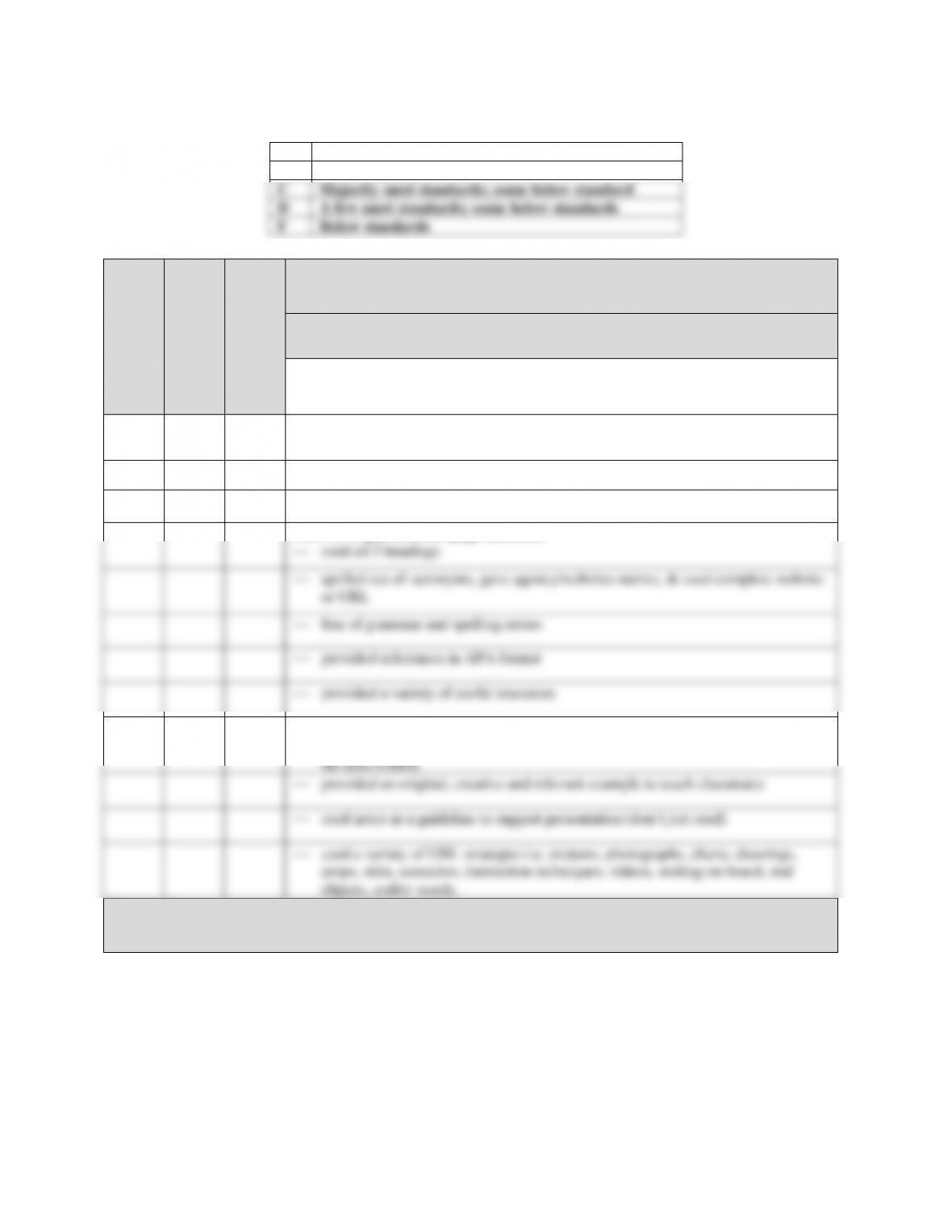
Exceeds standards
Meets standard
Below standard
Students names:
Intervention name:
Standard
Part 1: Did accurate research in these heading areas:
1
2
3
Part 1: Prepared a one-page handout:
used all 5 headings
spelled out all acronyms, gave agency/websites names, & used complete website
or URL
free of grammar and spelling errors
provided references in APA format
provided a variety of useful resources
Part 2: Presentation and demonstration of intervention:
presented enough information to help classmates understand how to implement
the intervention
provided an original, creative and relevant example to teach classmates
used notes as a guideline to support presentation (don’t just read)
used a variety of UDL strategies i.e. pictures, photographs, charts, drawings,
props, skits, scenarios, interaction techniques, videos, writing on board, real
objects, and/or words.
Comments:
A
Exceeds standards
B
Meet standards
C
Majority meet standards; some below standard
D
A few meet standards; some below standards
F
Below standards