Archives
978-0133974850 Chapter 1 Part 1
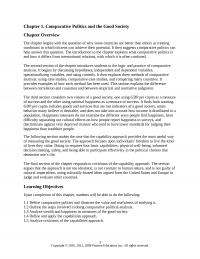
Chapter 1. Comparative Politics and the Good Society Chapter Overview The chapter begins with the question of why some countries are better than others at creating conditions in which citizens can achieve their potential. It then suggests comparative politics can […]
978-0133974850 Chapter 1 Part 2
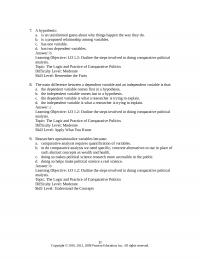
7. A hypothesis: a. is an uninformed guess about why things happen the way they do. b. is a proposed relationship among variables. c. has one variable. d. has two dependent variables. analysis. Topic: The Logic and Practice of Comparative […]
978-0133974850 Chapter 1 Part 3
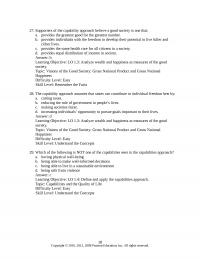
27. Supporters of the capability approach believe a good society is one that: a. provides the greatest good for the greatest number. b. provides individuals with the freedom to develop their potential to live fuller and richer lives. c. provides […]
978-0133974850 Chapter 10 Part 1
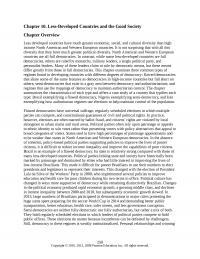
Chapter 10. Less-Developed Countries and the Good Society Chapter Overview Less developed countries have much greater economic, social, and cultural diversity than high income North American and Western European countries. It is not surprising that with all this diversity that […]
978-0133974850 Chapter 10 Part 2
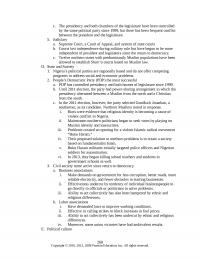
c. The presidency and both chambers of the legislature have been controlled by the same political party since 1999, but there has been frequent conflict between the president and the legislature. 5. Judiciary a. Supreme Court, a Court of Appeal, […]
978-0133974850 Chapter 10 Part 3
REVEL Assets 10.1 Explain why there are more regime types in less developed countries than in Western Europe and North America. Activity: Module 10.1 Quiz 10.2 Summarize the main features of flawed democracy. Activity: Module 10.2 Quiz 10.3 Describe the […]
978-0133974850 Chapter 10 Part 4
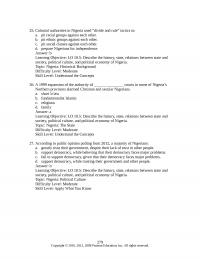
25. Colonial authorities in Nigeria used “divide and rule” tactics to: a. pit racial groups against each other. b. pit ethnic groups against each other. c. pit social classes against each other. d. prepare Nigerians for independence. society, political culture, […]
978-0133974850 Chapter 11 Part 1
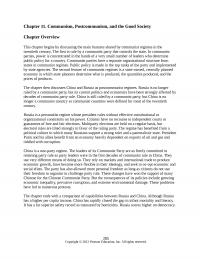
Chapter 11. Communism, Postcommunism, and the Good Society Chapter Overview This chapter begins by discussing the main features shared by communist regimes in the twentieth century. The first is rule by a communist party that controls the state. In communist […]
978-0133974850 Chapter 11 Part 2
c. Considerable overlap between the party and the state at the top levels i. The president of the state is always the president of the state ii. The state premier is always a member of the Politburo and its Standing […]
978-0133974850 Chapter 11 Part 3
16. The Russian legislature, known as the Federal Assembly, is __________ and known for being __________. a. bicameral, relatively weak b. unicameral, relatively weak c. bicameral, relatively strong d. unicameral, relatively strong society, political culture, and political economy of Russia. […]
978-0133974850 Chapter 11 Part 4
34. China’s judicial system: a. is modeled after the British and American judicial systems. b. has a supreme court and appellate courts. c. has no system for judicial review. d. is independent from Communist party oversight. society, political culture, and […]
978-0133974850 Chapter 2 Part 1
Chapter 2. The State Chapter Overview The introduction argues that the good society depends upon a society’s institutional arrangements. The most powerful institution of all is the state. The good society is based on a set of four defensible universal […]
978-0133974850 Chapter 2 Part 2
5. In general, stronger, more efficient states perform much better than weaker, failing ones. 6. Countries with the weakest states were the deadliest, most violent of all. G. Democracy 1. The quality of the state also seems to be correlated […]
978-0133974850 Chapter 2 Part 3
28. The difference between the head of government and the head of state: a. is that the head of state represents the country, while the head of government directs the executive branch. b. is that the head of government represents […]
978-0133974850 Chapter 3 Part 1
Chapter 3. State and Society Chapter Overview This chapter examines the links connecting state and society. State and society are connected to each other through political participation. The chapter examines political parties, interest groups, social movements, and patron-client relations as […]
978-0133974850 Chapter 3 Part 2
2. If institutional capacity is not sufficient to channel demands arising from electoral participation into effective government, then Iraqis may return to settling their differences with bullets instead of ballots again. IX. COMPRATIVE POLITICAL ANALYSIS: ARE PEOPLE BETTER OFF? WHY […]
978-0133974850 Chapter 3 Part 3
20. Which of the following is a characteristic of a corporatist interest group system? a. There are a large number of interest groups. b. Nonmembers cannot easily be sanctioned. c. Participation in a group is easily avoided. d. Groups are […]
978-0133974850 Chapter 4 Part 1
Chapter 4. Political Culture and Identity Chapter Overview This chapter examines political culture and political identity and why some countries can sustain stable democracies and improve the capabilities of their citizens, whereas others cannot. The chapter is divided into five […]
978-0133974850 Chapter 4 Part 2
VII. POLITICAL CULTURE, IDENTITY, AND THE GOOD SOCIETY A. This section examines how political culture and political identity affect citizens’ 1. General hypothesis: citizens living in countries with high levels of social trust are more likely to be willing to […]
978-0133974850 Chapter 4 Part 3
19. The supporters of recent research using the civic culture approach would suggest that if someone wanted to predict the likelihood of Iraq becoming a stable democracy, the most useful information to know would be: a. its GDP per capita. […]
978-0133974850 Chapter 4 Part 4
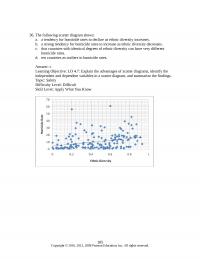
36. The following scatter diagram shows: a. a tendency for homicide rates to decline as ethnic diversity increases. b. a strong tendency for homicide rates to increase as ethnic diversity decreases. c. that countries with identical degrees of ethnic diversity […]
978-0133974850 Chapter 5 Part 1
Chapter 5. Political Economy Chapter Overview This chapter examines the proper sphere or range of state activity in the economy. It asks what balance between states and markets most enhances individuals’ capabilities and contributes to the good society. The chapter […]
978-0133974850 Chapter 5 Part 2
G. The issue is how to develop a balance between states and markets that promotes the best qualities of markets, such as innovation and productivity, while avoiding their worst effects, such as instability and inequality X. IN-DEPTH: INDIA: FROM STATES […]
978-0133974850 Chapter 5 Part 3
24. Which group would be most likely to support Washington Consensus policies? a. labor unions representing steel workers b. the owners of an American-owned car company c. advocates for the poor who want expanded access to welfare programs d. stockholders […]
978-0133974850 Chapter 6 Part 1
Chapter 6. Authoritarianism Chapter Overview Authoritarian leaders were on the defensive between 1974 and 2000 as a wave of democratization swept across the world. In the first decade of the twenty-first century, however, authoritarian regimes proved surprisingly resilient. The first […]
978-0133974850 Chapter 6 Part 2
7. Two political problems for authoritarian leaders are: a. authoritarian power sharing and authoritarian control. b. democracies and western leaders. c. religion and culture. d. opposition powers and authoritarian laws. rulers must address. Topic: Authoritarian Politics Difficulty Level: Easy Skill […]
978-0133974850 Chapter 6 Part 3
28. Research on political values among Muslim publics has found that: a. Muslims reject democracy. b. a majority of Muslims in several Muslim majority countries strongly support the idea that democracy is better than any other form of government. c. […]
978-0133974850 Chapter 7 Part 1
Chapter 7. Democracy Chapter Overview This chapter begins by defining democracy and examining the three waves of democracy that resulted in more people living in democracies than in dictatorships for the first time in history. It then turns to examine […]
978-0133974850 Chapter 7 Part 2
3. During the Arab Spring, students: a. used social media to express their desire for a government. b. did not have access to social media. c. used social media to bring down governments. d. discouraged the use of social media […]
978-0133974850 Chapter 7 Part 3
27. In countries using single-member districts and plurality vote: a. political parties can win a majority of seats in the legislature even though they do not win a majority of citizens’ votes. b. candidates for office must win elections by […]
978-0133974850 Chapter 8 Part 1
Chapter 8. Economic and Human Development Chapter Overview The chapter addresses the question of why some countries are more developed than others. The question matters because differences in development make a big difference in the choices people have to lead […]
978-0133974850 Chapter 8 Part 2
Multiple Choice Questions 1. Most children raised in the poor nation of Angola will __________, when compared to children raised in the wealthy nation of Sweden. a. be only fairly well-educated, despite rising oil revenues b. face much poorer life […]
978-0133974850 Chapter 8 Part 3
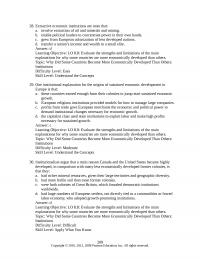
28. Extractive economic institutions are ones that: a. involve extraction of oil and minerals and mining. b. enable political leaders to concentrate power in their own hands. c. grew from European colonization of less developed nations. d. transfer a nation’s […]
978-0133974850 Chapter 9 Part 1
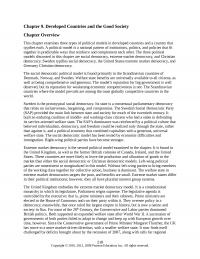
Chapter 9. Developed Countries and the Good Society Chapter Overview This chapter examines three types of political models in developed countries and a country that typifies each. A political model is a national pattern of institutions, politics, and policies that […]
978-0133974850 Chapter 9 Part 2
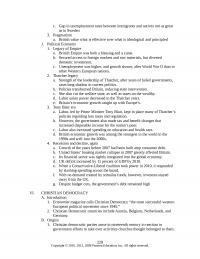
c. Gap in unemployment rates between immigrants and natives not as great as in Sweden 3. Pragmatism a. British value what is effective over what is ideological and principled J. Political Economy 1. Legacy of Empire a. British Empire was […]
978-0133974850 Chapter 9 Part 3
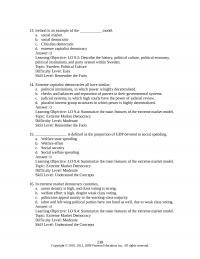
13. Ireland is an example of the ___________ model. a. social market b. social democratic c. Christian democratic d. extreme capitalist democracy political institutions, and party system within Sweden. Topic: Sweden: Political Culture Difficulty Level: Easy Skill Level: Remember the […]
978-0133974850 Chapter 9 Part 4
32. The national government’s authority in Germany is constrained by: a. the European Union and the European Central Bank, as well as the regional Länder (state) governments. b. only the regional Länder governments. c. Germany’s membership in the United Nations. […]