Archives
BUS 30061
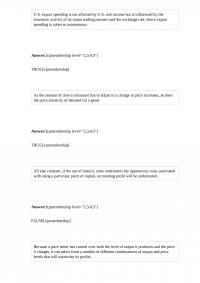
U.S. export spending is not affected by U.S. real income but is influenced by the economic activity of its major trading partners and the exchange rate, hence export spending is taken as autonomous. As the amount of time a consumer […]
BUS 49177
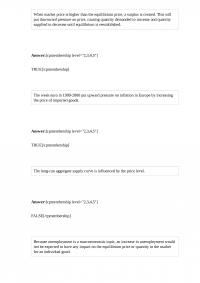
When market price is higher than the equilibrium price, a surplus is created. This will put downward pressure on price, causing quantity demanded to increase and quantity supplied to decrease until equilibrium is reestablished. The weak euro in 1999-2000 put […]
BUS 53570
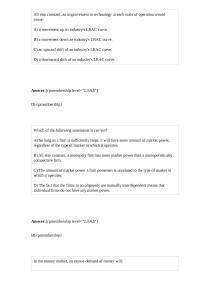
All else constant, an improvement in technology at each scale of operation would cause: A) a movement up an industry’s LRAC curve. B) a movement down an industry’s LRAC curve. C) an upward shift of an industry’s LRAC curve. D) […]
BUS 61445
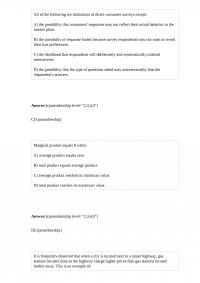
All of the following are limitations of direct consumer surveys except: A) the possibility that consumers’ responses may not reflect their actual behavior in the market place. B) the possibility of response biases because survey respondents may not want to […]
ECB 14178
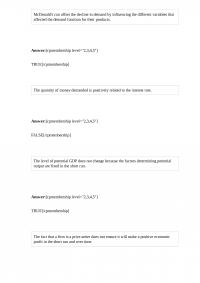
McDonald’s can offset the decline in demand by influencing the different variables that affected the demand function for their products. The quantity of money demanded is positively related to the interest rate. Answer: FALSE The level of potential GDP does […]
ECB 43202
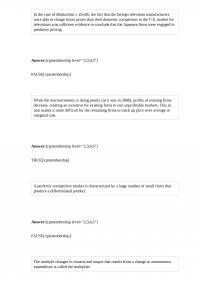
In the case of Matsushita v. Zenith, the fact that the foreign television manufacturers were able to charge lower prices than their domestic competitors in the U.S. market for televisions was sufficient evidence to conclude that the Japanese firms were […]
ECB 59006
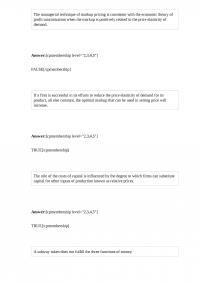
The managerial technique of markup pricing is consistent with the economic theory of profit maximization when the markup is positively related to the price elasticity of demand. If a firm is successful in its efforts to reduce the price elasticity […]
ECB 64434
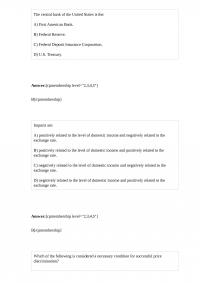
The central bank of the United States is the: A) First American Bank. B) Federal Reserve. C) Federal Deposit Insurance Corporation. D) U.S. Treasury. Imports are: A) positively related to the level of domestic income and negatively related to the […]
ECB 77130
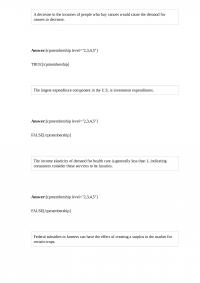
A decrease in the incomes of people who buy canoes would cause the demand for canoes to decrease. The largest expenditure component in the U.S. is investment expenditures. Answer: FALSE The income elasticity of demand for health care is generally […]
ECON 59188
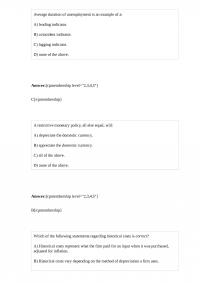
Average duration of unemployment is an example of a: A) leading indicator. B) coincident indicator. C) lagging indicator. D) none of the above. A restrictive monetary policy, all else equal, will: A) depreciate the domestic currency. B) appreciate the domestic […]
ECON 65732
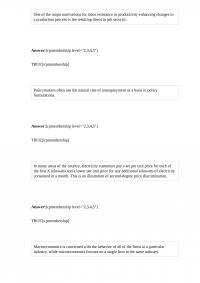
One of the major motivations for labor resistance to productivity enhancing changes in a production process is the resulting threat to job security. Policymakers often use the natural rate of unemployment as a basis in policy formulations. Answer: TRUE In […]
ECON 88184
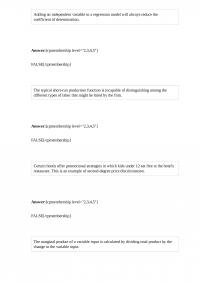
Adding an independent variable to a regression model will always reduce the coefficient of determination. The typical short-run production function is incapable of distinguishing among the different types of labor that might be hired by the firm. Answer: FALSE Certain […]
ECON A 33837
The elasticity of supply is measured by: A) the quantity supplied divided by price. B) the change in quantity supplied divided by the change in price. C) the percentage change in quantity supplied divided by the percentage change in quantity […]
ECON A 65108
Assume a firm is currently producing 800 units of output, P = $10, MC = $10, ATC = $8, and AVC = $6. In this case, the firm is maximizing its profit, which equals $1,600. Under a fixed exchange rate […]
ECON E 29553
In which of the following examples cited in the text is there the least amount of evidence of the potential for input substitution? A) Automobile production. B) Pipe organ production. C) French fry production. D) Production of health care services. […]
ECON E 63762
Long-run macroeconomic policies concentrate on: A) minimizing fluctuations around potential GDP. B) maximizing fluctuations around potential GDP. C) incentives for increasing productivity and the potential output of the economy. D) none of the above. A decrease in price will result […]
Economics 44812
Referring to the previous question, all else constant, a 5 unit increase in the wage index would cause: A) quantity supplied to increase by 9 units and be shown by a movement up the supply curve. B) quantity supplied to […]
Economics 48119
So long as marginal cost is greater than average variable cost, both average variable cost and average total cost must increase as output is increased. Because it does not face competition from other firms, a monopolist is guaranteed to make […]
Economics 75673
The natural rate of unemployment is also called: A) non-accelerating inflation rate of unemployment. B) accelerating inflation rate of unemployment. C) accelerating deflation rate of unemployment. D) none of the above. Under a fixed exchange rate system, the central bank […]
Economics 78802
An expansionary monetary policy, all else equal, will: A) depreciate the domestic currency. B) appreciate the domestic currency. C) all of the above. D) none of the above. Because firms produce a differentiated product, each of the firms in a […]
MicroEconomic 22180
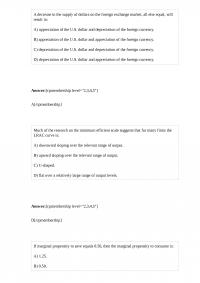
A decrease in the supply of dollars on the foreign exchange market, all else equal, will result in: A) appreciation of the U.S. dollar and depreciation of the foreign currency. B) appreciation of the U.S. dollar and appreciation of the […]
MicroEconomic 62575
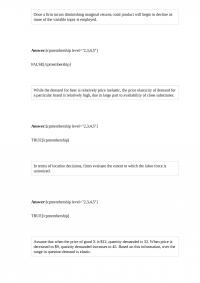
Once a firm incurs diminishing marginal returns, total product will begin to decline as more of the variable input is employed. While the demand for beer is relatively price inelastic, the price elasticity of demand for a particular brand is […]
MicroEconomic 62575 In the
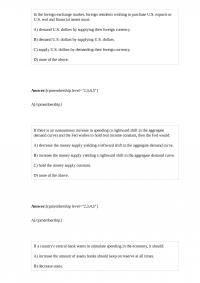
In the foreign exchange market, foreign residents wishing to purchase U.S. exports or U.S. real and financial assets must: A) demand U.S. dollars by supplying their foreign currency. B) demand U.S. dollars by supplying U.S. dollars. C) supply U.S. dollars […]
MicroEconomic 97655
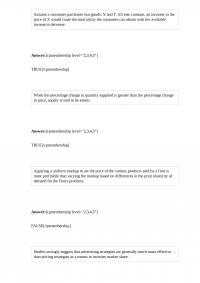
Assume a consumer purchases two goods: X and Y. All else constant, an increase in the price of X would cause the total utility the consumer can obtain with her available income to decrease. When the percentage change in quantity […]