
In the foreign exchange market, foreign residents wishing to purchase U.S. exports or
U.S. real and financial assets must:
A) demand U.S. dollars by supplying their foreign currency.
B) demand U.S. dollars by supplying U.S. dollars.
C) supply U.S. dollars by demanding their foreign currency.
D) none of the above.
If there is an autonomous increase in spending (a rightward shift in the aggregate
demand curve) and the Fed wishes to hold real income constant, then the Fed would:
A) decrease the money supply yielding a leftward shift in the aggregate demand curve.
B) increase the money supply yielding a rightward shift in the aggregate demand curve.
C) hold the money supply constant.
D) none of the above.
If a country’s central bank wants to stimulate spending in the economy, it should:
A) increase the amount of assets banks should keep on reserve at all times.
B) decrease taxes.

C) lower interest rates.
D) increase government spending.
Which of the following would be considered an example of a macroeconomic problem?
A) Should Microsoft reduce the price of its Windows operating system?
B) Should the federal government extend the eligibility period for unemployment
benefits?
C) Should Mitsubishi eliminate one of its production shifts?
D) Should JP Morgan Chase increase the interest rate it charges its credit card
customers?
Open market purchases and sales are conducted at the:
A) Federal Reserve Bank of Kansas City.
B) Federal Reserve Bank of New York.
C) Federal Reserve Bank of Chicago.
D) Federal Reserve Bank of St. Louis.

An industry characterized by a small number of dominant firms that face
downward-sloping demand curves is best described as:
A) a monopoly.
B) monopolistically competitive.
C) an oligopoly.
D) perfectly competitive.
Which of the following statements about the beer industry is correct?
A) Over the last 30 years, technological change has resulted in substantial diseconomies
of scale in the industry.
B) In 2000, the minimum efficient scale in the industry was approximately 18 million
barrels per year.
C) As a result of an increase in the number of microbreweries, the five largest firms in
the industry control less than 50 percent of the market.
D) The market share of microbreweries was estimated to be 20 percent in 1990.

Assume an analyst has been hired to estimate the price elasticity of demand for
hamburger (which sells for about $2.30 per pound) and filet mignon (which sells for
about $20 per pound), respectively. Considering the different determinants of the price
elasticity of demand and assuming the consumers in both markets have approximately
the same incomes, we would expect the coefficient of price elasticity of demand in
absolute value to be:
A) larger for hamburger than for filet mignon.
B) larger for filet mignon than for hamburger.
C) approximately the same for both hamburger and filet mignon.
D) none of the above because different determinants would have opposing effects on
the two estimates.
An increase in consumer confidence would shift the:
A) aggregate demand curve rightward.
B) aggregate demand curve leftward.
C) aggregate supply curve rightward.
D) aggregate supply curve leftward.

In the case of the perfectly competitive firm:
A) marginal revenue equals the market price.
B) marginal revenue is greater than the market price.
C) marginal revenue is less than the market price.
D) marginal revenue is equal to, less than, or greater than market price depending on
the level of output.
If a good is price inelastic, a decrease in price will:
A) decrease total revenue.
B) increase total revenue.
C) not affect income.
D) none of the above.
The portion of the short-run aggregate supply that reflects the economy’s resources are

not fully employed is the:
A) vertical portion.
B) horizontal portion.
C) upward sloping portion.
D) none of the above.
In the case of Thailand in 1997, the Thai government was running a large:
A) current account surplus, requiring capital inflows from abroad.
B) current account deficit, requiring capital inflows from abroad.
C) current account surplus, requiring capital outflows.
D) current account deficit, requiring capital outflows.
Industrial production is an example of a:
A) leading indicator.
B) coincident indicator.
C) lagging indicator.

D) none of the above.
Scenario 1: The following is a hypothetical short-run production function:
Hours of Total Marginal
Labor Output Product
0 ___ ___
1 100 100
2 ___ 80
3 240 ___
Refer to Scenario 1. What is the total output when 2 hours of labor are employed?
A) 80
B) 100
C) 180
D) 200
Decreases in autonomous spending have a contractionary effect and make ________
levels of real income consistent with a given interest rate.
A) lower
B) higher
C) constant
D) none of the above.
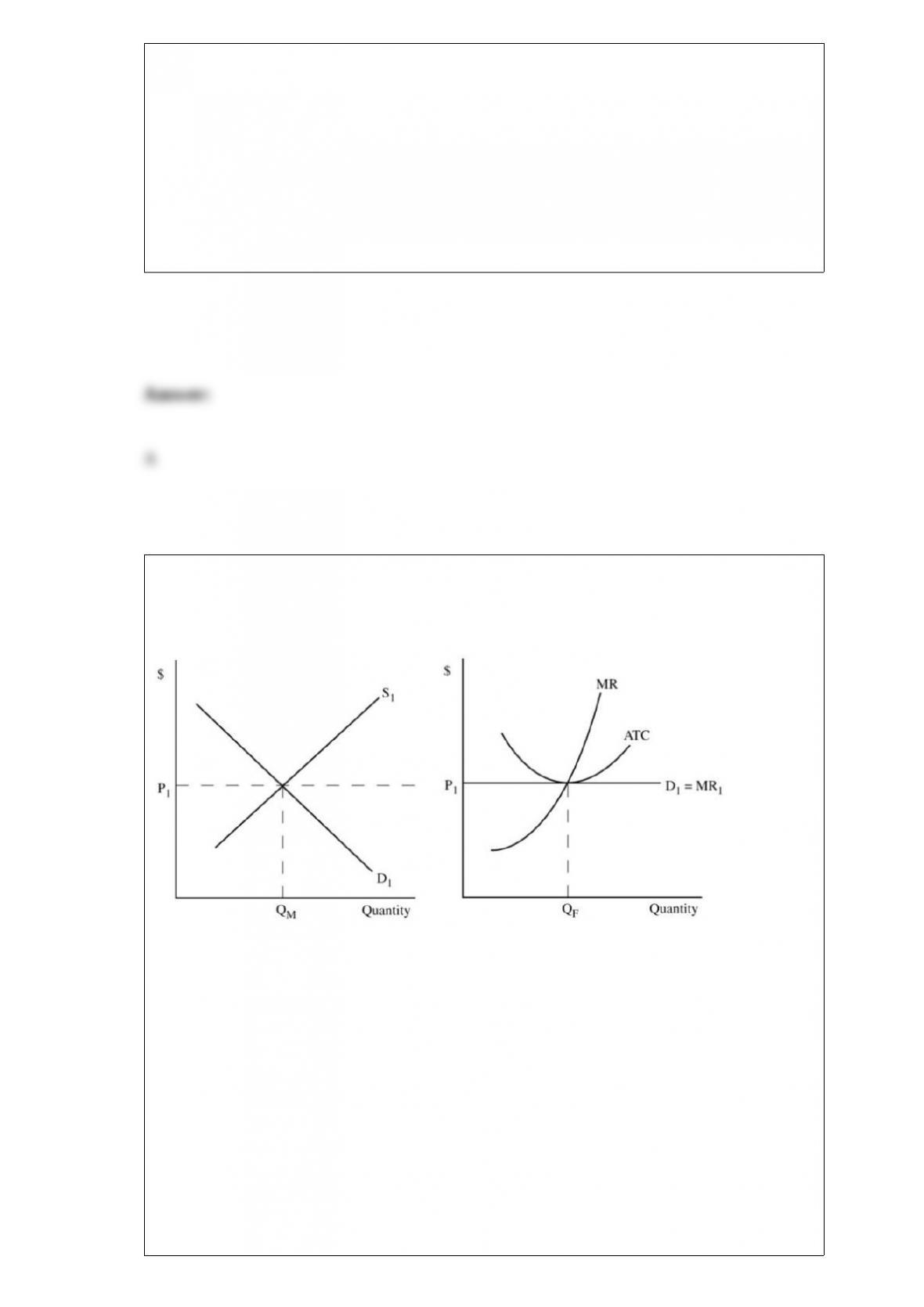
Use the following pair of graphs, which illustrate the market for corn (which is used to
produce corn-based ethanol) and a representative firm, to answer the following
questions.
Figure 7.1
a. Assume policymakers pass a law requiring that all gas sold in the United States
contain at least 10 percent corn-based ethanol. In the graphs above, illustrate the
short-run effects of this law. In particular, show how the law would affect
– the short-run equilibrium in the market for corn,
– the short-run demand curve faced by the representative firm, and
– the representative firm’s short-run profit-maximizing level of output.
Label the new curves and equilibrium values using a subscript 2.

b. Next, graphically illustrate how, after the initial changes you illustrated in question 7,
the corn market and the representative firm would adjust back to long-run equilibrium.
Label any new curves and equilibrium values using a subscript 3. After all adjustments
have taken place, what has happened to the equilibrium market price, the number of
firms operating in the market, and the representative firm’s profits? Why?
Suppose a perfectly competitive firm, which is initially in long-run equilibrium
experiences a decrease in the wages it must pay its employees. In the short run, which
of the following will occur?
A) ATC will shift up and MC will shift down, causing the firm to incur a loss.
B) ATC will shift down and MC will shift up, causing the firm to earn a positive
economic profit.
C) ATC and MC will shift down, causing the firm to earn a positive economic profit.
D) ATC and MC will shift up, causing the firm to incur a loss.

Measuring expenditures and income with the price level allowed to vary, so that
changes in these values represent changes in either the actual amount of goods,
services, and income or changes in the price level or a combination of both factors is
denoted in ________ terms.
A) nominal
B) real
C) constant dollar
D) all of the above
The manager of a perfectly competitive firm has to decide:
A) the quantity of output the firm should produce.
B) the price the firm should charge for its output.
C) the quantity of output the firm should produce and the price it should charge.
D) neither the quantity of output the firm should produce nor the price it should charge
because the market makes both of these decisions.
Data collected on a sample of individuals with different characteristics at a specific
point in time are called:

A) cross-section data.
B) time series data.
C) panel data.
D) none of the above.
Net exports are:
A) negatively related to domestic income, positively related to income in the rest of the
world, and positively related to currency appreciation.
B) negatively related to domestic income, positively related to income in the rest of the
world, and positively related to currency depreciation.
C) positively related to domestic income, positively related to income in the rest of the
world, and positively related to currency appreciation.
D) positively related to domestic income, positively related to income in the rest of the
world, and positively related to currency depreciation.
As a currency depreciates:
A) exports increase and imports decrease.
B) exports decrease and imports increase.

C) exports increase and imports increase.
D) exports decrease and imports decrease.
Assume there is a reduction in the shipments of petroleum products due to political
tension in the Persian Gulf. Which of the following would not be expected to happen?
A) Oil companies would “ration” their supplies of gasoline by raising price.
B) There would be a shortage of the original equilibrium price.
C) Quantity demanded would decrease.
D) The demand curve would shift to the left.
Assume there is a decrease in the market demand for a good sold by price-taking firms
that are initially producing the profit-maximizing level of output. How will the market
adjust over time?
A) Firms will enter the market, causing price to rise until losses are eliminated.
B) Firms will enter the market, causing price to fall until positive profits are eliminated.
C) Firms will exit the market, causing price to rise until losses are eliminated.
D) Firms will exit the market, causing price to fall until positive profits are eliminated.

All of the following are measures of market power except the:
A) Lerner Index.
B) Minimum-Efficient Scale Index.
C) four-firm concentration ratio for an industry.
D) Herfindahl-Hirschman Index.
The “marginal rate of substitution” between two goods is measured by:
A) the ratio of the market prices of the two goods.
B) the number of units of a good consumed divided by the market price of the other
good.
C) the number of units of one good a consumer would give up to consume one more
unit of another good, while holding total utility constant.
D) the consumer’s budget constraint divided by the price of each good.
Use the following table to answer questions a-c.
Output (Q): 0 1 2 3 4 5 6
Total Cost (TC): $36 $45 $52 $61 $74 $91 $110
a. What is the average fixed cost of producing 4 units of output?
b. What is the marginal cost of producing the third unit of output?
c. At what level of output does the firm encounter diminishing marginal returns? How
do you know?
The ratio of the regression coefficient to its standard error is called:
A) t-statistic.
B) F-statistic.
C) partial F-statistic.
D) coefficient of determination.

The difference between nominal and real exchange rates is:
A) absolute prices.
B) foreign prices.
C) domestic prices.
D) ratio of domestic prices to foreign prices.
Assume there is an improvement in the technology used to produce Blu-ray disc
players. What could be expected to happen to the equilibrium price and quantity in the
market for Blu-ray disc players?
A) Equilibrium price would increase and equilibrium quantity would decrease.
B) Equilibrium price and quantity would both decrease.
C) Equilibrium price would decrease and equilibrium quantity would increase.
D) Equilibrium price and quantity would both increase.

An approach to analyzing consumer behavior in which consumer reaction to different
prices is analyzed in a laboratory situation or a test market is called:
A) price experiments.
B) non-price experiments.
C) focus groups.
D) none of the above.
In a circular-flow diagram, total income and total expenditures in an economy are:
A) equal because firms are ultimately owned by households.
B) equal only if there is no saving.
C) equal because every transaction has a buyer and a seller.
D) always equal because some people’s income is not for production.
Assume that for a particular firm’s output price = $80, marginal cost = $30, average
total cost = $25. This information suggests that the firm in question has:
A) no market power.
B) very little market power.

C) a fair degree of market power.
D) absolute market power.