
The managerial technique of markup pricing is consistent with the economic theory of
profit maximization when the markup is positively related to the price elasticity of
demand.
If a firm is successful in its efforts to reduce the price elasticity of demand for its
product, all else constant, the optimal markup that can be used in setting price will
increase.
The role of the costs of capital is influenced by the degree to which firms can substitute
capital for other inputs of production known as relative prices.
A subway token does not fulfill the three functions of money.

Assume the price elasticity of supply for grade wheat has been estimated to be +0.82.
This means that when the price of wheat increases by 10 percent, the quantity of wheat
supplied to the market increases by 82 percent.
The full opportunity costs of production are calculated as the sum of both explicit and
implicit costs.
Potential GDP measures the capacity of the economy in terms of the actual goods and
services to be produced.

As the number of available substitutes for a good increases, the price elasticity of
demand for the good will increase as well.
Equilibrium in the foreign exchange market implies equilibrium in the balance of
payments.
The fact that a firm is using a capital-intensive method of production means that input
substitution is not possible.
A joint venture allows a foreign firm to easier adjust to a new market and often meet
various institutional requirements.

The slope of the linear consumption function represents autonomous consumption
expenditures.
The text considers three methods that can be used to obtain empirical estimates of
long-run costs in different industries. Of those three, surveys of expert opinion are
considered to be most reliable because they are less subject to bias than the other two
methods.
Economic variables that tend to move in tandem with the overall phases of the business
cycle are called leading indicators.

An increase in the price of fuel and fertilizer used for corn would cause farmers to
increase corn production in an effort to make up for lost profits.
By definition, in the typical firm’s short-run production function all inputs are fixed in
amount.
The Federal Reserve looks at the threshold of capital utilization rates as an indicator of
inflationary pressures.
The political stability of countries has an impact on the foreign exchange market.

A consumer is in equilibrium, that is, a consumer is maximizing her utility when
marginal utility and price are equal for each of the goods the consumer purchases.
The available data strongly suggest that, as the “needs” argument would suggest, the
demand for health care is virtually perfectly inelastic.
The trade balance must equal the level of private and public saving in the country.

The total sum of squares equals the sum of squares of the variation explained by the
regression and the sum of squares of the errors.
Assume a monopolist regularly posts price increases three months in advance of when
they will take effect. After a small number of new firms enter the market, the original
firm continues the practice of announcing price increases in advance. Following the
court’s logic in the Ethyl case, the firms in this market would not be guilty of price
fixing behavior.
The equilibrium level of income and output is that level of income where the desired
spending by all sectors of the economy equals the value of output produced and the
income received from production.
The slope of the linear consumption function represents induced consumption
expenditures.

Aggregate supply changes much faster than aggregate demand.
When using expert opinion, consumer surveys, test marketing, and price experiments to
analyze consumer behavior, managers must consider whether the participating groups
are representative of the larger population.
If an increase in price causes total revenue to decrease, we can conclude that demand is
price elastic.

As the price elasticity of demand for an item increases, so does the firm’s ability to
mark up the price of the item above average cost.
Because two percent of the largest farms grow half of all of the grain in the United
States, the grain industry is technically classified as an oligopoly.
Assume that at the current level of output, price equals marginal revenue, but is less
than average total cost. So long as price is greater than average variable cost, the firm
should continue to operate in the short run to minimize its losses.

Because cooperation dominates noncooperation as a strategy for maximizing profits,
cheating is rarely if ever an issue that cartels have to contend with.
An increase in government expenditure would shift the:
A) aggregate demand curve rightward.
B) aggregate demand curve leftward.
C) aggregate supply curve rightward.
D) aggregate supply curve leftward.
Gold certificates, special drawing rights, the reserve position of the IMF, and the
holdings of foreign currencies represent:
A) physical assets.
B) reserve assets.
C) monetary assets.
D) none of the above.

Which of the following statements regarding a price-taking firm is correct?
A) Demand = average revenue > marginal revenue.
B) Demand = marginal revenue > average revenue.
C) Demand = price = average revenue = marginal revenue.
D) Demand = price > average revenue > marginal revenue.
It has been observed that whenever one imported beer distributor raises its price, other
imported beer distributors quickly raise their price as well. Such behavior is
characteristic of:
A) the barometric-firm model of price leadership.
B) explicit collusion.
C) price leadership.
D) the kinked-demand curve model of oligopoly.

Assuming we are considering a normal good, the calculated price elasticity of demand
is:
A) always positive.
B) always negative.
C) positive if demand is elastic and negative if demand is inelastic.
D) positive if demand is inelastic and negative if demand is elastic.
Business taxes increase. What is the impact on aggregate expenditures and income?
A) Both increase.
B) Both decrease.
C) Aggregate expenditure increases and income decreases.
D) Aggregate expenditure decreases and income increases.
An increase in production costs will shift the:
A) aggregate demand curve.
B) short-run aggregate supply curve.

C) long-run aggregate supply curve.
D) none of the above.
An economy with only a domestic sector is called:
A) a mixed economy.
B) an open economy.
C) a closed economy.
D) a command economy.
The level of aggregate output and income where there is a balance between spending
and production decisions and where the economy moves toward is called:
A) disequilibrium level of output and income.
B) equilibrium level of output and income.
C) disequilibrium level of employment.
D) none of the above.

If movies on DVD for home rental and movies seen at a theater are substitutes, and the
price of movies seen at a theater increases, the demand for movies on DVD will:
A) increase.
B) stay the same.
C) decrease.
D) cannot be determined.
Which of the following statements concerning the long-run average cost (LRAC) curve
is correct?
A) The LRAC curve represents the least-cost input combination of inputs for producing
each level of output.
B) The LRAC curve is derived from a series of short-run marginal cost curves.
C) The short-run cost curve at the minimum point of the LRAC curve represents the
least-cost plant size for all levels of output.
D) As output increases, the amount of capital employed by the firm is held constant
along the LRAC curve.

As the level of competition in an industry increases, the price-cost margin approaches:
A) 0.
B) 1.
C) 10.
D) infinity.
The Sherman Antitrust Act:
A) prohibits conspiracies in restraint of trade.
B) allows the formation of trusts so long as they are public enterprises.
C) allows a group of firms to form a trust only if it is done to take advantage of
economies of scale.
D) prevents the military from using armored vehicles on the public streets.

Exports are:
A) positively related to income in the rest of the world and currency appreciation.
B) positively related to income in the rest of the world and currency depreciation.
C) positively related to domestic income and currency appreciation.
D) positively related to domestic income and currency depreciation.
In which of the following situations would the minimum efficient scale of operation
provide little or no guidance regarding how many firms should serve the market to
minimize production costs?
A) When the LRAC curve slopes downward over the relevant range of output.
B) When the LRAC curve hits its minimum point at a relatively low level of output and
then increases and the demand for output is quite large.
C) When the LRAC curve hits its minimum point at a relatively low level of output but
then remains constant as the scale of operation is increased and the demand for output is
quite large.
D) When the LRAC curve initially increases and then decreases beyond some point.
In a closed economy firms sell goods and services to:

A) households and foreigners.
B) households and the government.
C) just the government.
D) none of the above.
Data collected on the same observation unit at a number of points in time are called:
A) cross-section data.
B) time series data.
C) panel data.
D) none of the above.
Open market sale of government securities results in:
A) an increase in bank reserves.
B) a decrease in bank reserves.
C) a decrease in interest rates.
D) none of the above.

An increase in the nominal money supply would shift the:
A) aggregate demand curve rightward.
B) aggregate demand curve leftward.
C) aggregate supply curve rightward.
D) aggregate supply curve leftward.
The coefficient of determination will range between what values?
A) 0 and 1
B) -1 and +1
C) -3 and +3
D) none of the above

Capital outflows occur if:
A) domestic interest rates are higher than foreign interest rates.
B) domestic interest rates are lower than foreign interest rates.
C) domestic and foreign interest rates are the same.
D) none of the above.
A production method that relies on large quantities of machines and equipment and
smaller quantities of labor is referred to as a:
A) variable-input-intensive method of production.
B) labor-intensive method of production.
C) technology-intensive method of production
D) capital-intensive method of production.
Marginal cost is defined as:
A) the change in total cost due to a one unit change in output.

B) total cost divided by output.
C) the change in output due to a one unit change in an input.
D) total product divided by the quantity of input.
Which of the following is not included in GDP?
A) Unpaid maintenance of your house by your spouse.
B) Services such as those provided by lawyers and dentists.
C) The estimated rental (imputed) value of owner-occupied housing.
D) Production by foreign citizens in the U.S.
Assume there is an increase in demand in a perfectly competitive market that was
initially in long-run equilibrium. Which of the following statements isfalse?
A) Consumers have shown that they now consider the good to be more valuable.
B) In the short run, profits will be lower than normal.
C) Resources from other industries will be attracted into the market.
D) Over time, the market supply curve will shift right.

The marginal propensity to consume is 0.75, marginal propensity to invest is 0.3, and
the marginal propensity to import is 0.2. What is the size of the multiplier?
A) 6.67
B) 5.67
C) 4.67
D) 1.67
Assume the four major grocery stores in a large metropolitan area decide to meet
secretly to fix prices for meat. It would be easiest to maintain this arrangement when:
A) the number of additional competitors is very small.
B) the cost conditions for the four firms differ substantially.
C) individual firms are able to offer secret price discounts to selected buyers.
D) demand for meat and fresh vegetables is falling.

Domestic currency depreciation will:
A) help domestic firms that export and hurt domestic firms that import.
B) help domestic firms that import.
C) hurt domestic firms that export and help domestic firms that import.
D) hurt domestic firms that export.
Industry Y is a perfectly competitive industry. Assume that as a result of changes in
other markets there is a twenty percent increase in the price of variable inputs used by
firms in industry Y. After all adjustments have taken place, we would expect the
equilibrium price in industry Y to:
A) decrease and the number of firms to increase.
B) decrease and the number of firms to decrease.
C) increase and the number of firms to increase.
D) increase and the number of firms to decrease.

Features of the U.S. federal government expenditure and taxation programs that tend to
automatically slow the economy during times of high economic activity and boost the
economy during periods of recession are called:
A) discretionary expenditures.
B) automatic stabilizers.
C) non-automatic stabilizers.
D) none of the above.
In the summer of 2013, many news commentators started to raise concern over a
potential tapering by the Federal Reserve. If The Federal Reserve were to cut the money
supply and raise interest rates to control inflationary pressures, how would that be
illustrated in the Keynesian cross diagram? Graphically illustrate and explain the impact
on aggregate expenditure and income.
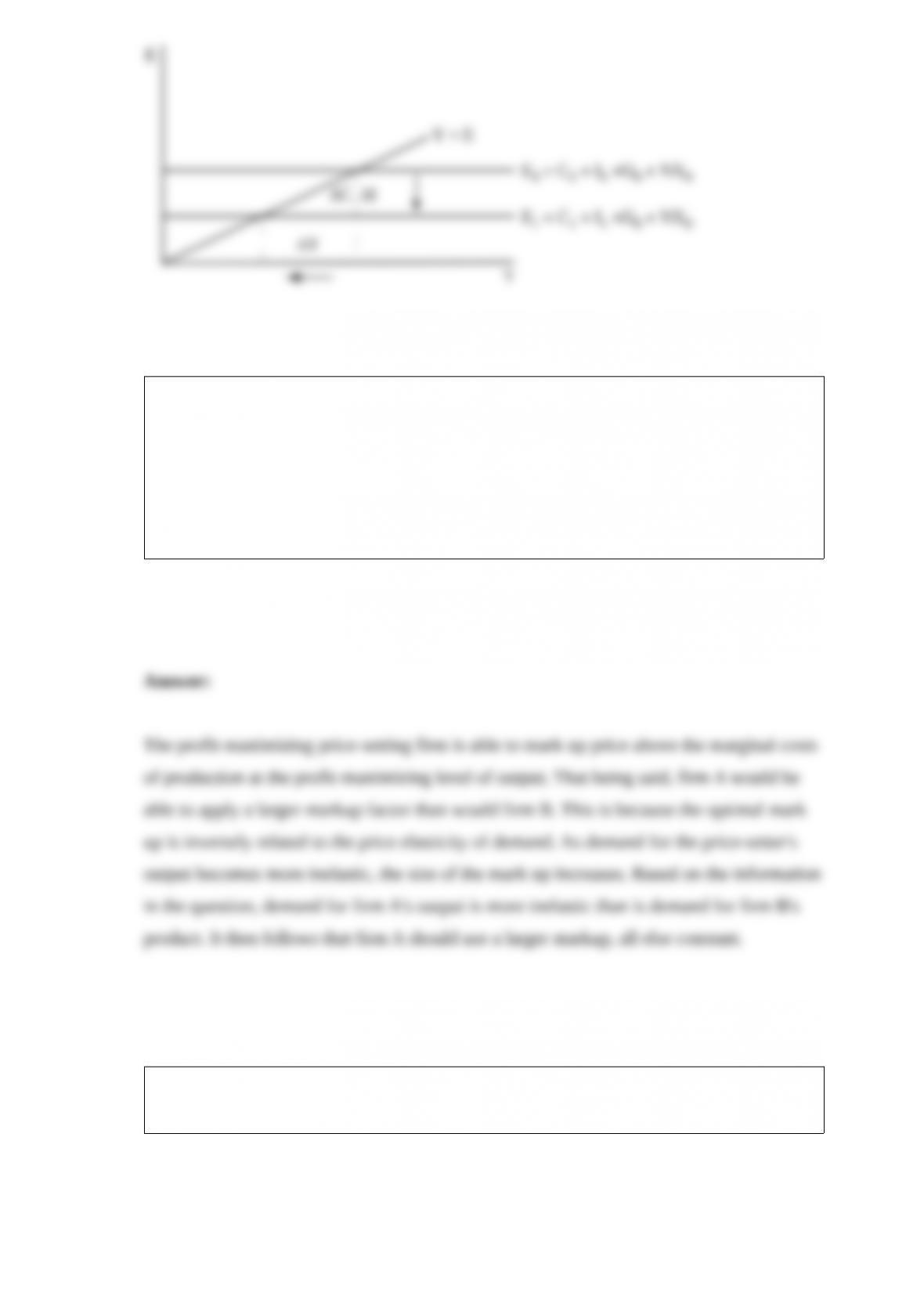
Assume you have been hired to advise two different firms, A and B, regarding the price
each firm should charge for its product, focusing on the amount each firm should mark
up price over marginal cost. While both firms are price setters, the product produced by
firm A is extremely unique and enjoys widespread appeal. In contrast, firm B sells a
fairly standard product for which there are are several good, but not perfect, substitutes.
How would your advice to each firm differ? How does the price elasticity of demand
influence your recommendations?
Elaborate on the statement “Every multiple regression analysis is influenced by the
sample of the data used.”
Assume a new technology is developed that increases the productivity of capital and
creates additional economies of scale. How would this affect the firm’s minimum
efficient scale of operation. Illustrate this effect graphically.
Distinguish between the short-run and long-run factors that affect residential
investment.
What are some of the issues associated with the consumer price index?
Why is the money multiplier smaller than the simple deposit multiplier?
Explain why a firm should continue to operate in the short run so long as market price
is greater the the firm’s average variable cost at the profit-maximizing level of output.
Assume the market shares of the six largest firms in an industry are 12 percent each.
Calculate the six-firm concentration ratio and Herfindahl-Hirschman index for this
industry. What does each of these measures have to say about the degree of
concentration in the industry? Explain.
How did McDonald’s attempt to address the cultural differences around the world in
selling its product?
Distinguish between “a change in demand” and “a change in quantity demanded.” What
are the causes of each type of change and how do we illustrate them graphically?
What are the two policy options used to influence the economy?
The U.S. imports Japanese cars with a domestic price of 5,000,000 yen and the
yen/dollar exchange rate is 120 on January 1, 2003. On January 1, 2004 the yen/dollar
exchange rate is 125. What is the dollar price of the cars on January 1, 2003? What is
the dollar price of the cars on January 1, 2004?
Assume the production technology changes for a good that is currently produced in a
perfectly competitive market. In particular, the new technology is such that the marginal
costs of production for a single firm decline over the entire range of the demand curve
for the good in question. How would this affect the number of firms that operate in this
market? Explain.
What is the significance of the mutual interdependence among the firms in an
oligopolistic market?
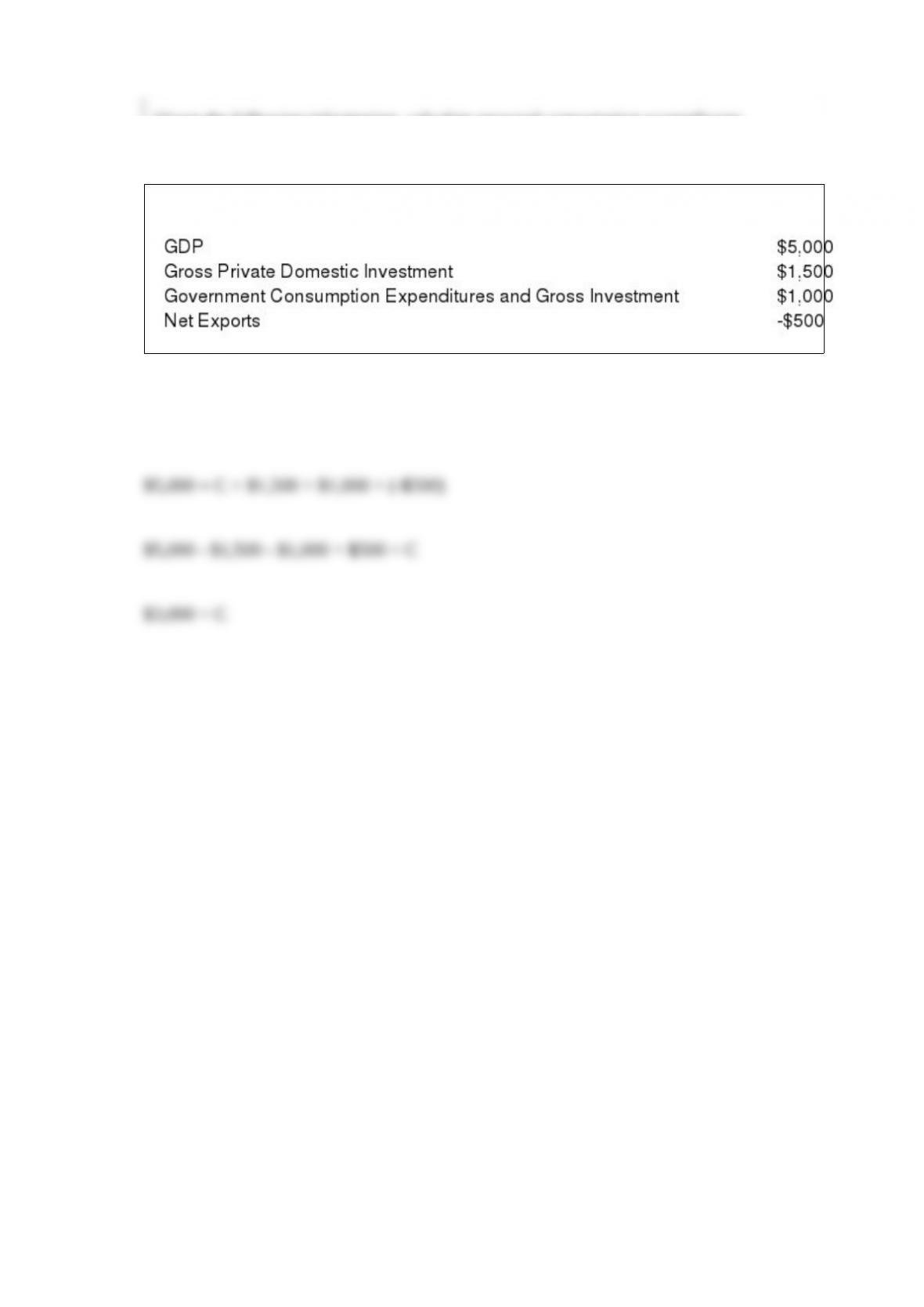
Given the following information, calculate personal consumption expenditures.