
So long as marginal cost is greater than average variable cost, both average variable
cost and average total cost must increase as output is increased.
Because it does not face competition from other firms, a monopolist is guaranteed to
make excess profits over time.
Assume that when the price of good X is $7, quantity demanded is 25. When price is
increased to $9, quantity demanded falls to 20. Based on this information, over the
range in question demand is elastic.
Assume X is an inferior good. If the incomes of people who buy X increase, demand
for X will increase as well, but by a smaller percentage than the increase in income.

To develop a competitive advantage and increase their firm’s profitability, managers
need to understand what affects their revenues, costs, and their ability to set prices.
When price is greater than the market equilibrium price, a shortage is created.
Business debt is an example of a lagging indicator.

When shopping the consumer is interested in absolute prices.
Price will always exceed marginal cost for the profit-maximizing monopolist, or any
price-setter firm for that matter.
According to the kinked demand curve model, regardless of whether a firm increases or
decreases price, its total revenues will decrease as a result of the price change.
The decision by the federal government to prohibit cigarette companies from
advertising on television actually caused the companies’ profits to increase, an outcome
that is consistent with the prediction of the prisoner’s dilemma game.

Declining real GDP for two quarters in a row is often called a recession.
In the case of a linear demand function, the marginal revenue function is twice as steep
as the demand function.
Price elasticities tend to be higher, the greater the number of substitutes.

High fuel prices and losses by smaller firms have resulted in a considerable amount of
consolidation in the trucking industry, which now most closely resembles the oligopoly
market structure.
The core rate of inflation is a measure of the relative price changes that excludes
changes in energy and food prices.
For a linear demand function, slope and the price elasticity of demand are equal.
Because it is based on differences in the price elasticity of demand among different
groups of consumers, third-degree price discrimination is a more profitable price
discrimination strategy than is first-degree price discrimination.

The Bretton Woods conference in 1944 established the gold standard, which was
abandoned in 1971.
The real interest rate, business taxes, expected profits and business confidence, and
capacity utilization are embedded in the slope of the investment function.
The horizontal portion of the short-run aggregate supply curve reflects the Keynesian
assumption of “sticky” prices.

Assuming that C = $6,200, I = $1,300, G = $1,100, Exports = $630, Imports = $750,
and Depreciation = $600 (all in billions of dollars), GDP equals $7,880.
Assume there is a decrease in the supply of a product produced in a perfectly
competitive market. All else constant, in the short run this will cause the profits of firms
that produce substitutes for the good in question to increase.
Real money supply expresses the money supply in terms of real goods and services.
A lending of a country’s savings that occurs when the country has a trade deficit and its
citizens purchase real and financial assets from abroad is called a capital inflow.

A major weakness of the kinked demand curve model is that it does not explain how the
equilibrium price, i.e., the price at the kink in the demand curve, is determined.
Assume the demand function for good X can be written as
Qd = 80 – 3Px + 2Py + 10I
where Px = the price of X,
Py = the price of good Y, and
I = Consumer income.
This equation implies that X and Y are substitutes.
Assume the market for cell phone service is initially in equilibrium. An increase in
supply would cause a surplus at the initial equilibrium price. The market adjustment
would then involve a decrease in price which would in turn cause quantity demanded to
increase and quantity supplied to decrease until equilibrium is reestablished.
Changes in the natural rate of unemployment are related to changes in the composition
of the labor force and to the changes in the productivity of the economy over time.
One could argue that price competition among oligopolistic firms is highly likely to
cause the revenues of individual firms to decline, while competition on the basis of
product differentiation could cause demand, and total revenues, of individual firms to
increase.
Which of the following is the best example of tacit collusion?
A) The formation of a cartel.
B) Price leadership.

C) Predatory pricing.
D) Noncooperative pricing behavior.
As the percentage of the consumer’s income accounted for by a particular good
decreases, demand for the good will:
A) tend to become more price elastic.
B) tend to become more price inelastic.
C) tend to become closer to unit elastic.
D) tend toward being perfectly elastic.
Assume the income elasticity of a good has been calculated to be +0.83. Based on this
information, we can infer that the good is:
A) a normal good and a luxury.
B) an inferior good and a necessity.
C) a normal good and a necessity.
D) an inferior good and a luxury.

Which of the following statements regarding patents is false?
A) Patents can help firms gain market power through innovation and then act as a
barrier to entry.
B) A firm that has market power as a result of a patent may be more likely to innovate
than a perfectly competitive firm.
C) Patents encourage the production of information, which might otherwise be under
supplied.
D) Patents can last for an indefinite time period.
Under a fixed exchange rate system, a balance of payments surplus may:
A) decrease the country’s money supply if there is a non-sterilized central bank
intervention.
B) decrease the country’s money supply if there is a sterilized central bank intervention.
C) increase the country’s money supply if there is a non-sterilized central bank
intervention.
D) increase the country’s money supply if there is a sterilized central bank intervention.

Scenario 3:
Total Product (Q): 0 1 2 3 4 5 6
Total Cost (TC): $50 $80 $105 $125 $155 $195 $250
Refer to Scenario 3. The average variable cost of producing three units of output is:
A) $15.
B) $25.
C) $41.67 (approximate).
D) $75.
If an industry is characterized by economies of scale:
A) barriers to entry are usually not very large.
B) long-run average costs of production increase as the quantity the firm produces
increases.
C) capital requirements are small due to the efficiency of the large-scale operations.
D) the costs of entry into the market are likely to be substantial.

The Herfindahl-Hirschman Index is a measure of market power that focuses on:
A) the ratio of the price of a firm’s product to the price elasticity of demand for the
product.
B) the share of the market controlled by the X largest firms in the market.
C) the sum of the squares of the market share of each firm in an industry.
D) the difference between a firm’s product price and its marginal costs of production.
All of the following are considered to be problems associated with the use of
concentration ratios to measure market power except:
A) the market definitions used in their construction may be arbitrary.
B) two different markets with the same concentration ratio may have very different
distributions of market share among firms used to calculate the concentration ratio.
C) consideration of exports and imports generally causes concentration ratios to be
overstated.
D) concentration ratios are often based on national statistics and may not reflect
substantial concentration in a market at a more localized level.

If a good is price elastic, a decrease in price will:
A) decrease total revenue.
B) increase total revenue.
C) not affect revenue.
D) none of the above.
Refer to Scenario 2. The marginal cost of the sixth unit of output is:
A) $1.33.
B) $7.50.
C) $8.00.
D) $45.00.
The “minimum efficient scale” of operation in an industry is defined as:
A) the smallest plant size that can be operated by firms in the industry.
B) the scale of operation at which economies of scale are exhausted.

C) the smallest number of firms that could effectively meet demand for an industry’s
output.
D) the scale of operation by firms in an industry that is least efficient.
“Personalized pricing” and “group pricing” are examples of:
A) first-degree and second-degree price discrimination, respectively.
B) second-degree and third-degree price discrimination, respectively.
C) first-degree price discrimination.
D) first-degree and third-degree price discrimination, respectively.
The practice of charging different prices to various groups of customers that are not
based on differences in the costs of production is referred to as:
A) predatory pricing.
B) markup pricing.
C) discretionary pricing.
D) price discrimination.

Assume that in the market for plasma TVs there is an increase in supply. The result will
be:
A) an increase in equilibrium price and quantity.
B) a decrease in equilibrium price and quantity.
C) an increase in equilibrium quantity and uncertain effect on equilibrium price.
D) a decrease in equilibrium price and increase in equilibrium quantity.
In which of the following scenarios would a predatory pricing scheme have the greatest
chance of success, all else constant?
A) The predatory price is set well below cost, many rivals are likely to enter after the
strategy ends, and profits can be recouped only over a relatively long period of time.
B) The predatory price is set well below cost, relatively few rivals are likely to enter
after the strategy ends, and profits can be recouped in a relatively long period of time.
C) The predatory price is set just below cost, many rivals are likely to enter after the
strategy ends, and profits can be recouped in a moderate period of time.
D) The predatory price is set just below cost, relatively few rivals are likely to enter
after the strategy ends, and profits can be recouped in a very short period of time.

The assumption that rival firms will match a firm’s price decreases but not its price
increases is a basic feature of:
A) model of limit pricing.
B) the kinked demand curve model.
C) the predatory pricing model.
D) cartel theory.
Although McDonalds operates in a market structure with many competitors and
substitute foods, it often engages in ________ with its major fast food competitors.
A) monopoly behavior.
B) oligopoly behavior.
C) competitive behavior.
D) none of the above.

Refer to Table 11.1. What is the value of personal consumption expenditures?
A) $3,000.
B) $1,000.
C) $4,350.
D) $2,350.
An indifference curve is negatively-sloped because:
A) utility is a subjective concept.
B) as the consumer obtains additional units of one good, the consumer is willing to
sacrifice increasing amounts of the other good.
C) in order to remain at the same level of utility, if an individual gets more of one good,
he must sacrifice some of the other good.
D) marginal utility is constant along an indifference curve, and increases in the
consumption of one good cause the price of that good to fall.
According to the kinked demand curve model, if an oligopolistic firm lowers its price, it
should expect to see its total revenue:

A) increase.
B) stay the same.
C) decrease
D) cannot be determined without more information.
In the market for cell phones, all of the following would cause the supply of cell phones
to change except:
A) an improvement in the technology used to produce cell phones.
B) an increase in the cost of labor used to produce cell phones.
C) a change in cell phone producers’ expectations.
D) an increase in the number of buyers in the market for cell phones.
The major factor contributing to the depreciation of the Euro in 1999 and 2000 was:
A) low interest rates in the U.S. relative to Europe.
B) high interest rates in the U.S. relative to Europe.
C) trade barriers in Europe.

D) none of the above.
Assume the price elasticity of demand for a product is -4. In this case, the firm’s optimal
markup is (approximately):
A) 400 percent.
B) 100 percent.
C) 33 percent.
D) 25 percent.
Under a fixed exchange rate system, a balance of payments deficit may:
A) decrease the country’s money supply if there is a non-sterilized central bank
intervention.
B) decrease the country’s money supply if there is a sterilized central bank intervention.
C) increase the country’s money supply if there is a non-sterilized central bank
intervention.
D) increase the country’s money supply if there is a sterilized central bank intervention.

In 2002, this company was estimated to hold the largest share of the U.S. burger
market:
A) McDonald’s.
B) Burger King.
C) Wendy’s.
D) none of the above.
At a price of $5, consumers buy 200 units of good X. When the price falls to $4,
quantity demanded increases to 250 units. We can conclude that over this range,
demand is:
A) elastic.
B) unit elastic.
C) inelastic.
D) perfectly inelastic.
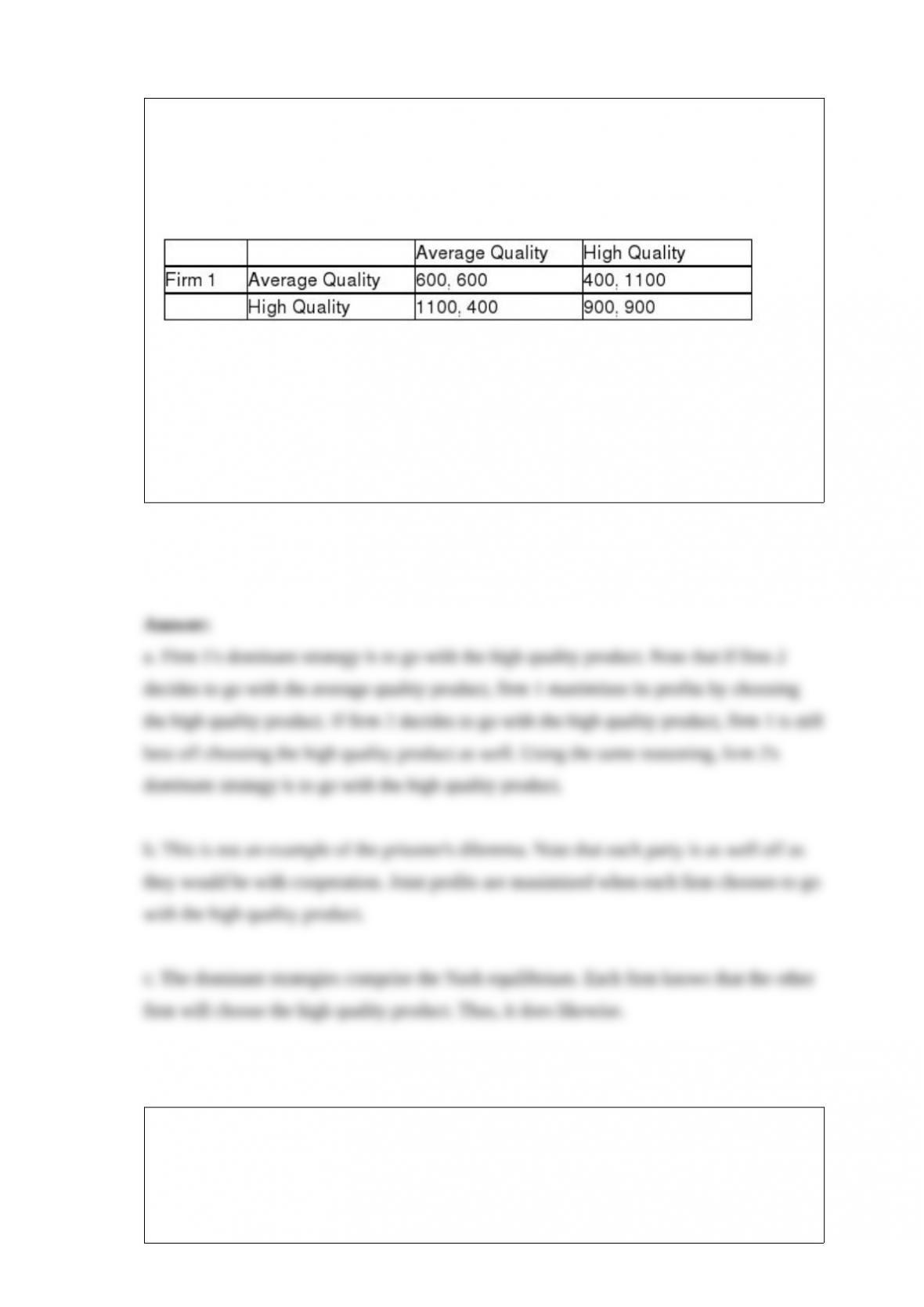
Use the information in the following table, which summarizes the payoffs (i.e., profit)
to two firms that must decide between an average-quality and a high quality product, to
answer the questions that follow:
Firm 2
a. What is each player’s dominant strategy? Explain your reasoning.
b. Referring to the table above, is this an example of a prisoner’s dilemma game? Why
or why not?
c. Is there a Nash equilibrium? If so, what is it?
Short-run macroeconomic policies concentrate on:
A) minimizing fluctuations around potential GDP.
B) maximizing fluctuations around potential GDP.

C) incentives for increasing productivity and the potential output of the economy.
D) none of the above.
Which of the following is not an example of a noncooperative oligopoly model?
A) The kinked demand curve model.
B) The model of limit pricing.
C) The prisoner’s dilemma game.
D) The cartel model.
The success of a predatory pricing strategy in an oligopolistic market depends on all of
the following except:
A) the number of firms operating in the industry prior to enactment of the policy.
B) how far the predatory price is below cost.
C) the period of time for which the predatory price is in effect.
D) the length of time over which recoupment of profits occurs.

Compared to the GDP deflator, the consumer price index measures:
A) the price of all the goods and services produced in the economy.
B) the price of a fixed market basket of goods and services.
C) the price of exported goods and services.
D) the price of wholesale goods and services.
Suppose a sole proprietorship is earning total revenues of $100,000 and is incurring
explicit costs of $75,000. If the owner could work for another company for $30,000 a
year, we would conclude that:
A) the firm is incurring an economic loss.
B) implicit costs are $25,000.
C) the total economic costs are $100,000.
D) the individual is earning an economic profit of $25,000.

The simple deposit multiplier is:
A) 1/excess reserves.
B) 1/reserve requirement.
C) 1/deposit requirement.
D) none of the above.
As McDonald’s expanded globally, it was able to achieve:
A) economies of scope.
B) economies of scale.
C) diseconomies of scale.
D) none of the above.
In the general textbook treatment, the firm’s short run average variable and average total
cost curves are U-shaped, while the average fixed cost curve is downward sloping over
the entire range of output. Explain why.
What will a U.S. corporation do if it believes that the dollar will continue to appreciate
when it changes foreign earnings back into dollars?
Explain the difference between the short run and the long run as it relates to the firm’s
production function. Why is this distinction important to a firm’s manager?
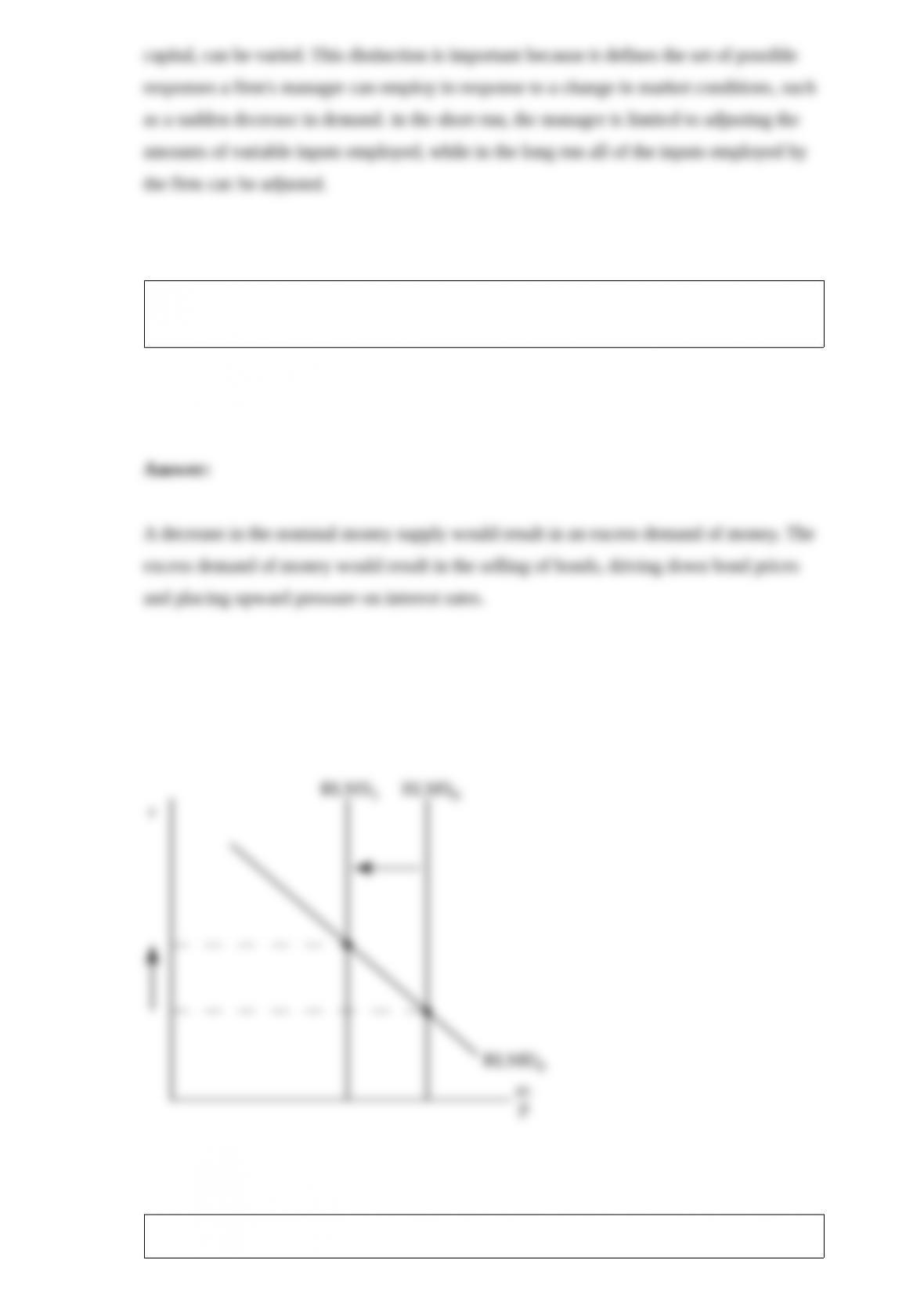
In the context of the money market, graphically illustrate and explain the impact of a
contractionary monetary policy on interest rates.
You are given the following information on the various sectors of the economy. Derive
the aggregate expenditure function.
C = 100 + 0.75Y
I = 200 + 0.20Y
G = 500
X = 250
M = 100 + 0.10Y
List the factors that influence supply. How does a change in each of the factors you
have listed affect the supply curve?
Many analysts have argued that the federal government should stop spending money on
programs such as agricultural price supports and should redirect that spending to such
things as improvements in the nation’s roads and bridges. Construct an economic
argument that supports this proposed change in policy.
You are given the following information on the macroeconomy:
Consumption: 200 + 0.75Y
Investment: 100 + 0.10Y
Government Spending 500
Exports 100
Imports 50 + 0.25Y
Compute the equilibrium level of income, the size of the multiplier, and the change in
equilibrium income for an increase in autonomous consumption of $50 million.
“In the past five years the average price of our Chevrolets has risen about 6 percent a
year, and each year we have sold 10 percent more cars than the previous year.” How can
this car dealer sell more cars as the price of the cars increases?
Assume the market for a good produced by perfectly competitive firms is currently in
equilibrium (economic profit = 0). Now assume there is a decrease in market demand
for the good. Analyze the short-run effects of the decrease in demand on equilibrium
market price and output. What has happened to the profits of each of the firms in the
industry? Over time, what will happen to the number of firms in the industry? Why?
Distinguish between real and nominal GDP. Which one is a better measure of the
business cycle?
Explain the long-run consequences of continued increases in the money supply.
Assume the price of product A increases from $1 to $1.50, while the price of competing
product B increases from $1.50 to $2.00. Based on the information, what we can say
about the absolute and relative price differences between the two products and the
relative attractiveness of the two products to consumers.
Explain the difference between a cartel and tacit collusion. Is tacit collusion illegal in
the United States? Explain.
Provide a simple definition of the price elasticity of demand and explain why knowing
the price elasticity for her product is useful to the firm’s manager.
How did McDonalds address the obesity issue in China?
Describe the fractional reserve banking system.
Assume there is an increase in the price of electricity (which is the result of a decrease
in the supply of electricity), and electricity and natural gas are substitutes. How would
this affect the demand for natural gas, and what would happen to the equilibrium price
and quantity of natural gas?