
The natural rate of unemployment is also called:
A) non-accelerating inflation rate of unemployment.
B) accelerating inflation rate of unemployment.
C) accelerating deflation rate of unemployment.
D) none of the above.
Under a fixed exchange rate system, the central bank of a country experiencing a
balance of payments surplus will:
A) increase the supply of domestic currency to prevent currency depreciation.
B) increase the demand for domestic currency to prevent currency depreciation.
C) increase the supply of domestic currency to prevent a currency appreciation.
D) increase the demand for domestic currency to prevent a currency appreciation.
Suppose an oligopolistic firm raises the price of its output. Demand for the firm’s output
will be relatively price ________ if the other dominant firms in the market ________.
A) elastic; do not raise price
B) unit elastic; do not raise price

C) inelastic; also raise price
D) cannot be determined
The vital link between the real and monetary sectors of the economy is the:
A) price level.
B) interest rate.
C) balance of payments.
D) budget deficit.
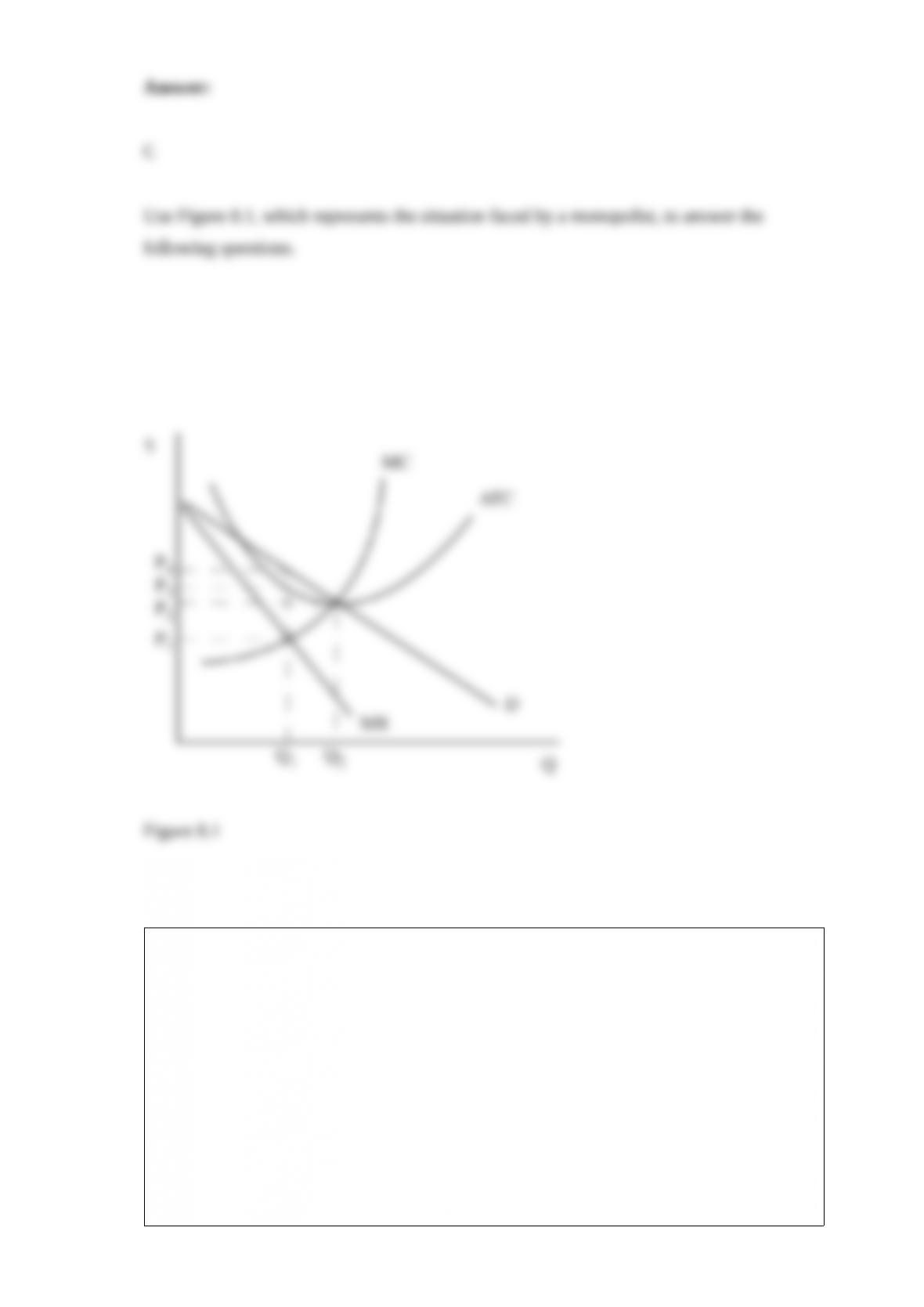
Which of the following conditions holds for a monopolist, but not for a perfect
competitor, at the profit-maximizing level of output?
A) Price = average revenue.
B) Marginal revenue = marginal cost.
C) Price > marginal cost.
D) Profit = (AR-ATC) x Q.
All else constant, an increase in productivity has the effect of causing:
A) the marginal product of labor to increase and no effect on the average product of
labor.
B) the average product of labor to increase and no effect on the marginal product of
labor.
C) the marginal product of labor to increase and the average product of labor to
decrease.
D) both the marginal and average product of labor to increase.

X-inefficiency refers to the situation in which:
A) highly competitive firms have less incentive to minimize their costs of production
than other firms because the highly competitive firms have almost no chance to earn
above-average profits.
B) firms are unable to minimize their costs of production because there is no potential
for input substitution.
C) firms that use labor-intensive production methods tend to be less efficient than firms
that use capital-intensive production methods.
D) firms with market power have less incentive to minimize their costs of production
than more competitive firms.
In the run up to the war in Iraq that began in 2003, one of the many concerns raised was
that a war could result in a decrease in the supply of oil. At the same time, the U.S.
economy was having a hard time recovering from the recession of 2001 and, as a result,
incomes of many consumers had decreased (due to layoffs, wage cuts, and so forth). All
else constant, it was reasonable to predict, with certainty, that the combination of these
two factors would cause the equilibrium:
A) quantity of oil to decrease.
B) quantity of oil to increase.
C) price of oil to increase.

D) price of oil to decrease.
Cross-sectional data observed at several points in time is known as:
A) time series data.
B) panel data.
C) experimental data.
D) none of the above.
In order to import German goods into the United States, U.S. importers must buy those
goods with German currency, i.e., Euros. Assume, all else constant, there is a decrease
in the price of U.S.-made cars compared to the price of German cars. Based on this
information, we can conclude, with certainty, that in the market for Euros (where the
price of Euros is measured in dollars), this would cause:
A) an increase in the equilibrium price of Euros.
B) a decrease in the equilibrium price of Euros.
C) an increase in the equilibrium quantity of Euros.
D) a decrease in the equilibrium quantity of Euros.

The price of one good in relation to the price of another good is called:
A) absolute prices
B) exchange rate
C) relative prices
D) none of the above
In which of the following situations would a firm be more likely to rely on a
capital-intensive method of production?
A) When the rate of technological innovation is low.
B) When capital is relatively expensive.
C) When the firm’s output cannot be produced using the assembly line method of
production.
D) When labor supply is limited relative to the available amount of capital.

Assume the production of a particular good is characterized by significant economies of
scale. In addition, three different versions of the good can be produced, and large
segments of the population prefer different versions of the good. In this case, the
preferred market structure for this good would be:
A) perfect competition.
B) monopoly.
C) monopolistic competition.
D) oligopoly.
In the foreign exchange market, a balance of payments surplus is represented by:
A) excess supply of dollars.
B) excess demand for dollars.
C) equilibrium in the foreign exchange market.
D) none of the above.
The total amount of spending on nonresidential structures, equipment, software,
residential structures, and business inventories in a given period of time is called:

A) net exports.
B) government consumption and investment.
C) gross private domestic investment.
D) personal consumption.
Imports are:
A) positively related to income in the rest of the world and currency appreciation.
B) positively related to income in the rest of the world and currency depreciation.
C) positively related to domestic income and currency appreciation.
D) positively related to domestic income and currency depreciation.
Assume there is a simultaneous decrease in the cost of batteries used in hybrid cars and
a shift in consumer preferences toward more fuel-efficient vehicles. Based on this, we
can conclude, with certainty, that in the market for hybrid cars, equilibrium:
A) price will decrease.
B) price will increase.

C) quantity will decrease.
D) quantity will increase.
An income tax system where higher tax rates are applied to increased amounts of
income is called:
A) a regressive tax system.
B) a proportional tax system.
C) a progressive tax system.
D) a flat rate tax system.
In an open economy, injections and leakages are related as:
A) I + G = S + T.
B) I + G + X = S + T + M.
C) X + G = T + M.
D) none of the above

Which of the following statements is false?
A) Economic costs include the opportunity costs of the resources owned by the firm.
B) Accounting costs typically include only explicit costs.
C) Economic profit will always be less than accounting profit if resources owned and
used by the firm have any opportunity costs.
D) Accounting profit is equal to total revenue minus implicit costs.
In the foreign exchange market, the quantity U.S. dollars supplied is a function of:
A) the amount of imports and the level of capital outflows.
B) the amount of exports and the level of capital outflows.
C) the amount of exports and the level of capital inflows.
D) none of the above.

Money serves all of the following functions except:
A) medium of exchange.
B) store of value.
C) unit of account.
D) measure of power.
Many people consider hot dogs to be an inferior good. For such people, all else held
constant, a decrease in income would cause their demand for hot dogs to:
A) increase.
B) stay the same.
C) decrease.
D) cannot be determined with the information given.
The key distinguishing characteristic of an oligopoly is the:
A) presence of long-run economic profits.
B) fact that in all cases firms produce a standardized product.
C) mutual interdependence of the firms in the market.
D) near total absence of advertising.
Assume the cross price elasticity of demand between peanut butter and grape jelly is
negative.
a. Does the cross price elasticity coefficient indicate that peanut butter and grape jelly
are substitutes or complements? Why?
b. Describe the effect associated with an increase in the price of peanut butter on the the
demand for both peanut butter and grape jelly.
When the central banks of various countries intervene in the foreign exchange market to
maintain an exchange rate, this type of exchange rate system is called a ________
exchange rate system.

A) fixed
B) flexible
C) all of the above
D) none of the above
Assume that goods X and Y are substitutes and are produced in perfectly competitive
markets. All else constant, in the short run, a decrease in the supply of good X would
cause:
A) an increase in the demand for good Y.
B) a decrease in the demand for good Y.
C) an increase in the supply of good Y.
D) a decrease in supply of good Y.
Personal income taxes are reduced as part of an expansionary fiscal policy. What is the
impact on aggregate expenditures and income?
A) Both increase.
B) Both decrease.

C) Aggregate expenditure increases and income decreases.
D) Aggregate expenditure decreases and income increases.
In the money market, an increase in money demand will:
A) result in a rightward shift in the money demand curve increasing interest rates.
B) result in a rightward shift in the money demand curve decreasing interest rates.
C) result in a leftward shift in the money demand curve increasing interest rates.
D) result in a leftward shift in the money demand curve decreasing interest rates.
The difference between interest income or receipts earned on investments in the rest of
the world by the residents of a given country and the payments to foreigners on
investments they have made in a given country is called:
A) unilateral transfers.
B) net investment income.
C) capital expenditures.
D) none of the above.

Borrowing from abroad represents:
A) a capital outflow.
B) a capital inflow.
C) positive net savings.
D) none of the above.
On September 3, 2003, Universal Music Group announced plans to reduce the
wholesale price of music CDs it distributes by an average of 25-30 percent. All else
constant (i.e., ignoring the effects of file-sharing programs), how would this change
affect the retail market for new music CDs?
A) Demand for CDs would increase, causing equilibrium price and quantity to increase.
B) The supply of CDs would increase, causing equilibrium price to decrease and
equilibrium quantity to increase.
C) Demand for CDs would decrease, causing equilibrium price and quantity to
decrease.
D) The supply of CDs would decrease, causing equilibrium price to increase and
equilibrium quantity to decrease.