
A decrease in the incomes of people who buy canoes would cause the demand for
canoes to decrease.
The largest expenditure component in the U.S. is investment expenditures.
The income elasticity of demand for health care is generally less than 1, indicating
consumers consider these services to be luxuries.
Federal subsidies to farmers can have the effect of creating a surplus in the market for
certain crops.

A “change in demand” is caused only by a change in the price of the good.
Adjusted R2 gives the actual percentage of the variation in the dependent variable
explained by the regression model.
Promotional pricing is designed to take advantage of differences in the price elasticity
of demand among customers. As such, it is an application of first-degree price
discrimination.

A problem with the CPI is the presence of a substitution bias on the behalf of
consumers.
Increased profits provide more internal funds to finance capital investments and a major
factor in lenders’ and investors’ decisions to provide external funds to the firm.
As the price of labor increases relative to the price of capital, the firm will move to a
more labor-intensive production method to minimize costs.
Managerial economics refers to the application of microeconomics to business decision
making.

Assume the price elasticity of demand for a good is -3. In this case, a decrease in price
would result in marginal revenue of (2/3)P.
The Lerner Index is preferred to the Herfindahl-Hirschman Index as a measure of
market power due to the former’s simplicity and straightforward interpretation.
Assume the market for used single-family homes is initially in equilibrium. All else
constant, an increase in home foreclosures would cause equilibrium price and quantity
to decrease.

The goal of “personalized pricing” is to determine how much each individual customer
is willing to pay for a product. As such, it is an application of first-degree price
discrimination.
Increases in resources and efficiency would increase potential GDP.
Financial innovations such as ATMs and electronic banking have caused an increase in
the demand for money.
When demand is unit elastic, an increase in price will cause total revenue to increase,
stay the same, or decrease, depending on the corresponding change in quantity
demanded.

Assume a national brewing company loses market share to a lower-priced competitor.
Assume also that the company’s workers go on strike and are able to negotiate a hefty
wage increase. As such, we can conclude, with certainty, that the combination of these
two changes would cause the equilibrium price and quantity of the company’s product
to decrease.
Multinational companies are concerned about exchange rate risk.
Price discrimination strategies that cause considerable consumer resentment or a
negative reaction from competitors can reduce or eliminate the effectiveness of such
strategies.

Although tacit collusion can enhance the price-setting power of the participating firms,
it can also result in greater efficiency in production, which also benefits society. Thus, it
is not immediately clear, a priori, when tacit collusion actually hurts or helps
consumers.
The price elasticity of demand for pleasure travel (-1.9) and business travel (-0.8)
suggests that air travel for pleasure is a luxury and air travel for business is a necessity.
Sound business decision making requires a firm understanding of both microeconomic
and macroeconomic concepts.

The value at which one currency can be exchanged for another currency is called the
real exchange rate.
The quoted in the textbook study of consumer behavior at Starbucks company stores
demonstrated that including calorie count on menus had no impact on consumer
behavior.
Barriers to entry reduce the likelihood that price-setter firms will see their positive
economic profits competed away over time.
A French citizen lives in Detroit, but works in Windsor, Canada; his income is counted
in U.S. GDP.

Business investment is usually more volatile than overall economic growth.
The addition of gasoline pumps at a grocery store is a good example of a network
externality.
The currency exchange rate is the rate at which one nation’s currency can be exchanged
for another.

The perfectly competitive firm’s supply curve is that portion of the marginal cost curve
that lies above the firm’s average total cost curve.
At the point where a firm incurs diminishing marginal returns, total product will begin
to decline.
Although an improvement in technology enables perfectly competitive firms to earn a
positive economic profit in the short run, entry by new firms will ensure that those
profits are eliminated over time.
Assume a firm has decided to undertake a limit pricing strategy. For the strategy to be
successful, the firm does not need to actually possess a cost advantage over potential
entrants. Rather, the firm simply has to be able to convince potential entrants that it
does, in fact, possess an advantage.

The price elasticity of demand is measured as the percentage change in price divided by
the percentage change in quantity demanded.
When demand is perfectly inelastic with respect to price, the demand curve is
horizontal.
What is the “most efficient capacity” for the perfectly competitive firm?
A) The plant size at which LRAC is at its minimum.
B) The plant size at which any of the SRATC curves are tangent to the LRAC curve.
C) The plant size at which MR = MC.
D) The plant size for which Price = AR.

Which of the following would not be categorized as a form of third-degree price
discrimination?
A) Group pricing.
B) Promotional pricing.
C) Versioning.
D) Personalized pricing.
If there is an autonomous decrease in spending (a leftward shift in the aggregate
demand curve) and the Fed wishes to hold real income constant, then the Fed would:
A) decrease the money supply yielding a leftward shift in the aggregate demand curve.
B) increase the money supply yielding a rightward shift in the aggregate demand curve.
C) hold the money supply constant.
D) none of the above.

The approach to analyzing consumer behavior that asks consumers to rank and choose
among different product attributes to reveal their relative valuation of different
characteristics is called:
A) a direct consumer survey.
B) contingent valuation.
C) the hedonic estimation technique.
D) conjoint analysis.
A constant-elasticity demand function can be obtained by:
A) taking the logarithm of the dependent variable only.
B) taking the logarithm of the independent variable(s) only.
C) taking the logarithm of the dependent and independent variable(s).
D) taking the reciprocal of the dependent variable(s).

An increase in the amount of resources would shift the long-run aggregate supply
curve:
A) rightward.
B) leftward.
C) no shift.
D) none of the above.
Promotional pricing would best be categorized as a form of:
A) first-degree price discrimination.
B) second-degree price discrimination.
C) third-degree price discrimination.
D) no price discrimination.
Which of the following approaches to understanding and predicting consumer behavior
provides the most insight into how consumers can be expected to respond in an actual
market setting?
A) Test marketing.

B) Conjoint analysis.
C) Analysis of historical data.
D) Expert opinion.
Assume the LRAC curve for a particular industry hits its minimum point at a relatively
low level of output and then increases, and the demand for industry output is quite
large. In this case, consideration of the minimum efficient scale of operation suggest
that the market should be served by:
A) a large number of small firms to minimize production costs.
B) a small number of large firms to minimize production costs
C) a large number of large firms to minimize production costs.
D) an indeterminate number of firms of indeterminate size to minimize production
costs.
For much of 2001 and 2002, McDonalds faced a(n):
A) decrease in demand.
B) increase in demand.
C) increase in profits.

D) none of the above.
As macroeconomic conditions improve and consumers’ incomes and wealth increase,
their demand for many products tends to become ________ price inelastic. As such, the
ability of firms to mark up price above cost will ________.
A) more; increase
B) more; decrease
C) less; increase
D) less; decrease
The fact that the firms in an oligopoly are mutually interdependent means that each
firm:
A) must consider the reactions of its competitors when it sets the price for its output.
B) produces a product that is similar, but not identical, to the products of its
competitors.
C) produces a product that is identical to the products of its competitors.
D) faces a perfectly elastic demand curve for its product.

For a normal good, the income elasticity of demand is:
A) positive or negative depending on the share of income accounted for by the good.
B) always equal to 1.
C) positive if income increases and negative when income declines.
D) always positive.
Which of the following statements regarding the trucking industry is correct?
A) The recession of 2007 -2009 caused many trucking firms to exit with many firms
filing for bankruptcy.
B) The trucking industry most closely resembles an oligopoly.
C) Even though there is a high degree of competition, firms in the trucking industry are
able to sustain positive economic profits as a result of a substantial degree of product
differentiation.
D) The trucking industry was largely unaffected by the recession of 2007-2009 mainly
because the industry is comprised by large firms with significant market power.

The term “industry concentration”:
A) refers to the degree of product differentiation in an industry.
B) is a measure of how many firms produce the total output of an industry.
C) refers to how capital or labor intensive a particular industry is.
D) is a measure of how many customers purchase the total output of an industry.
Assume goods X and Y are complements and are produced in perfectly competitive
markets. All else constant, an increase in demand for good X would cause:
A) a decrease in the number of firms that produce good X.
B) an increase in the number of firms that produce good Y.
C) a decrease in the number of firms that produce good Y.
D) no effect on the number of firms that produce either good.

A labor-intensive method of production is one that:
A) requires employees to work harder than they would in other occupations.
B) relies exclusively on labor.
C) relies on large quantities of labor and smaller quantities of capital equipment.
D) combines a small but sophisticated labor force with a large amount of capital.
The rising phase of a business cycle measured by an increase in real GDP is called:
A) trough.
B) expansion.
C) recession.
D) contraction.
The current flows of goods, services, investment income, and unilateral transfers
between a country and the rest of the world is called the:
A) current account.
B) financial account.

C) national income product account.
D) none of the above.
Assume that with existing tax and spending laws, government spending exceeds
government tax revenues. To cover the resulting shortfall, the government must:
A) increase consumers’ incomes.
B) print more money.
C) Borrow money in the financial markets.
D) lower interest rates.
Over time Americans have chosen to cook less at home and dine out more. This change
in behavior:
A) increases GDP.
B) reduces GDP.
C) does not affect GDP.
D) none of the above

Which of the following statements is correct?
A) Because it is subject to change, and frequently does, consumer and business
confidence has only a minimal impact on future economic activity.
B) Because it has historically remained steady, consumer and business confidence has
only a minimal impact on future economic activity.
C) Consumer and business confidence is extremely important and can have a great
impact on future economic activity.
D) Consumer confidence is extremely important and can have a great impact on future
economic activity. The same is not true of business confidence.
Which of the following statements is correct?
A) Arc elasticity of demand is the same as the slope of the demand curve.
B) Arc elasticity of demand only applies to a nonlinear demand curve.
C) Point elasticity of demand is measured at each point along a demand curve.
D) Point elasticity of demand is measured between two adjacent points on a demand
curve.

The function of money that enables prices of goods and services to be quoted is called:
A) medium of exchange.
B) store of value.
C) unit of account.
D) measure of power.
The sum of personal consumption expenditure, investment expenditure, government
expenditure, and net export expenditure on the total amount of real output in the
economy in a given period of time is called:
A) potential GDP.
B) aggregate expenditure.
C) real money balances.
D) none of the above.

Long-run average cost is defined as:
A) the minimum average cost of producing any level of output when all inputs are
variable.
B) the minimum average cost of producing any level of output when the amount of
capital is varied and all other inputs are held constant.
C) the average of the short-run costs associated with each amount of capital employed
by the firm.
D) the minimum average cost of producing any level of output when all inputs are
fixed.
The fraction of deposits banks are required to keep as reserves is called the:
A) deposit requirement.
B) reserve requirement.
C) excess reserve requirement.
D) none of the above.
At a given price level, an increase in expected profits and business confidence will shift
the aggregate demand curve:

A) rightward.
B) leftward.
C) both.
D) none of the above.
Scenario 2:
Output (Q): 0 1 2 3 4 5 6
Total Cost (TC): $24 $33 $41 $48 $54 $61 $69
Refer to Scenario 2. The average fixed cost of 2 units of output is:
A) $8.00.
B) $8.50.
C) $12.00.
D) $20.50.
The major categories of expenditures in the economy are:
A) consumption, gross investment, and government purchases.

B) consumption, net investment, and net exports.
C) consumption, fixed investment, government purchases, and net imports.
D) consumption, gross investment, government purchases, and net exports.
A decrease in resources, efficiency, or technology will shift the:
A) short-run aggregate supply curve rightward.
B) short-run aggregate supply curve leftward.
C) long-run aggregate supply curve rightward.
D) long-run aggregate supply curve leftward.
Unemployment compensation is an example of:
A) non-discretionary expenditures.
B) discretionary expenditures.
C) taxes.
D) none of the above.

Suppose a monopolist is producing a level of output such that MR > MC. What should
the firm do to maximize its profits?
A) The firm should do nothing it wants to maximize the difference between MR and
MC in order to maximize its profits.
B) The firm should hire less labor.
C) The firm should increase price.
D) The firm should increase output.
You are given the following linear consumption function: C = 200 + 0.80Yd. What is
the size of the autonomous consumption expenditures and induced expenditures?
The text describes three different “degrees” of price discrimination. Of these, which one
is theoretically capable of generating the greatest amount of economic profit for the
firm? Why? In contrast, which one do you think has the greatest applicability to the
range of goods and services consumers typically purchase?
Assume that, over time, engineers develop new residential furnaces that can run on
different types of fuels, e.g., natural gas, electricity, propane, and fuel oil, simply by
flipping a switch on the furnace. How would this technological change affect the price
elasticity of demand for natural gas? Why?

If one is interested in comparing the economic well-being of citizens across countries
which of the following measures would be the most useful: nominal GDP, real GDP, or
real GDP per capita? Explain.
Explain the basic distinction between microeconomic analysis and macroeconomic
analysis. Describe the types of issues that each branch of analysis focuses on.
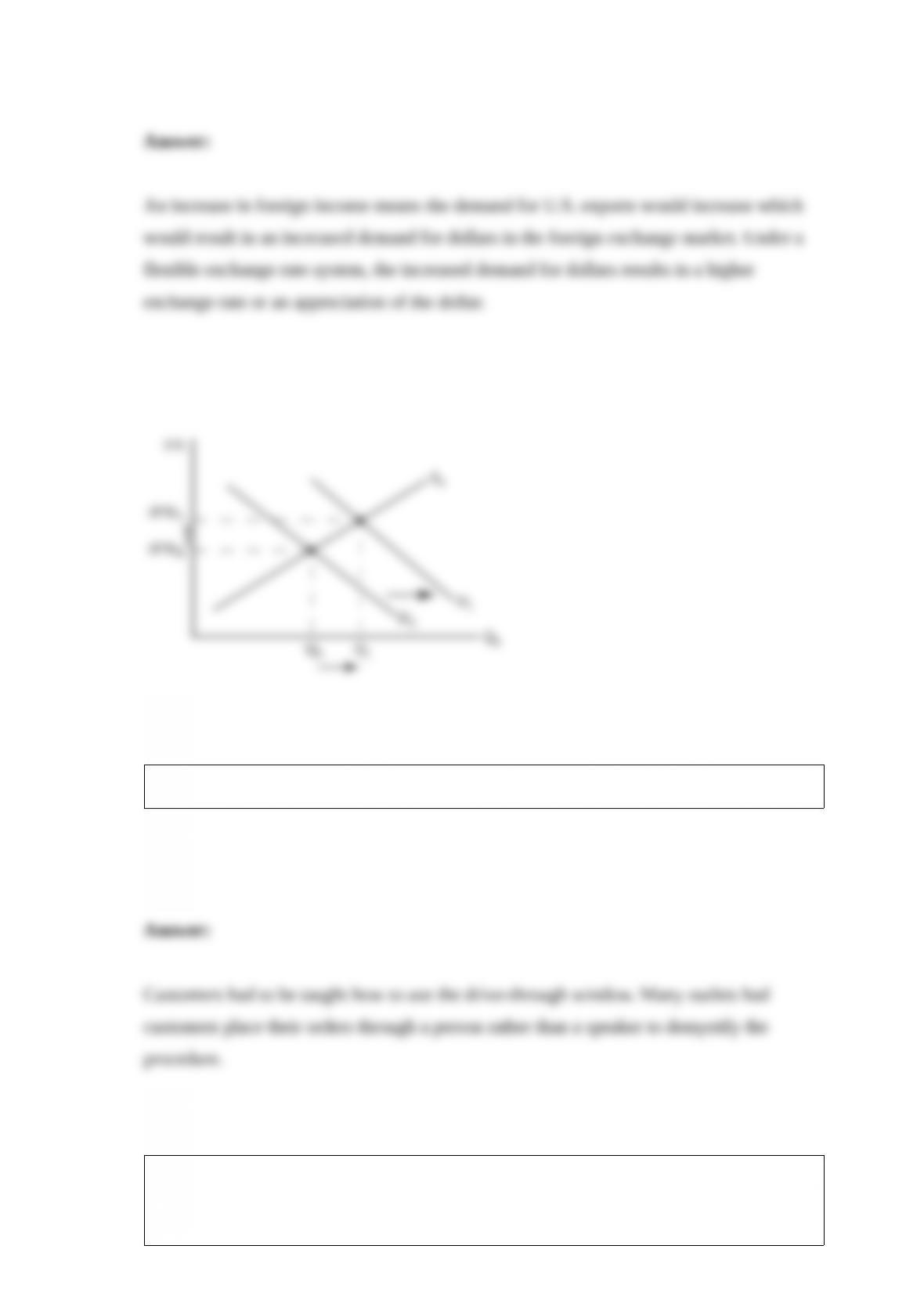
Using the foreign exchange market diagram, graphically illustrate and explain the
impact of an increase in foreign income, all else constant, on the exchange rate.
How did McDonalds address the drive-through innovation in China?
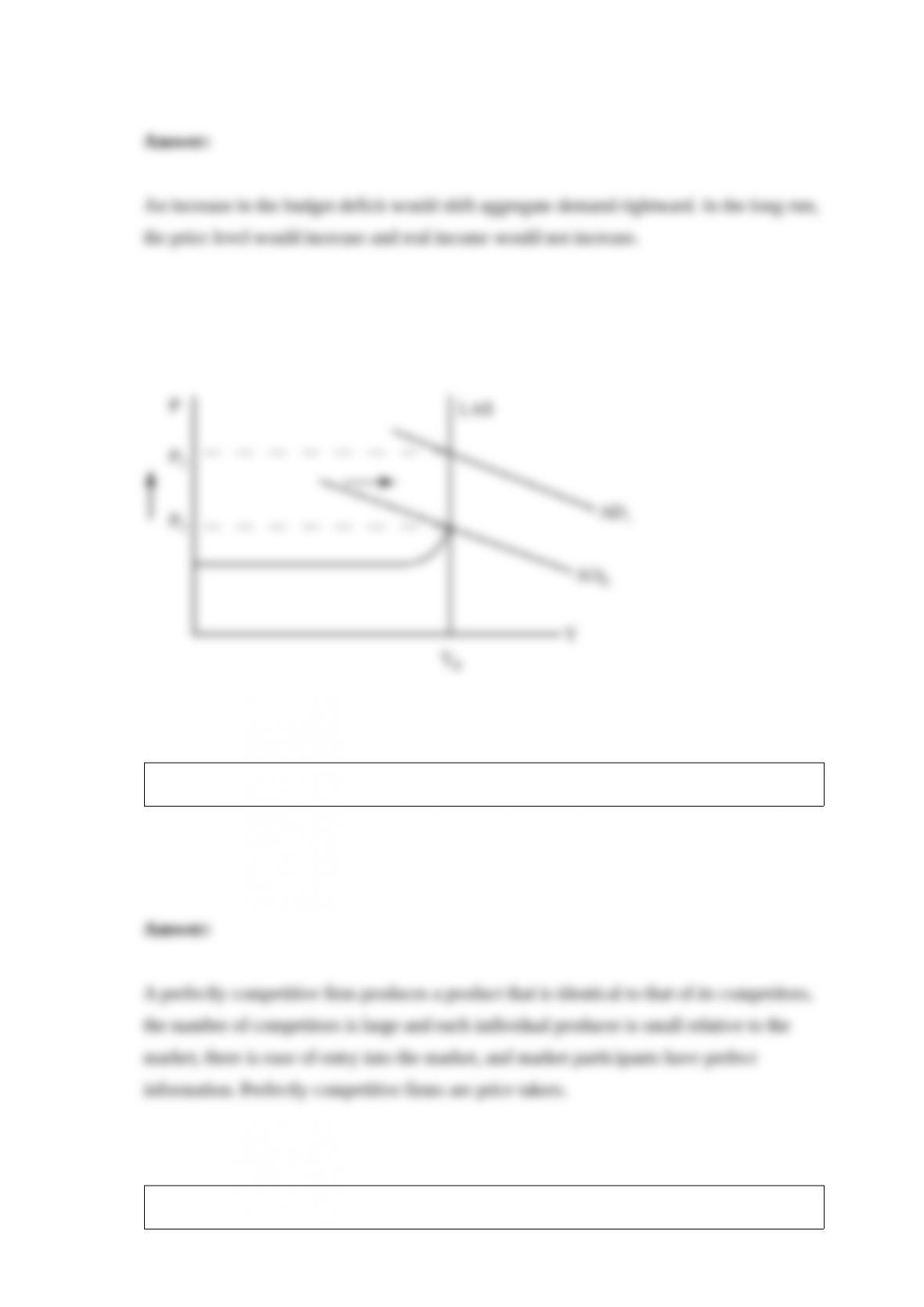
Using the aggregate demand-aggregate supply diagram, graphically illustrate and
explain the impact of an escalating budget deficit on the price level and real income in
the long-run.
Summarize the characteristics of a perfectly competitive market.
SUMMARY OUTPUT

Regression Statistics
Multiple R 0.745495
R Square 0.555762
Adjusted R Square 0.532981
Standard Error 7211.848
Observations 42
ANOVA
df SS MS F Significance
FRegression 2 2537650171 1.27E+09 24.39544
1.3443E-07Residual 39 2028419591 52010759Total 41
4566069762
Coefficients Standard t Stat P-value Lower 95%
Upper 95% Error
Intercept 47331.38 13884.34664 3.408974 0.001528 19247.6673
75415.0958
House Age -825.161 607.3128421 -1.35871 0.182046 -2053.5662
403.243744
Square Feet 40.91107 6.696523994 6.109299 3.65E-07 27.3660835
54.4560534
Refer to Scenario 2. What is the estimated regression equation for determining the
market value of houses?
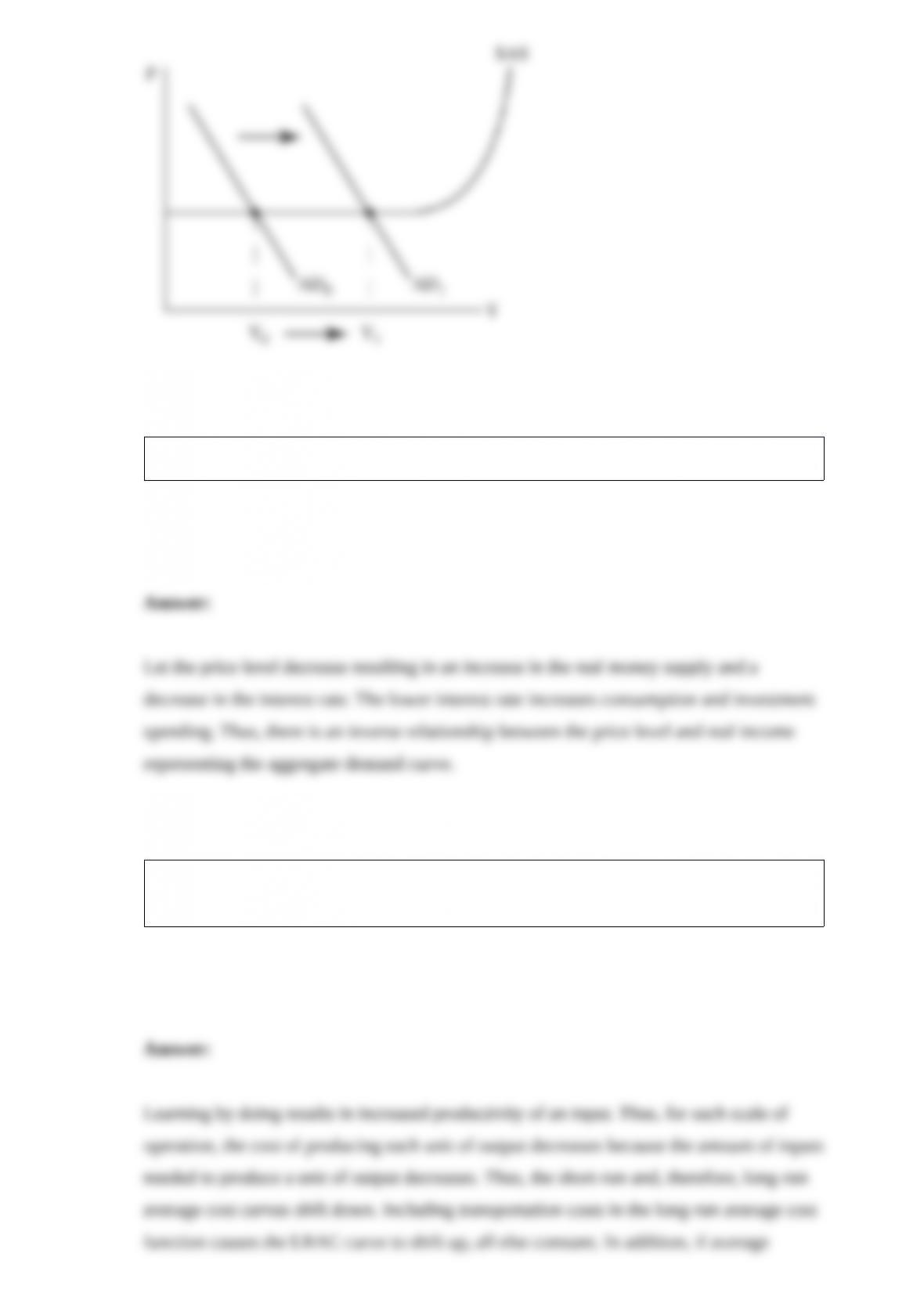
Using the aggregate demand-aggregate supply diagram, graphically illustrate and
explain the impact of an expansionary monetary policy on the price level and real
income in the very short run.
Explain how the aggregate demand curve is derived.
Explain how “learning by doing” and transportation costs each affect the long-run
average cost curve.

Briefly discuss the relationship between leakages and the size of the multiplier.
Briefly summarize the empirical literature on the long-run costs typically incurred by
firms in a variety of industries. In particular, is there reason to believe that firms’
long-run cost curves assume the typical U-shape? Why or why not?
What is the relationship between unemployment and the price level in the short run?
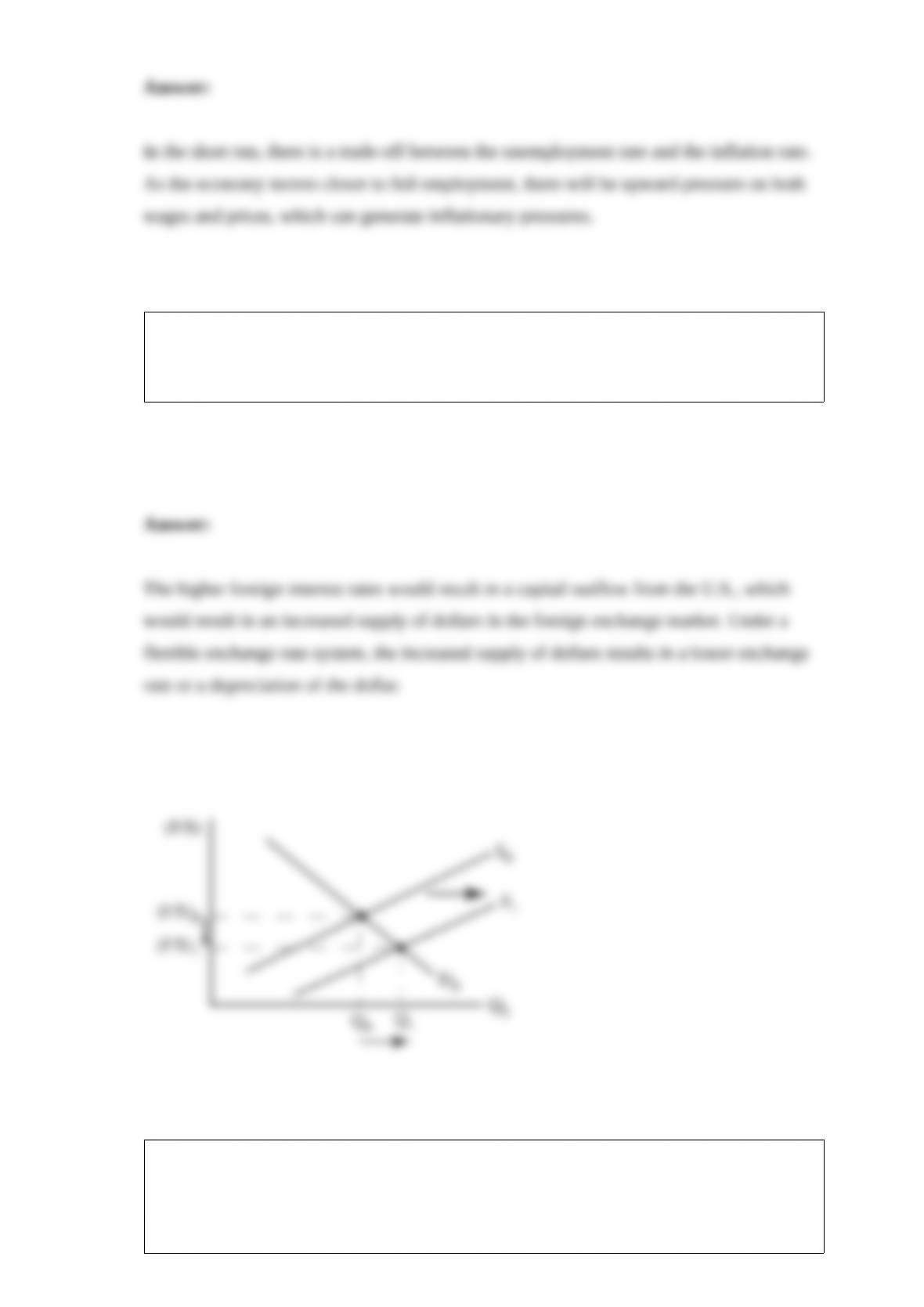
Using the foreign exchange market diagram, graphically illustrate and explain the
impact of foreign interest rates that exceed U.S. interest rates, all else constant, on the
exchange rate.
During the recession of 2007-2009, the U.S. economy was experiencing a decrease in
home prices and consumer wealth, a credit crisis in the financial markets, and declining
consumer and business confidence. What components of aggregate demand were
affected and what was the impact on real output? What were the policy options?
Economists describe short-run decisions as “constrained” decisions, while long-run
decisions are described as “planning” decisions. Referring to a firm’s short-run average
cost function and long-run average cost function, explain this distinction.
List and describe the sources of spending in the economy by focusing on the four major
sectors of the economy.