
Assume a consumer purchases two goods: X and Y. All else constant, an increase in the
price of X would cause the total utility the consumer can obtain with her available
income to decrease.
When the percentage change in quantity supplied is greater than the percentage change
in price, supply is said to be elastic.
Applying a uniform markup to set the price of the various products sold by a firm is
more profitable than varying the markup based on differences in the price elasticity of
demand for the firm’s products.
Studies strongly suggest that advertising strategies are generally much more effective
than pricing strategies as a means to increase market share.

Assume a monopolistically competitive firm comes up with a new innovation that
allows it to earn above-normal economic profits. Given the nature of the market in
which it operates, over time those profits will be competed away as new competitors
enter the market.
When using expert opinion, consumer surveys, test marketing, and price experiments to
analyze consumer behavior, managers must consider how to isolate the effect of
different variables that influence demand.
If, for a particular short-run production, we observe that marginal product is decreasing
we can conclude that average product is decreasing as well.

Stabilization of business cycle fluctuations focuses on the long run.
In 1997, the Thai government was unable to maintain its exchange rate given the
amount of international reserves.
The barter system requires the double coincidence of wants to be fulfilled.
Failure to account for the increased transportation costs that would result from building
fewer and more centrally located production facilities could result in firm managers
selecting a scale of operation that is larger than the optimum.

In comparing an oligopolistic firm to a perfectly competitive firm it is generally
assumed that the price charged by the competitive firm will be higher than the price
charged by the oligopolistic firm.
Price coordination among firms will be more difficult when there are substantial
differences among the cost structures of the competing firms and the technologies they
employ.
Microsoft was charged with violating the antitrust laws not because it had a virtual
monopoly in the form of its Windows operating system, but because it acted like a
monopolist in trying to control the market for certain software applications.

The total willingness to pay for a given number of units of a good or service is
determined by multiplying the equilibrium price of the good by the number of units
purchased.
U.S. import spending is not affected by U.S. real income but is influenced by the
economic activity of its major trading partners and the exchange rate, hence import
spending is taken as autonomous.
All else constant, as the price elasticity of demand decreases, so does the marginal
revenue resulting from a decrease in price.

All else constant, if the use of historic costs understates the opportunity costs associated
with using a particular piece of capital, economic profit will be overstated.
Consumer income can be used for three things: purchases of goods and services, paying
taxes and saving.
Labor resistance can be a major impediment to increased productivity in many firms.
Decreases in autonomous spending cause rightward shifts of the aggregate demand and
supply curves.

For a typical short-run production function, so long as marginal product is increasing,
average product will be increasing as well.
Government expenditure does not include transfer payments.
If the inputs to a production process are perfect complements, the firm can choose from
a virtually infinite array of combinations of the two inputs to minimize the costs of
producing a given level of output.

Assuming the demand curve in question is downward sloping, the calculated price
elasticity of demand will always be negative.
Open market operations are an appropriate tool for day-to-day changes in monetary
policy.
Observations of consumer behavior suggest that when the price of gasoline rose above
$3.50 per gallon, consumer demand for gas became considerably more price elastic.
The statistical significance of the slope coefficient can only be tested using the F test.

The price of one currency in terms of another is called an exchange rate.
Diseconomies of scale are illustrated graphically by an upward shift of the firm’s
long-run average cost curve.
If a 10 percent increase in the price of a luxury hotel room causes the quantity
demanded to decrease by 41.5 percent., we can conclude that the price elasticity of
demand for luxury hotel rooms is approximately -0.24.

“Learning by doing” results in decreased average costs of production and is illustrated
by a downward shift of the firm’s long-run average cost curve.
A firm’s production function is the relationship between the factors of production and
the resulting outputs of the production process.
All else constant, an improvement in technology would cause a firm’s total, average and
marginal product functions to increase (graphically, shift up).
It is reasonable to expect that if one firm in an oligopolistic market raises price, the its
competitors will do the same so that all firms can earn increased revenues.

In the value added approach to calculating GDP, counting both the intermediate good
and the final product would understate the contribution to GDP.
The fact that supermarkets, a land-intensive form of organization, have become the
dominant form of grocery store in the United States suggests that there is little or no
potential for input substitution in the grocery store business.
In recent years, U.S. exports have exceeded U.S. imports.

Proprietor’s income is not considered part of national income.
If banks operated under a 100 percent reserve system, commercial banks would not be
able to create any further money.
Assume there is a reduction in the shipments of petroleum products due to political
tension in the Persian Gulf. In a market economy, which consumers would get the
reduced supplies of gas?
A) The consumers who value gasoline the most and are able to pay for it.
B) Wealthy consumers.
C) Lower income consumers.
D) Who gets the gasoline would be a random process. Those who arrive at the service
station first will get the gasoline, regardless what its price is.

An increase in taxes would shift the:
A) aggregate demand curve rightward.
B) aggregate demand curve leftward.
C) aggregate supply curve rightward.
D) aggregate supply curve leftward.
Changes in the amount of goods produced, but not sold in a given year is called:
A) inventory investment
B) business fixed investment
C) residential fixed investment
D) consumption
Which of the following is least likely to limit the ability of a firm to minimize
production costs?

A) Resistance by labor.
B) The fact that the firm is a nonprofit organization.
C) An increase in the amount of competition faced by the firm.
D) Legislated input combinations for firms in particular industries, e.g, health care.
Assume wages paid by a firm to its workers decrease. What will be the reaction of
consumers as the market moves to its new equilibrium?
A) Quantity demanded will decrease.
B) Quantity demanded will increase.
C) The demand curve will shift to the left.
D) There will be no reaction by consumers, since input prices determine supply, not
demand.
Open market sale will result in:
A) increase in bank reserves and a decrease in the federal funds rate.
B) increase in bank reserves and an increase in the federal funds rate.

C) decrease in bank reserves and a decrease in the federal funds rate.
D) decrease in bank reserves and an increase in the federal funds rate.
In the foreign exchange market, the quantity supplied of dollars is 300 whereas the
quantity demanded of dollars is 500 results in a:
A) balance of payments surplus of 200.
B) balance of payments deficit of 200.
C) balance of payments surplus of -200.
D) balance of payments deficit of -200.
Assume declining profits in the market for Internet service force several firms in the
area to drop out of the market. All else constant, this would cause the:
A) equilibrium price and quantity to decrease.
B) equilibrium price and quantity to increase.
C) equilibrium price to increase and equilibrium quantity to decrease.
D) equilibrium price to decrease and equilibrium quantity to increase.
Use the firm’s long-run cost-minimizing decision rule to explain the differences in the
relative use of capital and labor in agriculture in the United States and the Peoples
Republic of China.
The perfectly competitive firm’s supply curve:
A) coincides with its perfectly elastic demand curve.
B) is perfectly inelastic at the market price.
C) is the firm’s marginal cost curve above the minimum point on the AVC curve.
D) is the firm’s average total cost curve above the shutdown point.

A vertical curve that defines the level of full-employment or potential output based on a
given amount of resources, efficiency, and technology in the economy is called:
A) the short-run aggregate supply curve.
B) the long-run aggregate supply curve.
C) the aggregate demand curve.
D) none of the above.
The nominal interest rate is 7 percent and the expected inflation rate is 4 percent. The
real interest rate is:
A) 10 percent.
B) -2 percent.
C) 3 percent.
D) 4 percent.

Those individuals 16 years of age and over who are working in a job or actively seeking
employment are called:
A) the labor force.
B) the employed.
C) the unemployed.
D) none of the above.
The market structure that is characterized by a small number of large firms that have
some market power is called:
A) perfect competition.
B) monopolistic competition.
C) oligopoly.
D) monopoly.
The monopolistically competitive seller’s demand curve will tend to become more
elastic the:
A) smaller the number of sellers.

B) greater the degree of product differentiation.
C) larger the number of close competitors.
D) more significant the barriers to entering an industry.
Assume a firm produces 500 units of a good by using two inputs, capital and labor,
whose per unit prices are $10 and $4. Assume also that the marginal physical product of
the last unit of capital is 30 and the marginal physical product of the last unit of labor is
10. To minimize costs this firm should employ:
A) the existing combination of resources.
B) more labor and less capital.
C) more capital and less labor.
D) both more labor and more capital.
Which of the following is most likely to create diseconomies of scale?
A) concentration of production in a small number of very large plants.
B) the use of automation devices.
C) technological advance.

D) division of labor.
If the percentage change in quantity demanded is less than the percentage change in
price, we would say that over this range, demand is:
A) elastic.
B) unit elastic.
C) inelastic.
D) perfectly elastic.
The currency deposit ratio, c, is 0.10. The reserve requirement, rr, is 0.08. The excess
reserve ratio, e, is 0.05. What is the size of the money multiplier?
A) 4.70
B) 4.78
C) 4.75
D) 4.00

If desired spending exceeds output, then firms:
A) accumulate their inventories and cut production.
B) deplete their inventories and cut production.
C) deplete their inventories and increase production.
D) accumulate their inventories and increase production.
A firm could gain from cheating on a cartel agreement by doing all of the following
except:
A) raising its price above the agreed level.
B) lowering its price below the agreed level.
C) selling more than its agreed quota.
D) increasing production.

The key characteristic of an oligopolistic market is:
A) production of a homogeneous product.
B) mutual interdependence among firms in the market.
C) the absence of market power by any one firm.
D) ease of entry into, and exit out of, the market.
When a perfectly competitive market has fully adjusted to demand and supply
conditions, all of the following are true except:
A) P = MC.
B) P = the minimum of SRATC.
C) P = the minimum of LRAC.
D) P = the minimum of AVC.
All else constant, an increase in the number of buyers in the market for cell phone
service would cause:
A) equilibrium price and quantity to increase.
B) equilibrium price and quantity to decrease.

C) equilibrium price to increase and equilibrium quantity to decrease.
D) equilibrium price to decrease and equilibrium quantity to increase.
In the market for French wines, an increase in demand is illustrated by:
A) a movement up the demand curve.
B) a movement down the demand curve.
C) a shift of the demand curve to the left.
D) a shift of the demand curve to the right.
Which of the following is true of the typical relationship between marginal product
(MP) and average product (AP)?
A) If MP is greater than AP, then AP is falling.
B) The AP curve intersects the MP curve at minimum MP.
C) The MP curve intersects the AP curve at maximum AP.
D) If MP is less than AP, then AP is increasing.

Assume at the firm’s profit-maximizing level of output P = AVC. In this case, the firm
will be:
A) earning a positive economic profit.
B) earning economic profit = 0.
C) incurring an economic loss.
D) breaking even.
Contractionary monetary policy is achieved by:
A) decreasing the amount of bank reserves and lowering the federal funds rate.
B) decreasing the amount of bank reserves and raising the federal funds rate.
C) increasing the amount of bank reserves and lowering the federal funds rate.
D) increasing the amount of bank reserves and raising the federal funds rate.

An increase in the amount of competition with other firms that employ “best practices”
would be likely to cause a particular firm’s labor productivity to:
A) increase
B) stay the same.
C) decrease.
D) cannot be determined without additional information.
To counter parents’ concerns about fast foods and childhood obesity, McDonalds
considered:
A) a variety of menu items such as milk shakes and candy.
B) a variety of menu items such as apple slices, fruit juices, peanut butter and jelly
sandwiches, and carrot sticks.
C) not changing the menu.
D) all of the above.
Refer to Scenario 2. If the age of a house is 25 years with 1,500 square feet, what is the
estimated market value of the house?
Compare and contrast the outcomes with respect to price and output in a
monopolistically competitive market and a perfectly competitive market. In which
situation are consumers better off? Why?
The actual unemployment rate exceeds the natural rate of unemployment. What are
policymakers concerned about in this situation?

Refer to Scenario 2. What percentage of the variation in the dependent variable, Market
Value, is explained by the regression model?
What role does the price elasticity of demand play in markup pricing, i.e., how does it
affect the firm’s ability to mark up price over marginal cost?
What did the European Central Bank (ECB) do to bolster the value of the euro in
September 2000?
Distinguish between implicit and explicit costs and give examples of each. In addition,
explain how explicit and implicit costs affect the distinction between economic profit
and accounting profit. What explains the distinction between the two measures of
profit?
Assume the current price of good X is too high, i.e., it is above the equilibrium price.
Describe the changes that would occur in a market as a result, i.e., explain how the
market would adjust to equilibrium.
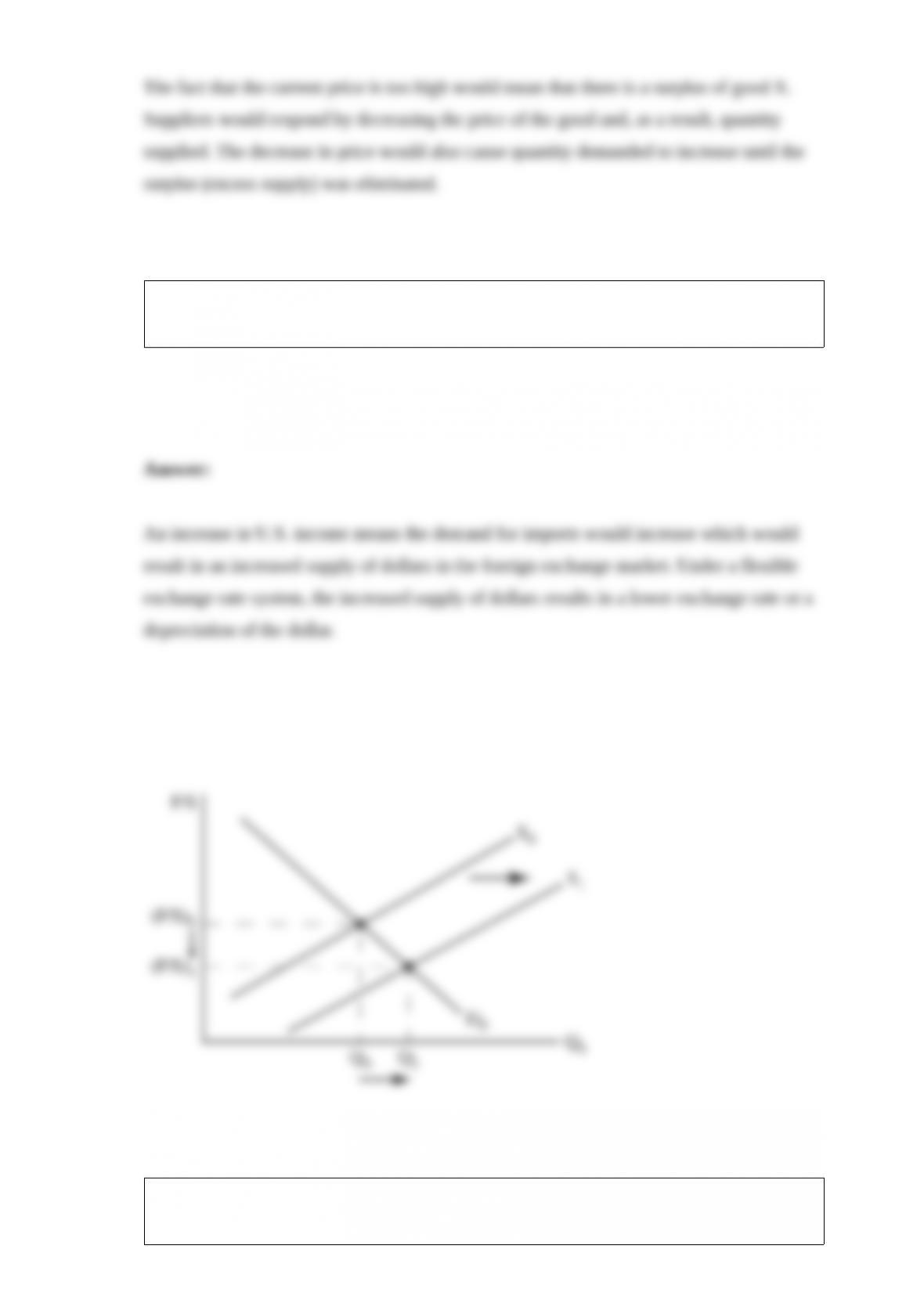
Using the foreign exchange market diagram, graphically illustrate and explain the
impact of an increase in U.S. income, all else constant, on the exchange rate.
You are given the following information on the banking system.
Reserve requirement rr = 1.00
Currency-deposit ratio c = 0.10
Excess reserve ratio e = 0.00
Compute the simple deposit and money multipliers.
Automobile manufacturers often use incentive programs, including special financing
rates and cash rebates, to increase sales. However, a customer is usually restricted to
choosing either the low financing rate or the rebate, but not both. Is this an example of
price discrimination? If so, what type? Explain your reasoning.
Assume the economy is headed into a recession. Considering this, and recognizing that
firms are slow to change the prices they charge for their products, are firms more or less
likely to be able to pursue an effective markup pricing strategy in their pursuit of
positive economic profit? Why?
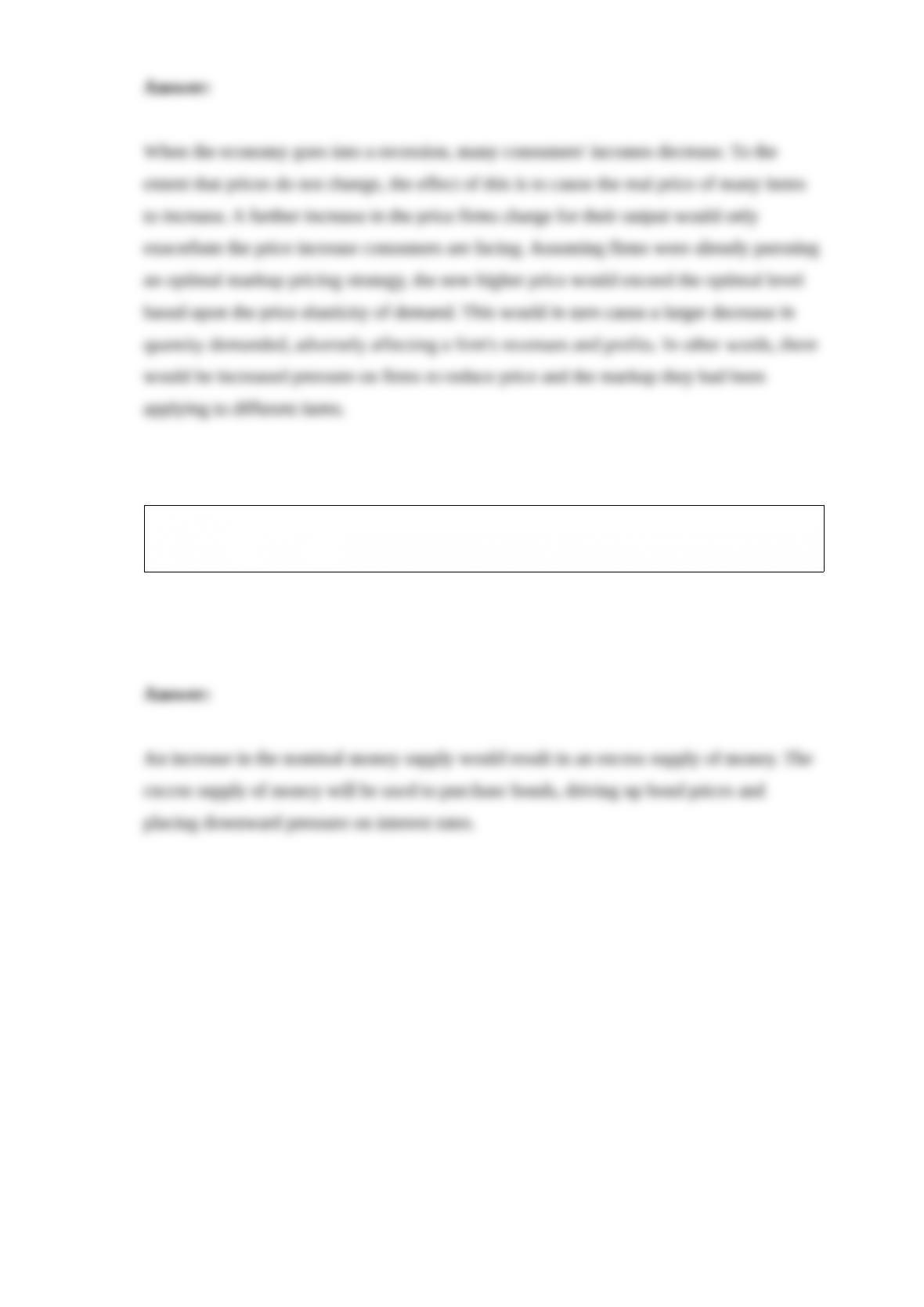
In the context of the money market, graphically illustrate and explain the impact of an
expansionary monetary policy on interest rates.
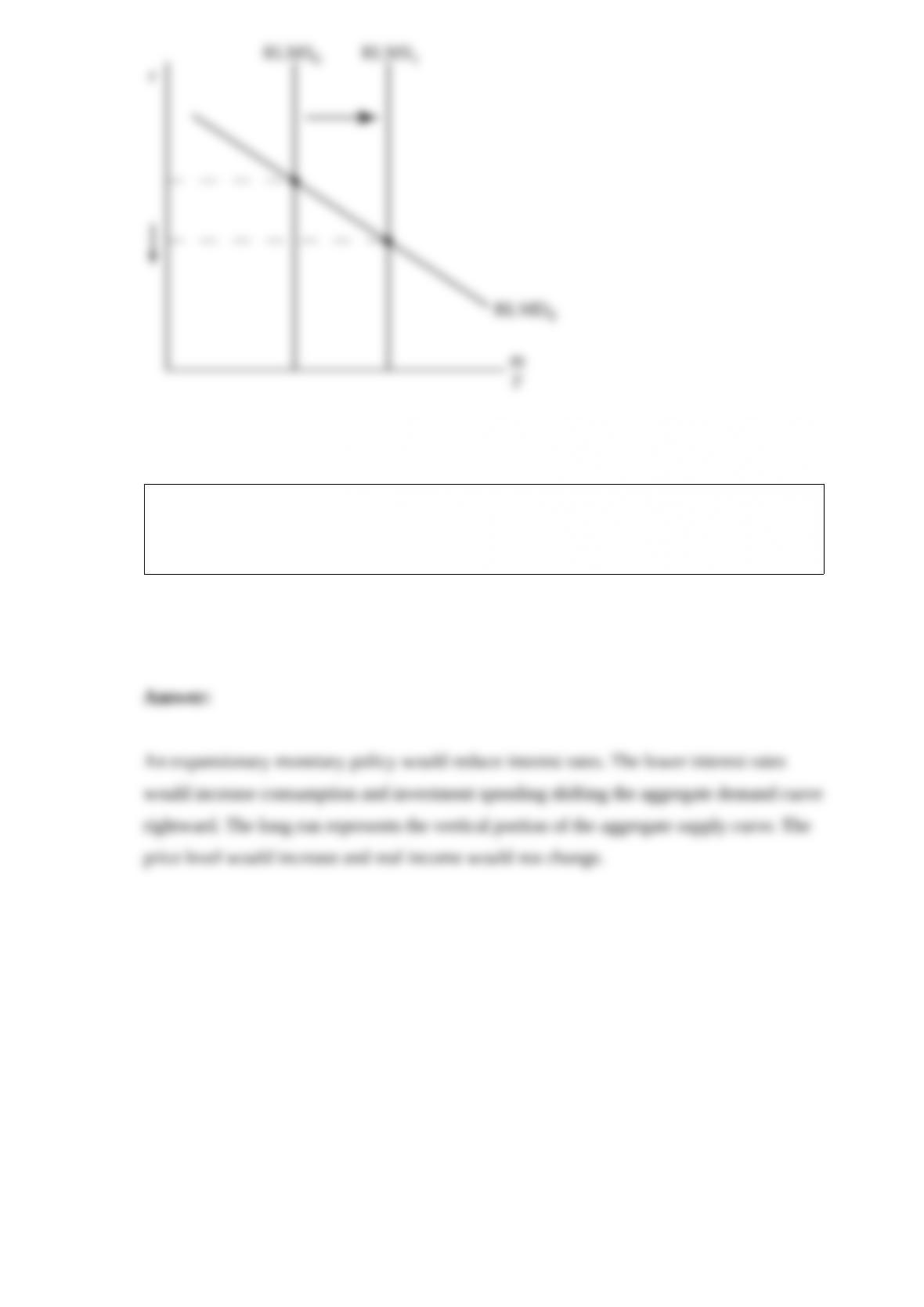
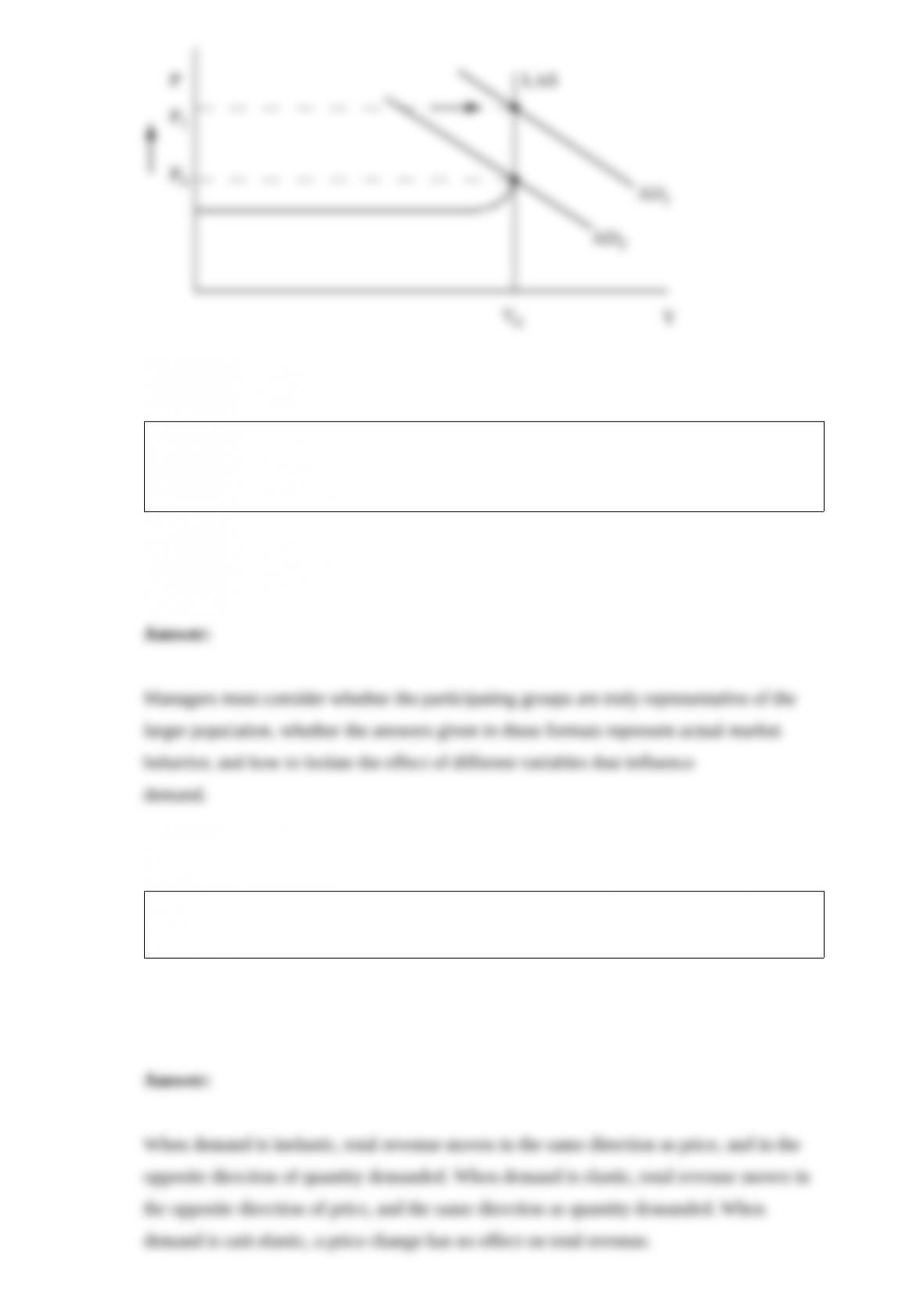
Using the aggregate demand-aggregate supply diagram, graphically illustrate and
explain the impact of an expansionary monetary policy on the price level and real
income in the long run.
Briefly describe the three key points managers must consider when using expert
opinion, consumer surveys, test marketing, and price experiments in analyzing
consumer behavior.
Summarize the relationship between elasticity, price changes, and changes in total
revenue.

Complete the table below, which represents the production costs for a typical firm.
(Round numbers to the nearest tenth.)
TP TFC TVC TC AFC AVC ATC MC
0 $20 $ 0 $__ — — — —
1 ___ 27.5 ___ $__ $__ $__ $27.5
2 ___ 46.8 ___ ___ 23.4 ___ ___
3 ___ 63.3 ___ ___ ___ ___ ___
4 ___ 82.5 ___ 5.0 ___ ___ ___
5 ___ 106.7 126.7 ___ ___ ___ ___
6 ___ 139.7 ___ ___ ___ ___ ___
7 ___ 181 ___ ___ ___ 28.7 ___
At what level of output do diminishing returns set in? How do you know?
Explain how labor resistance and political and legislative influences reduce the ability
of firms to minimize their costs of production. What do the two have in common in this
regard?
Assume an individual is considering opening a new car dealership in a medium-sized
metropolitan area (population = 200,000). Provide a list of economic variables you
would recommend that the person consider in making his decision whether to open the
business, and explain your rationale for including each variable.