
McDonald’s can offset the decline in demand by influencing the different variables that
affected the demand function for their products.
The quantity of money demanded is positively related to the interest rate.
The level of potential GDP does not change because the factors determining potential
output are fixed in the short run.
The fact that a firm is a price-setter does not ensure it will make a positive economic
profit in the short run and over time.

As their respective names imply, monopoly and monopolistic competition are the most
similar of the four market structures.
In a open economy, aggregate expenditures are the sum of personal consumption,
investment, government, and net export expenditures.
Changing consumer taste and preferences, lawsuits, and competitive pressures
adversely affect McDonald’s sales.

Rent controls have the effect of keeping prices under control and maintaining an
adequate supply of affordable housing for lower income people.
Most of the empirical research on long-run costs suggests that the long-run average cost
curve for most firms has a very pronounced U-shape.
Consider the market for air travel. A simultaneous increase in the price of fuel and
another terrorist attack on United States soil would cause the equilibrium quantity of air
travel to go down, but have an uncertain effect on equilibrium price.
A price-setting firm prefers to operate in the inelastic portion of its demand curve
because total revenue increases when price is increased.

Open market sale of government securities by the Fed decreases the federal funds rate.
When calculating the arc elasticity of demand, the percentage change in price (quantity)
should be based on the average of the starting and ending prices (quantities).
All else constant, so long as it is negative, as the cross price elasticity of demand
between a firm’s product and those of its competitors increases, so does the market
power possessed by the firm.

A firm has reached its shutdown point when price is equal to minimum average total
cost.
Understanding how individual sectors of the economy will respond to changes in key
economic variables gives us a better understanding of how the macroeconomy behaves.
“Gross Investment spending” refers exclusively to purchases of plant and equipment by
businesses and net changes in business inventories.
Assume the supply function for good X can be written as
Qs = -100 + 27Px – 5Py – 1.8W

where Px = the price of X,
Py = the price of good Y, and
W = Wage index for workers in industry X.
This equation implies that X and Y are complements in production.
Changes in the macroeconomy, such as an increase in average per person income, can
have effects at the microeconomic level, for example, on the profitability of firms in a
particular industry.
Predatory pricing will be most effective when the costs structures of the firms in an
industry, including potential entrants into the market, are identical or at least very
similar.

Credit cards do not fulfill the three functions of money.
All else constant, an increase in the amount of government spending on roads and
bridges would cause GDP in the domestic economy to increase.
Efforts by firms to secure patents increase the amount of competition in the affected
markets.
The price elasticity of demand is measured as the percentage change in quantity
demanded divided by the percentage change in price.

Over time, the price of personal computers has fallen dramatically. All else constant,
this would lead us to expect that demand for personal computers has become more price
elastic.
Regression analysis is used for prediction, while correlation analysis is used to measure
the strength of the association between two variables.
All else constant, a decrease in the level of economic activity in foreign countries could
be expected to have an adverse effect on the domestic economy.

A trade surplus exists if export spending is less than import spending.
The level toward which the economy is moving and where it will stay unless spending
patterns of the economy will change is called the equilibrium level of output and
income.
A firm’s short-run cost functions depend primarily on the firm’s production function and
the prices of the inputs to production.
An open market sale, an increase in the discount rate, and an increase in the reserve
requirement would shift the aggregate demand curve leftward.

Empirical evidence suggests that economies of scale, advertising and image
differentiation, and risk spreading all help account for the large-scale production that
exists in many sectors of the economy.
One way for the federal government to increase the amount of spending in the domestic
economy would be to decrease personal and business taxes.
Price will be higher and output will be lower under monopoly than under perfect
competition with the same demand and cost conditions.

When a firm is considering whether to buy a new piece of equipment with retained
earnings, the amount of interest that could be earned on that money is an explicit cost
and should be treated as such.
A firm’s decision to expand the size of its production facility would be considered a
short-run decision so long as the expansion can be completed in less than a year.
Assuming the inverse demand function for good Z can be written as P = 90 – 3Q, when
Q is equal to 5, average revenue and marginal revenue are equal to ________ and
________.
A) $75; $75.
B) $85; $85.
C) $75; $60.
D) $60; $60.

Economic profit is equal to the difference between:
A) total revenue and the full opportunity cost of all the resources used in production.
B) total revenue and implicit costs.
C) accounting profit and explicit costs.
D) implicit and explicit costs.
A decrease in the discount rate would:
A) decrease bank borrowing of reserves and reflect an expansionary monetary policy.
B) decrease bank borrowing of reserves and reflect a contractionary monetary policy.
C) increase bank borrowing of reserves and reflect an expansionary monetary policy.
D) increase bank borrowing of reserves and reflect a contractionary monetary policy.
All else constant, a large decrease in the number of people who want to own sport
utility vehicles (SUVs) because of their poor fuel efficiency could be expected to cause:
A) an increase in the supply of SUVs.

B) a decrease in the equilibrium price of gasoline.
C) an increase in the equilibrium price of SUVs.
D) an increase in the supply of gasoline.
Balance of payments issues are related to the relative value of different countries’
currencies and the flow of goods, services, and financial assets among countries. The
rate at which one country’s currency can be traded for another is called:
A) the trade balance.
B) capital inflows.
C) capital outflows.
D) the exchange rate.
Expansionary monetary policy should be used if:
A) aggregate demand-aggregate supply equilibrium is below potential output.
B) aggregate demand-aggregate supply equilibrium is above potential output.
C) aggregate demand-aggregate supply equilibrium is equal to potential output.
D) none of the above.

The function that shows the inverse relationship between planned consumption and
investment spending and the real interest rate, all else constant, is called the:
A) interest-related expenditure function.
B) aggregate expenditure function.
C) consumption function.
D) investment function.
The F-statistic is an alternative measure of goodness-of-fit of an estimated regression
equation and defined as the:
A) variation not explained by the regression equation relative to the variation explained.
B) variation explained by the regression equation to the variation not explained.
C) variation explained.
D) variation not explained.

Managers can increase firm profits by:
A) increasing revenue only.
B) decreasing costs only.
C) increasing revenue and decreasing costs.
D) none of the above.
An economy with only the household and firm sectors is called:
A) a mixed economy.
B) a private economy.
C) a command economy.
D) none of the above.
An increase in foreign real income would shift the:

A) aggregate demand curve rightward.
B) aggregate demand curve leftward.
C) aggregate supply curve rightward.
D) aggregate supply curve leftward.
The banking system in the U.S. is based on:
A) 100 percent reserve banking.
B) fractional reserve banking.
C) 0 percent reserve banking.
D) none of the above.
Lending abroad represents:
A) a capital outflow.
B) a capital inflow.
C) positive net savings.
D) none of the above.

The major factor contributing to the appreciation of the dollar between 1995 to 2000
was:
A) decrease in capital inflows.
B) increase in capital inflows.
C) slow GDP growth in the U.S.
D) none of the above.
Taxes levied on a firm’s earnings ________ the effective cost of funds.
A) lower
B) raise
C) have no effect
D) none of the above

Assume that at the current market price, a perfectly competitive firm’s
profit-maximizing level of output yields total revenues that are just equal to total costs.
Which of the following statements applies to this firm?
A) The firm should shut down right now.
B) The firm should continue to operate in the short run to minimize losses, but shut
down if things don’t improve over the long run.
C) The firm is earning zero economic profit and should continue to operate.
D) The firm should increase its explicit costs to reduce its tax burden.
Information on the price elasticity of demand is particularly important to managerial
decision making because:
A) the higher the price elasticity of demand for a product is, the more profitable it will
be to produce more of it.
B) depending on the elasticity coefficient, decision makers will immediately know if a
price change will cause profits to increase or decrease.
C) it allows one to predict how total revenue will respond, i.e., increase or decrease, to a
change in price.
D) as the price elasticity coefficient approaches one, profits will increase.

Decrease in stock market wealth will ________ the expenditure curve:
A) decrease.
B) increase.
C) not change.
D) none of the above.
Over the past few years, airlines have tended to compete in the market for
intercontinental business class travelers on the basis of:
A) price.
B) cost.
C) timeliness of their flight schedules.
D) amenities.
Which of the following approaches to understanding and predicting consumer behavior
depends primarily on the knowledge and experience of a firm’s employees and its
suppliers?
A) Direct consumer surveys.

B) Expert opinion.
C) Analysis of historical data.
D) Test marketing and price experiments.
The legislation passed in 1946 that requires governmental institutions to promote
“maximum employment, production, and purchasing power” is called:
A) Full Employment and Balanced Growth Act.
B) Federal Reserve Act.
C) Employment Act.
D) Unemployment Act.
Marginal revenue equals 0 when:
A) total revenue is increasing.
B) total revenue is at its maximum.
C) total revenue is decreasing.
D) none of the above; marginal revenue is always positive.

As we move down a linear demand curve, the absolute value of the price elasticity of
demand:
A) increases.
B) stays the same.
C) decreases.
D) cannot be determined without more information.
In which of the following market structures would X-inefficiency be most likely to
exist?
A) Perfect competition.
B) Monopolistic competition.
C) Oligopoly.
D) Monopoly.

Which of the following would make it easier to maintain an effective collusive
agreement in a cartel?
A) An increase in the number of potential entrants into the industry.
B) A decrease in the elasticity of demand for the cartel’s product.
C) An increase in the number of substitutes for the product produced by the cartel.
D) A new method of pricing that makes it more difficult for each firm to monitor the
prices that the other firms in the cartel are charging.
Which of the following statements is correct?
A) A change in demand or supply can only be caused by a change in price.
B) A simultaneous decrease in demand and increase in supply will result in an increase
in equilibrium price and uncertain effect on quantity.
C) If price is currently above equilibrium, market adjustments will result in a decrease
in price and quantity supplied.
D) An increase in supply invariably leads to a shortage in the affected market.

The amount of cost cutting technical innovation introduced into a production process is
a function of:
A) technology only.
B) technology and consumer acceptance.
C) consumer acceptance only.
D) none of the above.
In the foreign exchange market, U.S. residents wishing to purchase foreign exports or
foreign real and financial assets must:
A) demand U.S. dollars by supplying foreign currency.
B) demand U.S. dollars by supplying U.S. dollars.
C) supply U.S. dollars by demanding foreign currency.
D) none of the above.
A decrease in foreign real income would shift the:
A) aggregate demand curve rightward.
B) aggregate demand curve leftward.

C) aggregate supply curve rightward.
D) aggregate supply curve leftward.
What is the difference between inflation and deflation?
A) Inflation is a sustained decrease in the price level whereas deflation is a sustained
increase in the price level.
B) Inflation is a sustained increase in the price level whereas deflation is a sustained
decrease in the price level.
C) Inflation is a measure of relative prices whereas deflation is a sustained increase in
the price level.
D) None of the above.
In order for the first player to move in a sequential game to be able to gain an advantage
from making the first move, the player must:
A) possess a dominant strategy that is better than the other player’s dominant strategy.
B) be able to achieve a higher maximum payoff than the other player.
C) follow the same strategy he would pursue in a Nash equilibrium.
D) be able to make a credible commitment to the strategy.
Explain the essential difference between games in which moves are simultaneous and
those in which moves are sequential.
Assume an individual is currently using all of his income to consume two goods X and
Y. If the prices of X and Y are $3 and $8, respectively, and the marginal rate of
substitution of X for Y is four, is this individual maximizing his net benefits from
consumption? If not, what should he do to increase his total utility?

Describe the basic characteristics of the monopoly model and explain how these
characteristics affect the ability of a monopolist to earn positive economic profits, both
in the short run and over time.
Explain why a firm maximizes its profits by producing the level of output at which
marginal revenue equals marginal costs.
What are the two primary factors that influence a firm manager’s choice between a
labor-intensive and a capital-intensive method of production? How does each factor
influence the manager’s choice.
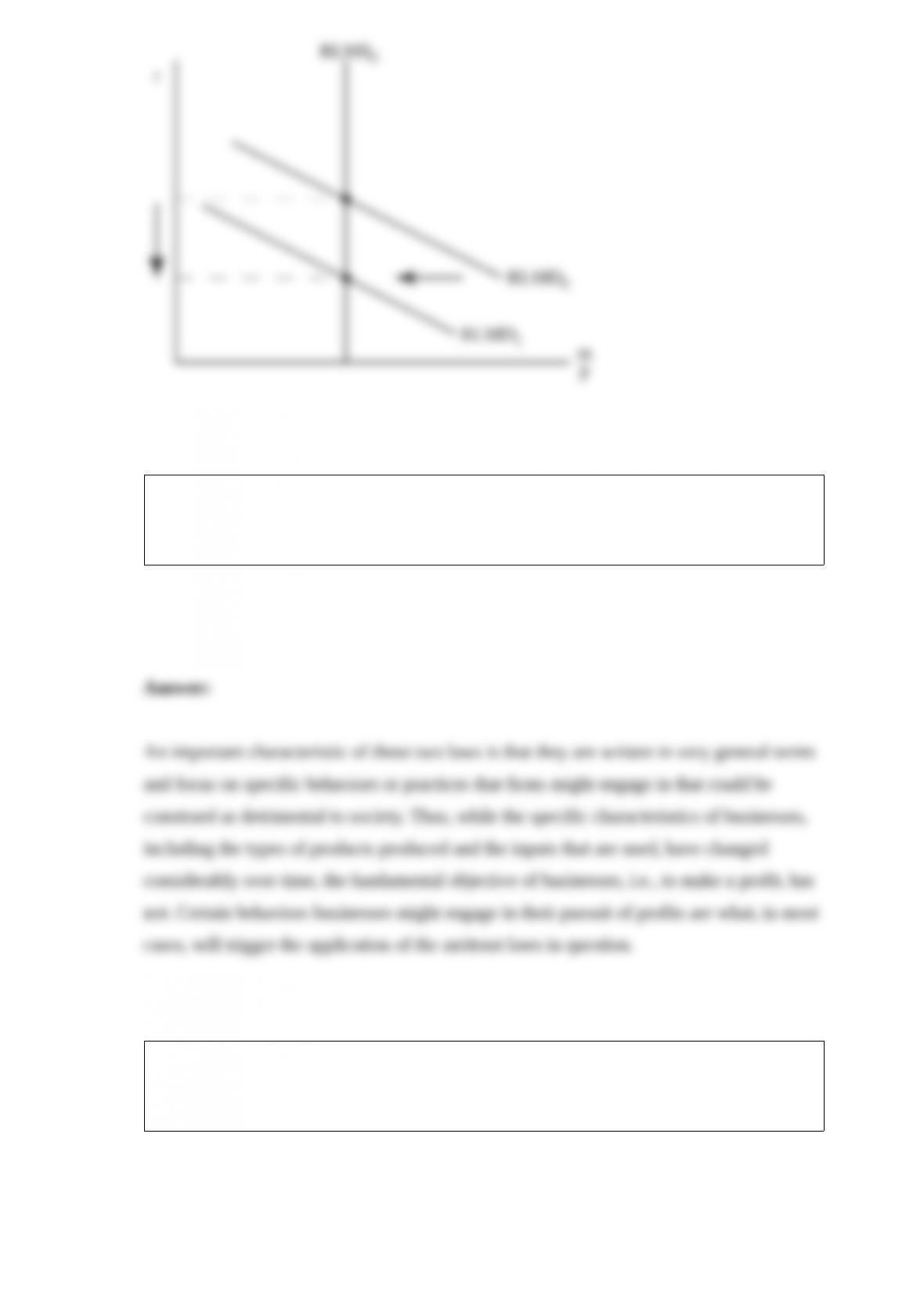
In the context of the money market, graphically illustrate and explain the impact of an
increase in the use of ATM machines on interest rates.
The Sherman Act and the Clayton Act were passed into law more than 100 years ago.
What characteristic of each of these laws enables them to remain applicable in today’s
modern economy?
Refer to Scenario 2. Based on the 95 percent confidence intervals for each of the partial
regression coefficients, which independent variable is statistically different from zero
and why?
Explain why, when all adjustment have taken place, the perfectly competitive firm will
operate at the minimum of its short-run and long-run average total cost curves and earn
zero economic profit.
Explain how network externalities act as a barrier to entry.
Calculate the arc price elasticity of demand for wheat in the two situations below:
The Wheat Market Farmer Brown’s Wheat
Old price; $3.40/bu Old price; $3.40/bu
Old quantity; 2.5 billion bu Old quantity; 28,000 bu
New price; $3.20/bu New price; $3.20/bu
New quantity; 2.525 billion bu New quantity; 35,000 bu
Can you account for the difference in elasticities?
Autonomous aggregate expenditures decreases by $200 million, the marginal

propensity to consume is 0.50, marginal propensity to invest is 0.25, and the marginal
propensity to import is 0.10. Calculate the change in income.
Briefly state several reasons for the decline in sales for McDonald’s in 2001-2002.
Assume two firms are currently competing in a market. If one of the two firms wants to
try to eliminate the other firm as a competitor, should it undertake a strategy of limit
pricing or predatory pricing? Why? In addition, describe the conditions under which the
strategy you have selected will be most successful.

Explain why the price elasticity of demand varies along a demand curve, even if the
demand curve is linear.
Summarize the three conditions cited in the text under which a cartel is most likely to
succeed. Of these three, which do you think is most important? Why?
What assumptions in the perfect competition model ensure that economic profit is zero
in the long run? Explain.