Archives
EDU 83750
Negative punishment can best be defined as: A. Delivery of a stimulus after a behavior that increases the occurrence of the behavior. B. Removal of a stimulus after a behavior that decreases the occurrence of the behavior. C. Delivery of […]
EDU 87783
What are the advantages and disadvantages of using a time-out room? Discuss the importance of replacement behavior when reducing or eliminating target behavior. Answer: If a problem behavior is to be eliminated or reduced, the practitioner must identify an adaptive […]
EDU 90458
True/False There are only a few skills in every day life that are considered behavioral chains. TRUE or FALSE. Planned ignoring involves the removal of social reinforcers. Answer: TRUE Measurement is accurate when observed values, the data produced by measuring […]
EDUC 10910
True/False When designing a DRA/DRI intervention, it is a good idea to use the reinforcers that maintain problem behavior as the reinforcers for the “A” and “I” behaviors. Overall response rate refers to the average rate of response over a […]
EDUK 64779
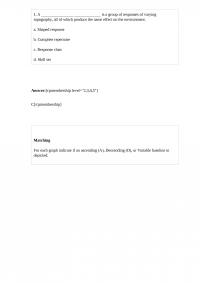
1. A ________________ _____________ is a group of responses of varying topography, all of which produce the same effect on the environment. a. Shaped response b. Complete repertoire c. Response class d. Skill set Matching For each graph indicate if […]
EDUK 93284
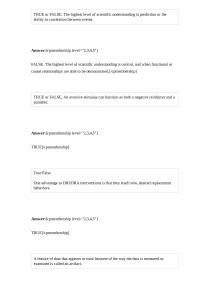
TRUE or FALSE. The highest level of scientific understanding is prediction or the ability to correlation between events. TRUE or FALSE. An aversive stimulus can function as both a negative reinforcer and a punisher. Answer: TRUE True/False One advantage to […]
SED AP 22007
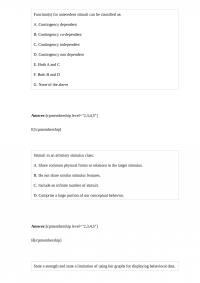
Function(s) for antecedent stimuli can be classified as: A. Contingency dependent B. Contingency co-dependent C. Contingency independent D. Contingency non dependent E. Both A and C F. Both B and D G. None of the above Stimuli in an arbitrary […]
SED AP 63978
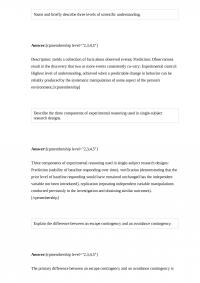
Name and briefly describe three levels of scientific understanding. Describe the three components of experimental reasoning used in single-subject research designs. Answer: Three components of experimental reasoning used in single-subject research designs: Prediction (stability of baseline responding over time), verification […]
SED DS 74955
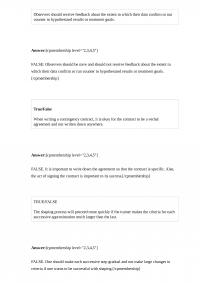
Observers should receive feedback about the extent to which their data confirm or run counter to hypothesized results or treatment goals. True/False When writing a contingency contract, it is okay for the contract to be a verbal agreement and not […]
SED EM 69137
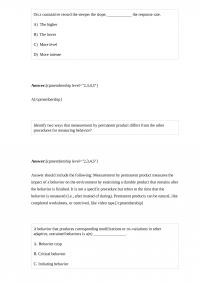
On a cumulative record the steeper the slope, ____________ the response rate. A) The higher B) The lower C) More level D) More intense Identify two ways that measurement by permanent product differs from the other procedures for measuring behavior? […]
SED LR 11130
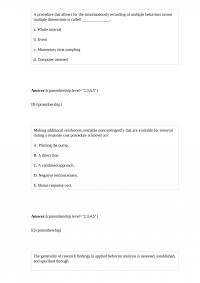
A procedure that allows for the simultaneously recording of multiple behaviors across multiple dimensions is called ______________. a. Whole interval b. Event c. Momentary time sampling d. Computer-assisted Making additional reinforcers available noncontingently that are available for removal during a […]
SESP 16409
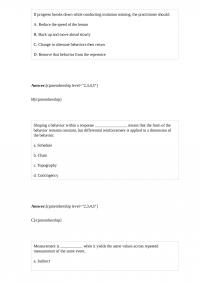
If progress breaks down while conducting imitation training, the practitioner should: A. Reduce the speed of the lesson B. Back up and move ahead slowly C. Change to alternate behaviors then return D. Remove that behavior from the repertoire Shaping […]
SESP 92982
TRUE/FALSE If a learner is making frequent mistakes during a shaping process, this is a signal that the criteria for reinforcement are being raised too quickly. TRUE/FALSE When the topography of a previous imitation occurs in the absence of the […]