Archives
978-0077606121 Chapter 18 Answers Questions
Chapter 18 – International Accounting and Financial Management Answers Questions 1. The cultural analysis of accounting Gray presents suggests that transparency is the result of a cultural characteristic of some countries and secrecy of others. Could the same attributes be […]
978-0077606121 Chapter 18 Lecture
CHAPTER 18 1 International Accounting and Financial Management 2 Learning Objectives LO18-1 Identify the major international accounting issues that international firms face, operating in foreign currencies. LO18-2 Describe the relationship between accounting and culture LO18-3 Describe the international accounting standards’ […]
978-0077606121 Chapter 1 Answers to End of Chapter Questions
Chapter 01 – The Challenging World of International Business Answers to End of Chapter Questions 1. What are the differences among multidomestic, global, and international companies? A global company attempts to standardize and integrate operations worldwide, whereas a multidomestic is […]
978-0077606121 Chapter 1 Lecture
CHAPTER 1 The Challenging World of International Business Learning Objectives LO1-1 Understand what international business is and why it is important. LO1-2 Comprehend why and how international business differs from domestic business. LO1-3 Appreciate that international business has a long […]
978-0077606121 Chapter 10 Answers to End of Chapter Questions
Chapter 10 – Organizational Design and Control Answers to End of Chapter Questions 1. Why is organizational structure an important issue for international companies? Organizational structure integrates the organization. It is the way jobs are grouped and their 2. What […]
978-0077606121 Chapter 10 Lecture
CHAPTER 10 1 Organizational Design and Control 2 Learning Objectives 3LO10-1 Explain why the design of organizational structure is important to international companies. 4LO10-2 Discuss the organizational dimensions that must be considered when selecting organizational structures. 5LO10-3 Discuss the various […]
978-0077606121 Chapter 11 Answer to Questions
Chapter 11 – Global Leadership Issues and Practices Answers to Questions 1. What is a global mindset and why is it important for international companies? Global mindset is defined as “one that combines an openness to and awareness of 2. […]
978-0077606121 Chapter 11 Lecture
CHAPTER 11 Global Leadership Issues and Practices Learning Objectives LO11-1 Discuss the importance of creating a company “global mindset.” LO11-2 Describe what distinguishes the practice of global leadership from its domestic counterpart. LO11-3 Identify the competencies required for effective global […]
978-0077606121 Chapter 12 Answers to Questions
Answers to Questions 1. Select a country and a product that you believe your firm can market there. Make a list of the sources of information you will use for each screening. Sources are found in the Global path Ahead, […]
978-0077606121 Chapter 12 Lecture
CHAPTER 12 1Assessing International Markets 2 3 Learning Objectives 4 LO1 Discuss environmental analysis and two types of market screening. 5 LO2 Explain market indicators and market factors. 6 LO3 Describe some statistical techniques for estimating market demand and grouping […]
978-0077606121 Chapter 13 Answers to End of Chapter Questions
Chapter 13 – Entry Modes Answers to End of Chapter Questions 1. If a company wanted to be a pioneer for entering a market, what conditions might increase the likelihood of success? If the company wanted to instead be a […]
978-0077606121 Chapter 13 Lecture
CHAPTER 13 1 Entry Modes 2 Learning Objectives 3LO 13-1 Explain the pros and cons of entering markets as a “market pioneer” versus being a “fast follower.” 4LO 13-2 Explain the international market entry methods. 5LO 13-3 Identify why firms […]
978-0077606121 Chapter 14 Answers to Questions
Chapter 14 – Export and Import Practices Answers to Questions 1. In exporting, to what point does the seller pay transportation and delivery costs? Where does the responsibility for loss or damage pass to the buyer? Use Incoterms in your […]
978-0077606121 Chapter 14 Lecture
CHAPTER 14 Export and Import Practices 1 Learning Objectives LO14-1 identify the sources of export counseling and support LO14-2 discuss the meaning of the various terms of sale known as Incoterms LO14-3 identify some sources of export financing LO14-4 describe […]
978-0077606121 Chapter 15 Answers to Questions
Chapter 15 – Marketing Internationally 1 Answers to Questions 1. Louis Vitton CEO Yves Carcelle says, “One to two thousand people is all you need. You can’t 2. What future do you see for global advertising? As ads move increasingly […]
978-0077606121 Chapter 15 Lecture
CHAPTER 15 1 Marketing Internationally 2Learning Objectives 3LO15-1 explain why there are differences between domestic and international marketing 4LO15-2 discuss why international marketing managers may wish to standardize the marketing mix 5LO15-3 explain why it is often impossible to standardize […]
978-0077606121 Chapter 16 Answers to End of Chapter Questions
Chapter 16 – Global Operations and Supply Chain Management Answers to End of Chapter Questions 1. What recent developments have caused supply chain management to become increasingly important to international companies? Individual businesses no longer operate in a vacuum and […]
978-0077606121 Chapter 16 Lecture
CHAPTER 16 1 Global Operations and Supply Chain Management 2 Learning Objectives 3LO 16-1 Understand the concept of supply chain management. 4LO 16-2 Recognize the relationship between design and supply chain management. 5LO 16-3 Describe the five global sourcing arrangements. […]
978-0077606121 Chapter 17 Lecture
CHAPTER 17 1 Managing Human Resources in an International Context 2 Learning Objectives 3LO 17-1 Discuss several of the major factors that may affect the quantity and quality of labor in a nation. 4LO 17-2 Explain the relationship between competitive […]
978-0077606121 Chapter 2 Answers to End of Chapter Questions
Chapter 02 – International Trade and Foreign Direct Investment Answers to End of Chapter Questions 1. How has trade in merchandise and services changed over the past decade? What have been the major trends? How might this information be of […]

978-0077606121 Chapter 2 Lecture
CHAPTER 2 International Trade and Foreign Direct Investment Learning Objectives LO2-1 Appreciate the magnitude of international trade and how it has grown. LO2-2 Identify the direction of trade, or who trades with whom, and trends in such trade. LO2-3 Outline […]
978-0077606121 Chapter 3 Answers to Questions
Chapter 03 – International Institutions from an International Business Perspective Answers to Questions 1. What are the characteristics of informal cognitive institutions and why are they of special significance to international business managers? Cognitive institutions use shared ideas to define […]
978-0077606121 Chapter 3 Lecturers
CHAPTER 3 International Institutions from an International Business Perspective Learning Objectives LO3-1 Explain the importance of international institutions to business decision makers and their firms. LO3-2 Describe the various types of institutions, drawing on institutional theory. LO3-3 Outline the United […]
978-0077606121 Chapter 4 Answers to Questions
Chapter 04 – Sociocultural Forces Answers to Questions 1. Drawing on Hall’s High and Low Context, describe some of the communication issues that might well arise when an Arab company officer who has spent his career in the Middle East […]
978-0077606121 Chapter 4 Lecturers
CHAPTER 4 Sociocultural Forces Learning Objectives LO4-1 Describe what culture is. LO4-2 Explain the significance of national-level culture differences for international business. LO4-3 Describe Hall’s concept of high and low context. LO4-4 Describe Hofstede’s framework. LO4-5 Outline Trompenaars’ dimensions. LO4-6 […]
978-0077606121 Chapter 5 Answers to Questions
Chapter 05 – Natural Resources and Environmental Sustainability Answers to Questions 1. Of the 38 nations listed by the UN as the least developed nations in the world, 16 are landlocked. How might being landlocked contribute to slower development? Remember […]
978-0077606121 Chapter 5 Lecturers
CHAPTER 5 Natural Resources and Environmental Sustainability Learning Objectives LO5-1 Describe how geographical features of a country or region create contextual differences that contribute to economic, cultural, political, and social conditions important to international business. LO5-2 Apply Porter’s diamond model […]
978-0077606121 Chapter 6 Answers to Questions
Chapter 06 – Political and Trade Forces XI. End of Chapter Questions 1. Why might governments nationalize firms, and why might a government-owned firm have an unfair advantage over privately owned companies? Governments put their hands on firms for a […]
978-0077606121 Chapter 6 Lecturers
CHAPTER 6 Political and Trade Forces Learning Objectives LO 6-1 Discuss nationalization and privatization of business. LO 6-2 Explain what terrorism is and the range of activities that terrorists can engage in, as well as countermeasures that companies and their […]
978-0077606121 Chapter 7 Answers to Questions
Chapter 07 – Intellectual Property and Other Legal Forces Answers to End of Chapter Questions 1.What is the significance of determining whether a country follows the rule of law? Investors, particularly foreigners, need assurance that their civil and property rights […]
978-0077606121 Chapter 7 Lecturers
CHAPTER 7 Intellectual Property and Other Legal Forces Learning Objectives LO 7-1 Discuss the complexity of the legal forces that confront international business LO 7-2 Explain possibilities for international dispute settlement LO 7-3 Recognize the need and methods to protect […]
978-0077606121 Chapter 8 Answers to Questions
Chapter 08 – The International Monetary System and Financial Forces Questions 1. Briefly outline the advantages and disadvantages of the gold system. 2. Was the Bretton Woods system bound to fail if it were successful? This question goes to the […]
978-0077606121 Chapter 8 Lecture
CHAPTER 8 The International Monetary System and Financial Forces Learning Objectives LO8-1 Describe the international monetary system’s evolution LO8-2 Explain the Trin paradox LO8-3 Describe the oating currency exchange rate system, including the IMF currency arrangements LO8-4 Discuss the purpose […]
978-0077606121 Chapter 9 Answers to End of Chapter Questions
Chapter 9 – International Competitive Strategy Answers to End of Chapter Questions 1. What is international strategy, and why is it important? International strategy is concerned with the way firms make fundamental choices about developing 2. What is the difference […]
978-0077606121 Chapter 9 Lecture
CHAPTER 9 1 International Competitive Strategy 2 Learning Objectives 3LO 9-1 Explain international strategy, competencies, and international competitive advantage. 4LO 9-2 Describe the steps in the global strategic planning process. 5LO 9-3 Explain the purpose of mission statements, vision statements, […]
BUS 30955
In a 12-country study conducted by Ernst & Young, 65 percent of U.S. companies were found to be engaged in a strategic alliance. Hall’s high-and low-context framework is based upon communication styles. TRUE Context is a critical aspect of communication […]
BUS 43983
The sales agreement should specify as simply as possible the duties of the representative and the firm. According to the text, Zara’s strategy of speed and flexibility has enabled the company to eliminate inventory. FALSE Zara’s strategy of speed and […]
BUS 53841
In the United States, punitive damage rulings have no measureable effect on medicine. Greater profits may be obtained by either increasing total revenue or decreasing the cost of goods sold. TRUE As stated directly in the text. Seeing what needs […]
BUS 91962
Although international firms maintain manufacturing facilities in countries at various levels of development, manufacturing systems should not vary significantly within the same company. There are four main types of FX risk: transaction, translation, economic, and arbitrage exposure. FALSE The first […]
ECO 11583
The EU is a supranational body that has become, essentially, a regional government. There is reverse culture shock when an expatriate returns to the home country and company. TRUE As stated directly in the text. Porter’s diamond can be used […]
ECO 16026
In some cases, an international company legally can keep more profit after taxes by allocating work and prices. Corporate anthropology refers to the process of obtaining market research data through focus groups and surveys. FALSE Corporate anthropology refers to the […]
ECO 47828
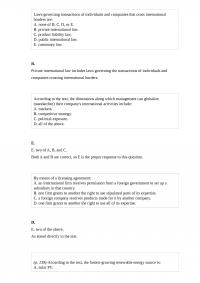
Laws governing transactions of individuals and companies that cross international borders are: A. none of B, C, D, or E. B. private international law. C. product liability law. D. public international law. E. customary law. According to the text, the […]

ECO 48201
College students may make good interviewers for firms doing market research in foreign countries. Once in export markets, new exporters tend to maintain their focus on them, despite what is happening in the home market. FALSE As stated directly in […]
ECO 54227
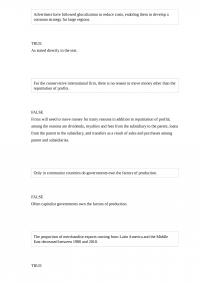
Advertisers have followed glocalization to reduce costs, enabling them to develop a common strategy for large regions. For the conservative international firm, there is no reason to move money other than the repatriation of profits. FALSE Firms will need to […]
ECO 60360
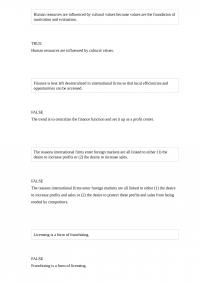
Human resources are influenced by cultural values because values are the foundation of motivation and evaluation. Finance is best left decentralized in international firms so that local efficiencies and opportunities can be accessed. FALSE The trend is to centralize the […]
ECO 76062
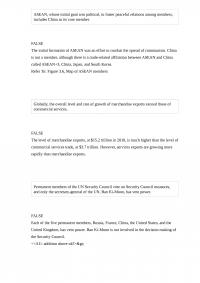
ASEAN, whose initial goal was political, to foster peaceful relations among members, includes China as its core member. Globally, the overall level and rate of growth of merchandise exports exceed those of commercial services. FALSE The level of merchandise exports, […]
ECON 21439
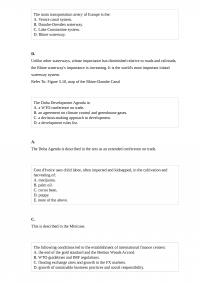
The main transportation artery of Europe is the: A. Venice canal system. B. Danube-Dresden waterway. C. Lake Constantine system. D. Rhine waterway. The Doha Development Agenda is: A. a WTO conference on trade. B. an agreement on climate control and […]
ECON 27236
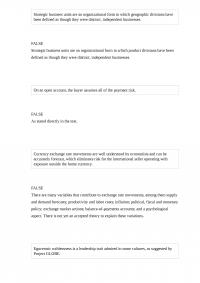
Strategic business units are an organizational form in which geographic divisions have been defined as though they were distinct, independent businesses. On an open account, the buyer assumes all of the payment risk. FALSE As stated directly in the text. […]
ECON 39732
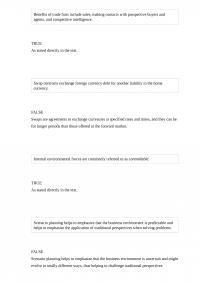
Benefits of trade fairs include sales, making contacts with prospective buyers and agents, and competitive intelligence. Swap contracts exchange foreign currency debt for another liability in the home currency. FALSE Swaps are agreements to exchange currencies at specified rates and […]
ECON 56079
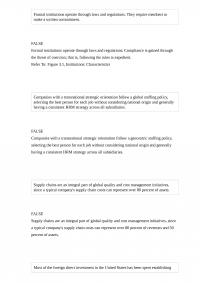
Formal institutions operate through laws and regulations. They require members to make a written commitment. Companies with a transnational strategic orientation follow a global staffing policy, selecting the best person for each job without considering national origin and generally having […]
ECON 65974
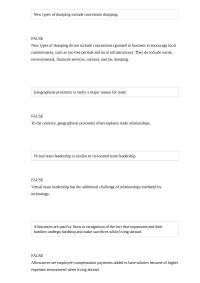
New types of dumping include concession dumping. Geographical proximity is rarely a major reason for trade. FALSE To the contrary, geographical proximity often explains trade relationships. Virtual team leadership is similar to co-located team leadership. FALSE Virtual team leadership has […]
ECON 89272
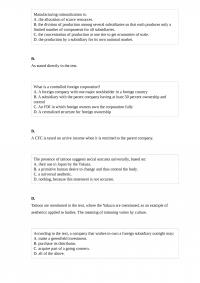
Manufacturing rationalization is: A. the allocation of scarce resources. B. the division of production among several subsidiaries so that each produces only a limited number of components for all subsidiaries. C. the concentration of production at one site to get […]
MGMT 20862
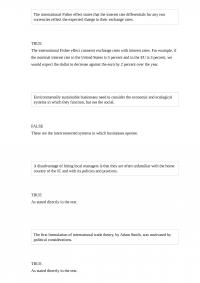
The international Fisher effect states that the interest rate differentials for any two currencies reflect the expected change in their exchange rates. Environmentally sustainable businesses need to consider the economic and ecological systems in which they function, but not the […]
MGMT 55444
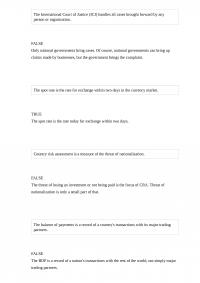
The International Court of Justice (ICJ) handles all cases brought forward by any person or organization. The spot rate is the rate for exchange within two days in the currency market. TRUE The spot rate is the rate today for […]
MGMT 72534
Trompenaars’ achievement vs. ascription dimension describes social status based on what one does or who one is. The United States is a culture in which people build who they are through work, so its social status tends to be based […]
MGMT 82630
There is a trend toward treating third-country nationals the same as home-country expatriates in terms of their compensation plans. The unspoken language cannot tell the international manager something that the spoken language does not. FALSE Nonverbal communication, if understood, can […]
MGMT 85109
Direct investment refers to overseas purchases of stocks and bonds to gain a return on the funds invested. For controls to be effective, all operating units of an IC must provide headquarters with timely, accurate, and complete reports, including those […]
MGMT 88911
Although India is a member of the WTO and has benefited greatly from increased trade as a result of WTO agreements, China is not yet a member. In the method favored by the majority of American ICs, the salary part […]
MGT 12385
The same general criteria for selecting home-country employees apply to host-country nationals. Multiplicity and interdependence are among the four dimensions of complexity identified by scholars. TRUE The other two are ambiguity and dynamism. FASB 52 requires that companies record foreign […]
MGT 17959
Strategic planning processes are something that only the company’s most senior executives are involved with. The United Kingdom Bribery Act includes penalties for corporate failure to prevent bribery, but only if the act of bribery occurred in the United Kingdom. […]

MGT 56787
Incoterms are established by the UN Commission on International Trade. International strategy involves decisions that deal with a single area, such as marketing or production. FALSE International strategy deals with all the various functions and activities of a company and […]
MGT 75343
Out of all the pricing methods mentioned, the preferred one for sellers is Ex-Works/factory door. Japanese cultural values suggest that in Japan, antitrust law against cartels would be strictly enforced. FALSE The zaibatsu, Japanese conglomerate, is hampered by antitrust legislation, […]