Archives
Finance Chapter 1 1 Which of the following statements best describes a relationship between sample size and other elements of auditing
Chapter 01 – An Introduction to Assurance and Financial Statement Auditing 1. Independence standards are required for audits of public companies, but not for audits of private companies. FALSE AACSB: Communication AICPA BB: Legal AICPA FN: Decision Making Blooms: Remember […]
Finance Chapter 1 2 On a high level, the accounting processes of a business consist of internal controls, individual transactions, and account balances
Chapter 01 – An Introduction to Assurance and Financial Statement Auditing 30. Preliminary engagement activities include A. Evaluating internal controls. B. Assessing audit risk at the account balance level. C. Setting materiality. D. Performing background checks on top management. AACSB: […]
Finance Chapter 10 1 Revenue is realized when a product or service is exchanged for cash or a promise to pay cash or other assets that can be converted into cash
Chapter 10 – Auditing the Revenue Process 1. Revenue is realized when a product or service is exchanged for cash or a promise to pay cash or other assets that can be converted into cash. TRUE AACSB: Analytic AICPA BB: […]
Finance Chapter 10 2 Which of the following procedures would ordinarily be expected to best reveal improper cutoff of sales at the balance sheet date
Chapter 10 – Auditing the Revenue Process 45. A CPA auditing an electric utility wishes to determine whether all customers are being billed. The CPA’s best direction of test is from the A. Meter department records to the billing (sales) […]
Finance Chapter 10 3 Customers having substantial year-end past due balances fail to reply after second request forms have been mailed directly to them
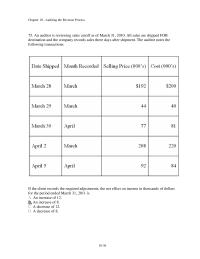
Chapter 10 – Auditing the Revenue Process 75. An auditor is reviewing sales cutoff as of March 31, 2010. All sales are shipped FOB destination and the company records sales three days after shipment. The auditor notes the following transactions: […]
Finance Chapter 11 1 Product costs should be matched directly with specific transactions and are recognized upon recognition of revenue
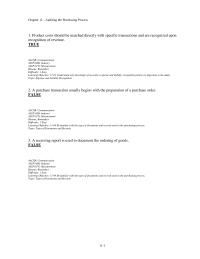
Chapter 11 – Auditing the Purchasing Process 1. Product costs should be matched directly with specific transactions and are recognized upon recognition of revenue. TRUE AACSB: Communication AICPA BB: Industry AICPA FN: Measurement Blooms: Remember Difficulty: 1 Easy Learning Objective: […]
Finance Chapter 11 2 Which of the following is a substantive procedure that an auditor most likely would perform to verify the existence of recorded accounts payable
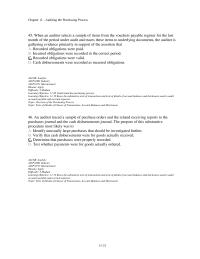
Chapter 11 – Auditing the Purchasing Process 45. When an auditor selects a sample of items from the vouchers payable register for the last month of the period under audit and traces these items to underlying documents, the auditor is […]
Finance Chapter 11 3 The key inherent risk factors an auditor must consider when auditing the purchasing process are industry factors.
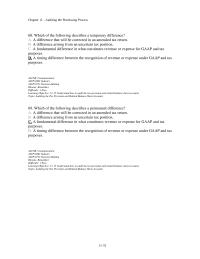
Chapter 11 – Auditing the Purchasing Process 68. Which of the following describes a temporary difference? A. A difference that will be corrected in an amended tax return. B. A difference arising from an uncertain tax position. C. A fundamental […]
Finance Chapter 12 1 There are few inherent risk factors that directly affect the human resource management process and its related accounts for non-officers.
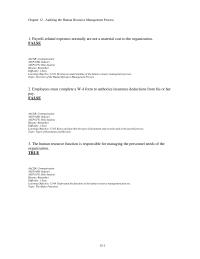
Chapter 12 – Auditing the Human Resource Management Process 1. Payroll-related expenses normally are not a material cost to the organization. FALSE AACSB: Communication AICPA BB: Industry AICPA FN: Risk Analysis Blooms: Remember Difficulty: 1 Easy Learning Objective: 12-01 Develop […]
Finance Chapter 12 2 Which of the following is a control activity that most likely could help prevent employee payroll fraud
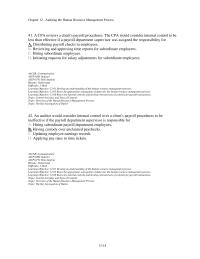
Chapter 12 – Auditing the Human Resource Management Process 12–18 41. A CPA reviews a client’s payroll procedures. The CPA would consider internal control to be less than effective if a payroll department supervisor was assigned the responsibility for AACSB: […]
Finance Chapter 13 1 The major control procedure for preventing fictitious inventory transactions from being recorded is proper segregation of duties.
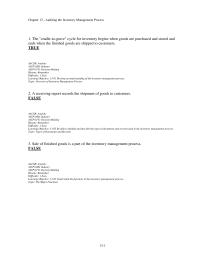
Chapter 13 – Auditing the Inventory Management Process 1. The “cradle-to-grave” cycle for inventory begins when goods are purchased and stored and ends when the finished goods are shipped to customers. TRUE AACSB: Analytic AICPA BB: Industry AICPA FN: Decision […]
Finance Chapter 13 2 Which of the following control activities would most likely be used to maintain accurate perpetual inventory records
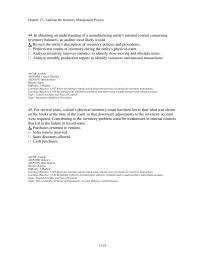
Chapter 13 – Auditing the Inventory Management Process 44. In obtaining an understanding of a manufacturing entity’s internal control concerning inventory balances, an auditor most likely would A. Review the entity’s description of inventory policies and procedures. B. Perform test […]
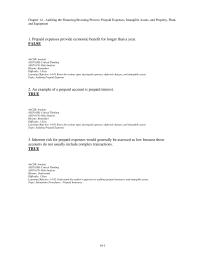
Finance Chapter 14 1 The purchase of capital assets should be consistent with the authorization table used by the client to approve such transactions
Chapter 14 – Auditing the Financing/Investing Process: Prepaid Expenses, Intangible Assets, and Property, Plant, and Equipment 1. Prepaid expenses provide economic benefit for longer than a year. FALSE AACSB: Analytic AICPA BB: Critical Thinking AICPA FN: Risk Analysis Blooms: Remember […]
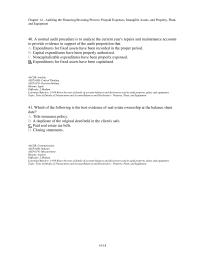
Finance Chapter 14 2 Which of the following audit procedures would be least likely to lead the auditor to find unrecorded fixed asset disposals
Chapter 14 – Auditing the Financing/Investing Process: Prepaid Expenses, Intangible Assets, and Property, Plant, and Equipment 40. A normal audit procedure is to analyze the current year’s repairs and maintenance accounts to provide evidence in support of the audit proposition […]
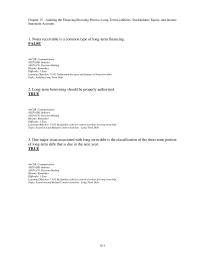
Finance Chapter 15 1 One major issue associated with long-term debt is the classification of the short-term portion of long-term debt that is due in the next year
Chapter 15 – Auditing the Financing/Investing Process: Long-Term Liabilities, Stockholders’ Equity, and Income Statement Accounts 1. Notes receivable is a common type of long-term financing. FALSE AACSB: Communication AICPA BB: Industry AICPA FN: Decision Making Blooms: Remember Difficulty: 1 Easy […]
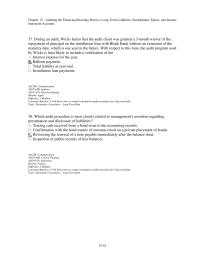
Finance Chapter 15 2 Which audit procedure is most closely related to management’s assertion regarding presentation and disclosure of liabilities
Chapter 15 – Auditing the Financing/Investing Process: Long-Term Liabilities, Stockholders’ Equity, and Income Statement Accounts 37. During an audit, Wicks learns that the audit client was granted a 3-month waiver of the repayment of principal on the installment loan with […]
Finance Chapter 16 1 A cutoff bank statement is used to verify the propriety of the reconciling items shown on the bank reconciliation
Chapter 16 – Auditing the Financing/Investing Process: Cash and Investments 1. The cash account is affected by all of the entity’s business processes. TRUE AACSB: Communication AICPA BB: Industry AICPA FN: Risk Analysis Blooms: Remember Difficulty: 1 Easy Learning Objective: […]
Finance Chapter 16 2 The auditor should insist that a representative of the client be present during the physical examination of securities in order to
Chapter 16 – Auditing the Financing/Investing Process: Cash and Investments 42. The auditor should insist that a representative of the client be present during the physical examination of securities in order to A. Lend authority to the auditor’s directives. B. […]
Finance Chapter 17 1 The auditor must perform final analytical procedures before deciding on the appropriate audit report to issue for the entity
Chapter 17 – Completing the Audit Engagement 1. Every contingent liability must be recorded. FALSE AACSB: Communication AICPA BB: Critical Thinking AICPA FN: Decision Making Blooms: Remember Difficulty: 1 Easy Learning Objective: 17-01 Be able to explain the audit issues […]
Finance Chapter 17 2 Which of the following ratios is least likely to assist the auditor in determining whether the client is experiencing financial difficulties
Chapter 17 – Completing the Audit Engagement 44. Which of the following ratios is least likely to assist the auditor in determining whether the client is experiencing financial difficulties? A. Net worth/total liabilities. B. Cash/total assets. C. Total liabilities/total assets. […]
Finance Chapter 17 3 For which of the following matters should an auditor obtain written management representations
Chapter 17 – Completing the Audit Engagement 66. For which of the following matters should an auditor obtain written management representations? A. Management’s cost-benefit justifications for not correcting internal control weaknesses. B. Management’s knowledge of future plans that may affect […]
Finance Chapter 18 1 A going concern issue requires a modification of the wording to the three-paragraph standard unqualified audit report
Chapter 18 – Reports on Audited Financial Statements 1. A going concern issue requires a modification of the wording to the three-paragraph standard unqualified audit report (public company). TRUE AACSB: Communication AICPA BB: Industry AICPA FN: Reporting Blooms: Remember Difficulty: […]
Finance Chapter 18 2 When reporting on comparative financial statements where the financial statements of the prior year have been examined by a predecessor
Chapter 18 – Reports on Audited Financial Statements 45. If a public company issues financial statements that purport to present its financial position and results of operations but omits the statement of cash flows, the auditor ordinarily will express a(an) […]
Finance Chapter 19 1 An indirect financial interest is defined as a financial interest that is owned or is under the control of an individual or entity
Chapter 19 – Professional Conduct, Independence, and Quality Control 1. The term “ethics” refers to a person’s propensity to follow the laws of the land. FALSE AACSB: Ethics AICPA BB: Critical Thinking AICPA FN: Decision Making Blooms: Remember Difficulty: 1 […]
Finance Chapter 19 2 In order to achieve effective quality control, a firm of independent auditors should establish policies and procedures for
Chapter 19 – Professional Conduct, Independence, and Quality Control 43. According to the ethical standards of the profession, which of the following acts is generally prohibited? A. Issuing a modified report explaining a failure to follow a governmental regulatory agency’s […]
Finance Chapter 2 1 What organization is responsible for setting auditing standards for audits of publicly-traded companies in the U.S
Chapter 02 – The Financial Statement Auditing Environment 1. A series of business and related auditing failures led to the passage of the Sarbanes-Oxley Act (2002). TRUE AACSB: Communication AICPA BB: Legal AICPA FN: Measurement Blooms: Remember Difficulty: 1 Easy […]
Finance Chapter 2 2 The fourth PCAOB standard of reporting requires an auditor to render a report whenever an auditor’s name is associated with financial statements
Chapter 02 – The Financial Statement Auditing Environment 41. The objective of the second PCAOB Standard of Reporting is to provide assurance that A. There are no variations in the format and presentation of financial statements. B. Substantially different transactions […]
Finance Chapter 20 1 An auditor can be guilty under federal statutory law if s/he was reckless in performance of her/his professional duties
Chapter 20 – Legal Liability 1. Common law is written law enacted by the legislative branches of governments. FALSE AACSB: Communication AICPA BB: Legal AICPA FN: Decision Making Blooms: Remember Difficulty: 1 Easy Learning Objective: 20-02 Know the definitions of […]
Finance Chapter 20 2 Suits are often brought against auditors that allege that the auditors did not detect some type of fraud or defalcation
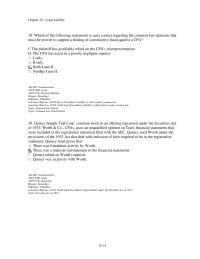
Chapter 20 – Legal Liability 38. Which of the following statements is (are) correct regarding the common law elements that must be proven to support a finding of constructive fraud against a CPA? I. The plaintiff has justifiably relied on […]
Finance Chapter 21 1 Assurance services are independent professional services that improve the quality of information specifically for internal decision makers.
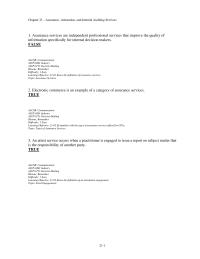
Chapter 21 – Assurance, Attestation, and Internal Auditing Services 1. Assurance services are independent professional services that improve the quality of information specifically for internal decision makers. FALSE AACSB: Communication AICPA BB: Industry AICPA FN: Decision Making Blooms: Remember Difficulty: […]
Finance Chapter 21 2 An accountant may accept an engagement to apply agreed-upon procedures to prospective financial statements provided that
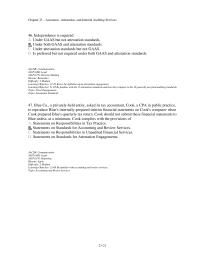
Chapter 21 – Assurance, Attestation, and Internal Auditing Services 46. Independence is required A. Under GAAS but not attestation standards. B. Under both GAAS and attestation standards. C. Under attestation standards but not GAAS. D. Is preferred but not required […]
Finance Chapter 21 3 76 According The Code Professional Conduct What Response Appropriate When Accountant Who
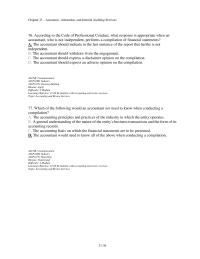
Chapter 21 – Assurance, Attestation, and Internal Auditing Services 21–36 76. According to the Code of Professional Conduct, what response is appropriate when an accountant, who is not independent, performs a compilation of financial statements? AACSB: Communication AICPA BB: Industry […]
Finance Chapter 3 1 The Code of Professional Conduct does not allow an auditor to disclose confidential client information without the client’s consent.
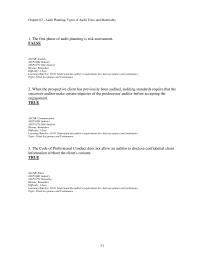
Chapter 03 – Audit Planning, Types of Audit Tests, and Materiality 1. The first phase of audit planning is risk assessment. FALSE AACSB: Analytic AICPA BB: Industry AICPA FN: Risk Analysis Blooms: Remember Difficulty: 1 Easy Learning Objective: 03-01 Understand […]
Finance Chapter 3 2 Which of the following would an auditor most likely use in determining the auditor’s planning materiality
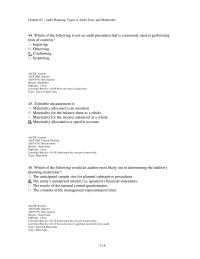
Chapter 03 – Audit Planning, Types of Audit Tests, and Materiality 44. Which of the following is not an audit procedure that is commonly used in performing tests of controls? A. Inquiring. B. Observing. C. Confirming. D. Inspecting. AACSB: Analytic […]
Finance Chapter 4 1 Audit risk is the auditor’s exposure to loss or injury of his or her reputation from events arising in connection with financial statements audited
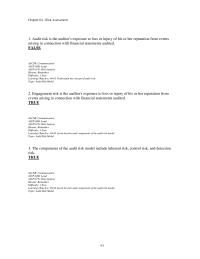
Chapter 04 – Risk Assessment 1. Audit risk is the auditor’s exposure to loss or injury of his or her reputation from events arising in connection with financial statements audited. FALSE AACSB: Communication AICPA BB: Legal AICPA FN: Risk Analysis […]
Finance Chapter 4 2 An auditor discovers a likely fraud during an audit but concludes that the overall effect of the fraud is not sufficiently material to affect the audit opinion
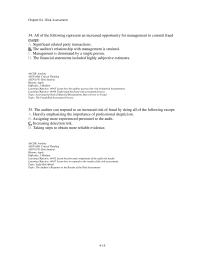
Chapter 04 – Risk Assessment 34. All of the following represent an increased opportunity for management to commit fraud except: A. Significant related party transactions. B. The auditor’s relationship with management is strained. C. Management is dominated by a single […]
Finance Chapter 5 1 Audit evidence includes only written information used by the auditor in arriving at an opinion about the fairness of financial statements
Chapter 05 – Evidence and Documentation 1. Audit evidence includes only written information used by the auditor in arriving at an opinion about the fairness of financial statements. FALSE AACSB: Analytic AICPA BB: Critical Thinking AICPA FN: Decision Making Blooms: […]
Finance Chapter 5 2 Which transaction assertion for transactions within the purchasing process are you most concerned with
Chapter 05 – Evidence and Documentation 50. Audit documentation A. Must be in electronic form. B. Must be in paper form only. C. Is not required, but is strongly recommended. D. May be in paper, electronic, or some other form. […]
Finance Chapter 5 3 Which of the following tends to be most predictable for purposes of analytical procedures applied as substantive procedures
Chapter 05 – Evidence and Documentation 75. Which of the following tends to be most predictable for purposes of analytical procedures applied as substantive procedures? A. Relationships involving balance sheet accounts. B. Transactions subject to management discretion. C. Relationships involving […]
Finance Chapter 6 1 Which of the following most likely would not be considered an inherent limitation of the potential effectiveness of an entity’s internal controls
Chapter 06 – Internal Control in a Financial Statement Audit 1. The concept of internal control includes IT systems and manual systems. TRUE AACSB: Analytic AICPA BB: Industry AICPA FN: Risk Analysis Blooms: Remember Difficulty: 1 Easy Learning Objective: 06-04 […]
Finance Chapter 6 2 During consideration of internal control in a financial statement audit of a nonpublic company, an auditor is not obligated to
Chapter 06 – Internal Control in a Financial Statement Audit 50. A substantive strategy differs from a reliance strategy in that a substantive strategy includes A. Increased implementation of detailed tests of transactions and balances. B. Extra tests of controls. […]
Finance Chapter 6 3 After the auditor has prepared a flowchart of the internal controls surrounding sales and evaluated the design of the system
Chapter 06 – Internal Control in a Financial Statement Audit 81. Which of the following is a general control that would most likely assist an entity whose systems analyst left the entity in the middle of a major project? A. […]
Finance Chapter 7 1 In a public company, management’s report on internal control must be signed by the members of the audit committee
Chapter 07 – Auditing Internal Control over Financial Reporting 1. All companies must follow the guidelines of AS5. FALSE AACSB: Communication AICPA BB: Industry AICPA FN: Decision Making Blooms: Remember Difficulty: 1 Easy Learning Objective: 07-01 Understand management’s responsibilities for […]
Finance Chapter 7 2 When testing a computerized accounting system, which of the following is false regarding the test data approach
Chapter 07 – Auditing Internal Control over Financial Reporting 42. Which of the following statements included in management’s assessment of the effectiveness of internal control over financial reporting would be considered acceptable for issuing an unqualified opinion? A. Nothing has […]
Finance Chapter 8 1 Attribute sampling is used to estimate the proportion of a population that possesses a specified characteristic
Chapter 08 – Audit Sampling: An Overview and Application to Tests of Controls 1. Auditing standards permit both statistical and nonstatistical methods of audit sampling. TRUE AACSB: Analytic AICPA BB: Critical Thinking AICPA FN: Risk Analysis Blooms: Remember Difficulty: 1 […]
Finance Chapter 8 2 Auditors who prefer statistical sampling to non statistical sampling may do so because statistical sampling helps the auditor
Chapter 08 – Audit Sampling: An Overview and Application to Tests of Controls 38. Which of the following best describes the distinguishing feature of statistical sampling? A. It requires the examination of a smaller number of supporting documents. B. It […]
Finance Chapter 9 1 The size of the upper limit on misstatement is largely dependent on the sample size, which is inversely related to the desired confidence level
Chapter 09 – Audit Sampling: An Application to Substantive Tests of Account Balances 1. The purpose of audit sampling is to draw inferences about the entire population from the results of a sample. TRUE AACSB: Analytic AICPA BB: Critical Thinking […]
Finance Chapter 9 2 Which of the following most likely would be an advantage in using classical variables sampling rather than monetary-unit sampling
Chapter 09 – Audit Sampling: An Application to Substantive Tests of Account Balances 34. If the upper limit on misstatements exceeds tolerable misstatement, the auditor is least likely to A. Increase sample size. B. Conduct other substantive procedures. C. Adjust […]