Chapter 05 – Evidence and Documentation
50. Audit documentation
51. Based on conversations with the owner-manager of an audit client, the auditor ascertained
that the company’s primary motivation is to avoid paying income taxes. Based on this
motivation, which account balance assertion for ending inventory will the auditor be most
concerned about verifying?
Chapter 05 – Evidence and Documentation
52. Your audit client is under intense pressure to meet an earnings target. Which transaction
assertion for transactions within the purchasing process are you most concerned with?
53. You are concerned with unrecorded transactions in the purchasing cycle. Which audit
procedure are you most likely to use when auditing purchases?
Chapter 05 – Evidence and Documentation
54. The following statements were made in a discussion of audit evidence between two CPAs.
Which statement is not valid concerning audit evidence?
55. Which of the following statements concerning audit evidence is correct?
Chapter 05 – Evidence and Documentation
56. The permanent audit file usually includes
57. The current audit file usually includes
Topic: Audit Documentation
58. All audit documentation should have a heading, which includes
Chapter 05 – Evidence and Documentation
59. The audit working papers belong to
60. Which of the following are ordinarily designed to detect possible material monetary errors
in the financial statements?
61. An auditor’s decision either to apply analytical procedures as substantive procedures or to
perform tests of transactions and account balances usually is determined by
Chapter 05 – Evidence and Documentation
62. A company sells a particular product only in the last month of its fiscal year. The company
uses commission agents for such sales and pays them 6% of their net sales 30 days after the
sales are made. The agents’ sales were $10 million. Experience indicates that 10% of the sales
are usually not collected and 2% are returned in the first month of the new year. The auditor
would expect the year-end balance in the accrued commissions payable account to be
63. Which of the following nonfinancial information would an auditor most likely consider in
performing analytical procedures during the planning phase of an audit?
Chapter 05 – Evidence and Documentation
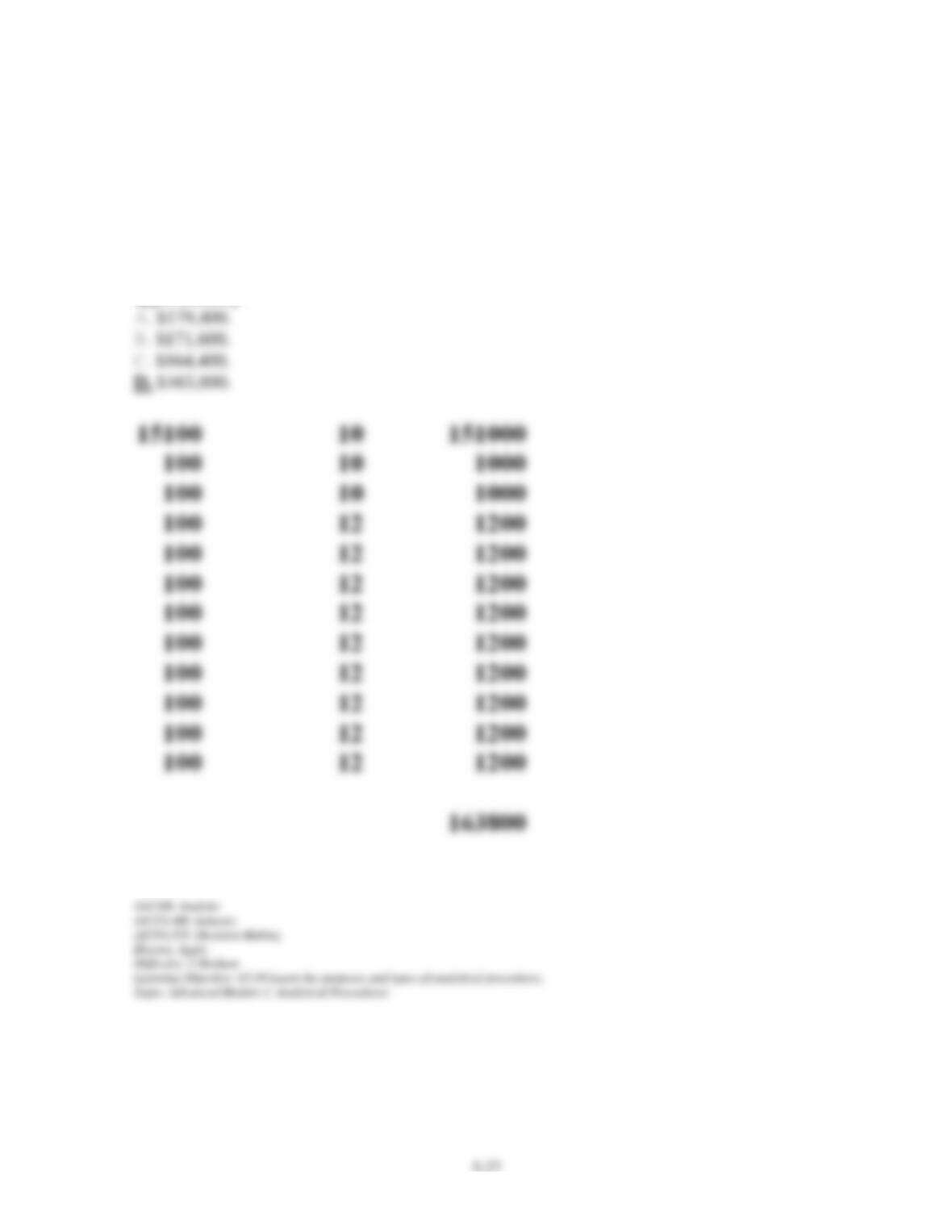
64. A not-for-profit organization published a monthly magazine that had 15,000 subscribers on
January 1, 2011. The number of subscribers increased steadily throughout the year and at
December 31, 2011, there were 16,200 subscribers. The annual magazine subscription cost was
$10 on January 1, 2011 and was increased to $12 for new members on April 1, 2011.
Subscriptions are paid in full at the beginning of the member term. An auditor should expect
that the revenue from subscriptions for the year ended December 31, 2011, would be
Chapter 05 – Evidence and Documentation
65. Analytical procedures performed in the overall review stage of an audit suggest that several
accounts have unexpected relationships. The results of these procedures most likely would
indicate that
66. Which of the following is not a typical analytical procedure?
Chapter 05 – Evidence and Documentation
67. Analytical procedures may be classified as being primarily which of the following?
68. An abnormal fluctuation in gross profit that might suggest the need for extended audit
procedures for sales and inventories would most likely be identified in the planning phase of the
audit by the use of
Chapter 05 – Evidence and Documentation
69. An example of an analytical procedure is the comparison of
70. Analytical procedures used in planning an audit should focus on identifying
Chapter 05 – Evidence and Documentation
71. Analytical procedures are
72. As a result of analytical procedures conducted during the planning phase, the independent
auditor determines that the gross profit percentage has declined from 30% in the preceding year
to 20% in the current year. The auditor should
Chapter 05 – Evidence and Documentation
73. The auditor generally gives most emphasis to ratio and trend analysis in the examination of
the
74. The auditor notices significant fluctuations in key elements of the company’s financial
statements. If management is unable to provide an acceptable explanation, the auditor should