Chapter 04 – Risk Assessment
34. All of the following represent an increased opportunity for management to commit fraud
except:
35. The auditor can respond to an increased risk of fraud by doing all of the following except:
Chapter 04 – Risk Assessment
36. An auditor discovers a likely fraud during an audit but concludes that the overall effect of
the fraud is not sufficiently material to affect the audit opinion. The auditor should probably
37. The acceptable level of detection risk is inversely related to the
Chapter 04 – Risk Assessment
38. As the acceptable level of detection risk decreases, an auditor may change the
39. As the acceptable level of detection risk decreases, the assurance directly provided from
Chapter 04 – Risk Assessment
40. Increased fraud risk could also result in all of the following except:
41. The objectives of the engagement partner’s communication with the audit team include
42. The auditor is most likely to presume that a high risk of a fraud exists if
Chapter 04 – Risk Assessment
43. Which of the following factors most likely would heighten an auditor’s concern about the
risk of fraudulent financial reporting?
44. A properly planned and performed audit may fail to detect a material misstatement resulting
from fraud because
Chapter 04 – Risk Assessment
45. Which of the following is correct concerning required auditor communications about
fraud?
Chapter 04 – Risk Assessment
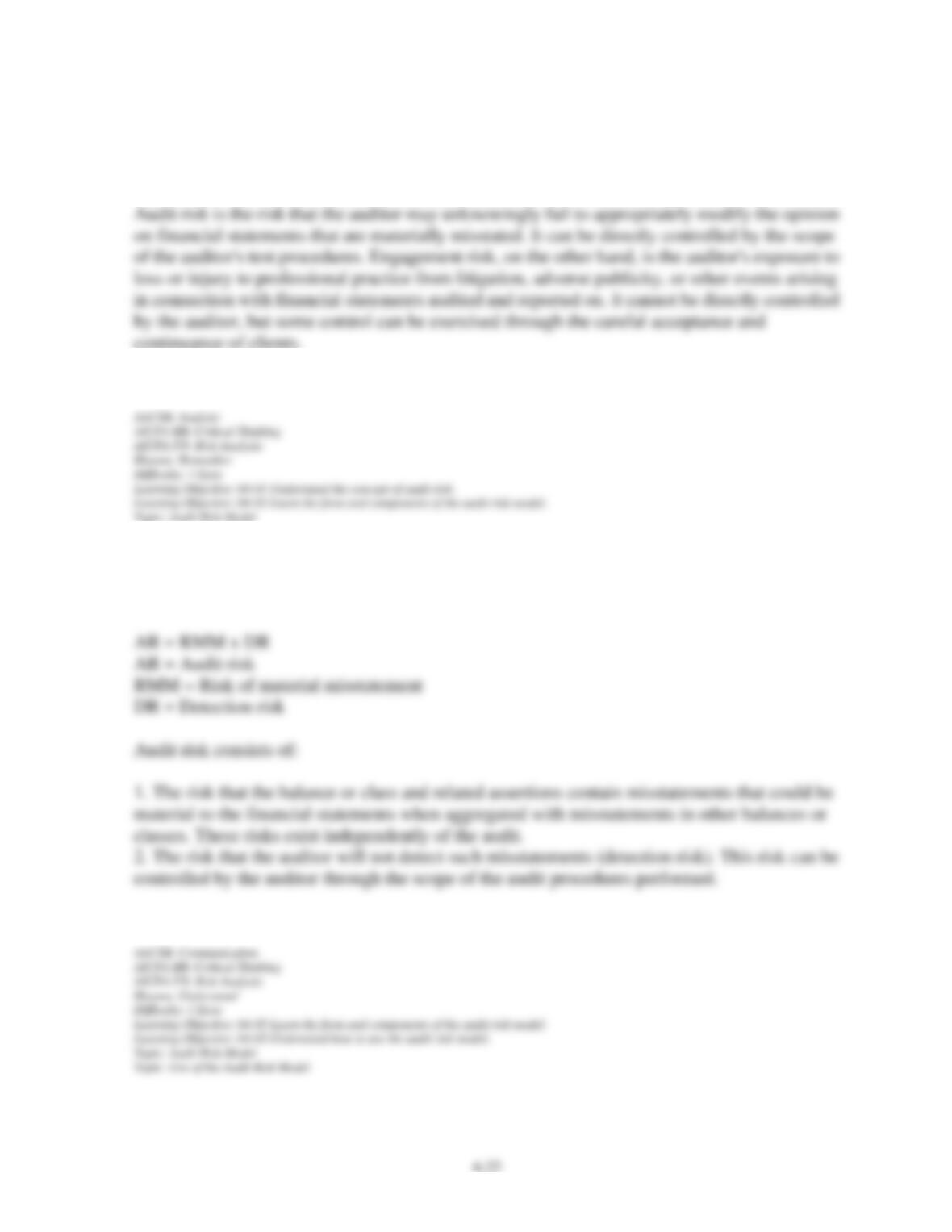
46. Using the audit risk model, identify the relationship between the following elements. For
each of the items below, highlight whether the two elements have an inverse relationship, a
direct relationship, or no relationship. When considering each item, assume that the other
components of the risk model remain constant.
Chapter 04 – Risk Assessment
47. What is the difference between audit risk and engagement risk?
48. You are teaching a class of new hires at your international accounting firm. Explain the
audit risk model using a mathematical formula.
Chapter 04 – Risk Assessment
49. Stacey, the partner in charge of the audit of RIF Enterprises, sets the planned level of audit
risk for the audit of accounts payable at .06. The risk of material misstatement is assessed at .65.
What is the detection risk for this audit?
50. Your classmate asserts, “Accountants shouldn’t need to take business courses besides
accounting, because they are only interested in the financial statements of a company.” Defend
or refute this statement.
Chapter 04 – Risk Assessment
51. You are the senior on an audit of Two Be Gone, a large public company. The company
recently completed an acquisition of its fifth largest competitor. What risks might this present?
How will you, the auditor, respond to these risks (i.e. what actions should you take)?
52. Define misstatements arising from fraudulent financial reporting and misstatements arising
from misappropriation of assets in one sentence each.
Chapter 04 – Risk Assessment
53. DATRIX, Inc., a Fortune 500 company, has been experiencing poor performance. Industry
analysts have been issuing negative reports and the company’s stock price has been steadily
declining. As an auditor, what would concern you about the audit engagement of DATRIX,
Inc.
Chapter 04 – Risk Assessment
54. During the course of the audit of FF Financial, you find that some accounting entries have
been altered. You believe this may be the result of management fraud and you have determined
that the effect of this could be material to the financial statements. What steps should you take
in response to the accounting entries and your concern about management fraud?
Chapter 04 – Risk Assessment
55. Assume that you are the new audit senior on the LV Drug Corporation (LVD) engagement.
LVD is a pharmaceutical company that has three successful drugs and a number of drugs in
progress in its research and development pipeline. You are considering your audit plan and it is
important to identify the inherent risks that LVD has and how they relate to the planning
process.
Required:
For each of the following factors, indicate whether it will tend to increase, decrease, or have no
effect on inherent risk, and the reasoning for your answer.