Chapter 09 – Audit Sampling: An Application to Substantive Tests of Account Balances
34. If the upper limit on misstatements exceeds tolerable misstatement, the auditor is least
likely to
35. Which of the following most likely would be an advantage in using classical variables
sampling rather than monetary-unit sampling?
Chapter 09 – Audit Sampling: An Application to Substantive Tests of Account Balances
36. The assurance factor for nonstatistical sampling is based on
37. The formula for nonstatistical sampling for tests of account balances provided by the
AICPA
38. The use of the ratio projection is most effective when
Chapter 09 – Audit Sampling: An Application to Substantive Tests of Account Balances
39. Which one of the following statements is true regarding two random samples, drawn in the
40. The accounting department reports that the balance of accounts receivable is $210,000. You
are willing to accept that balance if audit sampling suggests it is within $15,000 of the actual
balance. Using a classical variables sampling plan, you compute a 95% confidence interval of
$208,000 to $225,000. You would therefore
Chapter 09 – Audit Sampling: An Application to Substantive Tests of Account Balances
41. In a monetary-unit sample with a sampling interval of $10,000, an auditor discovered that a
selected account receivable with a recorded amount of $5,000 had an audit amount of $2,000.
The projected misstatement of this sample was
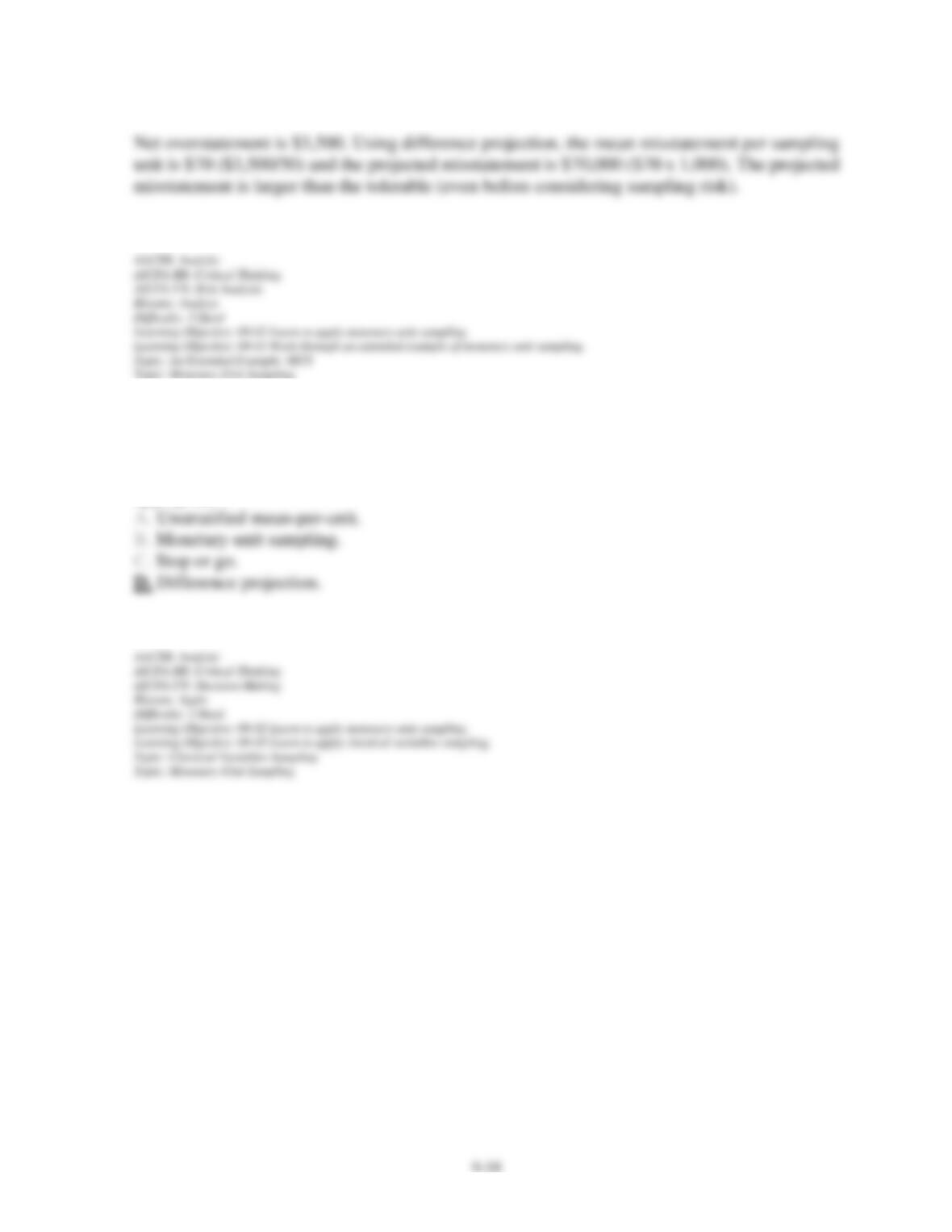
42. An auditor established a $60,000 tolerable misstatement for an account balance of
$1,000,000. The auditor selected a sample of every twentieth item from the population of 1,000
items that represented the asset account balance and discovered overstatements of $3,700 and
understatements of $200. Under these circumstances, the auditor most likely would conclude
that
Chapter 09 – Audit Sampling: An Application to Substantive Tests of Account Balances
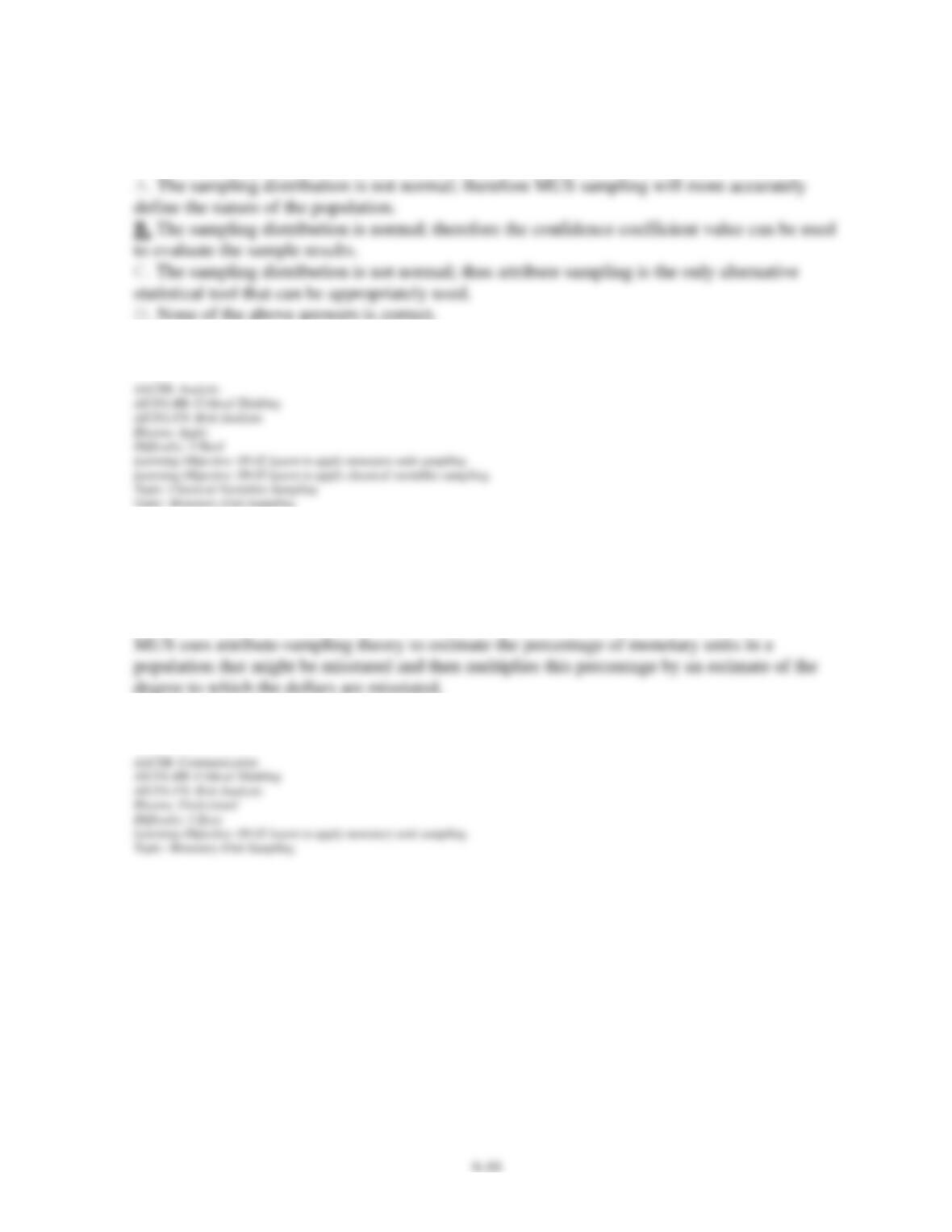
43. An auditor is performing substantive procedures of pricing and extension of perpetual
inventory balances consisting of a large number of items. Past experience indicates numerous
pricing and extension errors. Which of the following statistical sampling approaches is most
appropriate?
Chapter 09 – Audit Sampling: An Application to Substantive Tests of Account Balances
44. An auditor has taken a large sample from an audit population that is skewed in the sense that
it contains a large number of small dollar balances. The auditor can conclude
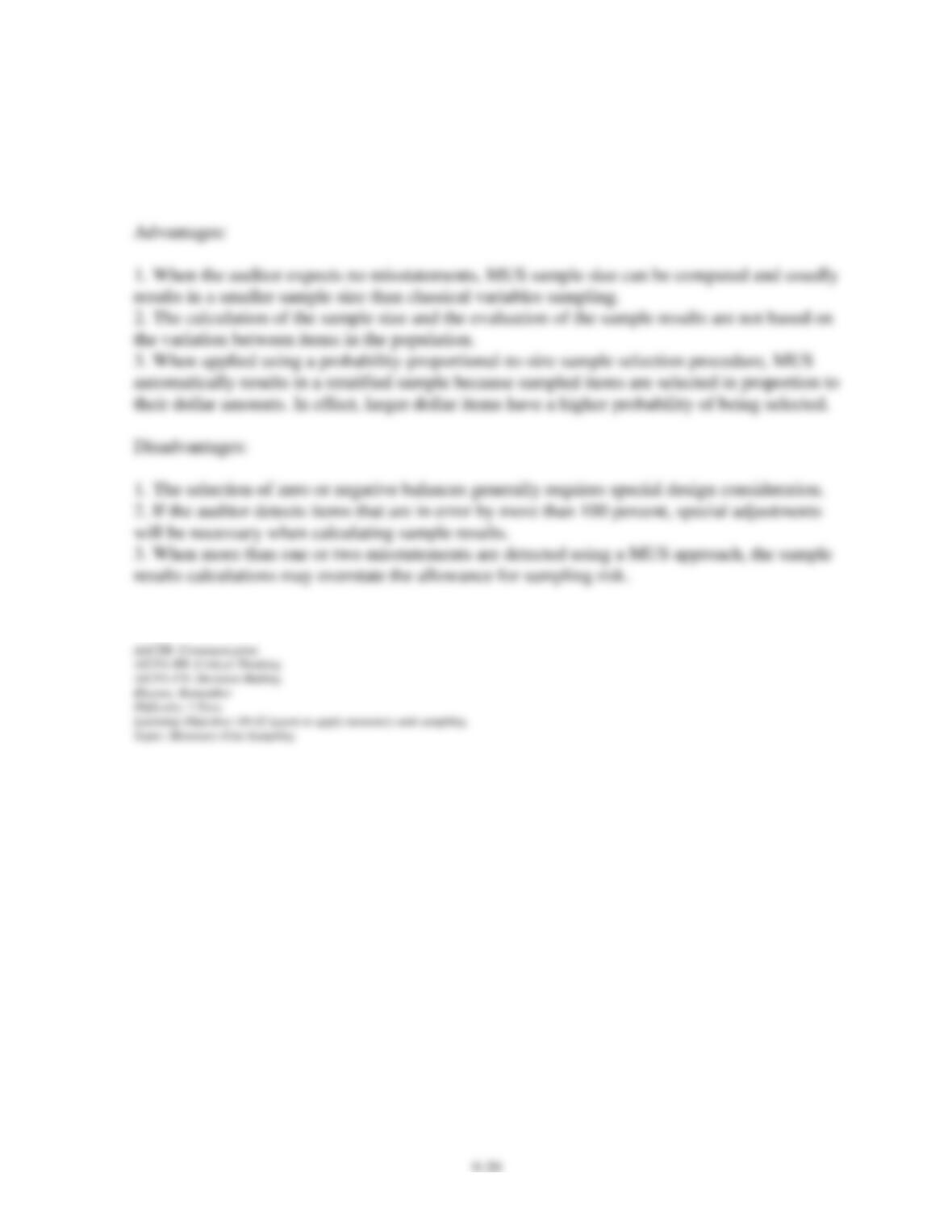
45. Summarize the concept behind monetary-unit sampling (MUS). How does MUS use
attribute-sampling theory?
Chapter 09 – Audit Sampling: An Application to Substantive Tests of Account Balances
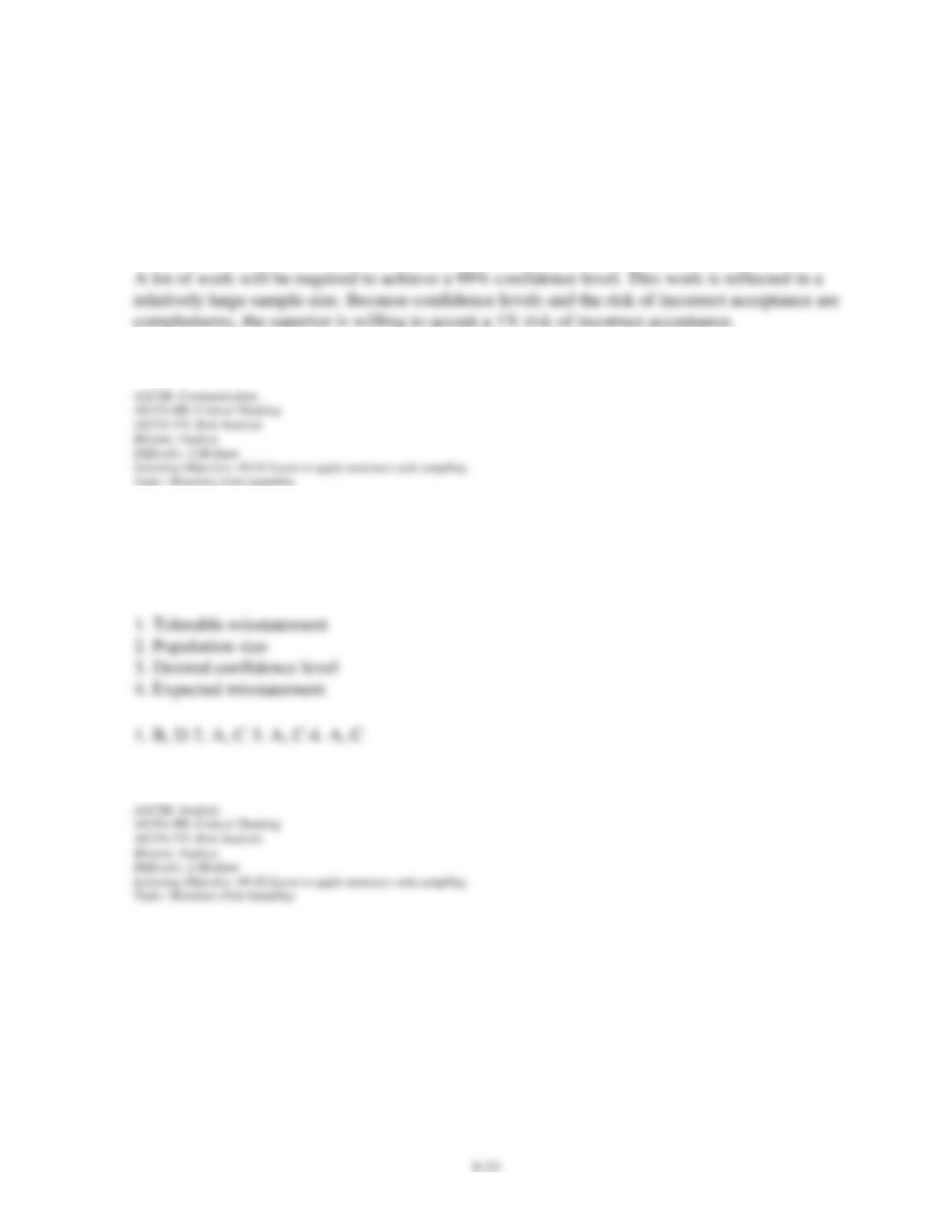
46. Describe two advantages and two disadvantages of monetary-use sampling (MUS).
Should include two advantages and disadvantages from the following:
Chapter 09 – Audit Sampling: An Application to Substantive Tests of Account Balances
47. You have been placed in charge of determining the sample size for an audit of accounts
receivable. Your superior would like a confidence level of 99%. How does this affect your
determination of sample size? What can you infer about the level of risk of incorrect acceptance
that your superior is willing to accept?
48. Match each factor of sample size to (1) its relationship to sample size (A-Direct or
B-Inverse) and (2) the appropriate effect on the sample size if the factor increases (C-Increase
or D-Decrease).
Chapter 09 – Audit Sampling: An Application to Substantive Tests of Account Balances
49. Whenever a statistical method is used, a decision rule determines whether the population is
acceptable. The decision rule for monetary-unit sampling is “Accept the conclusion that the
book value is not misstated by a material amount if _________________________.”
50. In nonstatistical sampling, describe the two methods auditors use to project sample results
to the population. How does an auditor determine which method to use?
Chapter 09 – Audit Sampling: An Application to Substantive Tests of Account Balances
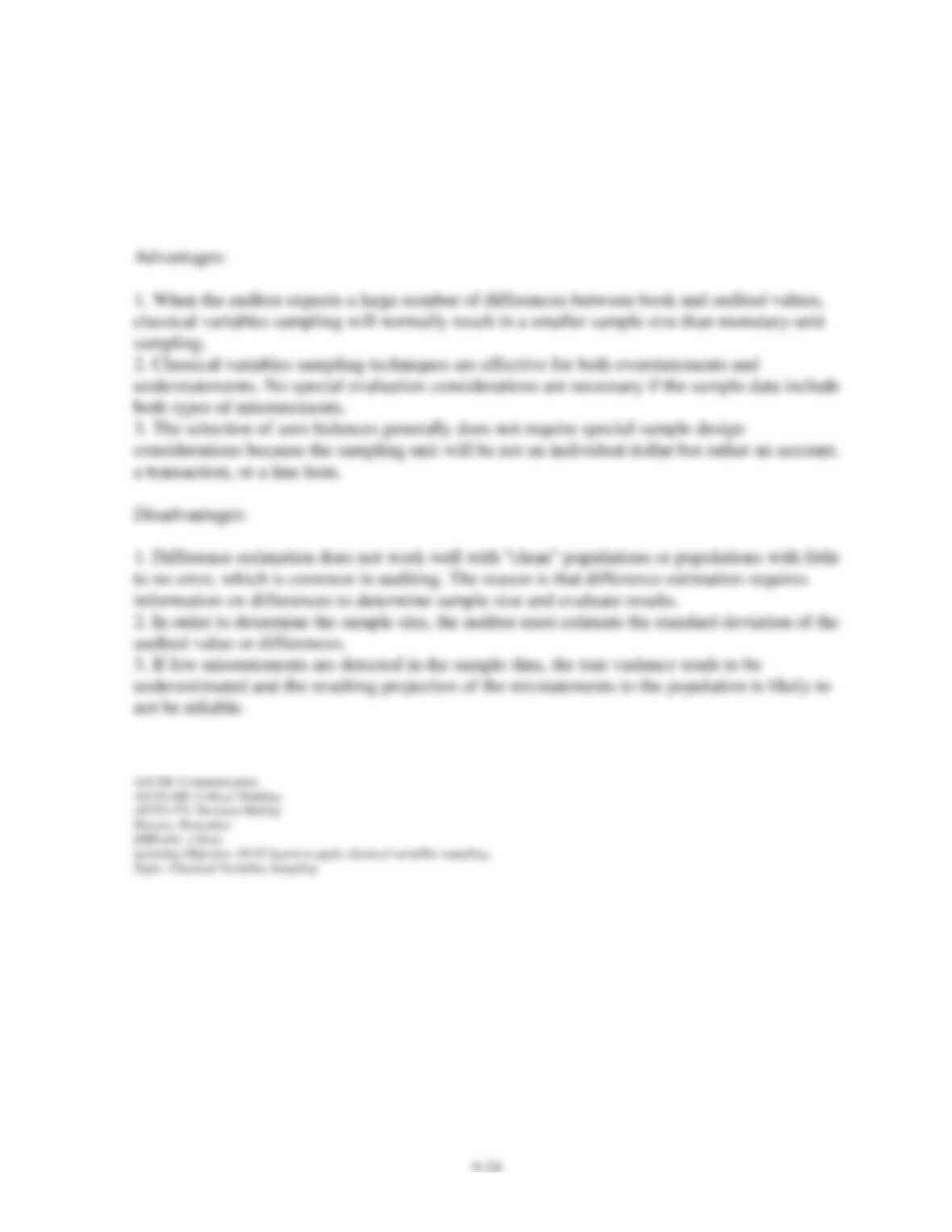
51. You are auditing accounts receivable for a small company and have found the following
results:
Chapter 09 – Audit Sampling: An Application to Substantive Tests of Account Balances
52. What is one advantage and one disadvantage of classical variables sampling?
Should include one advantage and disadvantage from the following:
Chapter 09 – Audit Sampling: An Application to Substantive Tests of Account Balances
53. When auditing accounts payable using classical variables sampling, Sue finds evidence
indicating that the account may be materially misstated. What are Sue’s options?
54. Matching
the total of the projected misstatement plus the
3. MUS Upper
the account or transaction that contains the selected
the difference between monetary amounts in the
client’s records and amounts supported by audit