Chapter 14 – Auditing the Financing/Investing Process: Prepaid Expenses, Intangible Assets, and Property, Plant,
and Equipment
1. Prepaid expenses provide economic benefit for longer than a year.
2. An example of a prepaid account is prepaid interest.
3. Inherent risk for prepaid expenses would generally be assessed as low because these
accounts do not usually include complex transactions.
Chapter 14 – Auditing the Financing/Investing Process: Prepaid Expenses, Intangible Assets, and Property, Plant,
and Equipment
4. Substantive analytical procedures are commonly used to test prepaid accounts.
5. Disposition of capital assets through sale, exchange, retirement, or abandonment are
transactions that occur in the property management process.
6. If the auditor has detected misstatements in prior audits, the assessment of inherent risk for
the property management process will usually be set higher.
Chapter 14 – Auditing the Financing/Investing Process: Prepaid Expenses, Intangible Assets, and Property, Plant,
and Equipment
7. The property, plant, and equipment records function should be segregated from the custodial
function.
8. Substantive analytical procedures should not be used in the audit of property, plant, and
equipment.
9. Reviewing capital budgets and comparing the amounts spent with amounts budgeted is an
example of a substantive analytical procedure for auditing prepaid accounts.
Chapter 14 – Auditing the Financing/Investing Process: Prepaid Expenses, Intangible Assets, and Property, Plant,
and Equipment
10. Inquiry of client personnel and a review of lease transactions for the same period can
provide evidence on proper cutoff for capital leases.
11. The purchase of capital assets should be consistent with the authorization table used by the
client to approve such transactions. However, no such table is normally used for lease
transactions.
12. If a periodic physical inventory of property, plant, and equipment is taken, the individual
responsible for the inventory should be independent of the custodial and record-keeping
functions.
Chapter 14 – Auditing the Financing/Investing Process: Prepaid Expenses, Intangible Assets, and Property, Plant,
and Equipment
13. If an entity has few capital asset purchases, it will generally not have a formal control
system over such transactions.
14. Generally, auditors rely on controls when auditing the property management function and
therefore less substantive testing is used.
15. Assets no longer used in operations are accounted for in essentially the same manner as
those used in operations.
Chapter 14 – Auditing the Financing/Investing Process: Prepaid Expenses, Intangible Assets, and Property, Plant,
and Equipment
16. An auditor typically sets inherent risk for intangible assets at this level
17. Which of the following policies constitutes a control weakness related to the acquisition of
factory equipment?
Chapter 14 – Auditing the Financing/Investing Process: Prepaid Expenses, Intangible Assets, and Property, Plant,
and Equipment
18. Which of the following questions would an auditor least likely include on an internal
control questionnaire concerning the initiation and execution of equipment transactions?
19. The auditor is most likely to seek information from the plant manager with respect to the
Chapter 14 – Auditing the Financing/Investing Process: Prepaid Expenses, Intangible Assets, and Property, Plant,
and Equipment
20. In the examination of property, plant, and equipment, the auditor tries to determine all of the
following except the
21. The auditor may conclude that depreciation charges are insufficient by noting
Chapter 14 – Auditing the Financing/Investing Process: Prepaid Expenses, Intangible Assets, and Property, Plant,
and Equipment
22. The auditor is least likely to learn of retirement of equipment through which of the
following?
23. Which of the following accounts would most likely be reviewed by the auditor to gain
reasonable assurance that additions to property, plant, and equipment are not understated?
Chapter 14 – Auditing the Financing/Investing Process: Prepaid Expenses, Intangible Assets, and Property, Plant,
and Equipment
24. Which of the following accounts would most likely be reviewed by the auditor to gain
reasonable assurance that additions to the equipment account are not understated?
25. In auditing intangible assets, an auditor most likely would review or recompute
amortization and determine whether the amortization period is reasonable in support of
management’s financial statement assertion of
Chapter 14 – Auditing the Financing/Investing Process: Prepaid Expenses, Intangible Assets, and Property, Plant,
and Equipment
26. Testing depreciation calculations for a sample of property, plant, and equipment tests the
assertion of
27. In testing plant and equipment balances, an auditor examines new additions listed on an
analysis of plant and equipment. This procedure most likely obtains evidence concerning
management’s assertion of
Chapter 14 – Auditing the Financing/Investing Process: Prepaid Expenses, Intangible Assets, and Property, Plant,
and Equipment
28. The cutoff assertion for prepaid insurance
29. Recomputing the unexpired portion of insurance policies in effect tests which of the
following assertions are for prepaid insurance?
Chapter 14 – Auditing the Financing/Investing Process: Prepaid Expenses, Intangible Assets, and Property, Plant,
and Equipment
30. In verifying the amount of goodwill recorded by a client, the most convincing evidence that
an auditor can obtain is by comparing the recorded value of assets acquired with the
31. To achieve effective control over fixed asset additions, a company should establish
activities that require
Chapter 14 – Auditing the Financing/Investing Process: Prepaid Expenses, Intangible Assets, and Property, Plant,
and Equipment
32. Which of the following constitutes a control weakness related to factory equipment?
33. To improve accountability for fixed asset retirements, management most likely would
implement a system of internal control that includes
Chapter 14 – Auditing the Financing/Investing Process: Prepaid Expenses, Intangible Assets, and Property, Plant,
and Equipment
34. Complex accounting issues for property, plant, and equipment include all of the following
except
35. When there are numerous property and equipment transactions during the year, an auditor
planning to set control risk at the minimum level usually plans to obtain an understanding of
internal control and to perform
Chapter 14 – Auditing the Financing/Investing Process: Prepaid Expenses, Intangible Assets, and Property, Plant,
and Equipment
36. Equipment acquisitions that are misclassified as maintenance expenses most likely would
be detected by a control activity that provides for
37. Which of the following situations has the best chance of being detected when a CPA
compares revenues and expenses reported for the year being audited (current year) with the
prior year and investigates all changes exceeding a fixed percentage?
Chapter 14 – Auditing the Financing/Investing Process: Prepaid Expenses, Intangible Assets, and Property, Plant,
and Equipment
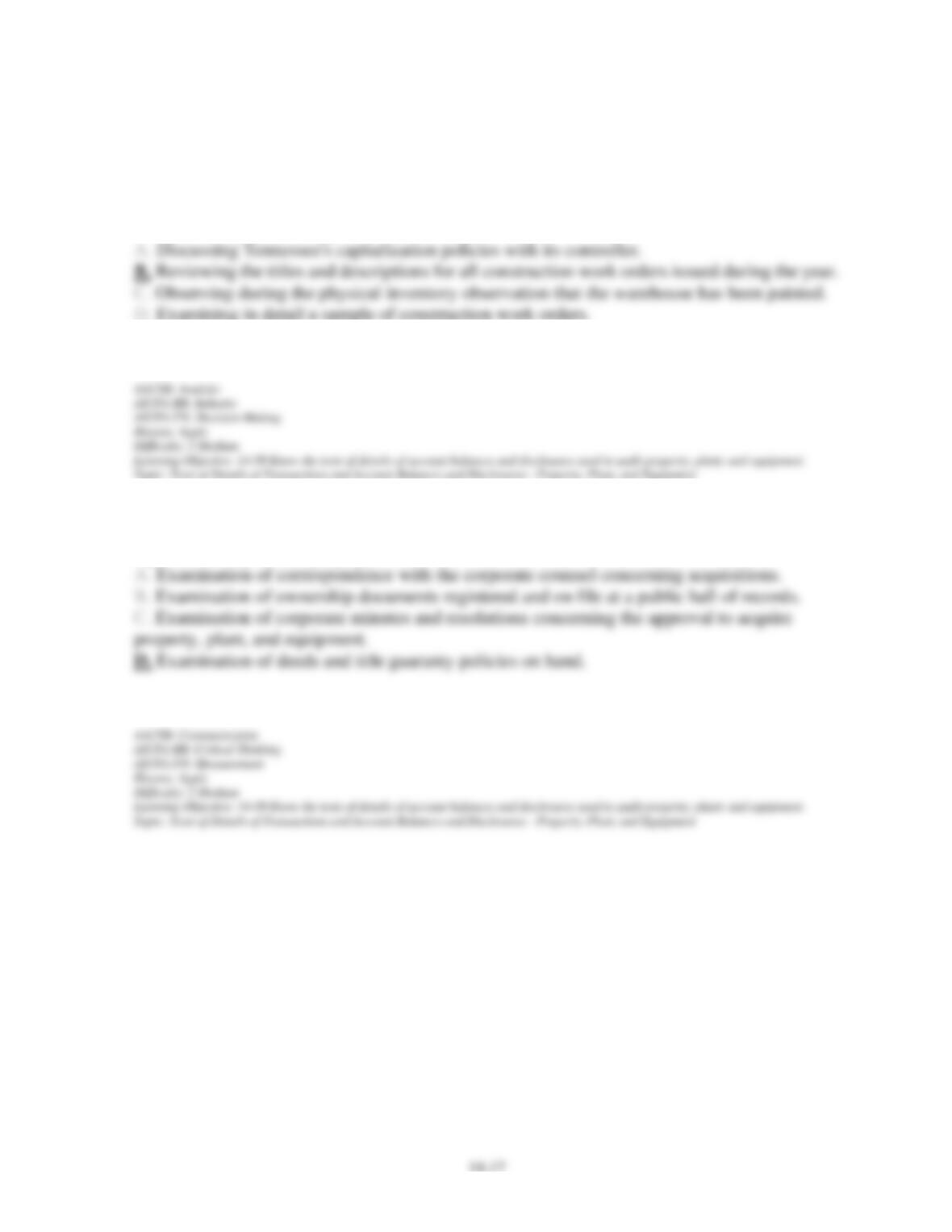
38. Tennessee Company violated company policy by erroneously capitalizing the cost of
painting its warehouse. The CPA examining Tennessee’s financial statements would most
likely learn of this error by
39. Which of the following is likely the most effective audit procedure for the verification of the
legal ownership of real property?