Chapter 21 – Assurance, Attestation, and Internal Auditing Services
21–36
76. According to the Code of Professional Conduct, what response is appropriate when an
accountant, who is not independent, performs a compilation of financial statements?
77. Which of the following would an accountant not need to know when conducting a
compilation?
Chapter 21 – Assurance, Attestation, and Internal Auditing Services
78. When an accountant compiles a nonpublic entity’s financial statements that omit
substantially all disclosures required by generally accepted accounting principles, the
accountant should indicate in the compilation report that the financial statements are
79. Which of the following procedures is more likely to be performed in a review engagement
of a nonpublic entity than in a compilation engagement?
Chapter 21 – Assurance, Attestation, and Internal Auditing Services
80. Statements on Standards for Accounting and Review Services (SSARS) require an
accountant to report when the accountant has
81. A CPA’s report on agreed-upon procedures related to management’s assertion about an
entity’s compliance with specified requirements should contain
Chapter 21 – Assurance, Attestation, and Internal Auditing Services
82. Which of the following represents the order from the least assurance to the most assurance
provided for the types of services provided?
83. Jones Retailing, a nonpublic entity, has asked Winters, CPA, to compile financial
statements that omit substantially all disclosures required by generally accepted accounting
principles. Winters may compile such financial statements, provided the
Chapter 21 – Assurance, Attestation, and Internal Auditing Services
21–40
84. During an engagement to review the financial statements of a nonpublic entity, an
accountant becomes aware of a material departure from GAAP. If the accountant decides to
modify the standard review report because management will not revise the financial statements,
the accountant should
85. Which set of standards was created by the AICPA to cover services relating to unaudited
financial statements?
Chapter 21 – Assurance, Attestation, and Internal Auditing Services
86. When engaged to compile the financial statements of a nonpublic entity, an accountant is
required to possess a level of knowledge of the entity’s accounting principles and practices. This
requirement most likely will include obtaining a general understanding of the
87. This concept, while used by both internal and external auditors, is typically assessed quite
differently for each.
Chapter 21 – Assurance, Attestation, and Internal Auditing Services
88. An entity’s WebTrust seal is managed by
89. A SysTrust engagement is conducted under which of the following sets of standards?
Chapter 21 – Assurance, Attestation, and Internal Auditing Services
90. For an auditor to examine management’s assertions about the effectiveness of internal
control in an attestation engagement, three conditions are necessary. Briefly explain them.
Chapter 21 – Assurance, Attestation, and Internal Auditing Services
91. An agreed-upon procedures engagement is significantly more limited in scope than an
examination. An accountant may perform an agreed-upon procedures attestation engagement
for prospective financial statements provided that attestation standards are complied with and
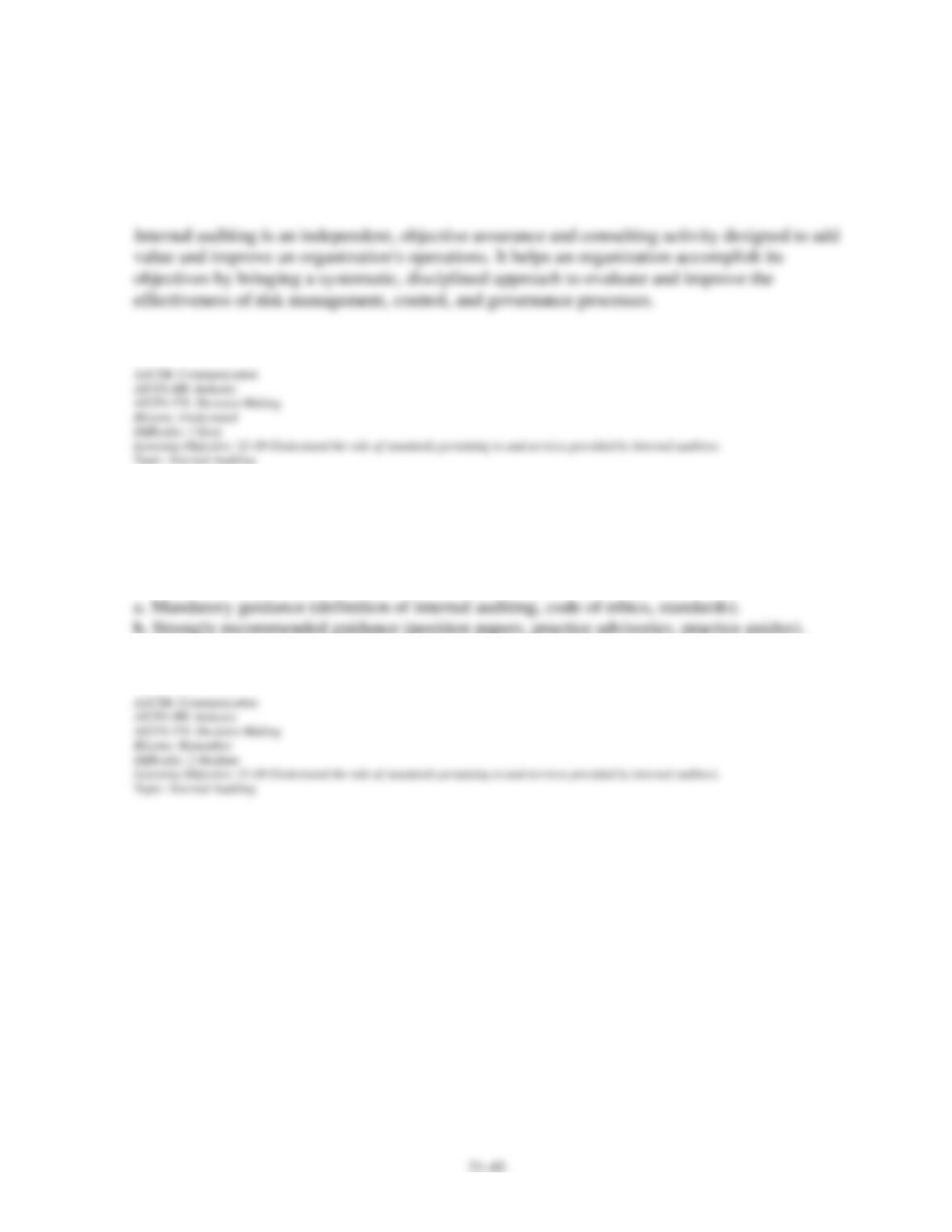
ten criteria are met. Identify five of the ten criteria below.
Chapter 21 – Assurance, Attestation, and Internal Auditing Services
92. In your own words, describe how the Institute of Internal Auditors (IIA) defines internal
auditing?
93. To bridge the gap between a changing business environment and the guidance that was then
available, the IIA developed a Professional Practices Framework. This framework consists of
two broad categories of guidance. List these categories of guidance and what they include.
Chapter 21 – Assurance, Attestation, and Internal Auditing Services
94. As with most professionals, internal auditors must follow guidelines promoting ethical
conduct. The IIA Code of Ethics is important for internal auditors because the reliability of their
work depends on a reputation for a high level of personal integrity. The Code of Ethics consists
of four main principles of ethical conduct and some associated rules that underpin the expected
conduct of IIA members. List the four main principles of the Code of Ethics and explain each.
95. Internal auditors fall into two primary categories―assurance services and consulting
services. Briefly explain these two categories in relation to internal auditors.
Chapter 21 – Assurance, Attestation, and Internal Auditing Services
96. How has the advancement in technology led to the creation of the Trust Services?
97. Explain each of the three PrimePlus Services typically offered by practitioners.
Chapter 21 – Assurance, Attestation, and Internal Auditing Services
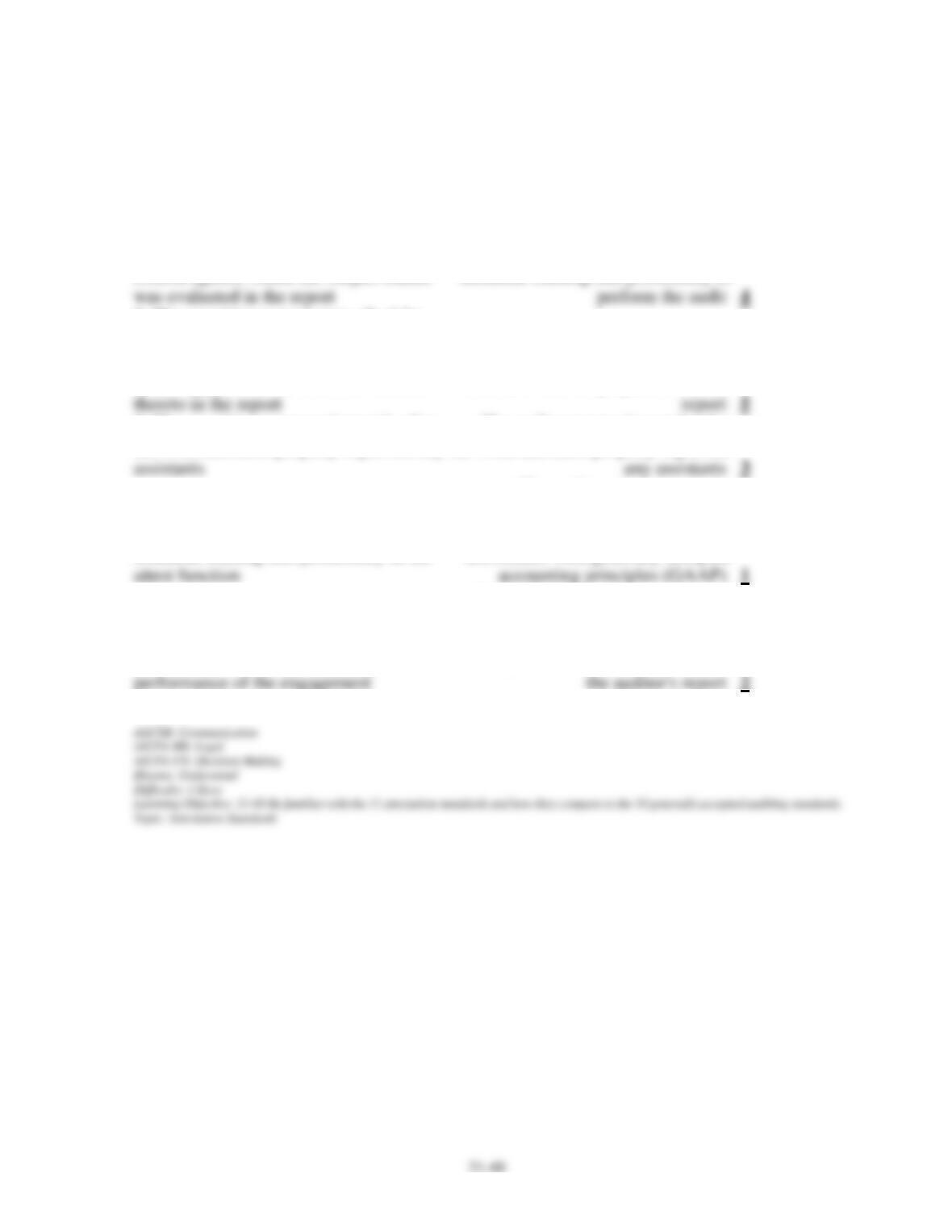
98. Match the attestation standard with the generally accepted auditing standard that is most
similar in nature.
1. The practitioner must state the
practitioner’s conclusion about the subject
matter or the assertion in relation to the
criteria against which the subject matter
The auditor must have adequate
2. The practitioner must state all of the
practitioner’s significant reservations
about the engagement, the subject matter
and, if applicable, the assertion related
The auditor must exercise due
professional care in the performance
of the audit and the preparation of the
3. The practitioner must adequately plan
the work and must properly supervise any
The auditor must adequately plan
the work and must properly supervise
4. The practitioner must have adequate
technical training and proficiency in the
The auditor must state in the
auditor’s report whether the financial
statements are presented in
5. The practitioner must exercise due
professional care in the planning and
The auditor must either express an
opinion regarding the financial
statements, taken as a whole, or state
that an opinion cannot be expressed, in
Chapter 21 – Assurance, Attestation, and Internal Auditing Services
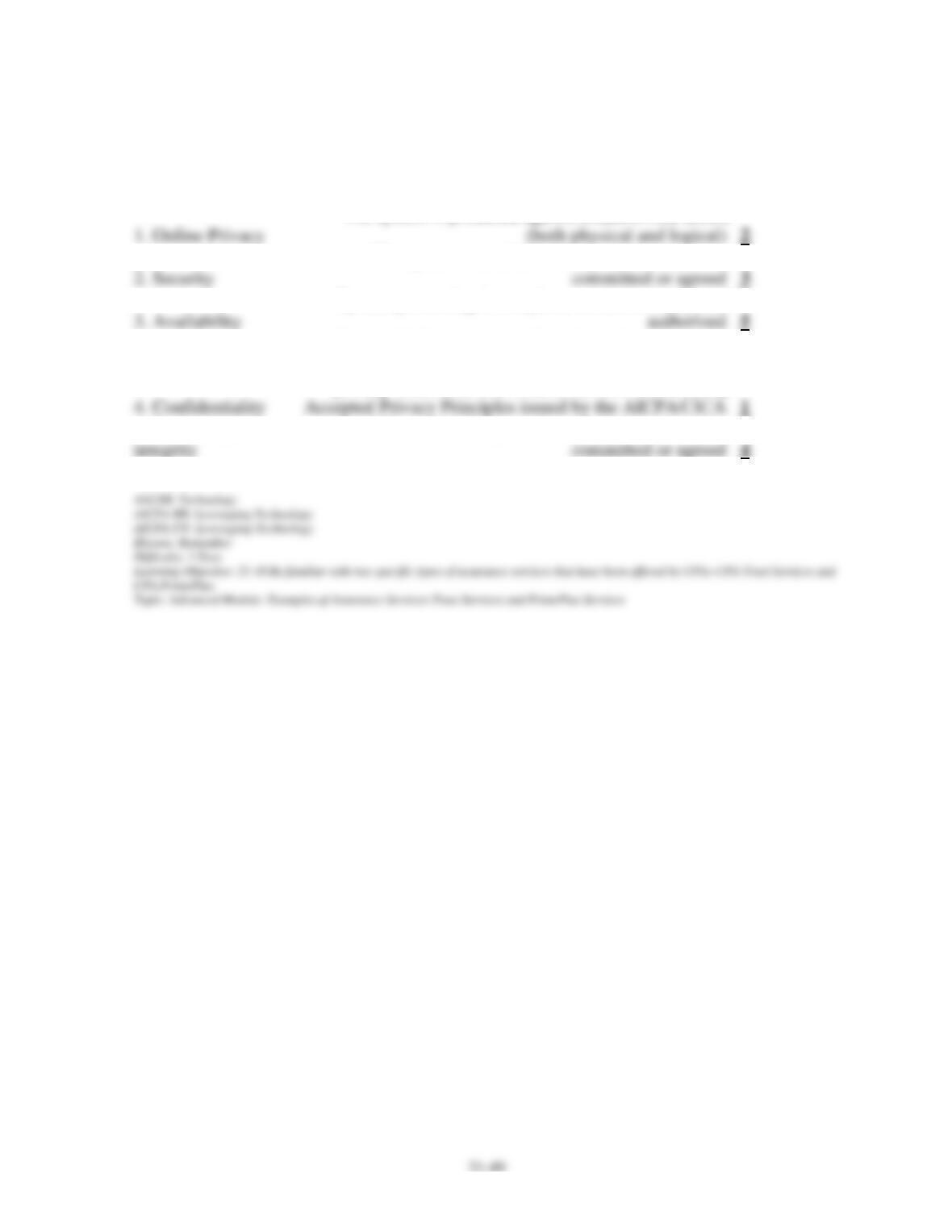
99. Match the Trust Services Principle with its proper definition.
The system is available for operation and use as
System processing is complete, accurate, timely, and
Personal information is collected, used, retained, and
disclosed in conformity with the commitments in the entity’s
privacy notice and with criteria set forth in Generally
5. Processing
Information designated as private is protected as