Archives: Solution Manual
978-0077687342 Chapter 16 Part 11
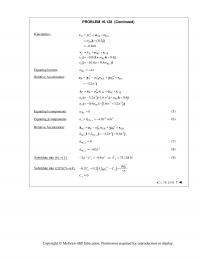
PROBLEM 16.128 (Continued) Kinematics: Equating i–terms: Relative Acceleration: 2 BC ωπ = − =aa 2 ω −+ra × r Equating i components: (5) Equating j components: (6) 0 BC a = 22 aa π = = − Relative Acceleration: (7) […]
978-0077687342 Chapter 16 Part 10
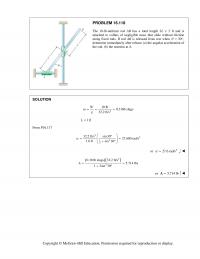
PROBLEM 16.118 The 10-lb–uniform rod AB has a total length 2L = 2 ft and is attached to collars of negligible mass that slide without friction along fixed rods. If rod AB is released from rest when 30 , θ […]
978-0077687342 Chapter 16 Part 9
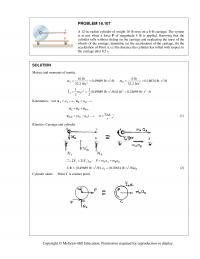
PROBLEM 16.107 A 12–in.–radius cylinder of weight 16 lb rests on a 6-lb carriage. The system is at rest when a force P of magnitude 4 lb is applied. Knowing that the cylinder rolls without sliding on the carriage and […]
978-0077687342 Chapter 16 Part 8
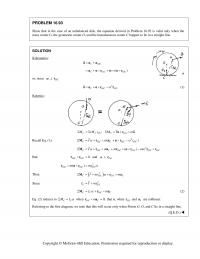
PROBLEM 16.93 Show that in the case of an unbalanced disk, the equation derived in Problem 16.92 is valid only when the mass center G, the geometric center O, and the instantaneous center C happen to lie in a straight […]
978-0077687342 Chapter 16 Part 7
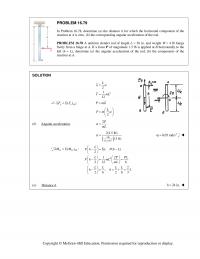
PROBLEM 16.79 In Problem 16.78, determine (a) the distance h for which the horizontal component of the reaction at A is zero, (b) the corresponding angular acceleration of the rod. PROBLEM 16.78 A uniform slender rod of length L = […]
978-0077687342 Chapter 16 Part 6
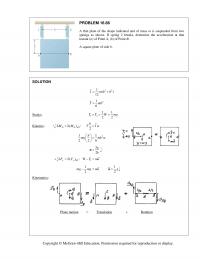
PROBLEM 16.66 A thin plate of the shape indicated and of mass m is suspended from two springs as shown. If spring 2 breaks, determine the acceleration at that instant (a) of Point A, (b) of Point B. A square […]
978-0077687342 Chapter 16 Part 5
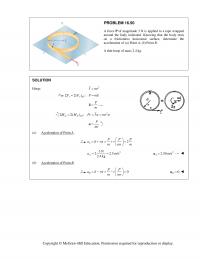
PROBLEM 16.50 A force P of magnitude 3 N is applied to a tape wrapped around the body indicated. Knowing that the body rests on a frictionless horizontal surface, determine the acceleration of (a) Point A, (b) Point B. A […]
978-0077687342 Chapter 16 Part 4
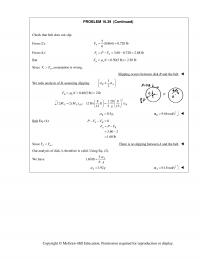
PROBLEM 16.39 (Continued) Check that belt does not slip. From (2): 6 A F= = From (4): 3.60 0.720 2.88 lb eA F PF=−= − = But 0.50(5 lb) 2.50 lb FN µ = = = 5(0.864) 0.720 lb ms […]
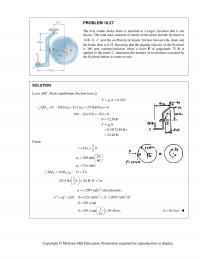
978-0077687342 Chapter 16 Part 3
PROBLEM 16.27 The 8–in.–radius brake drum is attached to a larger flywheel that is not shown. The total mass moment of inertia of the drum and the flywheel is 2 14 lb ft s⋅⋅ and the coefficient of kinetic friction […]
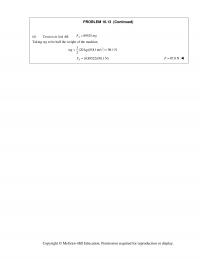
978-0077687342 Chapter 16 Part 2
PROBLEM 16.13 (Continued) (b) Tension in link AB. A Taking mg to be half the weight of the machine, 2 1(20 kg)(9.81 m/s ) 98.1 N 2 mg = = (0.89522)(98.1 N) A F= 87.8 NF= 89525 F mg= […]

978-0077687342 Chapter 16 Part 1
CHAPTER 16 PROBLEM 16.1 A 60–lb uniform thin panel is placed in a truck with end A resting on a rough horizontal surface and end B supported by a smooth vertical surface. Knowing that the deceleration of the truck is […]
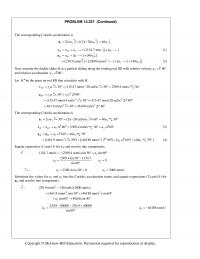
978-0077687342 Chapter 15 Part 20
PROBLEM 15.257 (Continued) 2 sin 60 ° 2 Copyright © McGraw–Hill Education. Permission required for reproduction or display. The corresponding Coriolis acceleration is 11 [2 u ω =a 1 ] [(2)( 20)u= − 1 ] 40u= 1HH u ′ = […]
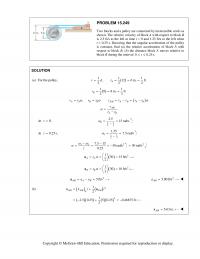
978-0077687342 Chapter 15 Part 19
PROBLEM 15.249 Two blocks and a pulley are connected by inextensible cords as shown. The relative velocity of block A with respect to block B is 2.5 ft/s to the left at time t = 0 and 1.25 ft/s to […]
978-0077687342 Chapter 15 Part 18
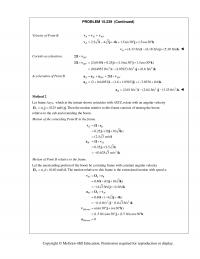
PROBLEM 15.239 (Continued) /boom /boom (1.5 ft/s)sin 30 (1.5 ft/s) cos30 0 B B = °+ ° = jk a Copyright © McGraw–Hill Education. Permission required for reproduction or display. Velocity of Point B. / 2.5 3 4 3 4 […]
978-0077687342 Chapter 15 Part 17
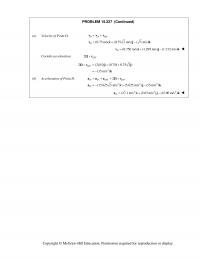
PROBLEM 15.227 (Continued) D=+−a ij k Copyright © McGraw–Hill Education. Permission required for reproduction or display. (a) Velocity of Point D. / (0.75 m/s) (0.75 3 m/s) ( 3 m/s) D D DF D ′ = + =+− vvv v […]
978-0077687342 Chapter 15 Part 16
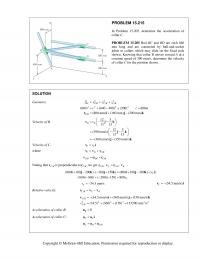
PROBLEM 15.215 In Problem 15.205, determine the acceleration of collar C. PROBLEM 15.205 Rod BC and BD are each 840 mm long and are connected by ball-and–socket joints to collars which may slide on the fixed rods shown. Knowing that […]
978-0077687342 Chapter 15 Part 15
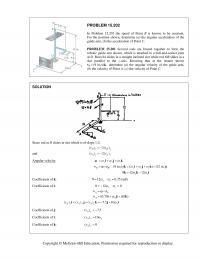
PROBLEM 15.202 In Problem 15.201 the speed of Point B is known to be constant. For the position shown, determine (a) the angular acceleration of the guide arm, (b) the acceleration of Point C. PROBLEM 15.201 Several rods are brazed […]
978-0077687342 Chapter 15 Part 14
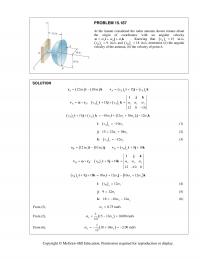
PROBLEM 15.187 At the instant considered the radar antenna shown rotates about the origin of coordinates with an angular velocity xyz ωωω =++i jk ω . Knowing that ( ) 15 Ay v= in./s, ( ) 9 By v= in./s, […]
978-0077687342 Chapter 15 Part 13
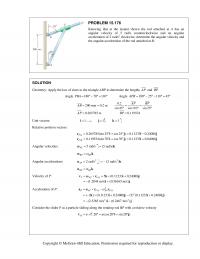
PROBLEM 15.176 Knowing that at the instant shown the rod attached at A has an angular velocity of 5 rad/s counterclockwise and an angular acceleration of 2 rad/s2 clockwise, determine the angular velocity and the angular acceleration of the rod […]
978-0077687342 Chapter 15 Part 12
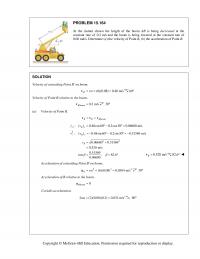
constant rate of 0.2 m/s and the boom is being lowered at the constant rate of 0.08 rad/s. Determine (a) the velocity of Point B, (b) the acceleration of Point B. SOLUTION Velocity of coinciding Point B′ on boom. (6)(0.08) […]
978-0077687342 Chapter 15 Part 11
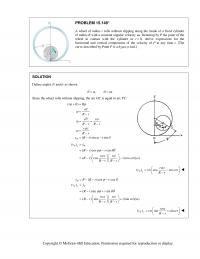
PROBLEM 15.148* A wheel of radius r rolls without slipping along the inside of a fixed cylinder of radius R with a constant angular velocity .ω Denoting by P the point of the wheel in contact with the cylinder at […]
978-0077687342 Chapter 15 Part 10
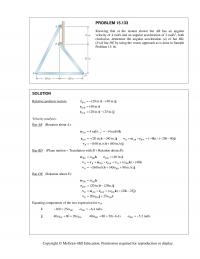
PROBLEM 15.133 Knowing that at the instant shown bar AB has an angular velocity of 4 rad/s and an angular acceleration of 2 rad/s2, both clockwise, determine the angular acceleration (a) of bar BD, (b) of bar DE by using […]
978-0077687342 Chapter 15 Part 9
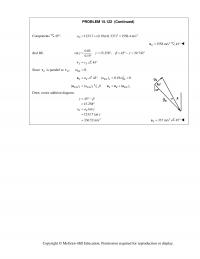
PROBLEM 15.122 (Continued) E Copyright © McGraw–Hill Education. Permission required for reproduction or display. Components 45 :° 22 1233.7 (0.19)(41.337) 1558.4 m/s D a=+= 2 1558 m/s D =a 45° Rod BE. 0.05 sin , 15.258 , 45 29.742 […]
978-0077687342 Chapter 15 Part 8
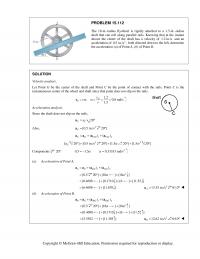
PROBLEM 15.112 The 18-in.–radius flywheel is rigidly attached to a 1.5-in. –radius shaft that can roll along parallel rails. Knowing that at the instant shown the center of the shaft has a velocity of 1.2 in./s and an acceleration of […]
978-0077687342 Chapter 15 Part 7
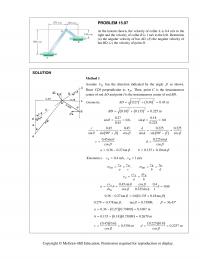
PROBLEM 15.97 At the instant shown, the velocity of collar A is 0.4 m/s to the right and the velocity of collar B is 1 m/s to the left. Determine (a) the angular velocity of bar AD, (b) the angular […]
978-0077687342 Chapter 15 Part 6
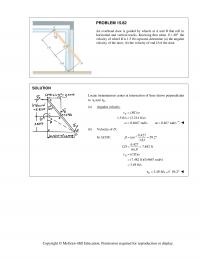
PROBLEM 15.82 An overhead door is guided by wheels at A and B that roll in horizontal and vertical tracks. Knowing that when 40 θ = ° the velocity of wheel B is 1.5 ft/s upward, determine (a) the angular […]
978-0077687342 Chapter 15 Part 5
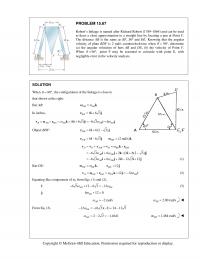
PROBLEM 15.67 Robert’s linkage is named after Richard Robert (1789–1864) and can be used to draw a close approximation to a straight line by locating a pen at Point F. The distance AB is the same as BF, DF and […]
978-0077687342 Chapter 15 Part 4
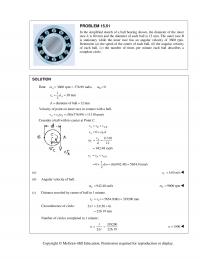
PROBLEM 15.51 In the simplified sketch of a ball bearing shown, the diameter of the inner race A is 60 mm and the diameter of each ball is 12 mm. The outer race B is stationary while the inner race […]
978-0077687342 Chapter 15 Part 3
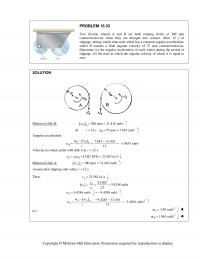
PROBLEM 15.33 Two friction wheels A and B are both rotating freely at 300 rpm counterclockwise when they are brought into contact. After 12 s of slippage, during which time each wheel has a constant angular acceleration, wheel B reaches […]
978-0077687342 Chapter 15 Part 2
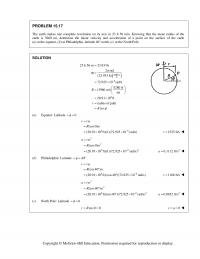
PROBLEM 15.17 The earth makes one complete revolution on its axis in 23 h 56 min. Knowing that the mean radius of the earth is 3960 mi, determine the linear velocity and acceleration of a point on the surface of […]

978-0077687342 Chapter 15 Part 1
CHAPTER 15 PROBLEM 15.1 The brake drum is attached to a larger flywheel that is not shown. The motion of the brake drum is defined by the relation 2 36 1.6 ,tt θ = − where θ is expressed in […]
978-0077687342 Chapter 14 Part 8
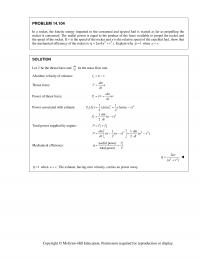
PROBLEM 14.104 In a rocket, the kinetic energy imparted to the consumed and ejected fuel is wasted as far as propelling the rocket is concerned. The useful power is equal to the product of the force available to propel the […]
978-0077687342 Chapter 14 Part 7
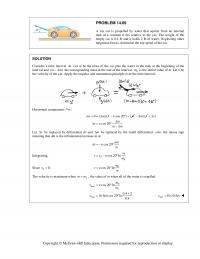
PROBLEM 14.89 A toy car is propelled by water that squirts from an internal tank at a constant 6 ft/s relative to the car. The weight of the empty car is 0.4 lb and it holds 2 lb of water. […]
978-0077687342 Chapter 14 Part 6
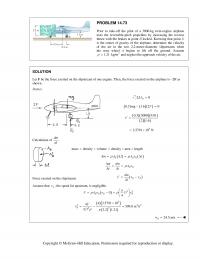
PROBLEM 14.73 Prior to take-off the pilot of a 3000-kg twin-engine airplane tests the reversible-pitch propellers by increasing the reverse thrust with the brakes at point B locked. Knowing that point G is the center of gravity of the airplane, […]
978-0077687342 Chapter 14 Part 5
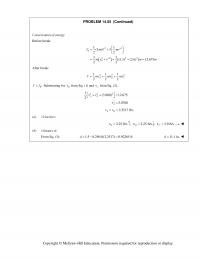
PROBLEM 14.55 (Continued) Conservation of energy. Before break: 22 0 22 2 2 0 11 (3 ) 3 22 33 [(1.3) (2.6) ] 12.675 22 Tmv mv mv v m m […]
978-0077687342 Chapter 14 Part 4
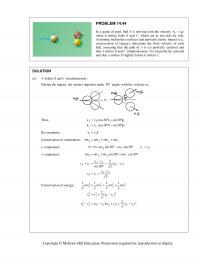
PROBLEM 14.44 In a game of pool, ball A is moving with the velocity 00 vvi when it strikes balls B and C, which are at rest side by side. Assuming frictionless surfaces and perfectly elastic impact (i.e., conservation of […]
978-0077687342 Chapter 14 Part 3
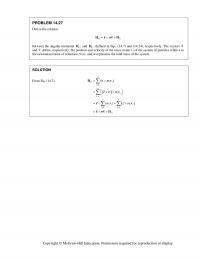
PROBLEM 14.27 Derive the relation OG m HrvH between the angular momenta O H and G H defined in Eqs. (14.7) and (14.24), respectively. The vectors r and v define, respectively, the position and velocity of the mass center G […]
978-0077687342 Chapter 14 Part 2
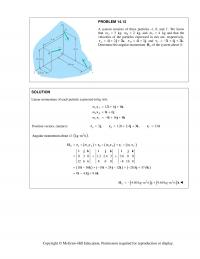
PROBLEM 14.13 A system consists of three particles A, B, and C. We know that 3 A m kg, 2 B m kg, and 4 C m kg and that the velocities of the particles expressed in m/s […]

978-0077687342 Chapter 14 Part 1
CHAPTER 14 PROBLEM 14.1 A 30-g bullet is fired with a horizontal velocity of 450 m/s and becomes embedded in block B which has a mass of 3 kg. After the impact, block B slides on 30-kg carrier C until […]

978-0077687342 Chapter 13 Part 17
PROBLEM 13.CQ5 The expected damages associated with two types of perfectly plastic collisions are to be compared. In the first case, two identical cars traveling at the same speed impact each other head on. In the second case, the car […]
978-0077687342 Chapter 13 Part 16
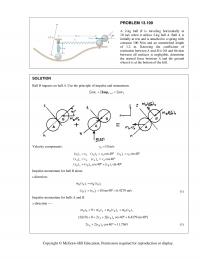
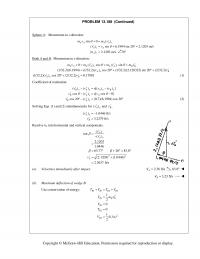
PROBLEM 13.199 A 2–kg ball B is traveling horizontally at 10 m/s when it strikes 2-kg ball A. Ball A is initially at rest and is attached to a spring with constant 100 N/m and an unstretched length of 1.2 […]
978-0077687342 Chapter 13 Part 15
PROBLEM 13.188 (Continued) Sphere A: Momentum in t–direction: ( ) sin 6.1994 sin 20 2.1203 m/s ( ) 2.1203 m/s 70° At A At vv θ ′= = °= =v Both A and B: Momentum in x–direction: 0 ()cos ()sin […]
978-0077687342 Chapter 13 Part 14
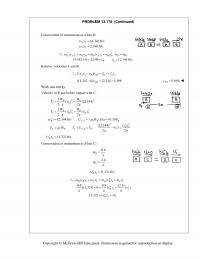
PROBLEM 13.178 (Continued) Conservation of momentum as A hits B: 2 2 ( ) 14.342 ft/s ( ) 2.198 ft/s A A v v = ′= 22 () () 14.342 0 2.198 12.144 ft/s A A BB B A BB […]
978-0077687342 Chapter 13 Part 13
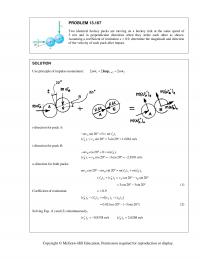
PROBLEM 13.167 Two identical hockey pucks are moving on a hockey rink at the same speed of 3 m/s and in perpendicular directions when they strike each other as shown. Assuming a coefficient of restitution e = 0.9, determine the […]
978-0077687342 Chapter 13 Part 12
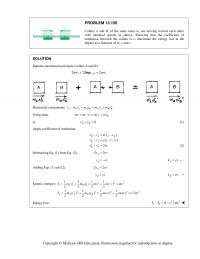
PROBLEM 13.156 Collars A and B, of the same mass m, are moving toward each other with identical speeds as shown. Knowing that the coefficient of restitution between the collars is e, determine the energy lost in the impact as […]
978-0077687342 Chapter 13 Part 11
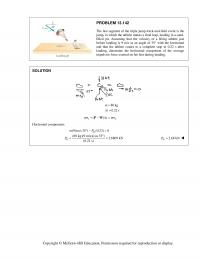
PROBLEM 13.142 The last segment of the triple jump track–and–field event is the jump, in which the athlete makes a final leap, landing in a sand- filled pit. Assuming that the velocity of a 80–kg athlete just before landing is […]
978-0077687342 Chapter 13 Part 10
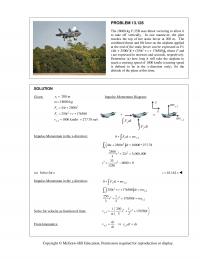
PROBLEM 13.126 The 18000-kg F-35B uses thrust vectoring to allow it to take off vertically. In one maneuver, the pilot reaches the top of her static hover at 200 m. The combined thrust and lift force on the airplane applied […]
978-0077687342 Chapter 13 Part 9
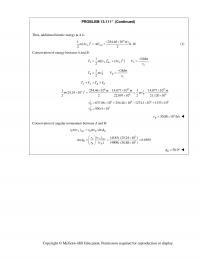
PROBLEM 13.111* (Continued) Thus, additional kinetic energy at A is 6 2 110 1 (254.46 10 ) ( ) ft lb 22 A m mv E × ∆ =∆= ⋅ (1) Conservation of energy between A and B: 22 circ […]
978-0077687342 Chapter 13 Part 8
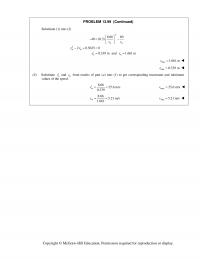
PROBLEM 13.99 (Continued) Substitute (1) into (2) 2 2 8.66 80 40 (0.3) 2 0.5625 0 0.339 m and 1.661 m mm mm mm rr rr rr −= − −+ = ′= = max 1.661 mr= […]
978-0077687342 Chapter 13 Part 7
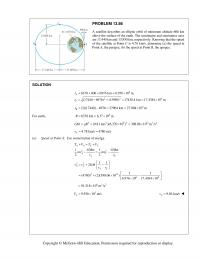
PROBLEM 13.86 A satellite describes an elliptic orbit of minimum altitude 606 km above the surface of the earth. The semimajor and semiminor axes are 17,440 km and 13,950 km, respectively. Knowing that the speed of the satellite at Point […]