Archives: Solution Manual
Industrial Engineering Chapter 2 Homework Both parties to an exchange may profit because
Industrial Engineering Chapter 1 Homework The role of the scientist is to add to
Biology & Life Sciences Chapter 6 Homework Tissue engineered Skin Substitutes Questions Compare
e1 QUESTIONS 1. Compare the assays used to assess corrosivity and irritancy in skin substitute test systems. 2. Discuss the advantages of cryopreservation in the blasts and keratinocytes to skin test systems? 4. What value may skin test systems have […]
Biology & Life Sciences Chapter 6 Homework As with any biological graft, researchers must select components
e1 QUESTIONS 1. Describe the tissue engineering paradigm as it relates to generating the myocardium. Consider the role of each component. 3. Describe the ideal properties of a scaffold for cardiac muscle engineering. Propose how you would develop such a […]
Biology & Life Sciences Chapter 6 Homework If you do decide to culture the construct
e1 EXERCISE You have been tasked with developing a synthetic bone graft for a young patient that has osteosarcoma of the femur. The patient is being treated with chemotherapy, and is scheduled to have the tumor removed in two which […]
Biology & Life Sciences Chapter 6 Homework This relates to the complexity of regulatory issues
e1 QUESTIONS 1. What are the advantages and disadvantages of cultur- ing cells on a scaffold using a bioreactor as compared to a conventional Petri dish? ANSWERS Advantages: • Perfusion of media provides sufficient nutrient supply inside the scaffold • […]
Biology & Life Sciences Chapter 5 Homework April 1946 Dr Frank Lahey Used Silicone
e1 QUESTIONS 1. Which material property was the basis for Charles b. hemocompatibility c. thermal stability d. viscoelasticity e. all of the above. 2. Silicone breast implants cause which of the following complications? a. breast cancer b. connective-tissue disease c. […]
Biology & Life Sciences Chapter 5 Homework Strategies Achieve This Are Usually Based Gastroretentive
e1 EXERCISES 1. List the major factors causing variability of drug absorption in the GI tract. ANSWERS 1. Absorption from drug formulations can be divided into physicochemical and physiological factors, with a large extent of interdependence. They may not work […]
Biology & Life Sciences Chapter 5 Homework What The Interaction Between The Drug And
e1 QUESTION In deciding between a non-degradable versus a degrad- able polymer for an implantable drug delivery system, what would you need to know before proceeding with the selection? List the questions would you have, includ- ing tests that would […]
Biology & Life Sciences Chapter 5 Homework Section Injected Degradable Depot Exercises
e1 EXERCISES 1. List the factors that can determine if an injected depot delivery system will be successful. delivery systems? ANSWERS 1. Made with approved polymers, contain a low toxic- ity drug, a precise well-defined release profile is not needed, […]
Biology & Life Sciences Chapter 5 Homework Answers Answers May Vary One Possible Answer
e1 EXERCISES 1. What is one advantage of PEGylation of non-viral ANSWERS 1. Answers may vary. One possible answer is that the PEG may interfere with efficient cellular uptake or intracellular trafficking so slow deshielding results in more efficient gene […]
Biology & Life Sciences Chapter 5 Homework Sutures Question Why Would You
e1 QUESTION KEY POINTS FOR ANSWER: a. Absorbable – short-term security is all that is needed, difficult to retrieve suture after implantation (e.g., subcutaneous or within abdominal wall, to secure anastamosis), surgeries where a second procedure is not advised. d. […]
Biology & Life Sciences Chapter 5 Homework Table Need Considered Before Deciding The
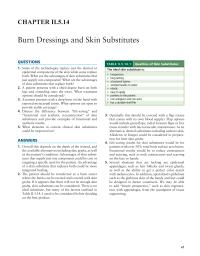
e1 QUESTIONS 1. Some of the technologies replace just the dermal or epidermal components of the skin while some replace both. What are the advantages of skin substitutes that just supply one component? What are the advantages of skin substitutes […]
Biology & Life Sciences Chapter 5 Homework Capacitive Charge Transfer Does Not Large Electrode
e1 EXERCISES 1. What are the three fundamental requirements of a difference between these two mechanisms of charge transfer? 3. Explain the inherent trade-off between choosing an electrode with a large surface area versus choosing an electrode with a small […]
Biology & Life Sciences Chapter 5 Homework How much DC power is required per channel if the VCSEL
PROBLEMS Problem 1 Sound at the level of the tympanic membrane demon- strates a pressure peak at a frequency of 2.5 kHz in the human. Consider the boundary conditions of the ear Ip=πd 4 32 . canal and explain why […]
Biology & Life Sciences Chapter 5 Homework Assume That The Oxides Titanium Electrode And
e1 QUESTIONS 1. What material would you choose for a deep brain trolyte interface. You do not have to model the tissue. Model only the interface. 2. Calculate the increase in charge injected by decreasing the frequency of a symmetric […]
Biology & Life Sciences Chapter 5 Homework Implant What Was The Basis For
e1 QUESTIONS 1. What are the advantages of IOL implantation over spectacles for correction of vision after removal of cataract? What other improvements have been 3. What is the rationale for foldable IOLs? Which fold- able soft hydrophobic materials are […]
Biology & Life Sciences Chapter 5 Homework For Example European Journal Orthopaedic Surgery
e1 QUESTIONS 1. Classify the different types of chemical bonds within and between molecules (intra– and inter-molecular bonds. These can be expressed either as forces or as interaction energies. What is the relationship between these two physical quantities? Group these […]
Biology & Life Sciences Chapter 5 Homework Generally orthopedic implants must be capable
e1 QUESTIONS 1. What are the general mechanical property qualifica- tions for orthopedic biomaterials, and what are the major categories of orthopedic implants? type involved in this process? 4. Name six of the primary orthopedic implant biomaterials. 5. Name one […]
Biology & Life Sciences Chapter 4 Homework Discuss The Possible Mechanisms Corrosion The Device
e1 QUESTIONS 1. (a) What are the three most common implant alloys used in structural applications? For each one, state which element in the alloy is chosen to enhance 2. Consider a situation in which a 316L stainless steel fracture […]
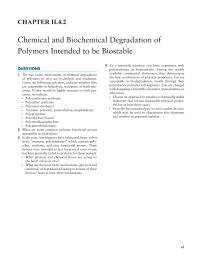
Biology & Life Sciences Chapter 4 Homework Choose an approach to produce a chemically
e1 QUESTIONS 1. The two major mechanisms of chemical degradation of polymers in vivo are hydrolysis and oxidation. Given the following polymers, indicate whether they are susceptible to hydrolysis, oxidation or both pro- 2. What are some common polymer functional […]
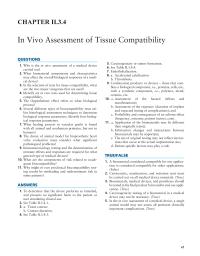
Biology & Life Sciences Chapter 3 Homework Carcinogenicity testing of a biomaterial in a medical
e1 QUESTIONS 1. Why is the in vivo assessment of a medical device carried out? 2. What biomaterial components and characteristics may affect the overall biological responses of a medi- cal device? 6. Several different types of biocompatibility tests uti- […]
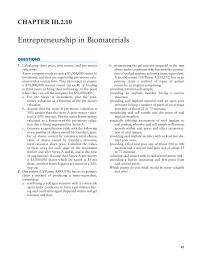
Biology & Life Sciences Chapter 2 Homework Entrepreneurship Biomaterials Questions Calculating Share
e1 QUESTIONS 1. Calculating share price, post money, and pre-money valuations. A new company needs to raise a $5,000,000 (series A) investment, and they are negotiating pre-money valu- ation with a venture firm. They also expect to require b. Assume […]
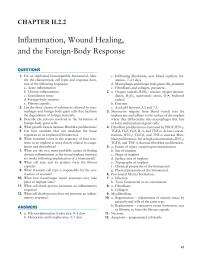
Biology & Life Sciences Chapter 2 Homework Rois Reactive Oxygen Intermediates H2o2 Superoxide
e1 QUESTIONS 1. For an implanted biocompatible biomaterial, iden- tify the characteristic cell types and response dura- tion of the following responses: a . Acute inflammation b. Chronic inflammation 2. List the three classes of substances released by mac- rophages […]
Biology & Life Sciences Chapter 2 Homework What is the mechanism of heat production in each case?
e1 HOMEWORK PROBLEMS 1. Draw diagrams of the emulsification processes used to create polymer microparticles (e.g., O/W, W/O, 2. Quantum dots have been widely used for imaging, particularly of cells and biomolecules. Describe some of the benefits quantum dots have […]
Biology & Life Sciences Chapter 2 Homework Also Given The Rate Which The Field
e1 EXERCISES 1. Think of a materials-related problem in biomedical engineering, for which there exists no current good solution: is there something that you wish a material 2. Identify an “Olympian feat” performed by a natural material (where the term […]
Biology & Life Sciences Chapter 2 Homework Textured And Porous Materials Questions
e1 QUESTIONS 1. Briefly define the following, using examples where applicable: a. angiogenesis b. osteointegration c. stress shielding d. enucleation 2. Name two medical device applications in which textured or porous materials/coatings are used. Describe how the surfaces were rendered […]
Biology & Life Sciences Chapter 2 Homework When Placed Aqueous Buffer Solution The Hydrogel
e1 QUESTIONS 1. You are assigned the task of designing a proteomics array to the surface of a standard, glass microscope slide in a 25 × 25 array. Design a scheme to make to spray-coat the device. When it is […]
Biology & Life Sciences Chapter 2 Homework Considering for instance an Anterior Cruciate Ligament
e1 QUESTIONS 1. How would you construct a ligament prosthesis? ANSWERS 1. Any design should take into account the specific requirements. The main requirement of a ligament is to transmit loads between the two bones to which it is connected. […]
Biology & Life Sciences Chapter 2 Homework For Ha Depending The Source Structures
e1 QUESTIONS 1. Alginic acid is a polysaccharide derived from algae and is commonly used in foods, for cell encapsula- 2. Chondroitin sulfate (CS) is a naturally-occurring glycosaminoglycan abundant in cartilage and is commonly sourced from animal cartilage or shark […]
Biology & Life Sciences Chapter 2 Homework Degradable And Resorbable Biomaterials Questions
e1 QUESTIONS 1. The transformation of a solid implant into water-sol- uble material(s) is best described by the term “bioero- sion”. Which of the following events may or may not accompany bioerosion? (a) Changes in the physico-mechanical properties of the […]
Biology & Life Sciences Chapter 2 Homework Name Two Such Examples Where This The
e1 QUESTIONS 1. Name at least four mechanisms that may hold a hydrogel together without covalent bonds. side groups on the network chains degrade; (c) their chains lose hydrophobically-bound water; or (d) their ionic groups are protonated. 3. pH-responsive, carboxylated […]
Biology & Life Sciences Chapter 2 Homework Astm Mandates Xray Diffraction Analysis All New
e1 PROBLEMS 1. Which of the following HAP ceramics do you believe would be the most successful in repairing a bone defect made by the excision of a large tumor in a weight-bearing bone, and why? 2. The ASTM mandates […]
Biology & Life Sciences Chapter 2 Homework This Important Soft Tissue And Vascular Applications
e1 QUESTIONS 1. Teflon™ is often called “inert.” Is it biologically inert? Explain. 2. The node-fibrillar morphology of ePTFE is critical to certain performances. Explain why. ANSWERS 1. All fluoropolymers react with biological components, so they are not biologically inert. […]
Biology & Life Sciences Chapter 2 Homework The Pumpable Lsrs Are Designed For The
e1 QUESTIONS 1. Draw the molecular structure represented by the shorthand notation D5. What is its chemical name? 2. What functions can fillers serve in silicone elastomers? a. material extender to reduce bulk cost 3. Describe at least two of […]
Biology & Life Sciences Chapter 2 Homework This Amine Often Further Reacts With Isocyanates
e1 QUESTIONS 1. One powerful chemical species is the isocyanates group. In this chapter we have discovered that the iso- cyanates group is important in the synthesis of poly- 2. Polyurethanes are important biomaterials; however, these polymers are also commercially […]
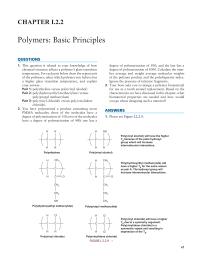
Biology & Life Sciences Chapter 2 Homework The hydroxyl group will increase intermolecular interactions
e1 QUESTIONS 1. This question is related to your knowledge of how chemical structure affects a polymer’s glass transition temperature. For each pair below draw the repeat unit of the polymers, select which polymer you believe has a higher glass […]
Biology & Life Sciences Chapter 1 Homework Implant Retrieval And Evaluation Questions
e1 QUESTIONS 1. The following statements characterize, in part, the goals and specific aims of an implant retrieval and evaluation program. Answer True or False. a. Determine rates, modes, and mechanisms of implant failure; b. Identify effects of patient and […]
Biology & Life Sciences Chapter 1 Homework Sometimes The Biomaterial Scientist Has Polymer
e1 QUESTIONS 1. Overview of major terminal sterilization modalities: a. What are the two dominant sterilization modalities? b. Why do so many device companies use them? c. What are their major safety concerns? 2. Please provide brief descriptions of: a. […]
Biology & Life Sciences Chapter 1 Homework Close packing means that the molecules touch each other at their boundaries
PROBLEMS 1. What are the three main driving forces that affect the competitive adsorption of proteins to biomaterials from complex mixtures such as blood plasma? 2. Calculate the amount of adsorbed protein in a close packed monolayer for an average […]
Biology & Life Sciences Chapter 1 Homework Surface Properties And Surface Characterization
e1 QUESTIONS 1. Scan the table of contents and abstracts from the last three issues of the Journal of Biomedical Materials Research or Biomaterials. List all the surface analy- sis methods used in the articles therein and briefly describe what […]
Biology & Life Sciences Chapter 1 Homework Why Calculate Numerical Value For The Toughness
e1 EXERCISES 1. What is the difference between: • resilience and toughness • toughness and fracture toughness • bulk modulus and shear modulus • nominal stress and normal stress 2. The net potential energy between two adjacent ions can be […]
Biology & Life Sciences Chapter 1 Homework Figure This Summarize Half Page
e1 CHAPTER I.1.2 The Nature of Matter and Materials QUESTIONS 1. Which types of intermolecular forces dominate the assembly of atoms and molecules into matter for each of these types of materials? (a) butter. 2. Consider Figure I.1.2.6 in this […]
Management Chapter 12s Homework For One Thing They Are Easier And
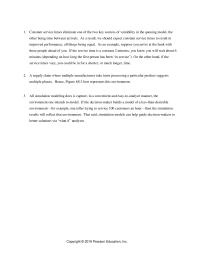
decision making and transactional requirements first. For one thing, they are easier to do and provide immediate payoffs. For another, these systems provide data that can be fed into higher-level planning systems. Copyright © 2016 Pearson Education, Inc. 1. An […]
Management Chapter 6s Homework Hence Figure 6s3 Best Represents This Environment
Copyright © 2016 Pearson Education, Inc. environment—for example, one teller trying to service 100 customers an hour—then the simulation results will reflect that environment. That said, simulation models can help guide decision-makers to better solutions via “what if” analyses. multiple […]
Management Chapter 15 Homework Question These Concerns Are Legitimate Some Ways
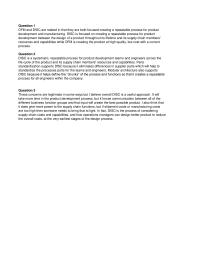
Question 1 Question 2 Question 3 DFM and DfSC are related in that they are both focused creating a repeatable process for product development and manufacturing. DfSC is focused on creating a repeatable process for product standardize the processes parts […]
Management Chapter 15 Homework For Instance Consumers May Want Their Good
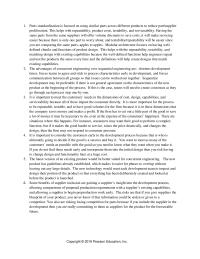
communication between all groups so that issues can be worked out together. Sequential development may be preferable if there is not general agreement on the characteristics of the new product at the beginning of the process. If this is the […]
Management Chapter 14 Homework Path Bcdgh The Only Path Greater Than
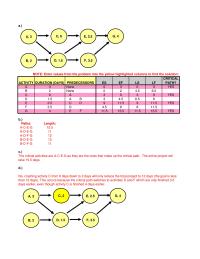
a.) NOTE: Enter values from the problem into the yellow highlighted columns to find the solution: A 3 None 0 3 0 3 YES B 2 None 0 2 4.5 6.5 b.) Paths: Length: A-D-F-G 12 B-D-E-G 10 B-D-F-G 11 […]
Management Chapter 14 Homework Network based Approaches Are Better Than Gantt Charts
that would place less value on project management skills would be ones that focus on routine activities such as a restaurant or retail store. Although even these businesses would have projects occuring now and then. Project management skills are good […]
Management Chapter 14 Homework Earliest Duration Earliest Finish Latest Days Start
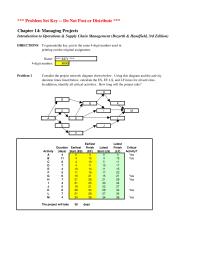
*** Problem Set Key — Do Not Post or Distribute *** Chapter 14: Managing Projects Introduction to Operations & Supply Chain Management (Bozarth & Handfield, 3rd Edition) DIRECTIONS To generatethe key, put in the same 4-digit number used in printing […]