Archives: Quiz
Economics Chapter 18 Analyze The Markets For The
1. In 2015, the total income of all U.S. residents was about a. $10 billion. b. $16 billion. c. $10 trillion. d. $16 trillion. ANSWER: d DIFFICULTY: Easy LEARNING OBJECTIVES: ECON.MANK.008 – Analyze the markets for the factors of production. […]
Economics Chapter 18 Jessica Receives Raise Her Current Parttime Job
True / False 1. A firm’s demand for labor is derived from its decision to supply a good in another market. a. True b. False ANSWER: True DIFFICULTY: Moderate LEARNING OBJECTIVES: ECON.MANK.008 – Analyze the markets for the factors of […]
Economics Chapter 17 Exxon Drills Two Wells Cannot Any Better
Subjective Short Answer 1. Why are the actions of firms interdependent in an oligopoly market but not in a monopolistically competitive market? ANSWER: Because there are only a few firms in an oligopoly market, their actions are interdependent. There are […]
Economics Chapter 17 The story of the prisoners’ dilemma shows why
1. The story of the prisoners’ dilemma shows why a. predatory pricing is clearly not in society’s best interest. b. economists are unanimous in condemning resale price maintenance, since it inevitably reduces competition. c. oligopolies can fail to act independently, […]
Economics Chapter 17 Given Example Business Practice Identify Resale price
1. From society’s standpoint, cooperation among oligopolists is a. desirable, because it leads to less conflict among firms and a wider variety of products for consumers. b. desirable, because it leads to an outcome closer to the competitive outcome than […]
Economics Chapter 17 If the firms reach the Nash equilibrium
ANSWER: d DIFFICULTY: Moderate LEARNING OBJECTIVES: ECON.MANK.183 – Given a payoff matrix, identify the dominant strategy, if present, for each player. TOPICS: Game theory Nash equilibrium KEYWORDS: BLOOM’S: Comprehension CUSTOM ID: 117.17.2 – MC – MANK08 118. The players in […]
Economics Chapter 17 Equilibrium Occurs Game When Price Equals
KEYWORDS: BLOOM’S: Application CUSTOM ID: 062.17.2 – MC – MANK08 63. Lori and Maya are competitors in a local market. Each is trying to decide if it is better to advertise on TV, on radio, or not at all. If […]
Economics Chapter 17 In the prisoners’ dilemma game with Bonnie and Clyde as the players
1. When firms are faced with making strategic choices to maximize profit, economists typically use a. the theory of monopoly to model their behavior. b. the theory of aggressive competition to model their behavior. c. game theory to model their […]
Economics Chapter 17 If duopolists individually pursue their own self-interest
c. increases, the market approaches the competitive market outcome. d. increases, the market approaches the monopoly outcome. ANSWER: c DIFFICULTY: Moderate LEARNING OBJECTIVES: ECON.MANK.299 – Identify if an attribute is a characteristic of oligopolies. TOPICS: Oligopolies KEYWORDS: BLOOM’S: Analysis CUSTOM […]
Economics Chapter 17 The Number Firms Oligopoly Market Decreases
DIFFICULTY: Challenging LEARNING OBJECTIVES: ECON.MANK.299 – Identify if an attribute is a characteristic of oligopolies. TOPICS: Collusion Oligopolies KEYWORDS: BLOOM’S: Application CUSTOM ID: 061.17.1 – MC – MANK08 62. Refer to Table 17-7. Assume there are two profit-maximizing internet radio […]
Economics Chapter 17 Small Town Remote Area Where
1. A distinguishing feature of an oligopolistic industry is the tension between a. profit maximization and cost minimization. b. cooperation and self interest. c. producing a small amount of output and charging a price above marginal cost. d. short-run decisions […]
Economics Chapter 17 Must Knowledgeable How People
1. Which of the following statements about oligopolies is not correct? a. An oligopolistic market has only a few sellers. b. The actions of any one seller can have a large impact on the profits of all other sellers. c. […]
Economics Chapter 17 Cartels with a small number of firms have a greater
True / False 1. The essence of an oligopolistic market is that there are only a few sellers. a. True b. False ANSWER: True DIFFICULTY: Easy LEARNING OBJECTIVES: ECON.MANK.094 – Examine the behavior of oligopolists. TOPICS: Oligopolies KEYWORDS: BLOOM’S: Knowledge […]
Economics Chapter 16 For The Economy Whole About
Subjective Short Answer 1. Which market structure(s) is(are) imperfectly competitive? ANSWER: oligopoly monopolistic competition DIFFICULTY: Easy LEARNING OBJECTIVES: ECON.MANK.023 – Classify an imperfectly competitive firm as an oligopoly or a monopolistically competitive firm. TOPICS: Monopolistic competition KEYWORDS: BLOOM’S: Comprehension CUSTOM […]
Economics Chapter 16 Compare The Market Outcomes Monopolistically competitive
1. Which market structure(s) is(are) imperfectly competitive? ANSWER: oligopoly monopolistic competition DIFFICULTY: Easy LEARNING OBJECTIVES: ECON.MANK.023 – Classify an imperfectly competitive firm as an oligopoly or a monopolistically competitive firm. TOPICS: Monopolistic competition KEYWORDS: BLOOM’S: Comprehension CUSTOM ID: 001.16.4 – […]
Economics Chapter 16 Starbucks Florida More Persuasive Than The Advertising
41. Television advertisements aired during major sporting events are very expensive. A theory asserting that people buy a product simply because it is advertised would suggest that information on the high cost of advertising a. enhances the effectiveness of the […]
Economics Chapter 16 Defenders Advertising a Concede That Advertising Increases Firms
1. Some firms have an incentive to advertise because they sell a a. homogeneous product and charge a price equal to marginal cost. b. homogeneous product and charge a price above marginal cost. c. differentiated product and charge a price […]
Economics Chapter 16 Classify Externality Either Positive Negative topics public
KEYWORDS: BLOOM’S: Comprehension CUSTOM ID: 227.16.2 – MC – MANK08 228. Monopolistic competition is an a. inefficient market structure because there is deadweight loss. b. inefficient market structure because price exceeds marginal cost. c. efficient market structure because free entry […]
Economics Chapter 16 A monopolistically competitive firm is currently
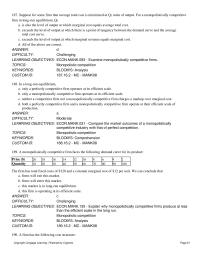
187. Suppose for some firm that average total cost is minimized at Q1 units of output. For a monopolistically competitive firm in long-run equilibrium, Q1 a. is also the level of output at which marginal cost equals average total cost. […]
Economics Chapter 16 Which The Following Market Structures Does
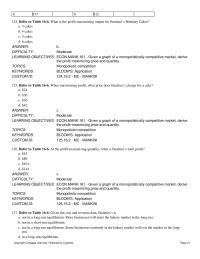
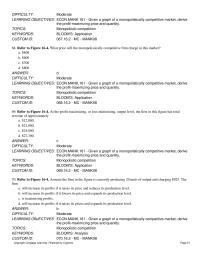
8 $77 8 $12 124. Refer to Table 16–6. What is the profit-maximizing output for Beatrice’s Birthday Cakes? a. 3 cakes b. 4 cakes c. 5 cakes d. 6 cakes ANSWER: b DIFFICULTY: Moderate LEARNING OBJECTIVES: ECON.MANK.161 – Given a […]
Economics Chapter 16 Examine Monopolistically Competitive
DIFFICULTY: Moderate LEARNING OBJECTIVES: ECON.MANK.161 – Given a graph of a monopolistically competitive market, derive the profit-maximizing price and quantity. TOPICS: Monopolistic competition KEYWORDS: BLOOM’S: Application CUSTOM ID: 067.16.2 – MC – MANK08 68. Refer to Figure 16–4. What price […]
Economics Chapter 16 Examine Monopolistically Competitive
1. A downward-sloping demand curve a. is a feature of all monopolistically competitive firms. b. means that the firm in question will never experience a zero profit. c. causes marginal revenue to exceed price. d. prohibits firms from earning positive […]
Economics Chapter 16 Determine Market Attribute Characteristic A competitive
ANSWER: b DIFFICULTY: Moderate LEARNING OBJECTIVES: ECON.MANK.094 – Examine the behavior of oligopolists. TOPICS: Oligopolies KEYWORDS: BLOOM’S: Comprehension CUSTOM ID: 052.16.1 – MC – MANK08 53. One way in which monopolistic competition differs from oligopoly is that a. there are […]
Economics Chapter 16 One Key Difference Between Oligopoly Market
1. A typical firm in the US economy would be classified as a. perfectly competitive. b. imperfectly competitive. c. a duopolist. d. an oligopolist. ANSWER: b DIFFICULTY: Easy LEARNING OBJECTIVES: ECON.MANK.012 – Apply basic, economic principles of individual decision making […]
Economics Chapter 16 It can earn an economic profit in the short run
1. The market for novels is a. perfectly competitive. b. a monopoly. c. monopolistically competitive. d. an oligopoly. ANSWER: c DIFFICULTY: Easy LEARNING OBJECTIVES: ECON.MANK.058 – Determine if a market attribute is a characteristic of a competitive market or a […]
Economics Chapter 16 Monopolistic competition is
True / False 1. There are four basic types of market structure. a. True b. False ANSWER: True DIFFICULTY: Easy LEARNING OBJECTIVES: ECON.MANK.012 – Apply basic, economic principles of individual decision making that determine how an economy generally works. TOPICS: […]
Economics Chapter 15 Assuming Changes Consumer Demand What Would Vincents
Subjective Short Answer 1. What are the three main sources of barriers to entry for monopolies? ANSWER: monopoly resources government regulation the production process DIFFICULTY: Moderate LEARNING OBJECTIVES: ECON.MANK.003 – Analyze the behavior and market effects of monopolies. TOPICS: Monopolies […]
Economics Chapter 15 Firms With Some Degree Monopoly Power Are
1. Which of the following strategies is not an effective strategy to reduce monopoly inefficiency? a. antitrust laws b. price discrimination c. doing nothing d. breaking up a natural monopoly into more than one firm ANSWER: d DIFFICULTY: Moderate LEARNING […]
Economics Chapter 15 Antitrust laws can reduce social welfare
1. Which of the following is the preferred strategy for the government to follow to remedy the inefficient allocation of resources associated with monopolies? a. preventing mergers through antitrust laws b. regulating the prices that monopolies can charge c. doing […]
Economics Chapter 15 With Perfect Price Discrimination The Total Surplus
1. Price discrimination a. is illegal in the United States and Europe. b. can occur in both perfectly competitive and monopoly markets. c. is illogical because it does not maximize profits. d. can maximize profits if the seller can prevent […]
Economics Chapter 15 Monopoly pricing prevents some mutually beneficial trades from
1. Monopolies are inefficient because they (i) eliminate barriers to entry. (ii) price their product at a level where marginal revenue exceeds marginal cost. (iii) restrict output below the socially efficient level of production. a. (i) and (ii) only b. […]
Economics Chapter 15 Analyze The Behavior And Market
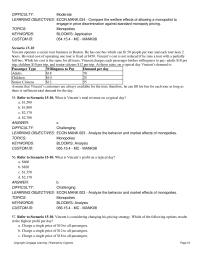
DIFFICULTY: Moderate LEARNING OBJECTIVES: ECON.MANK.034 – Compare the welfare effects of allowing a monopolist to engage in price discrimination against standard monopoly pricing. TOPICS: Monopolies KEYWORDS: BLOOM’S: Application CUSTOM ID: 054.15.4 – MC – MANK08 Scenario 15–10 Vincent operates a […]
Economics Chapter 15 How Much Profit Will The Firm Earn
ANSWER: c DIFFICULTY: Moderate LEARNING OBJECTIVES: ECON.MANK.003 – Analyze the behavior and market effects of monopolies. TOPICS: Monopolies KEYWORDS: BLOOM’S: Application CUSTOM ID: 132.15.2 – MC – MANK08 133. Refer to Table 15-7. Sally will maximize her profits by selling […]
Economics Chapter 15 What Quantity Output Q Will It produce And
71. Refer to Figure 15–3. Which panel could represent the demand curve facing a soybean farmer? a. Panel A b. Panel B c. Panel C d. Panel D ANSWER: b DIFFICULTY: Moderate LEARNING OBJECTIVES: ECON.MANK.003 – Analyze the behavior and […]
Economics Chapter 15 Which The Following Statements Correct For
1. Which of the following statements is (are) true of a monopoly? (i) A monopoly has the ability to set the price of its product at whatever level it desires. (ii) A monopoly’s total revenue will always increase when it […]
Economics Chapter 15 The Defining Characteristic Natural Monopoly Isa
KEYWORDS: BLOOM’S: Comprehension CUSTOM ID: 051.15.1 – MC – MANK08 52. Drug companies are allowed to be monopolists in the drugs they discover in order to a. allow drug companies to charge a price that is equal to their marginal […]
Economics Chapter 15 Because Monopoly Firms Not Have Compete
1. A competitive firm a. and a monopolist are price takers. b. and a monopolist are price makers. c. is a price taker, whereas a monopolist is a price maker. d. is a price maker, whereas a monopolist is a […]
Economics Chapter 15 Declining average total cost with increased production
1. Monopolists can achieve any level of profit they desire because they have unlimited market power. a. True b. False ANSWER: False DIFFICULTY: Moderate LEARNING OBJECTIVES: ECON.MANK.003 – Analyze the behavior and market effects of monopolies. TOPICS: Monopolies KEYWORDS: BLOOM’S: […]
Economics Chapter 14 Given Scenario Categorize Cost Implicit
Subjective Short Answer 1. If a firm can influence the market price of the good it sells, then it is said to have __________. ANSWER: market power DIFFICULTY: Easy LEARNING OBJECTIVES: ECON.MANK.092 – Examine firms in competitive markets. TOPICS: Perfect […]
Economics Chapter 14 You Should Stay And Watch The Remainder
DIFFICULTY: Moderate LEARNING OBJECTIVES: ECON.MANK.172 – Given a graph of the firm’s production costs, determine the shutdown price in the short run for a perfectly competitive firm. TOPICS: Perfect competition Short run KEYWORDS: BLOOM’S: Analysis CUSTOM ID: 217.14.2 – MC […]
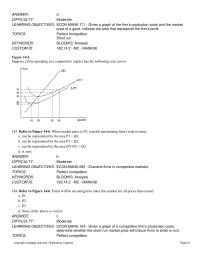
Economics Chapter 14 Which Line Segment Best Reflects The Long run
ANSWER: d DIFFICULTY: Moderate LEARNING OBJECTIVES: ECON.MANK.171 – Given a graph of the firm’s production costs and the market price of a good, indicate the area that represents the firm’s profit. TOPICS: Perfect competition Short run KEYWORDS: BLOOM’S: Analysis CUSTOM […]
Economics Chapter 14 Refer Figure 145 When Market Price
c. $250 d. $450 ANSWER: c DIFFICULTY: Moderate LEARNING OBJECTIVES: ECON.MANK.284 – Given the market price and the firm’s production costs, determine the profit-maximizing outcome of a perfectly competitive firm. TOPICS: Perfect competition Short run KEYWORDS: BLOOM’S: Analysis CUSTOM ID: […]
Economics Chapter 14 The Accountants Hired The Brookside Racquet
ANSWER: b DIFFICULTY: Moderate LEARNING OBJECTIVES: ECON.MANK.284 – Given the market price and the firm’s production costs, determine the profit-maximizing outcome of a perfectly competitive firm. TOPICS: Perfect competition KEYWORDS: BLOOM’S: Application CUSTOM ID: 062.14.2 – MC – MANK08 63. […]
Economics Chapter 14 the firm cannot be a competitive firm because competitive firms cannot earn
1. If a competitive firm is currently producing a level of output at which marginal revenue exceeds marginal cost, then a. a one-unit increase in output will increase the firm’s profit. b. a one-unit decrease in output will increase the […]
Economics Chapter 14 Suppose That Firm Operating
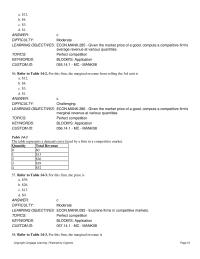
a. $12. b. $4. c. $3. d. $1. ANSWER: c DIFFICULTY: Moderate LEARNING OBJECTIVES: ECON.MANK.285 – Given the market price of a good, compute a competitive firm’s average revenue at various quantities. TOPICS: Perfect competition KEYWORDS: BLOOM’S: Application CUSTOM ID: […]
Economics Chapter 14 only a few buyers will have market power
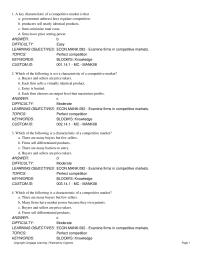
1. A key characteristic of a competitive market is that a. government antitrust laws regulate competition. b. producers sell nearly identical products. c. firms minimize total costs. d. firms have price setting power. ANSWER: b DIFFICULTY: Easy LEARNING OBJECTIVES: ECON.MANK.092 […]
Economics Chapter 14 For Any Competitive Market
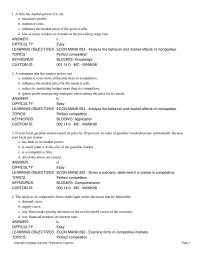
1. A firm has market power if it can a. maximize profits. b. minimize costs. c. influence the market price of the good it sells. d. hire as many workers as it needs at the prevailing wage rate. ANSWER: c […]
Economics Chapter 14 Objectives Econmank 092 Examine Firms Competitive
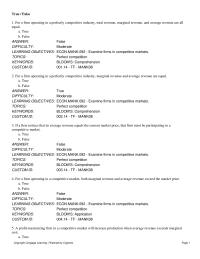
True / False 1. For a firm operating in a perfectly competitive industry, total revenue, marginal revenue, and average revenue are all equal. a. True b. False ANSWER: False DIFFICULTY: Moderate LEARNING OBJECTIVES: ECON.MANK.092 – Examine firms in competitive markets. […]
Economics Chapter 13 Nations Adam Smith Credits Economies Scale Toa
1. Adam Smith used a famous example of what type of firm to illustrate economies of scale? a. Apple b. a pin factory c. a lumber mill d. a British university ANSWER: b DIFFICULTY: Easy LEARNING OBJECTIVES: ECON.MANK.012 – Apply […]
Economics Chapter 13 Given Graph The Average total cost Curve
DIFFICULTY: Difficult LEARNING OBJECTIVES: ECON.MANK.170 – Given a graph of the average-total-cost curve in the long run, identify the regions that represent economies of scale, constant returns to scale, and diseconomies of scale. TOPICS: Producer theory Production costs Long run […]